
风电

Search documents
中方加强两用物项对日出口管制;美股存储芯片概念大涨丨盘前情报
2 1 Shi Ji Jing Ji Bao Dao· 2026-01-07 01:00
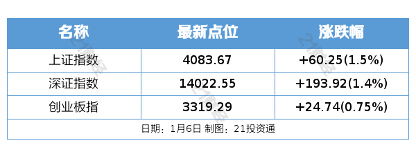
Market Performance - On January 6, major indices in China saw collective gains, with the Shanghai Composite Index rising by 1.5% to close at 4083.67 points, the Shenzhen Component Index increasing by 1.4% to 14022.55 points, and the ChiNext Index up by 0.75% to 3319.29 points [1][2] - The trading volume in the Shanghai and Shenzhen markets reached 2.81 trillion yuan, an increase of 260.2 billion yuan compared to the previous trading day [1] Sector Highlights - The commercial aerospace sector experienced significant activity, with over ten constituent stocks hitting the daily limit [1] - The brain-computer interface concept continued to show strength, while the financial sector collectively surged [1] - The intelligent driving concept gained traction, and the chemical sector also saw positive performance, along with active movements in the non-ferrous metals sector [1] International Market Overview - In the U.S., major stock indices also rose on January 6, with the Dow Jones Industrial Average increasing by 484.90 points (0.99%) to 49462.08 points, the S&P 500 up by 42.77 points (0.62%) to 6944.82 points, and the Nasdaq Composite rising by 151.35 points (0.65%) to 23547.17 points [3] - The storage sector in the U.S. saw significant gains, with Micron Technology rising over 10% and Western Digital increasing by over 16% [3] Commodity Prices - International oil prices fell on January 6, with light crude oil futures for February delivery dropping by $1.19 to $57.13 per barrel (a decrease of 2.04%), and Brent crude oil for March delivery down by $1.06 to $60.70 per barrel (a decrease of 1.72%) [4][5] Monetary Policy Insights - The People's Bank of China emphasized the continuation of a moderately loose monetary policy, focusing on promoting high-quality economic development and reasonable price recovery [6] - The central bank plans to utilize various monetary policy tools flexibly and efficiently, maintaining ample liquidity and relatively loose financing conditions [6] Rare Earth Export Regulations - China is considering tightening export license reviews for rare earths to Japan, potentially impacting economic relations and trade dynamics [8] - If restrictions on rare earth exports to Japan last for three months, it could result in an estimated loss of 660 billion yen, affecting GDP by 0.11% [8] Investment Opportunities - Analysts suggest that the tightening of rare earth export controls could enhance the strategic value of the rare earth industry, leading to a revaluation of related listed companies [8] - Companies such as Huahong Technology, China Rare Earth, and Northern Rare Earth are highlighted as potential investment opportunities in the context of rising rare earth prices [8]

A股盘前播报 | 央行部署今年工作!继续实施适度宽松货币政策 两大热门牛股停牌核查
智通财经网· 2026-01-07 00:38
Macro - The central bank has emphasized the continuation of a moderately loose monetary policy for 2026, utilizing tools such as reserve requirement ratio cuts and interest rate reductions to inject medium-term liquidity into the market [1] Market - Several popular stocks in the commercial aerospace and brain-computer interface sectors, including Beidouxing and Hangtianhuanyu, have announced suspensions for review due to significant price increases, with some stocks rising over 200% recently [2] - The US stock market reached new highs, with the Dow Jones and S&P 500 indices closing at record levels, driven by a surge in storage chip prices amid AI demand, particularly following NVIDIA CEO Jensen Huang's announcements at CES [3] Industry - China is reportedly considering tightening export license reviews for rare earth elements to Japan, in response to Japan's recent poor performance, alongside an announcement from the Ministry of Commerce to strengthen export controls on dual-use items [4]
民生福祉绘新篇!2026年康平县这些重点工作暖民心
Xin Lang Cai Jing· 2026-01-06 23:41
Core Viewpoint - The government of Kangping County has outlined its key work for 2026, focusing on industrial upgrades, ecological protection, urban renewal, and livelihood guarantees to achieve high-quality development. Group 1: Economic Development - Kangping aims to sign at least 60 projects worth over 100 million yuan each in 2026, focusing on precise investment attraction and efficient service to support economic growth [3] - The county will target major projects in infrastructure and key sectors, including a rural water supply project and a new funeral home, with 26 projects seeking inclusion in the central budget [3] - The goal is to secure over 1 billion yuan in funding, with a focus on industries such as biochemistry, new energy, and new materials [3] Group 2: Renewable Energy Initiatives - Kangping plans to ensure the full capacity grid connection of the 300,000 kW wind power project by China Resources and commence a 500,000 kW joint venture wind power project [4] - The county will also implement modifications to wind farms and develop a green liquid fuel distribution network [4] Group 3: Rural Development and Livelihood - The county aims to enhance food security and promote rural revitalization by strengthening local brands and increasing the scale of agricultural production [5] - The goal is to achieve a rural water supply rate of over 45% and improve rural infrastructure, including the construction and renovation of roads and power grids [5] Group 4: Urban Development and Infrastructure - Kangping will work towards becoming a national civilized city by enhancing urban functions, services, and ecological quality, including the construction of new parking spaces [6] - Projects include relocating the local prison, upgrading old neighborhoods, and improving public utilities [6] Group 5: Social Welfare and Public Services - The county will prioritize public welfare by implementing free preschool education and improving the quality of elderly care services [7][8] - Efforts will be made to enhance healthcare services through the expansion of the county hospital and the establishment of a county-level elderly care system [8]

时代新材斩获33.2亿元风电叶片订单
Zheng Quan Shi Bao· 2026-01-06 18:16
Group 1 - The company signed a sales contract worth approximately 3.32 billion yuan with major wind turbine manufacturers for the period from October 1 to December 31, 2025 [1] - The contract includes 190 million yuan for offshore wind projects and 3.13 billion yuan for onshore wind projects [2] - The contract amount is expected to account for about 16% of the company's total revenue and 40% of the wind blade segment revenue for 2024 [2] Group 2 - The wind blade segment is the company's largest business, with a revenue of 3.911 billion yuan in the first half of 2025, representing a year-on-year growth of 39.38% [3] - The company has established strong strategic partnerships with leading domestic wind turbine manufacturers and has seen a 300% year-on-year increase in overseas revenue [3] - The company plans to expand production capacity in existing factories to meet domestic demand while focusing new bases on overseas market needs [3] Group 3 - The company has been extending its business chain by engineering high-performance polymer materials, achieving a revenue of 250 million yuan in the new materials segment in the first half of 2025, a year-on-year increase of 116.71% [4] - The company is accelerating capacity ramp-up and new construction projects, with significant demand and orders in the new materials business [4] - The Zhuzhou base is exceeding expectations in capacity ramp-up, and the Yibin base is expected to complete construction and commence production by the end of the year [4]

风电深海抢滩!中国50%全球占比背后,深远海开发三大挑战
Sou Hu Cai Jing· 2026-01-06 17:15
Core Insights - The Chinese renewable energy industry has shifted focus towards high-quality development, moving away from merely scaling up and installing capacity [2][3] - The global energy transition, driven by carbon neutrality goals and the construction of new power systems, is pushing the energy structure towards cleaner and lower carbon sources [3] Energy Storage - Energy storage has gained significant attention in 2026, with global new installations expected to reach 438 GWh, a 62% year-on-year increase, and China projected to contribute 250 GWh [6] - The market is now driving energy storage development, with profit opportunities arising from price differences in electricity markets [7] - Energy storage has transitioned from a cost item to a revenue-generating asset, aided by technological innovations such as improved lithium batteries and the potential of solid-state and hybrid batteries [9][10] - New demands from AI computing centers are creating a need for high-performance energy storage systems capable of rapid response and grid regulation [10][12] - Long-duration energy storage is becoming a hot topic, with various technologies being explored to store energy for days or weeks [12][13] Photovoltaics - The photovoltaic sector faces challenges with overcapacity leading to reduced profit margins despite increased installations [15] - Technological advancements are crucial for the industry's resilience, with TOPCon technology becoming mainstream and innovations in HJT and BC cells being explored [15][17] - The potential commercialization of perovskite solar cells could significantly alter the photovoltaic landscape, with ongoing developments in tandem technology [18][20] - Investment trends are shifting towards innovative technologies rather than just scaling up existing capacities [20] Wind Power - Offshore wind power has become a key focus, with China holding 50% of the global installed capacity [20] - The industry is experiencing a small peak in project construction due to improved policy environments, although challenges remain in terms of approval processes and costs [22] - Innovative pricing mechanisms are being introduced to encourage exploration of deeper offshore projects [22] - The integration of wind power with other industries, such as aquaculture and tourism, is being promoted to enhance revenue streams and risk resilience [24] Integration of Energy Sources - The synergy between wind, solar, and storage is essential for creating a stable and efficient energy system, moving beyond individual competition to a collaborative approach [25][27] - Future competition will focus on system design, integration capabilities, and overall service rather than just hardware manufacturing [27][28] - The renewable energy sector is transitioning from rapid expansion to high-quality development, indicating a maturation phase with both challenges and opportunities [28]
A股公告精选 | 药明康德(603259.SH)遭18家股东累计减持2%公司股份
智通财经网· 2026-01-06 12:08
Group 1 - WuXi AppTec's third, fourth, and sixth largest shareholders reduced their holdings by 2% from November 20, 2025, to January 5, 2026, totaling 59.6751 million shares at prices ranging from 84.66 to 95.08 CNY per share [1] Group 2 - Robotech's subsidiary ficonTEC signed a significant contract worth approximately 770,000 euros (about 63.0784 million CNY) with a Swiss client, representing over 5.70% of the company's audited revenue for 2024 [2] Group 3 - Times New Material signed a sales contract for wind turbine blades worth approximately 3.32 billion CNY, effective from October 1, 2025, to December 31, 2025, which is expected to positively impact the company's performance [3] Group 4 - YHLO signed a strategic cooperation framework agreement with Brain Machine Star Chain to enhance market expansion and sales of brain-machine interface products, leveraging both companies' resources [4] Group 5 - Guanshang Technology plans to acquire 100% of Liao Jing Electronics through a combination of stock issuance and cash payment, with the deal expected to create synergies in the defense technology sector [5] Group 6 - Siwei Control announced the termination of its control change planning due to a lack of agreement on core terms, with no significant adverse impact on its business operations [6] - Baihua Pharmaceutical also terminated its control change planning for similar reasons, with no major negative effects on its operations [8] Group 7 - Chaoying Electronics adjusted the investment amount for its AI high-end printed circuit board expansion project from 1.468 billion CNY to 3.315 billion CNY, with a new production capacity target of 166,500 square meters annually [9] Group 8 - Baotailong's controlling shareholder was ordered to rectify its failure to fulfill a share buyback commitment, having only bought back 10.0018 million shares out of a planned 20 to 40 million shares [10]

时代新材斩获33.2亿元风电叶片订单 风电业务再下一城
Zheng Quan Shi Bao Wang· 2026-01-06 12:04
Group 1 - The company signed sales contracts totaling approximately 3.32 billion yuan for wind turbine blades with major manufacturers, with offshore wind projects accounting for 190 million yuan and onshore projects for 3.13 billion yuan [1] - The wind power blade segment is the largest business for the company, with expected sales revenue of 8.2 billion yuan in 2024, representing about 40% of the segment's revenue and 16% of total revenue [1] - The company reported a 39.38% year-on-year increase in sales revenue for the wind power blade segment in the first half of 2025, reaching 3.911 billion yuan [2] Group 2 - The company plans to expand domestic wind power blade production capacity through existing factories and focus on overseas markets for new bases, with an ideal capacity of approximately 5,000 sets per year [3] - A wholly-owned subsidiary has been established in Vietnam, with an investment of 458 million yuan planned to enhance operational capabilities, and production is expected to start in April 2026 [3] - The company has seen a significant increase in demand for new materials, with sales revenue from new materials and other segments reaching 250 million yuan in the first half of 2025, a year-on-year increase of 116.71% [3]
龙虎榜 | 消闲派2亿布局中超控股,深股通助攻!2机构追高利欧股份
Ge Long Hui A P P· 2026-01-06 09:45
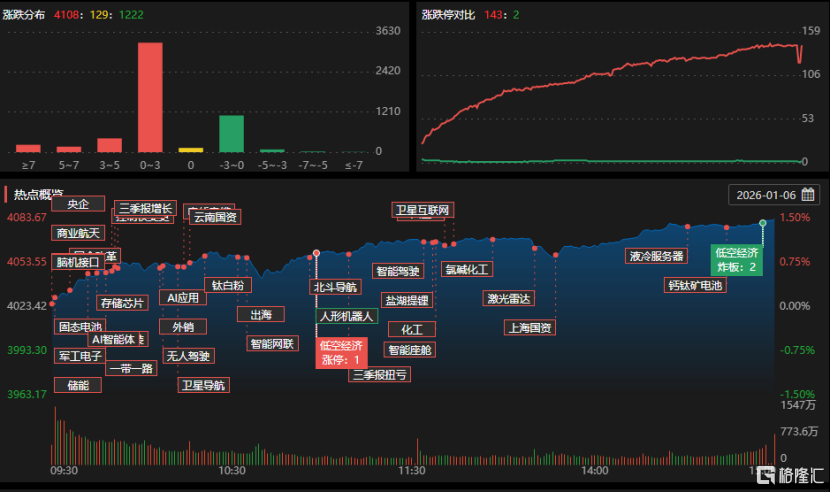
Market Overview - The Shanghai Composite Index achieved a 13-day consecutive rise, reaching a 10-year high, with over 4,100 stocks in the market rising, and more than 100 stocks hitting the daily limit for two consecutive days [2] - Key sectors showing significant gains include brain-computer interfaces, large finance, non-ferrous metals, commercial aerospace, and unmanned driving [2] Notable Stocks - Shengtong Energy has achieved a 13-day limit-up streak, while Fenglong Co. and Leike Defense have seen 8 and 5 consecutive limit-ups, respectively [2] - Key stocks with notable performance include: - Lianjian Optoelectronics: Price at 8.20, up 20.06% with a turnover rate of 29.85% [1] - Wanjitech: Price at 37.66, up 20.01% with a turnover rate of 28.47% [1] - Raylwei: Price at 26.51, up 20.01% with a turnover rate of 6.97% [1] - Tianli Technology: Price at 32.21, up 20.01% with a turnover rate of 19.26% [1] - Weisi Medical: Price at 69.70, up 20.01% with a turnover rate of 10.74% [1] Trading Activity - The top three net buying stocks on the daily leaderboard were: - Shanzik Technology: Net buying of 6.66 billion with a daily increase of 10.12% [4] - Goldwind Technology: Net buying of 6.14 billion with a daily increase of 9.99% [4] - Beidou Xingtong: Net buying of 4.53 billion with a daily increase of 10.01% [4] Institutional Activity - Institutional net buying was significant in stocks such as: - Liou Co.: Net buying of 1.35 billion with a daily increase of 6.94% [6] - Haige Communication: Net buying of 1.01 billion with a daily increase of 9.98% [6] - Daoshi Technology: Net buying of 931.65 million with a daily increase of 14.52% [6] Sector Highlights - The brain-computer interface sector continues to attract attention, with multiple companies showing strong performance and significant trading volumes [1][2] - The commercial aerospace sector is also gaining traction, with companies like Goldwind Technology involved in strategic partnerships and projects [11][15]




金风科技今日涨停 1家机构专用席位净买入2490.07万元
Mei Ri Jing Ji Xin Wen· 2026-01-06 08:39
每经AI快讯,1月6日,金风科技(002202)今日涨停,成交额136.64亿元,换手率18.42%。盘后龙虎榜 数据显示,深股通专用席位买入6.35亿元并卖出6.02亿元,1家机构专用席位净买入2490.07万元。 ...
时代新材(600458.SH):签订33.2亿元的《叶片销售合同》
Ge Long Hui A P P· 2026-01-06 08:32
格隆汇1月6日丨时代新材(600458.SH)公布,公司2025年10月1日—2025年12月31日与风电各大主机厂 (称"买方")签订《叶片销售合同》(称"合同"或"本合同")。公司向买方销售叶片及相关服务,合同金 额总计约合人民币33.2亿元(含税价)。 ...