
铁路建设

Search documents
正略咨询助力山东铁路投资控股集团有限公司“十五五”发展规划
Zhong Guo Chan Ye Jing Ji Xin Xi Wang· 2025-06-13 08:49
Group 1 - Shandong Railway Investment Holding Group (Shandong Iron Investment Group) collaborates with Zhenglue Consulting to develop the "14th Five-Year" (2026-2030) overall strategic plan, focusing on innovation-driven development and high-quality growth [1] - The group, established with a registered capital of 48.68 billion yuan, is a large state-owned enterprise approved by the Shandong Provincial Government, specializing in railway investment, construction, operation, and management [1] - As of now, Shandong province has a high-speed railway operating mileage of 3,047 kilometers, ranking first in the country [1] Group 2 - Shandong Iron Investment Group emphasizes its mission of "leading and taking responsibility," focusing on "main business + scientific innovation" to enhance quality and efficiency while ensuring stable development [2] - The group aims to create a comprehensive railway development entity that leads in operational scale, development quality, industry influence, and technological innovation [2] Group 3 - Zhenglue Consulting has extensive experience in the "big transportation" sector, having served over half of the provincial transportation investment groups in China, including Shandong Highway Group and Guangdong Provincial Transportation Group [3] - The consulting firm provides strategic planning, organizational control, human resources, brand marketing, financial management, and digital transformation services to various industries [4]
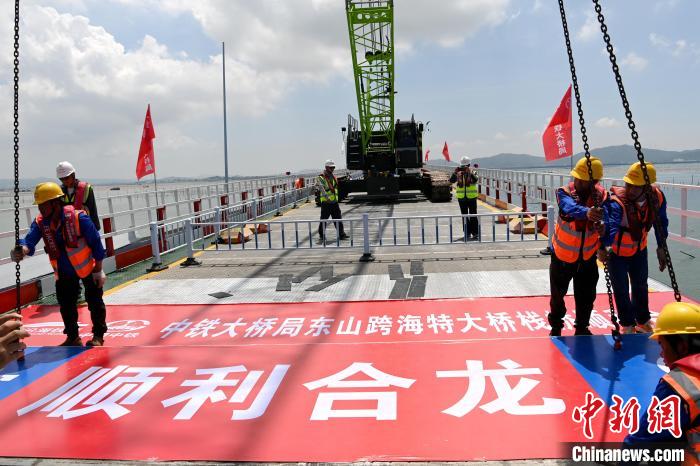
漳汕高铁东山跨海特大桥栈桥合龙
Zhong Guo Xin Wen Wang· 2025-06-12 15:31
Core Points - The successful completion of the last bridge deck panel marks the joining of the Zhangshan High-speed Railway Dongshan Cross-sea Bridge trestle [1][3] - The Dongshan Cross-sea Bridge spans 20.26 kilometers, connecting Yunxiao County, Dongshan County, and Zhao'an County in Fujian Province, and is a key control project of the Zhangshan High-speed Railway [3][5] - The trestle bridge, measuring 9.4 kilometers, serves as an important construction "auxiliary road" and "platform" for the main bridge [3][5] Construction Details - The project faced complex construction conditions, including strong winds and seawater erosion, which were overcome through technical innovations and precise construction methods [5] - The project team utilized the BeiDou satellite positioning system to ensure accurate placement of steel pipe piles, enhancing construction precision [5] - The completion of the trestle bridge allows for a significant reduction in construction distance from 20 kilometers to 9 kilometers, accelerating the overall bridge construction process [7] Strategic Importance - The Zhangshan High-speed Railway is a vital part of the national "eight vertical and eight horizontal" high-speed railway network, enhancing connectivity between the Yangtze River Delta, Guangdong-Hong Kong-Macao Greater Bay Area, and Southeast coastal city clusters [7] - The project is expected to promote the integration of industrial resources between Guangdong and Fujian provinces and facilitate regional economic and social development [7]

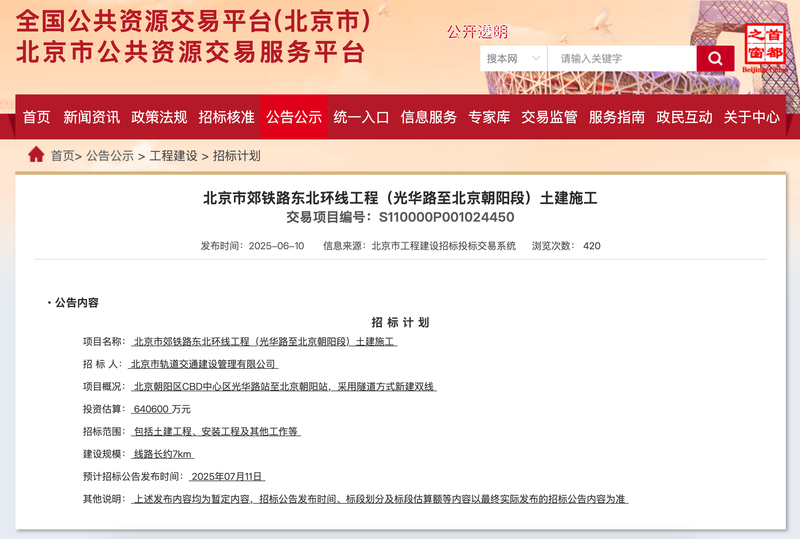
市郊铁路东北环线即将工程招标,率先建设光华路至北京朝阳段
Xin Jing Bao· 2025-06-12 02:19
Core Viewpoint - The construction of the Beijing suburban railway Northeast Ring Line is progressing, with the civil engineering bidding plan for the section from Guanghua Road to Beijing Chaoyang set to officially start in July 2023, following environmental approval earlier this year [1][2][3]. Group 1: Project Overview - The Northeast Ring Line will extend approximately 59 kilometers, connecting Guanghua Road Station in Chaoyang District to Nankou Station in Changping District, with a total of 16 stations along the route [2][6]. - The Guanghua Road to Beijing Chaoyang section is about 7 kilometers long and will be constructed as a double-track underground tunnel, with an estimated investment of 6.406 billion yuan [2][3]. - The project aims to alleviate commuting pressure for residents in the northwest of Beijing, providing a direct connection to the city center [11][12]. Group 2: Construction Timeline and Features - The construction of the Guanghua Road to Beijing Chaoyang section is expected to take 5 years, while the segment from Beijing Chaoyang to Nankou will take approximately 2.5 years [3][10]. - The railway will feature a design speed of 100 km/h for the Guanghua Road to Beijing Chaoyang section, 120 km/h for the Beijing Chaoyang to Jiuxianqiao section, and 160 km/h for the Jiuxianqiao to Nankou section [10]. Group 3: Connectivity and Impact - The Northeast Ring Line will facilitate transfers to multiple subway lines, including Line 1, Line 5, Line 8, Line 13, and the upcoming Line 19, enhancing the overall public transport network [7][10]. - The line is expected to significantly reduce travel time, with journeys from the Longguan area to the Guomao area taking about half an hour [11]. - The project is anticipated to improve the commuting experience for residents in densely populated areas, thereby positively impacting traffic congestion in the city [12].
渝厦高铁重庆段7座站房全面完工亮相
Zhong Guo Xin Wen Wang· 2025-06-12 00:42
Core Points - The completion of the Chongqing section of the Yuxia High-speed Railway is a significant milestone in China's "Eight Vertical and Eight Horizontal" high-speed rail network, enhancing connectivity from Chongqing to Xiamen [1] - The project includes the construction of 7 stations, with 6 newly built and 1 renovated, showcasing local cultural and natural features [1] - The new railway will reduce travel time from downtown Chongqing to Qianjiang District from 4 hours to under 1 hour, promoting economic development along the route [2] Group 1 - The Yuxia High-speed Railway Chongqing section is an important part of the Yuxia corridor in China's high-speed rail network [1] - The project features 7 stations, including 6 new constructions and 1 renovation, with a focus on local landmark characteristics [1] - Innovative construction techniques were employed to address challenges such as complex geological conditions and limited space [1] Group 2 - The railway's completion will significantly shorten travel time, facilitating the implementation of the Yangtze River Economic Belt development strategy [2] - The new high-speed rail line is expected to enhance the overall layout of the high-speed railway network in the region [2] - The project aims to accelerate the formation of a main high-speed rail corridor between Chongqing and Xiamen, boosting economic and social development in the surrounding areas [2]
我国电气化铁路技术达世界领先水平
Jing Ji Ri Bao· 2025-06-11 21:59
Core Viewpoint - The news highlights the advancements in China's electrified railway technology, particularly focusing on the successful trial operation of the Chongqing section of the Yuxia High-Speed Railway, which significantly reduces travel time and integrates multiple districts into a "one-hour economic circle" [1]. Group 1: Electrified Railway Development - The Yuxia High-Speed Railway achieved a test speed of 385 km/h, demonstrating the advanced capabilities of China's electrified railway technology [1]. - By the end of 2024, China's total railway operating mileage is expected to reach 162,000 kilometers, with high-speed rail accounting for 48,000 kilometers and an electrification rate of 75.8% [1]. - The progress in the "four electrical systems" is crucial for modern railway development, serving as the power source and nerve center of the railway [1]. Group 2: Technological Innovations - China has fully mastered the design and construction technology of high-speed electrified railways, having developed over 150 industry and national standards and more than 1,000 authorized patents [2]. - The domestically produced constant tension catenary wire laying vehicle has achieved complete independent intellectual property rights, reducing manufacturing costs by 43% [2]. - The precision and sensitivity of the catenary wire tension control have significantly improved, with overall straightness precision controlled within 0.05 mm, surpassing the acceptance standard for high-speed rail [2]. Group 3: Smart Construction Technologies - The railway sector is advancing the application of smart construction technologies, utilizing big data, 5G, cloud computing, and drones to enhance operational efficiency [3]. - The implementation of the 4C visual intelligent analysis system has transformed high-speed rail catenary network defect detection, increasing the detection of effective hazards by ten times and improving analysis efficiency by over 80 times [4].
广东铁路进度刷新 多条线路开始验收
Shen Zhen Shang Bao· 2025-06-10 22:33
Core Viewpoint - The construction of multiple railway projects in Guangdong has entered the acceptance phase, significantly advancing the "Railway on the Bay Area" initiative, with several key projects nearing completion [1][2]. Group 1: Project Progress - Four out of seven planned railway projects for this year have entered the acceptance phase as of the end of May [1]. - The overall progress of the new Bai-Guang intercity railway from Zhuli to Airport T2 has reached 99%, connecting major transportation hubs in the region [1]. - The overall progress of the Suiguan-Shenzhen intercity railway Panyu branch project has also reached 99%, enhancing connectivity between various intercity rail lines [2]. Group 2: Project Details - The new Bai-Guang intercity railway will link Guangzhou North Station and Guangzhou Baiyun International Airport, facilitating a convenient passenger transport corridor in the Pearl River Delta [1]. - The Shantou South to Shantou section of the Shantou-Shantou railway has achieved 92% completion, forming a crucial part of the southeast coastal high-speed rail corridor [2]. - The new Guangzhou to Zhanjiang high-speed railway project has reached 83.2% completion, with a total length of 401 kilometers and a design speed of 350 km/h, enabling a 90-minute travel time between the two city centers [2].
联邦资金被撤,美国首条高铁面临“烂尾”
Huan Qiu Shi Bao· 2025-06-09 22:29
Core Viewpoint - The California high-speed rail project is facing significant setbacks, including a potential withdrawal of $4 billion in federal funding due to delays and mismanagement, which could push back the project's operational timeline by up to ten years [1][3]. Funding and Financial Challenges - The U.S. government plans to cut approximately $4 billion in federal funding for the California high-speed rail project after a four-month review, citing issues such as construction delays and poor management [3]. - The project has already spent $16 billion over 17 years without laying any track, with a compliance report indicating that there is no feasible path to complete the project on time and within budget [3]. - California has a funding gap of $6.5 billion, and the loss of federal funding could jeopardize the completion of even the initial segment of the project [4][5]. Project Timeline and Scope - Originally approved in 2008 with a budget of $9 billion, the project has seen its estimated cost balloon to over $100 billion, with the completion date pushed to 2033 [4]. - The focus has shifted from the original plan connecting major metropolitan areas to a reduced version covering only 275 kilometers in the Central Valley [4]. Management and Operational Issues - The California high-speed rail project has been criticized for poor planning, with a 315-page compliance report highlighting the project's severe challenges [3][7]. - Experts suggest that without federal funding, the likelihood of delivering operational trains within the next decade is extremely low [5]. Broader Implications for U.S. High-Speed Rail - The challenges faced by the California project reflect broader issues in U.S. high-speed rail development, including high costs, lengthy return periods, and a lack of consensus among stakeholders [7]. - The federal government's inconsistent support for high-speed rail projects has contributed to delays and funding uncertainties [7][8].
陕西工程建设按下“加速键”
Shan Xi Ri Bao· 2025-06-09 00:05
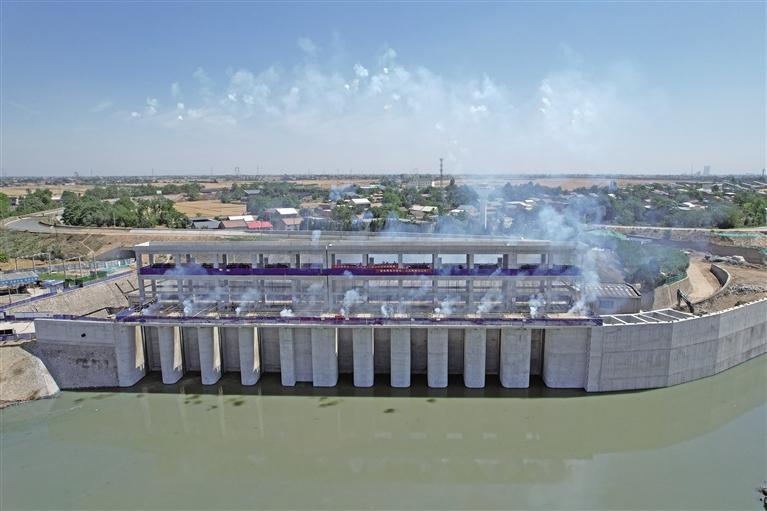
Group 1: Xi'an High-Speed Railway Project - The Xi'an hub of the Xiyan High-Speed Railway has achieved a significant milestone by completing the first long rail transport three days ahead of schedule, with 500 meters of long rail safely delivered to the project site [2] - The total length of the Xi'an hub project is 52 kilometers, with the China Railway Xi'an Bureau Group responsible for laying 49.22 kilometers of mainline tracks and 2.8 kilometers of station tracks, along with 18 sets of turnouts and 140,500 cubic meters of track ballast [2] - The project team adopted an innovative "three-machine linkage + segmented traction" scheme to overcome complex transportation challenges, ensuring that the new line was pre-laid 1.5 kilometers in both directions [2] Group 2: Water Resource Management Projects - The trial operation of the water intake gate for the provincial Jiao Kou water diversion project was successfully conducted, marking a significant achievement in the modernization and reconstruction of the water diversion hub [3] - The completion of this project is expected to greatly improve water intake conditions and enhance flood control and pumping capabilities, supporting regional food stability and efficient water resource utilization [3] - The project will transition into the phase of supporting facilities and information technology construction [3] Group 3: Construction Efficiency Improvements - Various participating units have focused on the summer irrigation goals, implementing a "build while operating" approach to accelerate construction progress [4] - The temporary water intake gate has been activated to ensure irrigation while construction is ongoing, demonstrating a dual focus on drought relief and project development [4] - The completion of the water diversion tunnel for the Li Jia He Reservoir project has been achieved, with measures taken to enhance efficiency and address geological challenges during construction [4]
各地扎实推进一批重大工程建设 助力经济高质量发展
Yang Shi Wang· 2025-06-08 22:34
Group 1: Infrastructure Development - The successful excavation of the Tongbaiyuan No.1 Tunnel, the longest tunnel of the Yan-Yu High-speed Railway, has reached 2000 meters, with a total length exceeding 14,000 meters. The railway will reduce travel time from Xi'an to Yulin from 5 hours to 2 hours upon completion [1] - The construction of the Luo-Ruo Railway, approximately 297 kilometers long, has begun track laying, which will enhance the "road-to-rail" transport capacity in Xinjiang by connecting with the Lanzhou-Xinjiang Railway and the Ge'ku Railway [2] - The Hefei-Wuhan section of the Yangtze River High-speed Railway has entered full construction phase, with the first steel truss beam of the Shi River Bridge successfully installed. The railway is expected to be completed by 2028 [3] Group 2: Renewable Energy Projects - The expansion of the Tianjin South 1000 kV UHV substation, a key project under the national "14th Five-Year Plan," has commenced operation, capable of transmitting over 40 billion kWh of electricity annually, enhancing the transmission capacity of clean energy from Inner Mongolia and Hebei to Tianjin [4] - The construction of the largest single-unit solar thermal storage project in China, the CGN Delingha 1 million kW solar thermal storage integrated project, has made progress with all heliostats installed and entering the equipment debugging phase. The project is expected to be operational by the end of this year, delivering 1.8 billion kWh of green electricity annually, equivalent to saving about 550,000 tons of standard coal and reducing carbon dioxide emissions by 1.3 million tons [4]
一大早!中国传来2个好消息,中美会谈有成效,巴西总统访华
Sou Hu Cai Jing· 2025-06-07 09:51
Group 1 - The recent China-US economic talks in Switzerland have yielded substantial progress, with both sides reaching important consensus [3][6][21] - China emphasized the mutual benefits of the economic relationship and insisted on the removal of all unilateral tariffs imposed by the US, which disrupt global supply chains [8][10] - The establishment of a trade negotiation mechanism is expected to positively impact the global economy by stabilizing supply chains and reducing trade uncertainties [12][14] Group 2 - The visit of Brazilian President Lula to China marks his sixth visit, aiming to enhance bilateral relations and cooperation in multiple fields [31][35] - Lula's visit coincides with the fourth ministerial meeting of the China-Latin America Forum, indicating a significant step in strengthening China-Brazil ties [33][37] - The proposed construction of the "Two Oceans Railway" will connect the Pacific and Atlantic Oceans, significantly improving trade efficiency and security for China and Brazil [39][41]
