
装备制造业

Search documents
累计增速转正,8月份增长超20%!工业企业利润明显改善
Jing Ji Ri Bao· 2025-09-28 22:14
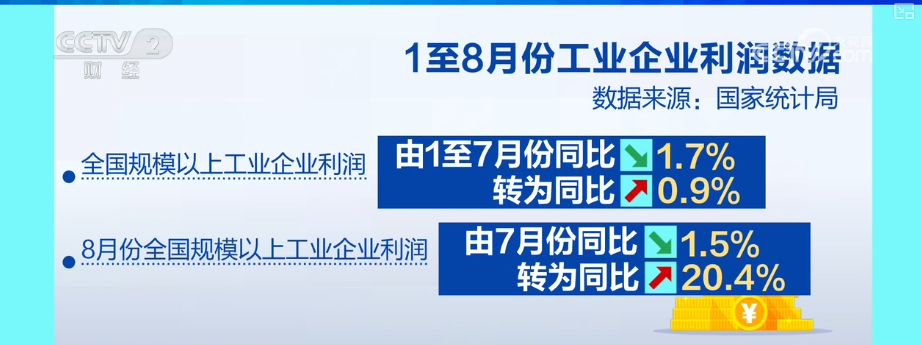
Core Insights - In the first eight months of the year, profits of industrial enterprises above designated size turned from a 1.7% year-on-year decline to a 0.9% increase, reversing a continuous decline since May [1] - In August, profits increased by 20.4% compared to a 1.5% decline in July, indicating significant improvement in monthly profits [1] - Revenue for industrial enterprises maintained stable growth, with an increase of 2.3% year-on-year in the first eight months, and a 1.9% increase in August, which accelerated by 1.0 percentage points from July [1] Group 1: Industrial Sector Performance - The manufacturing sector saw a profit increase of 7.4% in the first eight months, accelerating by 2.6 percentage points compared to the previous seven months [2] - The electricity, heat, gas, and water production and supply sector grew by 9.4%, an acceleration of 5.5 percentage points [2] - The mining sector experienced a decline of 30.6%, but the rate of decline narrowed by 1.0 percentage points [2] Group 2: Equipment Manufacturing and Raw Materials - The equipment manufacturing sector's profits grew by 7.2%, contributing 2.5 percentage points to the overall profit growth of industrial enterprises [2] - Seven out of eight industries within equipment manufacturing reported profit growth, with railways, shipping, and aerospace seeing a rapid increase of 37.3% [2] - Raw materials manufacturing profits increased by 22.1%, accelerating by 10.0 percentage points, while consumer goods manufacturing profits turned from a 2.2% decline to a 1.4% increase [2] Group 3: Profit Improvement by Enterprise Size - Profits for medium and small-sized enterprises increased by 2.7% and 1.5% respectively, with improvements of 1.1 and 0.4 percentage points compared to the previous seven months [3] - Private enterprises saw a profit growth of 3.3%, surpassing the average growth of all industrial enterprises by 2.4 percentage points [3] - In August, the cost per hundred yuan of revenue decreased by 0.20 yuan year-on-year, marking the first decrease since July 2024 [3]
累计增速转正,8月份增长超20%—— 工业企业利润明显改善
Jing Ji Ri Bao· 2025-09-28 21:50
Core Insights - In the first eight months of the year, profits of industrial enterprises above a designated size turned from a year-on-year decline of 1.7% in the first seven months to a growth of 0.9%, reversing a continuous decline since May [1] - In August, profits increased significantly by 20.4% compared to a 1.5% decline in July, indicating a notable improvement in monthly profits [1] - Revenue for industrial enterprises maintained stable growth, with an increase of 2.3% year-on-year in the first eight months, and a 1.9% increase in August, which accelerated by 1.0 percentage points from July [1] Industrial Sector Performance - The manufacturing sector saw a profit growth of 7.4% in the first eight months, accelerating by 2.6 percentage points compared to the previous seven months [2] - The electricity, heat, gas, and water production and supply sector grew by 9.4%, an acceleration of 5.5 percentage points [2] - The mining sector experienced a decline of 30.6%, although the rate of decline narrowed by 1.0 percentage points [2] Equipment Manufacturing and Raw Materials - The equipment manufacturing sector's profits grew by 7.2%, contributing 2.5 percentage points to the overall profit growth of industrial enterprises [2] - Seven out of eight industries within equipment manufacturing reported profit growth, with railways, shipping, and aerospace seeing a rapid increase of 37.3% [2] - Raw materials manufacturing profits increased by 22.1%, while consumer goods manufacturing profits turned from a decline of 2.2% to a growth of 1.4% [2] Company Size and Type Analysis - Profits improved across different scales of enterprises, with medium and small enterprises seeing year-on-year profit growth of 2.7% and 1.5%, respectively [3] - Private enterprises outperformed the average profit growth of industrial enterprises, achieving a growth of 3.3%, which is 2.4 percentage points higher than the overall average [3] - In August, the cost situation for industrial enterprises improved, with costs per 100 yuan of revenue decreasing by 0.20 yuan year-on-year, marking the first decrease since July 2024 [3]
前8个月和8月份单月利润同比增速双双转正 工业经济释放向好积极信号
Zheng Quan Ri Bao· 2025-09-28 16:08
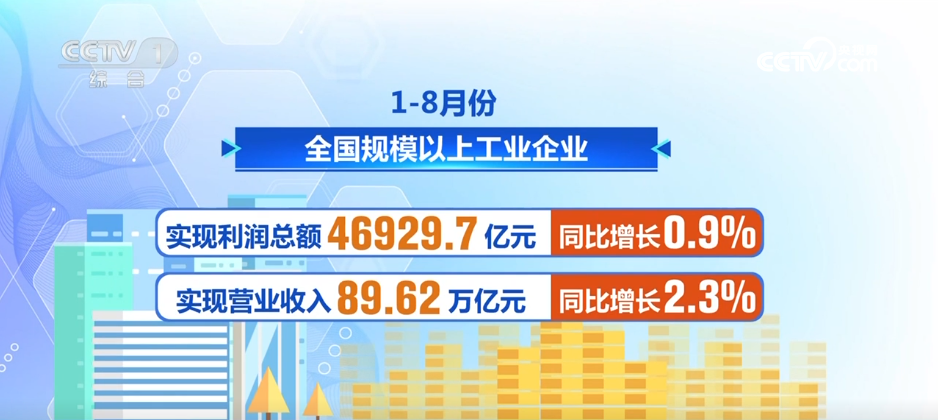
Core Insights - The profit of industrial enterprises above designated size in China reached 46,929.7 billion yuan in the first eight months, showing a year-on-year growth of 0.9% [1] - In August, the profit of these enterprises saw a significant recovery with a year-on-year increase of 20.4%, reversing a decline of 1.5% in July [1][2] - The growth in profits is attributed to effective macro policies, the deepening of a unified national market, and a low base from the previous year [1][2] Group 1: Profit Trends - The profit of industrial enterprises turned from a decline of 1.7% in the first seven months to a growth of 0.9% in the first eight months, ending a continuous decline since May [2] - The operating income of these enterprises increased by 2.3% year-on-year, consistent with the previous seven months, while August saw a 1.9% increase, accelerating by 1.0 percentage points from July [2] - Profits improved across different scales of enterprises, with private enterprises showing a notable acceleration in profit growth [2] Group 2: Sector Performance - The equipment manufacturing sector played a crucial role, with profits growing by 7.2% in the first eight months, contributing 2.5 percentage points to the overall profit growth of industrial enterprises [3] - Among the eight industries within equipment manufacturing, seven reported profit growth, with rail, shipbuilding, and aerospace industries seeing rapid profit increases of 37.3% and 11.5% respectively [3] - Raw material manufacturing profits increased by 22.1%, while consumer goods manufacturing profits shifted from a decline of 2.2% to a growth of 1.4% [3] Group 3: Structural Changes and Future Outlook - In August, industrial profits exhibited a pattern of declining volume, rising prices, and improved profit margins, indicating a shift in industry dynamics due to "anti-involution" policies [4] - It is anticipated that the profit growth of industrial enterprises will remain positive in the fourth quarter, driven by last year's low base effects [4] - However, challenges remain due to insufficient downstream demand, which may hinder the transmission of upstream price increases to downstream enterprises [4]
两类行业利润改善——8月工业企业利润点评
一瑜中的· 2025-09-28 13:58
Core Viewpoint - The profit growth of industrial enterprises in August showed a significant recovery, with a year-on-year increase of 20.4%, reversing the previous month's decline of 1.5% [4][19]. Group 1: Profit Improvement in Two Types of Industries - The profit improvement is evident in two categories of industries: one benefiting from price recovery and revenue improvement, leading to enhanced gross margins, and the other benefiting from increased investment income, resulting in improved profit margins [4][10]. - In the upstream manufacturing sector, the average PPI year-on-year for eight industries was -4.4%, a narrowing from -5.7% previously, with revenue growth of 2.29% in August compared to -1.65% previously [5][11]. - The downstream manufacturing sector saw a profit growth rate of 36.3% in August, up from -5.2% previously, with a profit margin of 7.93%, significantly improved from 5.68% year-on-year [6][12]. Group 2: August Industrial Enterprise Profit Data Review (1) Overall Situation: Profit Growth Recovery - In August, the profit of industrial enterprises increased by 20.4% year-on-year, with inventory growth at 2.3% compared to 2.4% previously [2][19]. - The profit margin for industrial enterprises was 5.83%, an increase of 0.90 percentage points year-on-year, with costs per hundred yuan of revenue decreasing by 0.20 yuan, marking the first year-on-year decrease since July 2024 [20][19]. (2) Industry Situation: Profit Growth Across Sectors - The mining industry experienced a profit growth rate of -23%, an improvement from -39.24% previously, while the manufacturing sector saw a growth rate of 26.3%, up from 6.63% [22]. - The upstream manufacturing sector's profit growth was 16.08%, while the midstream and downstream sectors reported growth rates of 6.75% and 36.3%, respectively [22].


【权威解读】1—8月份规模以上工业企业利润同比实现增长
中汽协会数据· 2025-09-28 09:13
Core Insights - In the first eight months of 2025, profits of industrial enterprises above designated size increased by 0.9% year-on-year, reversing a decline that had persisted since May 2025, supported by macro policies and a low base from the previous year [1][2][3] Group 1: Profit Trends - The profit of industrial enterprises improved significantly, with a notable increase of 20.4% in August compared to a decline of 1.5% in July [1] - The manufacturing sector saw a profit increase of 7.4%, while the electricity, heat, gas, and water production and supply sector grew by 9.4%. The mining sector, however, experienced a decline of 30.6% [1][2] - In August, the profit of industrial enterprises showed a double-digit growth, marking a significant recovery [1] Group 2: Revenue Growth - Revenue for industrial enterprises above designated size grew by 2.3% year-on-year in the first eight months, with August showing a 1.9% increase, which is an acceleration compared to July [2] - The equipment manufacturing sector played a crucial role, with profits increasing by 7.2%, contributing 2.5 percentage points to the overall profit growth of industrial enterprises [2][3] Group 3: Sector Performance - Raw material manufacturing profits increased by 22.1%, significantly contributing to the overall profit growth, while consumer goods manufacturing profits turned from a decline of 2.2% to a growth of 1.4% [3] - The steel industry returned to profitability with a total profit of 83.7 billion, while the non-ferrous industry saw a profit increase of 12.7% [3] Group 4: Enterprise Size and Type - Profits improved across different enterprise sizes, with medium and small enterprises seeing increases of 2.7% and 1.5% respectively, while large enterprises experienced a reduced decline [4] - Private enterprises outperformed the average, with a profit growth of 3.3%, which is 2.4 percentage points higher than the overall industrial average [4] Group 5: Cost and Profitability - In August, the cost per hundred yuan of revenue decreased by 0.20 yuan, marking the first year-on-year reduction since July 2024 [5] - The profit margin for industrial enterprises rose to 5.83%, an increase of 0.90 percentage points year-on-year [5]

1至8月份泰安市经济延续回升向好态势 新动能投资增长迅速,高新技术产业投资同比增长24.2%
Qi Lu Wan Bao Wang· 2025-09-28 08:47
Economic Overview - The city's economy has shown stable recovery and continuous improvement from January to August, with a more pronounced upward trend [1] - Industrial production remains steady, with the industrial added value of large-scale enterprises increasing by 7.7% year-on-year [1] Industrial Performance - The manufacturing sector leads the growth, with an added value increase of 8.5%, contributing 6.7 percentage points to the overall industrial growth [1] - Among 37 industrial categories, 27 reported year-on-year growth, resulting in a growth coverage of 73.0% [1] - Key sectors such as equipment manufacturing, high-tech manufacturing, and consumer goods manufacturing saw added value increases of 9.3%, 8.9%, and 8.8% respectively [1] Investment Trends - Fixed asset investment in the city grew by 3.7% year-on-year, with significant growth in the secondary industry at 22.9% [2] - Industrial investment increased by 22.8%, with manufacturing investment rising by 20.0% [2] - New momentum investments, including "Four New" investments and high-tech industry investments, grew by 11.0% and 24.2% respectively [2] Consumer Market - The retail market accelerated recovery, with retail sales of above-limit units reaching 36.91 billion yuan, a year-on-year increase of 14.5% [2] - Categories such as home appliances and audio-visual equipment, grain and oil products, and petroleum products saw significant retail sales growth of 48.7%, 18.3%, and 16.6% respectively [2] Service Sector - The revenue of large-scale service enterprises increased by 11.6% year-on-year, with 19 out of 29 industry categories showing growth [3] - Key sectors like scientific research, information technology services, and cultural and entertainment services experienced double-digit growth [3] Financial Indicators - The city's general public budget revenue reached 18.53 billion yuan, a year-on-year increase of 3.8% [3] - By the end of August, the balance of deposits in financial institutions was 738.65 billion yuan, up 11.0% year-on-year [3] Energy Consumption - Total electricity consumption reached 20.65 billion kilowatt-hours, a year-on-year increase of 5.0%, with industrial and tertiary sector electricity consumption growing by 3.0% and 8.8% respectively [3] Price Trends - The Consumer Price Index (CPI) was 99.6, reflecting a year-on-year decrease of 0.4%, with five categories of goods and services experiencing price increases [3]
透过数据感知我国工业发展活力 新动能加速蓄势聚力
Yang Shi Wang· 2025-09-28 02:21
Core Insights - China's industrial sector continues to show resilience and improvement despite challenging external conditions and insufficient domestic demand, with industrial profits increasing by 0.9% year-on-year from January to August [1][3]. Industrial Performance - From January to August, the total profit of large-scale industrial enterprises reached 46,929.7 billion yuan, marking a 0.9% increase year-on-year, while operating revenue grew by 2.3% to 89.62 trillion yuan [3]. - In August alone, profits for large-scale industrial enterprises surged by 20.4%, reversing a decline observed in July [5]. Sector Analysis - The equipment manufacturing sector has played a crucial role, with profits increasing by 7.2% from January to August, particularly in the railway, shipbuilding, aerospace, and electrical machinery industries [5]. - High-tech manufacturing is driving significant growth, with Hubei province's industrial added value rising by 7.8% year-on-year, and high-tech manufacturing contributing a 14.2% increase [8]. Technological Innovation - Companies are leveraging advanced technologies such as AI and IoT to enhance production efficiency, with one icebox manufacturer reporting a 20% increase in production efficiency and a 15% reduction in product quality loss [8]. - The automotive industry in Hubei is rapidly advancing, with significant breakthroughs in core technologies, including the development of a new generation of hybrid engines with leading thermal efficiency [10]. Policy and Collaboration - The Ministry of Industry and Information Technology emphasizes the importance of deepening cooperation in the automotive sector, supporting collaboration in capital, technology, management, and talent [13]. - The government has lifted foreign ownership restrictions in the new energy vehicle sector, encouraging foreign companies to operate in China and collaborate with domestic firms [17].

0.9%、20.4%、7.2%,增长!多维度“数”览全年工业利润改善有基础
Yang Shi Wang· 2025-09-28 02:14
Group 1 - The core viewpoint is that from January to August 2025, the profits of large-scale industrial enterprises in China increased by 0.9% year-on-year, reversing a trend of decline since May 2025 due to effective macro policies and the deepening of a unified national market [1][3][17] - In August 2025, profits of large-scale industrial enterprises showed significant improvement, with a growth of 20.4%, compared to a decline of 1.5% in July [3] - The equipment manufacturing sector was a major contributor to profit recovery, with a profit growth of 7.2% from January to August 2025 [6] Group 2 - Among the eight industries in the equipment manufacturing sector, seven experienced profit growth, with notable increases in the railway, shipbuilding, aerospace, and electrical machinery industries [9] - The raw materials manufacturing sector saw a profit increase of 22.1% year-on-year, driven by rising market demand, price recovery, and cost reductions, with the steel industry turning profitable [14] - The consumer goods manufacturing sector also turned around, with profits growing by 1.4% year-on-year, particularly in the beverage and agricultural products industries, which achieved double-digit growth [15]
前八个月规上工业企业利润实现同比增长0.9%
Ke Ji Ri Bao· 2025-09-28 01:10
Group 1 - The total profit of industrial enterprises above designated size in China reached 46,929.7 billion yuan from January to August, showing a year-on-year increase of 0.9% [1] - The profit growth reversed a declining trend that had persisted since May, with profits previously decreasing by 1.7% year-on-year from January to July [1] - In August alone, profits for industrial enterprises saw a significant increase of 20.4%, compared to a decline of 1.5% in July [1] Group 2 - The equipment manufacturing sector played a crucial role, with profits increasing by 7.2% from January to August, contributing 2.5 percentage points to the overall profit growth of industrial enterprises [2] - Among the eight industries within equipment manufacturing, seven experienced profit growth, with notable increases in the railway, shipbuilding, aerospace, and electrical machinery sectors, which grew by 37.3% and 11.5% respectively [2] - The raw materials manufacturing sector also saw a profit increase of 22.1%, accelerating by 10.0 percentage points compared to the previous period, further supporting the overall profit growth of industrial enterprises [2]
前8个月我国规模以上工业企业利润增长0.9%
Yang Guang Wang· 2025-09-28 01:08
Group 1 - The core viewpoint is that from January to August, the profits of industrial enterprises above designated size increased by 0.9% year-on-year, reversing a decline that had persisted since May, driven by macro policies and a low base from the previous year [1] - In August, the profits of industrial enterprises above designated size saw a significant increase of 20.4%, compared to a decline of 1.5% in July, indicating a strong recovery [1] - The revenue of industrial enterprises in August grew by 1.9%, accelerating by one percentage point from July, which contributed positively to profit recovery [1] Group 2 - The equipment manufacturing industry showed a notable performance, with profits increasing by 7.2% from January to August, contributing 2.5 percentage points to the overall profit growth of industrial enterprises [2] - Among the eight sectors in equipment manufacturing, seven experienced profit growth, with the railway, shipbuilding, and aerospace sectors seeing rapid profit increases of 37.3% and 11.5% respectively [2] Group 3 - Profits in the raw materials manufacturing sector also grew significantly, while profits in the consumer goods manufacturing sector turned from decline to growth [3] - Profits of medium and small-sized enterprises above designated size increased by 2.7% and 1.5% year-on-year respectively, showing improvement compared to the previous months [3] - Private enterprises reported a profit growth of 3.3%, surpassing the average profit growth of all industrial enterprises above designated size by 2.4 percentage points [3]