私募基金

Search documents
更大力度培育耐心资本推动科技与产业创新融合发展
Shang Hai Zheng Quan Bao· 2025-06-24 18:12
Group 1 - The core viewpoint emphasizes the need for cultivating patient capital to bridge the funding gap and cycle mismatch in the integration of technological and industrial innovation [1][2] - The China Securities Regulatory Commission (CSRC) chairman highlighted the importance of long-term capital in supporting the sustainable growth of technology enterprises [1][4] - Private equity funds play a crucial role in nurturing patient capital, as they align with the growth patterns of technology innovation and cover the financing needs throughout the lifecycle of tech companies [1][2] Group 2 - Recent data shows that private equity and venture capital funds have invested in 90% of companies listed on the Sci-Tech Innovation Board and over half of those on the Growth Enterprise Market [2] - As of April 2025, there are nearly 20,000 private fund managers managing over 140,000 funds with a total scale of 20 trillion yuan [2] - The CSRC plans to focus on enhancing the fundraising, investment, management, and exit processes of private equity funds to attract more long-term capital [2][3] Group 3 - The development of technology innovation indices can provide a safety net and value anchor for patient capital by accurately selecting technology assets with long-term growth potential [3] - The introduction of public funds with technology attributes can transform fragmented and short-term market funds into long-term capital supporting technological innovation [3] - Since the launch of the "Eight Measures for the Sci-Tech Innovation Board," multiple technology innovation indices have been released, significantly contributing to attracting incremental capital into the market [3][4] Group 4 - The continuous nurturing of patient capital is essential for the growth of technology and industrial innovation, with expectations for improved policy environments and diversified funding sources [4] - The capital market is anticipated to accelerate the cultivation of patient and long-term capital to support the growth of technology enterprises and the rise of emerging industries [4]
算命、修订家谱、卖课… 部分私募遭监管通报
财联社· 2025-06-24 10:30
以下文章来源于创业板观察 ,作者闫军 其中,违规收取咨询顾问费、融资服务费等问题是通报的重点,比如某股权类私募机构因增量业务不足,与某房地产企业签署《承销协 议》,向多名自然人投资者推介该房企在伪金交所发行的应收账款收益权转让计划,并收取150余万元咨询顾问费;还有私募证券机构为多 家债券发行人提供咨询服务,对接金融机构资金,协助促成债券成交,并收取咨询费。 其中,有几种典型案例引发市场关注: 有的私募基金管理人公然在自媒体"卖课"、或向券商、期货公司推荐客户获取返佣;有的私募基金 管理人在市场上伙同其他机构进行利益输送、收取大额顾问费、更有甚者,在管基金与高管自有资金进行"高买低卖"交易。此外,还有私募 基金管理人涉嫌非法集资、操纵市场以及开展场外配资等。 今年以来,深圳证监局分别就基金募集销售、基金投资运作、从事无关业务等关键环节与领域出现的违规问题进行了通报。 "相关人员合规意识淡漠,为追求经济利益主动偏离或者放弃主责主业,个别机构甚至沦为犯罪工具。"深圳证监局表示,下一步将持续加强 对辖区私募基金管理人合规运作的监管检查力度,严肃问责各类违法违规行为,督导各私募机构聚焦投资主业,完善合规风控机制,不断 ...


私募圈大事件!张军、张维、但斌、裘慧明……行业大咖齐聚,周四相约武汉!
券商中国· 2025-06-24 00:37
一年一度的私募界盛会——"金长江"奖颁奖典礼即将开幕! 6月26日(周四),由证券时报主办、长江证券协办的"第十届中国金长江私募基金发展高峰论坛"将在武汉正 式举行。2015年至2025年,金长江走过了十年星光,始终以专业为炬、以公正为尺,丈量中国私募基金行业的 奔腾浪潮。 本届论坛可谓大咖云集。复旦大学经济学院院长张军、基石资本董事长张维、东方港湾董事长但斌、明汯投资 创始人裘慧明、中欧瑞博董事长吴伟志、银叶投资首席投资官许巳阳、茂源量化创始人郭学文、景林资产合伙 人田峰、高毅资产合伙人韩海峰、凯丰投资董事长吴星等数十位重量级嘉宾出席。 自"9·24"行情以来,受一系列重磅政策的刺激,大量长期资金进场。2025年开年,DeepSeek横空出世,一举扭 转了中国AI落后的悲观预期;4月初,关税战一度震动全球市场,仅40天后峰回路转,中国资产重受青睐,市 场信心再度增强。 在这样的背景下,A股市场情绪有所升温,两市日均成交额在1.2万亿元上方,沪指在3400点附近蓄势待发,私 募基金有望迎来一轮赚钱机遇。 为了让更多人能够聆听中国私募基金行业领袖的真知灼见,本届论坛主办方特别安排了线上直播,参与直播的 平台包括 ...
从投资者结构变化看资本市场投资端改革——2024年投资者结构全景分析
Zheng Quan Ri Bao Wang· 2025-06-23 14:13
Core Viewpoint - The optimization of the investor structure and the promotion of coordinated development among various types of investors are crucial aspects of the reform of the investment side of the capital market [1] Investor Structure Analysis - The A-share investor structure is categorized into five types: industrial capital, government holdings, professional investment institutions, individual major shareholders, and general individual investors, with their respective market value proportions at 34.4%, 7.6%, 19.2%, 6.4%, and 32.3% by the end of 2024 [1] - Industrial capital and government holdings have increased their market value share, while professional investment institutions and individual major shareholders have seen slight declines [1][2] Role of Industrial Capital and Government Holdings - Industrial capital and government holdings act as a "ballast" for the market, with their combined market value share rising from 37.4% at the end of 2021 to 42.0% by the end of 2024, reflecting their counter-cyclical adjustment role during weaker market conditions [1][2] - The number of shares held by general legal entities, including industrial capital and government holdings, reached 35.5 trillion shares, accounting for 50.9% of A-share circulating shares, marking a continuous increase over two years [2] Impact on Investment Chains - The changes in industrial capital and government holdings guide investment in the industrial chain and stabilize market expectations, particularly in strategic sectors such as public utilities and basic chemicals, where their shareholding has increased significantly [3] Growth of Professional Investment Institutions - Domestic professional investment institutions have been growing, with their shareholding proportion rising to 14.9% by the end of 2024, despite a slight decline in public fund holdings [6][7] - Public funds remain the largest category of institutional investors, with a market value of approximately 5.7 trillion yuan, although their shareholding proportion has decreased to 7.3% [7] Private Equity and Insurance Funds - Private equity funds have become significant players in the A-share market, with a shareholding proportion of 4.1% and a market value of 1.9 trillion yuan [8] - Insurance companies have seen their A-share holdings increase to 1.5 trillion yuan, with a shareholding proportion of 1.9%, reflecting a recovery trend [9] Social Security Fund and Other Institutions - The social security fund, with total assets exceeding 3 trillion yuan, has become an important channel for pension investment in the capital market, holding nearly 500 billion yuan in A-shares [10] - Other domestic investment institutions have also diversified, with their shareholding proportion rising to 0.9% by the end of 2024 [11] Foreign Investment Trends - Foreign institutional holdings have decreased, with a market value of approximately 3.4 trillion yuan, reflecting a decline from a high of 5.6% in 2021 to 4.3% by the end of 2024 [12] Individual Investor Dynamics - General individual investors maintain a shareholding proportion above 30%, with their holdings reaching 25 trillion yuan by the end of 2024, despite a slight decline [13][14] Trading Behavior and Market Impact - Public funds, quantitative private equity, and foreign institutions significantly influence A-share trading styles, with public funds accounting for 8.3% of total trading volume [15][17] - The trading behavior of individual investors has shown a slight decline, with institutional trends becoming more pronounced [16] Coordination Among Investor Types - The differing preferences of various investor types contribute to changes in A-share trading structure, with a need for better alignment and coordination among them to enhance market stability [18][19][20]
从事无关业务、利益输送……监管集中警示私募三类违规行为
Bei Ke Cai Jing· 2025-06-23 10:53
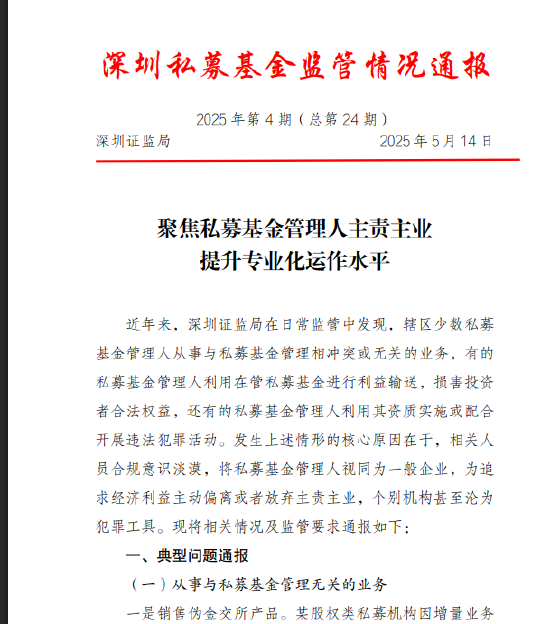
"近年来,深圳证监局在日常监管中发现,辖区少数私募基金管理人从事与私募基金管理相冲突或无关 的业务,有的私募基金管理人利用在管私募基金进行利益输送,损害投资者合法权益,还有的私募基金 管理人利用其资质实施或配合开展违法犯罪活动。"深圳证监局指出。 6月20日,深圳证监局发布最新一期《私募基金监管情况通报》,披露了当前私募基金管理人的典型问 题,涉及从事与私募基金管理无关的业务、利用在管私募基金进行利益输送、利用管理人资质从事违法 犯罪活动等三大类违规行为。 合规意识淡漠 三大类私募乱象频发 据了解,此次《私募基金监管情况通报》对当前私募基金管理人的典型问题进行了披露,主题为聚焦私 募基金管理人主责主业,提升专业化运作水平。 深圳证监局认为,从事与私募基金管理无关的业务是私募的主要乱象之一,包括销售伪金交所产品、对 外提供咨询服务、对外提供居间服务、销售投资标的公司股权、协助非公司员工获取基金从业资格、在 办公场地内开展无关活动等。 比如,在销售伪金交所产品方面,某股权类私募机构因增量业务不足,与某房地产企业签署《承销协 议》,向多名自然人投资者推介该房企在伪金交所发行的应收账款收益权转让计划,并收取150余万 ...
深圳私募乱象监管通报:办公场所有算命风水 基金沦为利益输送工具
Xin Lang Ji Jin· 2025-06-23 10:19
Core Viewpoint - The recent report from the Shenzhen Securities Regulatory Bureau reveals alarming violations in the private equity industry, highlighting issues such as the mingling of unrelated activities like fortune-telling with fund management, the sale of fraudulent gold exchange products, and illicit bond profit transfers [1][2]. Group 1: Industry Violations - Some private equity institutions have deviated from their core responsibilities, engaging in unrelated activities such as fortune-telling and knowledge payment services [3][4]. - Certain private equity firms have become conduits for illegal financial activities, promoting fraudulent investment schemes and charging significant consulting fees [4][11]. - The report indicates a troubling trend where private equity firms prioritize course sales over legitimate fund management, with a significant portion of income derived from unrelated activities [4][11]. Group 2: Illegal Operations and Profit Transfers - The report uncovers hidden profit transfer chains and illegal operational methods within the private equity sector, particularly in the bond market [6][7]. - Instances of profit transfer through related transactions have been identified, where private equity funds are manipulated to benefit insiders at the expense of investors [6][14]. - There are serious concerns regarding the use of private equity fund accounts for illegal activities, including unauthorized stock trading and illegal fundraising [7][15]. Group 3: Regulatory Response - In response to these rampant violations, the Shenzhen Securities Regulatory Bureau has established clear regulatory guidelines, emphasizing the need for private equity firms to focus on their core business and enhance compliance [8][18]. - The regulatory body has mandated that private equity institutions must not engage in activities that conflict with fund management and must prioritize investor interests [8][18]. - Future regulatory efforts will involve increased scrutiny of compliance operations within private equity firms, with strict accountability for violations [8][18].
卖课、算命、利益输送……深圳证监局通报私募乱象
证券时报· 2025-06-23 07:48
Core Viewpoint - The Shenzhen Securities Regulatory Bureau has identified significant misconduct among private fund managers in the region, including engaging in unrelated business activities and violating compliance standards, which undermines investor interests and market order [1][3][6]. Group 1: Misconduct in Private Fund Management - Some private fund managers have deviated from their core responsibilities by engaging in unrelated business activities such as selling pseudo-gold exchange products, providing consulting services, and conducting fortune-telling [1][3]. - Specific examples include a private equity firm promoting a real estate company's receivables plan and charging over 1.5 million yuan in consulting fees, as well as another firm offering financing services and receiving fees based on financing amounts [3][4]. - There are instances of private fund managers facilitating the acquisition of fund management qualifications for non-employees and conducting unrelated activities like fortune-telling within their offices [4][5]. Group 2: Profit Transfer and Investor Rights - Certain private fund managers have been found to use managed fund products for profit transfer, harming investor rights, particularly in the bond market [6][7]. - Examples include agreements between fund managers and securities firms to invest in designated bonds for a fee, and charging large advisory fees to funds without proper disclosure [6][7]. - There are also cases of fund managers engaging in "high buy low sell" transactions with their own funds, which constitutes profit transfer [7]. Group 3: Criminal Activities and Regulatory Concerns - Some private fund managers have exploited their qualifications to engage in illegal activities, highlighting the urgent need for regulatory oversight [9][10]. - Notable illegal activities include unauthorized fundraising, lending management qualifications to facilitate illegal fundraising, and using fund accounts for illegal margin trading [9][10]. - The Shenzhen Securities Regulatory Bureau has outlined five major illegal activities, including illegal fundraising and market manipulation [10][12]. Group 4: Regulatory Measures and Future Directions - The Shenzhen Securities Regulatory Bureau has proposed four regulatory requirements to guide private fund managers back to their core business and promote healthy industry development [11][12]. - These requirements emphasize focusing on core business, enhancing compliance and internal controls, preventing illegal activities, and ensuring sustainable operational capabilities [12][13]. - The Bureau plans to strengthen regulatory inspections and hold accountable those engaging in illegal activities, urging private fund managers to improve their operational standards [13].

卖课、算命、利益输送……深圳证监局通报私募乱象
券商中国· 2025-06-23 05:04
Core Viewpoint - The Shenzhen Securities Regulatory Bureau has identified significant misconduct among private fund managers, including engaging in unrelated business activities and violating compliance regulations, which undermines investor interests and market order [1][4][6]. Group 1: Misconduct in Private Fund Management - Some private fund managers have deviated from their primary responsibilities by engaging in unrelated business activities such as selling fraudulent gold exchange products and providing consulting services [2][3]. - Specific cases include a private equity firm promoting a real estate company's receivables plan and charging over 1.5 million yuan in consulting fees, as well as another firm offering financing services and charging fees based on financing amounts [2][3]. Group 2: Profit Transfer and Investor Rights - There are notable instances of profit transfer using managed private fund products, which harm investor rights. This includes arrangements where fund managers receive payments for facilitating bond transactions and charging excessive advisory fees without disclosing them to investors [4][5]. - A specific case involved a private equity firm selling bonds to its own executives at a price significantly lower than market value, only to repurchase them at a higher price shortly after [5]. Group 3: Criminal Activities and Regulatory Violations - Certain private fund managers have exploited their qualifications to engage in illegal activities, such as illegal fundraising and market manipulation, highlighting the urgent need for stricter regulation [6][7]. - Activities include unauthorized fundraising through unregistered partnerships, lending management qualifications to facilitate illegal public fundraising, and using private fund accounts for illegal margin trading [6][7]. Group 4: Regulatory Recommendations - The Shenzhen Securities Regulatory Bureau has proposed four regulatory measures to address these issues, including focusing on core business operations, enhancing compliance and internal controls, preventing illegal activities, and ensuring sustainable operational capabilities [8][9][10]. - The bureau emphasizes the importance of private fund managers adhering to investor interests and maintaining a high level of compliance to prevent conflicts of interest and protect investor rights [9][11].

主观多头榜单出炉!5月反弹但仍落后于量化!榕树投资、同犇投资等上榜!
私募排排网· 2025-06-21 09:48
Core Viewpoint - The subjective long-only strategy is one of the most traditional and common investment strategies among private equity funds, relying heavily on the judgment and research capabilities of the investment team regarding macroeconomics, industry development, and company fundamentals [2] Performance Overview - In May, the average return of subjective long-only private equity products reached 3.18%, significantly improving compared to April, ranking second among 16 secondary strategies, only behind quantitative long strategies [2] - Over the past six months and one year, the subjective long-only strategy ranked in the top three, achieving returns of 7.70% and 24.71% respectively [2] - However, the average return over the past three years was only 35.88%, placing it in the middle of all secondary strategies [2] Top Performers - In the top 20 subjective long-only products over the past six months, several firms such as Youbo Capital, Rongshu Investment, and Tongben Investment have shown outstanding performance [4] - Seven products in the top 20 achieved returns exceeding 100%, with "Nengjing Value Preferred No. 2" from Nengjing Investment ranking first [4] Detailed Rankings - The top 20 subjective long-only products over the past six months include: - "Nengjing Value Preferred No. 2" from Nengjing Investment - "Youbo No. 3 Class A" from Youbo Capital - "Qinsheng Jimaiton No. 1" from Qinsheng Fund [6] Yearly Performance - In the top 20 subjective long-only products over the past year, the threshold for inclusion reached ***%, with five products achieving returns over 200% [9] - "Xingbidazhi Zhen" from Xingbidazhi (Xiamen) Private Equity topped the list [11] Three-Year Performance - The top 20 subjective long-only products over the past three years had a threshold of ***%, with five products achieving returns over ***% [14] - "Pengtie Fengyun No. 3" from Qianhai Pengtie Investment ranked first in this category [16] Investment Strategies - Youbo Capital's success is attributed to its aggressive investment style and the significant growth of its product net value [8] - The investment philosophy of "value speculation" is highlighted by the manager of "Juren Baichuan No. 1" from Juren Asset, combining value investment with market volatility [18]
多地证监局开罚单!这些知名私募受罚
券商中国· 2025-06-21 07:15
Core Viewpoint - The article highlights the recent regulatory actions against several private equity firms in China, indicating ongoing scrutiny and a trend of industry consolidation due to compliance issues [1][6]. Group 1: Regulatory Actions - Zhejiang Securities Regulatory Bureau issued a warning letter to Hangzhou Jiaming Asset Management Co., citing violations such as non-compliance with fund investment agreements and providing false investment contracts to custodians [3]. - Hainan Securities Regulatory Bureau mandated corrective measures for Hainan Jiayue Private Securities Fund Management Co., due to issues like inter-fund investments without proper management systems and fundraising from non-qualified investors [4]. - Other firms, including Beijing Yanstone Investment Management Center and Shanghai Leitu Asset Management Co., also faced regulatory actions, with warning letters issued by local securities regulatory authorities [5]. Group 2: Industry Trends - The private equity industry in China is experiencing a significant wave of exits, with 580 firms having been deregistered this year alone, continuing a trend of rapid industry consolidation [6][7]. - Of the 580 deregistered firms, 266 opted for voluntary deregistration, while 275 were deregistered by the association, indicating a mix of proactive and reactive measures within the industry [7]. - Cumulatively, since 2021, a total of 8,063 private equity firms have been deregistered, reflecting ongoing challenges within the sector [7]. Group 3: Current Market Landscape - As of April 2025, there are 19,891 active private equity fund managers managing a total of 141,579 funds, with an aggregate management scale of 20.22 trillion yuan [7]. - The breakdown of active fund managers includes 7,827 managing private securities investment funds, 11,867 managing private equity and venture capital funds, and 6 managing asset allocation funds [7].