
采矿业

Search documents
大中矿业:上半年归母净利润4.06亿元,同比下降12.32%
Xin Lang Cai Jing· 2025-08-20 12:05
大中矿业8月20日晚间公告,公司上半年实现营业收入19.72亿元,同比下降0.07%;归属于上市公司股 东的净利润4.06亿元,同比下降12.32%;基本每股收益0.27元。报告期内,公司的主营业务、主要产品 以及经营模式未发生重大变化。 ...
北方矿业发盈喜 预计中期收益同比增长不少于45%
Zhi Tong Cai Jing· 2025-08-20 08:51
Group 1 - The company, Northern Mining (00433), expects to achieve a net profit for the six months ending June 30, 2025, compared to a net loss in the same period last year [2] - The company anticipates that its revenue for the current period will increase by no less than 45% compared to the same period last year [2] - The positive performance is primarily attributed to the full recovery of mining operations, leading to significant improvements in capacity and operational efficiency, which in turn has transformed financial results from loss to profit [2]
北方矿业(00433)发盈喜 预计中期收益同比增长不少于45%
智通财经网· 2025-08-20 08:46
Core Viewpoint - Northern Mining (00433) anticipates a return to profitability for the six months ending June 30, 2025, compared to a net loss in the same period last year, driven by a significant recovery in mining operations [1] Financial Performance - The company expects its revenue for the current period to increase by no less than 45% compared to the same period last year [1] - The anticipated positive performance is primarily attributed to the full recovery of mining operations, leading to substantial improvements in capacity and operational efficiency [1] Operational Impact - The stabilization of mining operations is expected to have a significant positive impact on the overall performance of the company [1]
从试点探索迈向全面推进 西藏推动绿色矿山建设提质增效
Zhong Guo Zi Ran Zi Yuan Bao· 2025-08-20 07:42
Core Viewpoint - Tibet has prioritized green mine construction as a key support for ecological civilization and high-quality economic development, transitioning from pilot exploration to comprehensive promotion [1][2]. Group 1: Institutional Standards - Tibet has established interim management measures, standards, and management regulations for green mine construction, clarifying goals, application procedures, and management requirements [1]. - The management mechanism is structured as "government guidance, departmental collaboration, enterprise initiative, third-party evaluation, regular review, and public supervision" [1]. - By the end of 2024, Tibet aims to have 14 green mines, including 7 at the national level and 7 at the regional level [1]. Group 2: Ecological Protection - Green mine enterprises in Tibet have invested over 900 million yuan in ecological restoration, completing over 11 million square meters of mine area restoration [2]. - An investment of 267 million yuan has been made to upgrade wastewater treatment facilities, achieving an annual wastewater treatment capacity of 18.63 million tons with a 100% compliance rate for wastewater discharge [2]. - The initiative promotes the synergy of resource development and ecological protection [2]. Group 3: Safety Risk Prevention - Green mine enterprises have invested over 90.98 million yuan to establish an intelligent risk prevention system, including underground safety systems and vehicle monitoring systems, achieving a warning accuracy rate of over 90% [2]. - Real-time monitoring of geological disasters, equipment status, and personnel dynamics has been implemented [2]. Group 4: Economic Development and Livelihood Improvement - Green mine enterprises in Tibet are adopting advanced technologies to enhance mining recovery rates and overall resource utilization [2]. - In 2024, the industrial output value of green mines in Tibet is projected to reach 17.9 billion yuan, with tax contributions of 2.8 billion yuan, creating job opportunities for over 3,000 local residents [2]. Group 5: Supervision and Management - Tibet has established a closed-loop regulatory framework for green mines, implementing a strict multi-departmental review mechanism during the selection phase [3]. - Regular on-site comprehensive inspections and third-party evaluations are conducted annually, utilizing an online regulatory system for transparency [3]. - Measures such as rectification deadlines, removal from the list, credit penalties, and administrative sanctions are enforced for poor management [3].
重达672吨!瑞典百年大教堂上演“搬家记”,通过滑轮装置缓慢“平移”
Huan Qiu Shi Bao· 2025-08-19 22:43
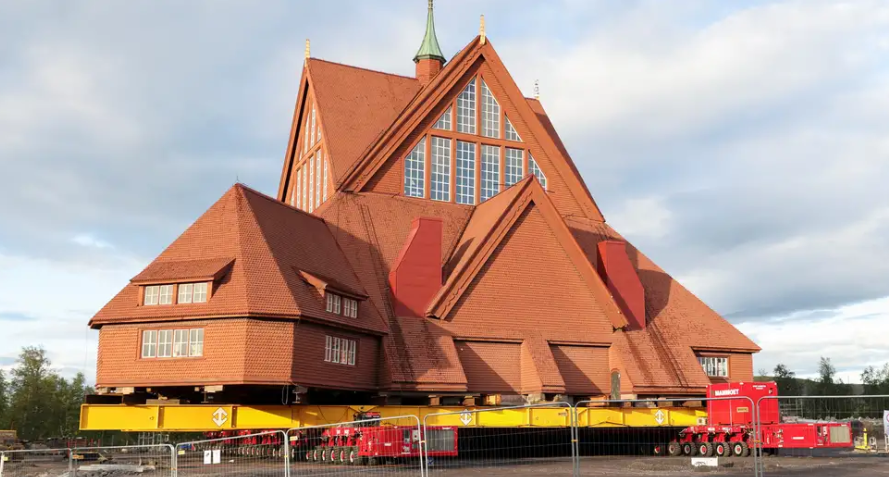
"教堂搬家"只是城镇整体东移的一环,相关计划早在2004年就已推出。基律纳铁矿资源丰富,近年随着开采工作的深入,当地 建筑与道路已经出现明显的裂痕,整体东移旨在预防建筑地基塌陷等事故。截至今年7月,基律纳已经有25栋建筑采用同样的 办法完成了搬迁。(刘皓然) 据《瑞典先驱报》报道,连日来,基律纳这座常住人口仅2.3万的矿业小镇人头攒动,数千名游客"空降"此地,只为了观看"大 教堂搬家"。基律纳大教堂始建于1909年,1912年完工,是瑞典矿业公司"基律纳山(LKAB)"赠送给当地社区的礼物。教堂的 建筑风格深受当地原住民萨米族人尖顶帐篷的影响,还融入了哥特以及巴洛克元素,曾被瑞典人评为"1950年以前落成的最佳 建筑",迄今仍然是知名旅游景点。 美联社称,"教堂搬家"在当地堪称一项大工程:整座教堂宽40米、总重达672吨,为此工程师特意将"搬迁"用的道路拓宽,甚 至拆掉了必经之路上的一座高架桥。19日上午,施工人员将整座教堂建筑放置在巨大的滑轮装置上,沿既定路线缓慢迁移。由 于移动时速较慢,这段总长5公里的"平移"要一直持续到20日。《瑞典先驱报》称,这场盛事吸引了约40家国内外媒体的现场 直播与报道,瑞典古 ...

安宁股份: 四川天健华衡资产评估有限公司关于深圳证券交易所《关于对四川安宁铁钛股份有限公司重大资产购买的问询函》回复之核查意见
Zheng Quan Zhi Xing· 2025-08-19 11:09
Core Viewpoint - The company, Sichuan Anning Titanium Iron Co., Ltd., is undergoing a significant asset acquisition, with the evaluation of the target asset, Jingzhi Mineral, showing a substantial increase in value through both asset-based and income approaches, indicating strong potential for future profitability [1][3][20]. Group 1: Asset Evaluation - The asset evaluation as of March 31, 2025, indicates an increase of 484,290.09 million yuan, with an appreciation rate of 1,831.95% using the asset-based method [3][20]. - The evaluation of finished products is based on a detailed report that estimates the low-grade ore stockpile at 57,961.3 thousand tons, with iron and titanium grades of 15.22% and 5.61%, respectively [3][5]. - The income approach assumes that the acquisition will enable the company to leverage synergies, leading to enhanced operational efficiency and profitability [9][20]. Group 2: Financial Metrics - The expected sales revenue from the processed products is calculated to be 742,908.00 million yuan, based on the estimated production of iron and titanium concentrates [6][20]. - The operating costs and investments are derived from a feasibility report, with total costs including construction investment of 23,060.00 million yuan and taxes of 27,543.00 million yuan [6][20]. - The net profit is projected after deducting taxes and appropriate profit margins, leading to a final evaluation value of 131,959.00 million yuan for the finished products [7][20]. Group 3: Methodology and Assumptions - The evaluation methods employed include both the asset-based approach and the income approach, with the latter considering specific synergies from the acquisition [10][20]. - Key parameters for the income approach include a discount rate of 9.61%, which reflects the weighted average cost of capital (WACC) and is justified by recent comparable cases in the industry [15][20]. - The differences in valuation results between the two methods are attributed to the expected operational synergies and the specific management capabilities of Anning Co. post-acquisition [11][20].
【宏观经济】一周要闻回顾(2025年8月13日-8月19日)
乘联分会· 2025-08-19 08:40
Group 1: Retail Sales - In July 2025, the total retail sales of consumer goods reached 38,780 billion yuan, with a year-on-year growth of 3.7%. Excluding automobiles, retail sales amounted to 34,931 billion yuan, growing by 4.3% [2][4] - From January to July 2025, the total retail sales of consumer goods reached 284,238 billion yuan, with a growth rate of 4.8%. Excluding automobiles, retail sales were 257,014 billion yuan, growing by 5.3% [2][4] Group 2: Fixed Asset Investment - From January to July 2025, national fixed asset investment (excluding rural households) totaled 288,229 billion yuan, with a year-on-year growth of 1.6%. Private fixed asset investment decreased by 1.5% [5][6] - In July 2025, fixed asset investment (excluding rural households) decreased by 0.63% month-on-month [6] - By industry, the first industry saw an investment of 5,646 billion yuan (growth of 5.6%), the second industry 104,455 billion yuan (growth of 8.9%), and the third industry 178,128 billion yuan (decline of 2.3%) [6] Group 3: Industrial Production - In July 2025, the industrial added value of enterprises above designated size grew by 5.7% year-on-year, with a month-on-month increase of 0.38% [7][8] - From January to July 2025, the industrial added value increased by 6.3% year-on-year [8] - By sector, mining industry added value grew by 5.0%, manufacturing by 6.2%, and electricity, heat, gas, and water production and supply by 3.3% [8] Group 4: Energy Production - In July 2025, the production of crude oil was stable, with an output of 1,812 million tons, a year-on-year increase of 1.2% [17] - Natural gas production accelerated, reaching 216 billion cubic meters in July, with a year-on-year growth of 7.4% [19] - Electricity production increased by 3.1% year-on-year in July, totaling 9,267 billion kilowatt-hours [21]

政策调整,经济阶段性回调
Bei Da Guo Min Jing Ji Yan Jiu Zhong Xin· 2025-08-19 05:40
Economic Growth - In July 2025, China's industrial added value grew by 5.7% year-on-year, slowing down by 1.1 percentage points from June[9] - Fixed asset investment from January to July 2025 increased by 1.6% year-on-year, a decrease of 1.2 percentage points compared to the first half of the year[10] - Social retail sales in July 2025 rose by 3.7% year-on-year, down 1.1 percentage points from the previous month[10] Trade and Exports - In July 2025, China's total exports reached $321.78 billion, a year-on-year increase of 7.2%, up 1.4 percentage points from the previous month[38] - Imports totaled $223.54 billion in July 2025, with a year-on-year growth of 4.1%[51] - The trade surplus for July 2025 was $98.24 billion[38] Inflation and Prices - The Consumer Price Index (CPI) in July 2025 showed no growth year-on-year, a decrease of 0.1 percentage points from the previous month[57] - The Producer Price Index (PPI) fell by 3.6% year-on-year, remaining stable compared to the previous month[57] Monetary Policy - New social financing in July 2025 was 1.16 trillion yuan, a decrease of 64.8% compared to July 2024[14] - New RMB loans in July 2025 were -50 billion yuan, a drop of 119% year-on-year[14] - M2 money supply grew by 8.8% year-on-year, reflecting a stable expansion of monetary supply[15]
7月经济数据点评:扩大内需从多方面入手
Bank of China Securities· 2025-08-19 05:36
Economic Performance - July industrial added value grew by 5.7% year-on-year, down 1.1 percentage points from June and slightly below the consensus expectation of 5.8%[4] - Retail sales in July increased by 3.7% year-on-year, a decline of 1.1 percentage points from June, with non-automotive retail sales growing by 4.3%[12] - Fixed asset investment from January to July showed a cumulative year-on-year growth of 1.6%, with private investment declining by 1.5%[23] Sector Analysis - From January to July, manufacturing investment rose by 6.2%, while real estate investment fell by 12.0%[25] - High-tech industries saw a cumulative year-on-year growth of 9.5% in industrial added value, indicating resilience in this sector[7] - Service consumption in July grew by 5.2% year-on-year, supported by strong demand during the summer travel season[15] Challenges and Risks - Economic data for July reflects significant downward pressure on growth, influenced by complex external conditions and adverse domestic weather factors[34] - Price factors continue to drag down nominal growth rates in retail sales and fixed asset investment[34] - Risks include potential global inflation resurgence and rapid economic downturns in Europe and the U.S.[36] Policy Recommendations - The report suggests that proactive macroeconomic policies are essential to stimulate domestic demand and support growth[35] - Attention should be given to the implementation of consumption loan interest subsidies and the impact of U.S.-China trade negotiations on foreign trade dynamics[35]
前7个月河南省规上工业增加值同比增长8.5%
Bei Ke Cai Jing· 2025-08-19 03:32
Core Viewpoint - In July, Henan Province's industrial added value experienced a year-on-year real growth of 8.8%, indicating a robust industrial performance despite economic challenges [1] Summary by Categories Industrial Growth - From January to July, the industrial added value above designated size in Henan grew by 8.5% year-on-year [1] - In July, the mining industry saw an added value growth of 3.5% [1] - The manufacturing sector recorded an increase of 8.7% in added value [1] - The electricity, heat, gas, and water production and supply industry experienced a significant growth of 14.5% [1]