
矿产资源

Search documents
中国中铁20260305
2026-03-06 02:02
Summary of Key Points from the Conference Call Company Overview - The conference call pertains to China Railway, focusing on its mining and infrastructure sectors. Core Industry Insights - **Mining Sector Performance**: The mining resources segment is expected to generate a net profit of approximately 2.5 billion yuan in the first half of 2025, with potential for profit growth if resource prices remain high. The segment's revenue share is projected to approach 20% in 2025 [2][6]. - **Project Development Timeline**: The Fuxing Tun silver mine is still in the exploration phase, with a production timeline of 4-5 years, contributing no short-term profits [2][4]. - **Order Trends**: A decline in new orders in 2024 is expected to constrain revenue and profit expectations for 2026, with a focus on overseas and domestic new infrastructure projects [2][7]. Financial Performance and Projections - **Profitability Outlook**: If resource prices remain elevated, there is room for profit improvement in 2026. The annual profit level can be estimated based on semi-annual profits and price fluctuations [5][11]. - **Dividend Strategy**: A significant increase in the dividend payout ratio is anticipated for 2026, driven by mid-term dividends and buyback arrangements. The long-term strategy aims for steady annual increases in dividends [2][11]. Operational Insights - **Infrastructure Margins**: The gross margin for the core infrastructure business is currently low, with stricter assessments for investment projects. The company is focusing on revitalizing existing assets through quasi-REITs structures [3][15]. - **Cash Flow Management**: The goal is to maintain positive cash flow, with expectations leaning towards stability rather than significant improvement [11]. Strategic Initiatives - **New Business Growth**: The new business segment aims for an overall growth rate exceeding 200%, with substantial opportunities in water conservancy and hydropower projects [9]. - **International Expansion**: The company is tracking multiple mining resource projects and is cautious about expanding during high price cycles, focusing on maintaining a steady pace of project advancement [10]. Market Dynamics - **Commodity Price Impact**: The company faces pressures from local governments in the Democratic Republic of the Congo regarding profit-sharing due to rising copper prices, which may affect profit margins [10]. - **Investment Climate**: The overall investment climate remains stable, with no significant acceleration in bidding or project launches observed in early 2026 compared to previous years [6][7]. Miscellaneous - **Hydrogen Energy Involvement**: The company currently does not engage in hydrogen energy-related businesses [8]. - **REITs Development**: There are no mature assets suitable for direct REIT issuance, but the company is actively pursuing quasi-REIT projects [15]. - **Regional Order Trends**: Domestic orders are performing well in traditional economic regions, with no significant changes in project volumes in areas like Xinjiang [13][14].
美国能源部长:对格陵兰的主要兴趣不是稀土
Jin Rong Jie· 2026-02-18 13:05
Core Viewpoint - The primary interest of the Trump administration in Greenland is national security rather than the development of its rare earth or energy resources [1] Group 1 - The Trump administration has long sought control over Greenland, focusing on negotiations for the development of untapped mineral resources [1] - The efforts to develop Greenland's resources are considered a secondary goal, with the main objective being the expansion of the U.S. military presence on the island [1] - The administration aims to create more economic opportunities for the people of Greenland while enhancing military presence [1]
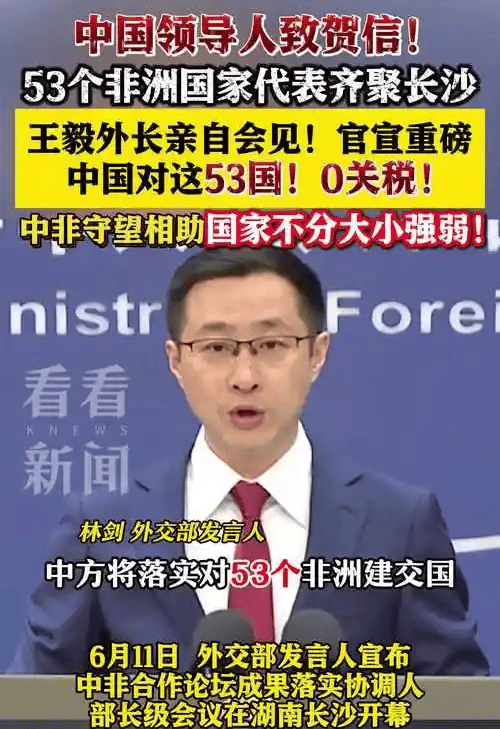
炸屏!中国官宣重大举措:5月起,53个非洲国家商品零关税入华,双向共赢太好哭
Sou Hu Cai Jing· 2026-02-15 01:31
Core Viewpoint - China officially announced that starting from May 1, 2026, it will implement 100% zero tariffs on products from 53 African countries, allowing compliant goods to enter the Chinese market without any hidden barriers [1][3]. Group 1: Zero Tariff Implementation - The zero tariff policy covers 53 African countries, including major economies, excluding Eswatini, which maintains diplomatic relations with Taiwan [3]. - This initiative includes a wide range of products, from Ethiopian coffee and Tanzanian cashews to Liberian rubber and South African wine, allowing compliant products from these countries to enter China without tariffs [3][5]. Group 2: Economic Impact on Africa - The zero tariff policy is seen as a significant development opportunity for Africa, as it will enhance the price competitiveness of African goods in the global market, which have previously faced high tariffs [5]. - For instance, Ethiopian coffee exports are expected to grow at an annual rate of 27% due to the removal of tariffs, potentially allowing African coffee to be sold at lower prices in China [5]. Group 3: Benefits for Chinese Consumers - Chinese consumers can expect a price reduction of 20%-40% on African products such as cashews and avocados, making these high-quality items more accessible [7]. - The import of zero-tariff African raw materials will also lower production costs for domestic companies, allowing them to invest in research and development [7][8]. Group 4: Broader Implications - This move by China counters the rising trend of unilateralism and trade protectionism globally, showcasing China's commitment to multilateralism and cooperation with African nations [8]. - The historical context of China's support for Africa is highlighted, showing a consistent effort over two decades to enhance trade relations, culminating in this comprehensive zero tariff policy [10].

最高法发布矿产资源纠纷案最新司法解释 2月1日起施行
Yang Shi Xin Wen· 2026-01-21 03:38
Core Viewpoint - The Supreme People's Court has issued an interpretation regarding the application of laws in mineral resource dispute cases, effective from February 1, 2026, to ensure the implementation of the new Mineral Resources Law that took effect on July 1, 2025 [1][2]. Group 1: Legal Framework - The interpretation consists of twenty-three articles aimed at clarifying the rights and obligations of parties involved in mineral resource transactions [1]. - It allows the transferee to terminate contracts if they cannot legally obtain mining land due to the transferor's actions, thereby protecting the transferee's rights to explore and mine [1]. - The interpretation mandates compensation for mining rights holders if their rights are revoked for public interest or if they are required to exit protected natural areas [1]. Group 2: Environmental and Compensation Provisions - Mining rights holders who have fulfilled their ecological restoration obligations and passed inspections cannot be sued for ecological damage caused by their mining activities, barring new evidence [2]. - For public interest projects in energy, transportation, and water resources, if mining resources are overlapped without a compensation agreement, it does not constitute infringement, but fair compensation for losses incurred must be provided [2]. - Compensation includes the value of the mining rights, exploration investments, established mining facilities, and relocation costs [2].
云南铜业:公司积极关注包括海外在内的优质矿产资源项目
Zheng Quan Ri Bao Wang· 2026-01-16 15:14
Core Viewpoint - Yunnan Copper (000878) emphasizes the importance of resource reserves for sustainable development while maintaining operations at existing mines and smelting plants [1] Group 1: Company Strategy - The company is actively monitoring high-quality mineral resource projects, including those overseas [1] - Resource project assessments and evaluations will be conducted cautiously based on the company's strategic layout and market demand [1]

委内瑞拉局势-现状-走向-连锁影响
2026-01-08 02:07
Summary of Key Points from the Conference Call Industry or Company Involved - The discussion primarily revolves around the political and economic situation in Venezuela, focusing on the power dynamics and U.S. involvement in the region. Core Points and Arguments - **Current Power Structure in Venezuela**: The regime is controlled by Interior Minister Diosdado Cabello and Defense Minister Vladimir Padrino, who oversee the country's security forces, including police, militia, and military, significantly influencing the situation in Venezuela [2][4]. - **U.S. Non-support for Opposition**: The U.S. has refrained from supporting the Venezuelan opposition due to concerns over their capability to challenge the military's power and the potential for creating a power vacuum that could lead to chaos and increased crime [3][4]. - **Trump Administration's Strategy**: The Trump administration has employed secretive operations to achieve short-term goals without fully overthrowing the Venezuelan regime, reflecting a cautious approach to avoid long-term conflict [5][10]. - **Economic Interests**: The U.S. seeks to secure economic benefits, particularly in oil and mineral resources, and aims to reduce the influence of countries like Russia and China in Venezuela, which will be critical in future negotiations [6][10]. - **Resource Allocation by Maduro**: Maduro maintains loyalty through the distribution of oil revenues, with estimates suggesting that 1/3 to 1/2 of oil income is used for stability purposes, complicating future negotiations regarding resource redistribution [7][8]. - **Stability and Future Negotiations**: The current stability in Venezuela is attributed to Maduro's relatively low personal desire for wealth, leading to generous resource distribution. However, any negotiations with the U.S. may disrupt the existing complex interest structures, potentially leading to internal conflicts [8][9]. - **Long-term Uncertainty**: While the Trump administration focuses on short-term economic gains, the long-term effectiveness of these strategies remains uncertain, with potential risks of refugee crises and increased drug-related crime if stability is not achieved [3][10]. Other Important but Possibly Overlooked Content - **Historical Context**: The discussion draws parallels with historical events, such as the Bay of Pigs invasion, highlighting the risks of U.S. intervention and the potential for unintended consequences if operations fail [11][12]. - **Political Risks in Latin America**: The upcoming elections in various Latin American countries present significant political risks, with a potential shift towards right-wing leadership, which may align ideologically with U.S. interests but could also lead to changes in foreign policy towards China [15]. - **Market Selection for Exporters**: Export companies are advised to prioritize markets in the Eastern Hemisphere, which are perceived as more stable and less influenced by U.S. intervention, while being cautious of potential upheavals in the Western Hemisphere [16].
“唐罗主义”2026年炸裂开局:抓马杜罗,拉美国家脊背发凉
Di Yi Cai Jing· 2026-01-04 13:15
Core Viewpoint - The article discusses the significant military action taken by the U.S. against Venezuela, marking a pivotal moment in U.S.-Latin America relations under Trump's administration, which is characterized by a new version of the Monroe Doctrine referred to as "Trump's Monroeism" [1][8]. Group 1: Military Action and Political Implications - On January 2, 2026, President Trump ordered a military operation that resulted in the capture of Venezuelan President Maduro, with over 150 U.S. military aircraft involved in the operation [1]. - Following Maduro's capture, the Venezuelan Supreme Court appointed Vice President Rodriguez as acting president, but did not declare Maduro "absolutely absent," suggesting no immediate elections will be held [3][4]. - Trump stated that the U.S. would "manage" Venezuela until a "safe" transition could occur, indicating a long-term U.S. involvement in Venezuelan affairs [4]. Group 2: Economic Interests and Resource Control - Trump emphasized the importance of Venezuela's oil resources, indicating that U.S. oil companies would invest billions in Venezuelan energy infrastructure, aiming to extract wealth for both Venezuelans and the U.S. [6][8]. - The U.S. has been conducting military operations in the Caribbean under the guise of combating "drug terrorism," which has resulted in significant military deployments and actions against vessels [6]. Group 3: Historical Context and Regional Reactions - The article draws parallels between the current situation and past U.S. interventions in Latin America, highlighting a historical pattern of U.S. involvement in the region's politics [10]. - Neighboring countries, particularly Colombia and Chile, have expressed concerns over U.S. military actions, emphasizing the need for respect for national sovereignty and calling for diplomatic solutions to the crisis [10][11].
道氏技术(300409.SZ):公司在刚果(金)有采矿权
Ge Long Hui· 2025-12-24 09:04
Group 1 - The company, Daoshi Technology (300409.SZ), has mining rights in the Democratic Republic of the Congo [1]

抛售资产后火速推出回购计划,中国中冶欲25亿“护盘”?
Huan Qiu Lao Hu Cai Jing· 2025-12-18 09:51
Core Viewpoint - China Metallurgical Group Corporation (China MCC) announced a share buyback plan to stabilize its stock price following significant market volatility due to a recent asset sale announcement [1][2]. Group 1: Share Buyback Announcement - The company plans to repurchase A-shares and H-shares using its own funds, with a minimum of 1 billion RMB and a maximum of 2 billion RMB allocated for A-shares, priced at no more than 4.90 RMB per share [1]. - The maximum amount for H-shares buyback is set at 500 million RMB, with the repurchased shares intended for cancellation to reduce registered capital [1]. Group 2: Recent Asset Sale and Market Reaction - The asset sale plan involves selling multiple assets to the controlling shareholder, China Minmetals Group, for 60.676 billion RMB, including 100% equity of MCC Real Estate and stakes in several resource subsidiaries [2]. - Following the announcement, the stock price of China MCC experienced a sharp decline, with A-shares closing at 3.05 RMB (limit down) and H-shares dropping over 21%, resulting in a market value loss exceeding 12 billion RMB [2]. Group 3: Financial Performance and Market Outlook - The company's financial performance has been under pressure, with revenues decreasing from 592.67 billion RMB in 2022 to an estimated 552.02 billion RMB in 2024, and net profits declining from 10.27 billion RMB to 6.75 billion RMB over the same period [3]. - In the first three quarters of 2025, revenue fell by 18.79% year-on-year to 335.09 billion RMB, and net profit dropped by 41.88% to 3.97 billion RMB, reflecting ongoing challenges in the steel, construction, and real estate sectors [3].
利比里亚因矿业管理漏洞,正面临巨额矿产收益流失
Shang Wu Bu Wang Zhan· 2025-12-10 18:16
Core Viewpoint - Legal experts warn that foreign mining companies are extracting Liberia's mineral resources at very low returns due to significant loopholes in laws and agreements, leading to potential revenue losses amounting to billions of dollars for the country [1] Group 1: Revenue and Contributions - Mittal Liberia generated over $1.2 billion in revenue from 2009 to 2022, with the government receiving only $138 million, approximately 11% of the total [1] - B2Gold exported gold worth $576 million, contributing only 26.12% to national revenue [1] Group 2: Root Causes - The issues stem from unfavorable terms in concession agreements, lack of robust regulations in areas like carbon credits, weak oversight of A/B class mining licenses, and insufficient accountability of the judicial system towards multinational companies [1] Group 3: Historical Context and Recommendations - Liberia has been trapped in a "resource curse" cycle since the 1950s, exporting raw materials while profits flow out, leaving local communities without benefits [1] - Experts urge the legal community to take immediate action to address these loopholes, renegotiate agreements, and ensure at least 20% local ownership and value localization to reverse the ongoing extraction of mineral wealth and the country's poverty [1]