黄金珠宝

Search documents
一夜涨回1200元!网友:我真的气炸!
Sou Hu Cai Jing· 2025-11-01 03:27
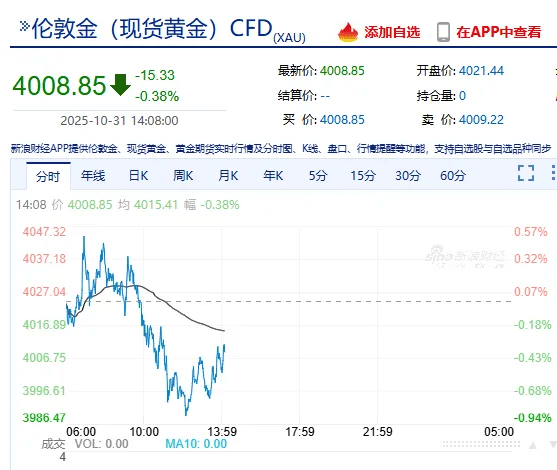
Group 1 - The core viewpoint of the articles indicates that international gold prices have ended a four-day decline, with domestic gold jewelry prices rising back to 1200 RMB per gram [1][4]. - As of October 31, the spot gold price in New York rose by 2.37% to 4023.00 USD per ounce, showing a continuous upward trend throughout the day [1]. - Domestic brands such as Chow Sang Sang and Lao Feng Xiang have seen significant increases in gold jewelry prices, with Chow Sang Sang's price reaching 1203 RMB per gram, up by 28 RMB, and Lao Feng Xiang at 1200 RMB, up by 17 RMB [4]. Group 2 - Analysts from Dahua Bank maintain a positive long-term outlook on gold, citing ongoing central bank purchases and investor demand for diversification amid a volatile de-dollarization narrative [7]. - The market is expected to continue experiencing wide fluctuations due to uncertainties in tariff policies, ongoing U.S. government shutdowns, and expectations of central bank gold purchases providing support for gold prices [7].



一夜涨回1200元!
Sou Hu Cai Jing· 2025-11-01 01:00
Core Insights - International gold prices ended a four-day decline, with domestic gold jewelry prices rising back to 1200 RMB per gram [1][4] - On October 30, the spot gold price in New York rose by 2.37% to 4023.00 USD per ounce, showing a continuous upward trend throughout the day [1] - On October 31, spot gold briefly fell below 4000 USD per ounce [2] Price Movements - Domestic gold jewelry prices saw significant increases, with brands like Chow Sang Sang priced at 1203 RMB per gram (up 28 RMB), Lao Feng Xiang at 1200 RMB (up 17 RMB), and Lao Miao Gold at 1192 RMB (up 20 RMB) [4] - The selling price for 24K gold jewelry is reported at 1203 RMB per gram, while the exchange price for gold is 1048 RMB [5] Market Analysis - Analysts from Dahua Bank indicated that despite recent price corrections, the long-term positive fundamentals for gold remain intact, driven by central bank purchases and investor demand for diversification amid increasing de-dollarization narratives [7] - The outlook for the gold market suggests continued support from factors such as tariff policy uncertainties, ongoing U.S. government shutdown, and expectations of central bank gold purchases, leading to a wide-ranging fluctuation pattern in precious metals [7]
周大福、周大生们迎零售大变局
2 1 Shi Ji Jing Ji Bao Dao· 2025-10-31 15:29
Core Viewpoint - The gold retail sector is experiencing mixed results amid rising gold prices, with some companies reporting positive growth in retail value and net profit, while facing challenges from store closures, particularly among franchise outlets [1][5][10]. Group 1: Financial Performance - Chow Tai Fook's retail value increased by 4.1% year-on-year in Q3, while Luk Fook's overall retail value rose by 18% [1][6]. - Zhou Dasheng reported a net profit growth of 13.57% attributable to the high gold prices and increased consumer spending [1][6]. - Despite the growth in retail value, the number of closed stores continues to rise, with Chow Tai Fook closing 296 stores and Luk Fook closing 49 stores in Q3 [1][12]. Group 2: Market Dynamics - The increase in retail value is supported by three main factors: high gold prices leading to higher average transaction values, an increase in the proportion of priced products sold, and strong growth in e-commerce channels [6][7]. - In Q3, Chow Tai Fook's same-store sales in mainland China grew by 7.6%, while same-store sales volume decreased by 8.6%, indicating a shift towards higher-priced items [6][7]. - E-commerce sales for Chow Tai Fook grew by 28.1% year-on-year, contributing significantly to overall retail value despite a general slowdown in physical store performance [7][8]. Group 3: Franchise Model Challenges - The franchise model, which has been a key growth strategy for many gold jewelry brands, is facing scrutiny as many franchise stores are underperforming and closing [1][10][12]. - As of September 30, Chow Tai Fook had 6,041 stores globally, with over 4,000 being franchise stores, highlighting the reliance on this model [11]. - The trend shows a shift towards increasing self-operated stores, with Zhou Dasheng opening 47 self-operated stores in the first nine months of the year, while closing 333 stores overall [14].
周大福、周大生们迎零售大变局
21世纪经济报道· 2025-10-31 15:19
Core Viewpoint - The article discusses the mixed performance of gold retail companies amid rising gold prices, highlighting both growth in retail values and ongoing challenges with franchise store closures [1][4]. Group 1: Financial Performance - Several gold jewelry brands reported positive retail value growth in Q3, with Chow Tai Fook's retail value increasing by 4.1%, Luk Fook's overall retail value rising by 18%, and Zhou Dasheng's net profit growing by 13.57% [1][4]. - Despite the growth, the "store closure wave" continues, particularly affecting franchise stores, with Chow Tai Fook closing 296 stores and Luk Fook closing 49 stores in Q3 [1][4]. Group 2: Factors Supporting Growth - Three main factors contributed to the retail value growth: high gold prices leading to increased average transaction values, a higher proportion of priced products sold, and strong growth in e-commerce channels [4][6]. - In Q3, Chow Tai Fook's same-store sales in mainland China grew by 7.6%, while same-store sales volume decreased by 8.6%, indicating a shift towards higher-priced products [4][6]. Group 3: E-commerce Performance - E-commerce channels showed significant growth, with Chow Tai Fook's e-commerce retail value increasing by 28.1% in Q3, contributing 6.7% to total retail value and 15.5% to sales volume [6]. - Luk Fook also reported that its retail value in mainland China rose by 20%, driven primarily by e-commerce business [6]. Group 4: Franchise Model Challenges - The franchise model, which allowed rapid expansion of store networks, is now facing challenges as many franchise stores are underperforming and closing [8][9]. - As of September 30, Chow Tai Fook had 6,041 stores globally, with over 4,000 being franchise stores, while Zhou Dasheng had 4,675 stores, with 4,275 being franchises [8]. Group 5: Shift to Self-operated Stores - Despite the reduction in franchise stores, self-operated stores are increasing, with Zhou Dasheng opening 47 self-operated stores in the first nine months of the year [9]. - The gross profit margin for self-operated stores is higher than that of franchise stores, indicating a potential shift in strategy towards more self-operated outlets [9].
曼卡龙(300945):25Q3净利润同增25%,线上渠道延续高增长
CMS· 2025-10-31 14:10
Investment Rating - The report maintains a "Strong Buy" rating for the company [3][6]. Core Insights - The company reported impressive performance with a 36.22% year-on-year increase in revenue and a 25.33% increase in net profit for Q3 2025 [1][6]. - Online sales continued to show high growth, with a 72.86% year-on-year increase in Q3 2025, while offline sales grew by 14.26% [1][6]. - The company is expected to achieve net profits of 126 million, 158 million, and 188 million yuan for 2025, 2026, and 2027, respectively, with growth rates of 31%, 25%, and 19% [1][6]. Financial Performance - For Q3 2025, the company achieved total revenue of 608 million yuan and a net profit of approximately 25.49 million yuan [6]. - The gross margin for Q3 2025 was 15.55%, showing a slight decrease of 0.40 percentage points year-on-year [6]. - The company’s total revenue for the first three quarters of 2025 was 2.164 billion yuan, reflecting a year-on-year growth of 29.30% [6]. Revenue and Profit Forecast - The company’s projected total revenue for 2025 is 3.01 billion yuan, with a year-on-year growth of 28% [2][9]. - The projected operating profit for 2025 is 152 million yuan, representing a 34% increase compared to the previous year [2][9]. - The expected earnings per share (EPS) for 2025 is 0.48 yuan, with a price-to-earnings (PE) ratio of 25.5 [2][9]. Market Position and Strategy - The company is focusing on digital management and targeting the young demographic with a differentiated positioning in the light luxury fashion sector [6]. - The company is enhancing its e-commerce channel development and deepening its presence in key online platforms such as Tmall, JD.com, and Douyin [6].
无忧之夜2025圆满举行 周大生无忧传媒创新跨界营销模式
Zheng Quan Shi Bao Wang· 2025-10-31 10:49
Core Viewpoint - The collaboration between Zhou Dasheng and Wuyou Media represents a strategic move to enhance brand value and redefine the modern value of gold jewelry through innovative marketing and cross-industry integration [1][2][3] Group 1: Event Overview - The "Tian Sheng Gan Yao" Wuyou Night 2025, sponsored exclusively by Zhou Dasheng, took place in Sanya, Hainan, featuring a blend of jewelry aesthetics, fashion art, and entertainment [1] - The event included a grand gala, red carpet show, and fan carnival, showcasing over 200 representative jewelry pieces from Zhou Dasheng's diverse brand matrix [2] - The event was broadcasted across multiple platforms, including Mango TV, Douyin, WeChat Video, and Kuaishou, maximizing its reach and impact [1] Group 2: Strategic Collaboration - Zhou Dasheng has established a strategic partnership with Wuyou Media, focusing on content creation and the interpretation of traditional Chinese culture, which significantly enhances the brand's value [2] - The collaboration aims to create a new paradigm for brand live streaming and incubate jewelry influencers, effectively expanding the reach to younger consumer demographics [2] - The partnership has led to the establishment of a joint venture named "Dasheng Wuyou," marking the first tangible outcome of their collaboration [1][2] Group 3: Market Impact - Zhou Dasheng's collaboration with Wuyou Media is expected to drive the integration of online and offline business models in the gold jewelry industry, enhancing brand visibility and market influence [3] - The performance of the Zhou Dasheng x National Treasure stores has reportedly exceeded that of the main brand, with some pilot stores experiencing rapid sales growth, projecting monthly sales to surpass 10 million [2]
金价,巨震!“前些天还涨呢,今天怎么又跌了?”
Mei Ri Jing Ji Xin Wen· 2025-10-31 10:45
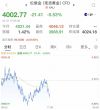
Core Viewpoint - Recent fluctuations in international gold prices have led to significant volatility, with spot gold prices dropping below $4000 after reaching a historical high of $4381 on October 20 [1][4]. Price Movements - On October 31, spot gold was priced at $4002.77, down 0.53% from the previous day, with a trading range between $3988.91 and $4046.13 [2]. - The domestic gold jewelry prices have also been affected, with brands like Chow Sang Sang and Lao Feng Xiang seeing increases in their gold prices per gram [2]. Investor Behavior - Investors are showing mixed reactions to the fluctuating gold prices, with some eager to cash out while others are hesitant, hoping for further price increases [3][4]. - The year-to-date gold price has risen from approximately $2624 per ounce to a peak of $4381, but recent declines have caused uncertainty among gold holders [4]. Gold Recovery Process - The gold recovery process can be complex, with many consumers unaware of the details involved in selling their gold [6][9]. - Different brands and institutions have varying policies on gold recovery, with some requiring original purchase receipts and charging fees based on the current market price [6][7]. Recommendations for Investors - Experts suggest that ordinary investors should avoid purchasing physical gold for investment purposes due to the complexities involved in recovery and potential losses [9]. - It is recommended to consider bank-issued gold bars or coins, which typically have lower premiums and better liquidity for future sales [9].
周大生“无忧之夜2025”三亚收官,引领红人经济新生态
2 1 Shi Ji Jing Ji Bao Dao· 2025-10-31 08:52
Core Insights - The event "Wuyou Night 2025" has gained significant attention, with total exposure exceeding 10 billion, including over 5.1 billion views on Douyin and 4 billion reads on Weibo, indicating a strong online presence and engagement [1] - The event, hosted by Wuyou Media and sponsored by jewelry company Zhou Dashing, took place in Sanya, Hainan, and featured a multi-platform live broadcast, showcasing the integration of online and offline experiences [1][3] - Wuyou Media aims to promote the healthy development of the influencer economy, emphasizing the importance of openness, vitality, and long-term growth in the industry [4][5] Event Overview - The event included three main components: a gala, a red carpet show, and a fan carnival, attracting over 40,000 attendees and effectively boosting consumption in Sanya [1] - The gala featured a unique "live competition + main stage performance" format, allowing audience participation through real-time voting, enhancing viewer engagement [2] - The event highlighted agricultural promotion through collaborations with influencers, showcasing local products and contributing to rural revitalization efforts [2] Cross-Industry Collaboration - "Wuyou Night" has expanded its scale and format this year, linking various resources and brands, including Zhou Dashing and others, to create a "content + scene + consumption" closed loop [3] - Zhou Dashing's involvement included customized performances and thematic stage designs, integrating brand elements seamlessly into the event [3] - The event also featured a fan carnival at the CDF Sanya International Duty-Free City, enhancing brand interaction and marketing effectiveness [3] Industry Leadership - Wuyou Media's CEO emphasized the keyword "health" for the year, advocating for a more open and vibrant industry approach [4] - A strategic partnership with Sina Finance was announced, focusing on resource integration and market development to empower small and medium enterprises [5] - Wuyou Media has maintained a leading position in the industry for 77 consecutive months, showcasing its strong resource integration capabilities [5]
金价重回1200!2025年10月31日各大金店黄金价格多少一克?
Sou Hu Cai Jing· 2025-10-31 07:20
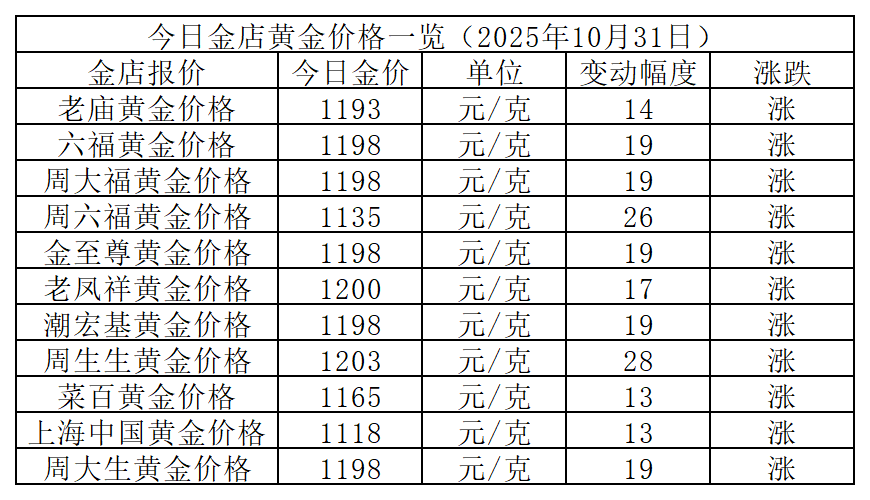
Group 1: Domestic Gold Prices - The price of gold jewelry in domestic stores is approaching 1200 CNY per gram, with some brands exceeding this price point [1] - Zhou Shengsheng's gold price has increased by 28 CNY per gram, reaching a new high of 1203 CNY per gram, while Shanghai China Gold remains the lowest at 1118 CNY per gram [1] - The price difference between the highest and lowest gold prices has expanded to 85 CNY per gram [1] Group 2: Platinum Prices - Platinum prices have also risen, with Zhou Shengsheng's platinum jewelry increasing by 7 CNY per gram to 650 CNY per gram [1] Group 3: Gold Recycling Prices - The gold recycling price has surged by 17.2 CNY per gram, with significant price variations among different brands [2] - The recycling price for gold is reported at 906.20 CNY per gram, with other brands like Lao Fengxiang at 916.70 CNY per gram [2] Group 4: International Gold Prices - The spot gold price rebounded to a maximum of 4026.87 USD per ounce, closing at 4024.55 USD per ounce, marking a 2.44% increase [4] - As of the latest update, the spot gold price has decreased to 4010.48 USD per ounce, reflecting a 0.35% decline [4] - The increase in gold prices was primarily supported by a weaker US dollar and ongoing concerns regarding US-China trade negotiations [4] Group 5: Global Gold Demand - In Q3 2025, global gold demand reached a record high of 1313 tons, with a total value of 146 billion USD, marking the highest quarterly demand for gold [4]
今日黄金多少钱一克?10月29日黄金价格跌价
Sou Hu Cai Jing· 2025-10-31 04:59
International Gold and Silver Market Dynamics - London spot gold closed at $4094.23 per ounce [3] - London spot silver closed at $46.9 per ounce [3] Domestic Real-Time Gold and Silver Prices - Domestic gold price is currently at ¥937.42 per gram [3] - Domestic silver price is currently at ¥10.8 per gram [3] - Domestic platinum price is currently at ¥356.6 per gram [3] Shanghai Gold Exchange Market Overview - Gold 9999 latest price is ¥935.77 per gram, up by ¥3.89, a 0.18% increase [3] - Gold 9995 latest price is ¥933.9 per gram, down by 0.73% [3] - Gold 100g latest price is ¥946 per gram, up by 0.59% [3] - mAuT D latest price is ¥933.5 per gram, down by 0.75% [3] - Gold T D latest price is ¥932.8 per gram, down by 0.94% [3] - Silver T D latest price is ¥11,352 per kilogram, up by 0.02% [3] Major Jewelry Brand Retail Prices - Major jewelry brands like Chow Tai Fook, Luk Fook, and others have retail prices for 99.9% pure gold at ¥1223 per gram [3] - Lao Feng Xiang and Lao Miao gold have retail prices at ¥1220 per gram [3] - Cai Bai Jewelry and China Gold have retail prices for 999 gold products at ¥1172 per gram [3] Precious Metal Recycling Price Reference - Gold (99.9% purity) recycling price is ¥915 per gram [4] - Silver (99.9% purity) recycling price is ¥9.1 per gram [5] Brand Product Structure Adjustments and Performance Analysis - Jewelry brands are shifting towards higher-margin "fixed-price" gold products to cope with rising gold prices and weak market demand [6] - Chow Tai Fook reported a 105.5% increase in sales of fixed-price gold products, but overall revenue fell by 17.5% year-on-year [6] - Net profit for Chow Tai Fook decreased by 8.98% year-on-year [6] - Fixed-price product retail value increased by 43.7% in Q2 2025, significantly boosting its revenue share [6] - Luk Fook Group also faced challenges, with same-store sales of fixed-price gold products up by 35.25%, but overall revenue and net profit down by 12.95% and 37.77% respectively [7] Factors Influencing International Gold Prices - The current exchange rate is 1 USD to ¥7.1215 [8] - Geopolitical risks may increase safe-haven demand, impacting gold prices [9] - Macroeconomic data, especially inflation and interest rate policies, significantly influence gold prices [10]