
工业

Search documents
2026年要把钱花在哪里?一图解读阳江“账本”
Xin Lang Cai Jing· 2026-02-04 05:07
Core Insights - Yangjiang's general public budget revenue has surpassed 10 billion yuan for the first time, reaching 11.54 billion yuan, with a year-on-year growth of 8.8%, ranking third in the province [1][3]. Financial Performance - Tax revenue amounted to 7.149 billion yuan, accounting for 62.0% of total revenue, which is an increase of 1.6 percentage points compared to 2024, indicating an improvement in revenue quality [3]. - The total public budget expenditure for the city was 27.41 billion yuan, reflecting a growth of 2% [25]. Expenditure Allocation - Significant allocations include 18.49 billion yuan for "three guarantees" (basic living security, education, and healthcare) and 1.52 billion yuan for ten key livelihood projects [17]. - Education received 5.28 billion yuan, while social security and employment were allocated 5.28 billion yuan [25]. Investment in Key Areas - The city has allocated 1.98 billion yuan to support the orderly transfer of industries and accelerate the integration into the Bay Area [8]. - Approximately 8.4 billion yuan is earmarked for key projects such as commercial aerospace launch sites and international wind power industrial cities [9]. Support for Economic Development - The city is focusing on enhancing market vitality with 649 million yuan directed towards emerging industries and urban renewal [11]. - A total of 99 billion yuan in new special bonds will be utilized, with over 90% directed towards high-quality development projects in counties and towns [14]. Environmental and Social Initiatives - 7.4 billion yuan is allocated for marine ecological restoration and soil protection, promoting sustainable use of marine resources [16]. - The city is investing 32.36 billion yuan in health and wellness, emphasizing grassroots healthcare capacity building [18].


深圳宝安区:深入实施“八大工程” 谱写高质量发展新篇章
Zhong Guo Jing Ji Wang· 2026-02-03 13:55
2月2日,记者从深圳市宝安区委宣传部获悉,2026年,宝安区将深入实施"八大工程",奋力谱写高质量 发展新篇章,实现"十五五"良好开局。 具体而言,宝安将实施扩大内需工程,大力提振消费扩大有效投资;实施价值提升工程,构建具有宝安 特点和宝安优势的现代化产业体系;实施动能培育工程,持续提升产业科技创新能力;实施动力增强工 程,进一步全面深化改革扩大高水平开放;实施协同发展工程,以"百千万工程"为牵引积极参与区域联 动;实施品质跃升工程,加快打造具有国际气质、湾区特色的现代化城区;实施民生幸福工程,不断提 升居民群众获得感满意度;实施安全筑基工程,全力建设更高水平平安宝安。 围绕"八大工程"部署,宝安将在经济领域重点实施工业固本强基、消费提振、投资攻坚、服务业扩能提 质、"人工智能+"、创新引领、外资外贸稳增长、重点片区建设、"企业服务2.0"等"九大行动"。 2025年是"十四五"规划收官之年。五年来,宝安有效应对系列风险挑战,高质量发展成果丰硕,改革创 新动能持续增强,城区功能整体跃升,民生保障扎实有力,文化强区建设展现新貌,社会大局平安和谐 稳定,党的建设全面加强,城区经济实力、创新活力、综合竞争力实现长足 ...
申昊科技(300853):中标杭州市西郊监狱采购项目,中标金额为249.86万元
Xin Lang Cai Jing· 2026-02-03 12:52
相关上市公司:申昊科技(300853.SZ) 同壁财经讯,企查查数据显示,根据《浙江国际招投标有限公司关于杭州市西郊监狱警用机器人及无人 机采购项目中标(成交)结果公告》,杭州申昊科技股份有限公司于2026年2月3日公告中标杭州市西郊监 狱采购项目,中标金额为249.86万元。 同壁财经小贴士: 申昊科技(300853.SZ)2024年营业收入为1.58亿元,营业收入增长率为-59.20%,归属母公司净利润 为-2.38亿元,归属母公司净利润增长率为-135.81%,净资产收益率为-23.79%。 申昊科技(300853.SZ)2024年营业收入为1.58亿元,营业收入增长率为-59.20%,归属母公司净利润 为-2.38亿元,归属母公司净利润增长率为-135.81%,净资产收益率为-23.79%。 2025年上半年公司营业收入为0.70亿元,营业收入增长率为91.79%,归属母公司净利润为-0.71亿元,归 属母公司净利润增长率为-3.24%。 目前公司属于工业行业,主要产品类型为变电设备、智能商用设备,2024年报主营构成为智能电力监测 及控制设备:52.78%;智能机器人:32.56%;其他业务:14. ...
广田集团(002482):中标深圳市东海江屋实业发展有限公司采购项目,中标金额为4935.46万元
Xin Lang Cai Jing· 2026-02-03 12:52
同壁财经讯,企查查数据显示,根据《江屋村二期城市更新雅园建设项目【现用名:港悦璟云轩项目】 精装修工程中标结果公示》,深圳广田集团股份有限公司于2026年2月3日公告中标深圳市东海江屋实业 发展有限公司采购项目,中标金额为4935.46万元。 相关上市公司:广田集团(002482.SZ) 同壁财经小贴士: 广田集团(002482.SZ)2024年营业收入为7.58亿元,营业收入增长率为-24.42%,归属母公司净利润 为-2.01亿元,归属母公司净利润增长率为-109.43%,净资产收益率为-29.70%。 同壁财经小贴士: 广田集团(002482.SZ)2024年营业收入为7.58亿元,营业收入增长率为-24.42%,归属母公司净利润 为-2.01亿元,归属母公司净利润增长率为-109.43%,净资产收益率为-29.70%。 2025年上半年公司营业收入为5.38亿元,营业收入增长率为223.89%,归属母公司净利润为-0.71亿元, 归属母公司净利润增长率为40.36%。 目前公司属于工业行业,主要产品类型为装饰材料,2024年报主营构成为装饰工程施工:91.4%;装饰工 程设计:7.09%;其他业务:1 ...

港股市场估值周报-20260203
Zhe Shang Guo Ji Jin Rong Kong Gu· 2026-02-03 06:30
Valuation of Hong Kong Stock Market - The report analyzes the valuation of major indices in the Hong Kong stock market, including the Hang Seng Composite Index (HSCI), Hang Seng Index (HSI), and Hang Seng Tech Index (HSTECH) [8][9][13][17]. - The report highlights that there are no industries currently undervalued with a PE valuation percentile below 20% [24]. - Industries with PE valuation percentiles below 50% include Consumer Discretionary, Consumer Staples, and Utilities [24]. Industry Valuation Levels - The report indicates that industries with relatively high PE valuations (above 50%) include Energy, Materials, Industrials, Healthcare, Financials, Information Technology, and Telecommunications [24]. - For PB valuation, no industries are currently undervalued with a percentile below 20% [24]. - Industries with PB valuation percentiles below 50% are Consumer Staples, Utilities, and Real Estate [24]. AH Share Premium/Discount Levels - The report includes a trend analysis of the Hang Seng AH Share Premium Index, showing fluctuations over time [34]. - The average value and standard deviations of the AH Share Premium Index are provided, indicating market sentiment towards AH shares [34].
11350.98亿元!2025年烟台GDP同比增长6.1%
Qi Lu Wan Bao· 2026-02-03 03:56
Economic Overview - In 2025, Yantai's GDP is projected to reach 1,135.098 billion yuan, reflecting a year-on-year growth of 6.1% at constant prices [1] - The economic performance is characterized by stability and improvement under the leadership of the municipal government [1] Sector Performance - The primary industry is expected to contribute 70.702 billion yuan, growing by 4.1% year-on-year [1] - The secondary industry is projected to add 4,812.20 billion yuan, with an increase of 8.0% [1] - The tertiary industry is anticipated to reach 5,831.76 billion yuan, growing by 4.8% [1] Agricultural Production - The total output value of agriculture, forestry, animal husbandry, and fishery is expected to be 136.72 billion yuan, a year-on-year increase of 4.5% [1] - Grain production is projected at 1.913 million tons, with a slight growth of 0.02% [1] - Vegetable production is expected to reach 2.801 million tons, growing by 2.8% [1] - Fruit production (including melons) is anticipated to be 8.99 million tons, increasing by 3.1% [1] - The number of pigs slaughtered is projected at 5.014 million, with an increase of 8.8% [1] - Poultry production is expected to reach 320.879 million, growing by 14.5% [1] - Aquatic product output is projected at 2.069 million tons, with a growth of 3.5% [1] Industrial Growth - The industrial added value for large-scale enterprises is expected to grow by 13.5% year-on-year [2] - The chemical raw materials and chemical products manufacturing sector is projected to grow by 46.2% [2] - The non-ferrous metal smelting and rolling processing industry is expected to increase by 15.7% [2] Investment Trends - Fixed asset investment is projected to decline by 18.8% year-on-year [2] - Investment in the primary industry is expected to decrease by 8.0% [2] - Investment in the secondary industry is projected to decline by 18.1% [2] - Investment in the tertiary industry is expected to decrease by 19.8% [2] Consumer Activity - The total retail sales of consumer goods are projected to reach 406.885 billion yuan, with a year-on-year growth of 5.8% [2] - Urban retail sales are expected to be 319.008 billion yuan, growing by 5.9% [2] - Rural retail sales are projected at 87.877 billion yuan, with an increase of 5.5% [2]
释放经济潜能,激发发展动能
Xin Hua Ri Bao· 2026-02-03 00:07
Core Viewpoint - The central economic work conference emphasizes the necessity of "five musts" to effectively address economic challenges, with a focus on fully tapping economic potential as a primary strategy for high-quality development [1] Group 1: Economic Potential and Innovation - The essence of tapping economic potential is to release suppressed social productive forces, enhancing material and technological supply capabilities [2] - Jiangsu aims to avoid ineffective accumulation of supply and instead foster advanced productivity through innovation and quality improvement [2] - The province will leverage its complete industrial chain and rich application scenarios to drive breakthroughs in key technologies and accelerate the application of major scientific achievements [2] Group 2: Service Manufacturing and Organizational Change - Jiangsu will integrate services deeply into the manufacturing lifecycle, encouraging businesses to expand into collaborative R&D, design, and comprehensive solutions [3] - The province aims to restructure industrial quality and enterprise organization by promoting market-driven changes and resource integration through mergers and acquisitions [3] Group 3: Domestic Market and Consumption - Enhancing consumer spending is crucial for economic growth, especially in a populous and consumption-driven province like Jiangsu [4] - The province will focus on improving both consumer capacity and willingness, addressing challenges related to supply exceeding demand [4] - Initiatives will include lowering costs of living and expanding social safety nets to boost consumption among low-income groups [4] Group 4: Spatial Structure and Regional Growth - Jiangsu is set to optimize its economic space by fostering high-growth and resilient economic units, enhancing collaboration among various regions [7] - The province will adjust its production layout in line with national policies, leveraging regional advantages to optimize productivity across the entire province [7] Group 5: Marine Economy Development - The marine economy is identified as a key area for high-quality development, with Jiangsu's marine GDP surpassing 1 trillion yuan [9] - The province will enhance the integration of marine innovation resources and development spaces, promoting collaboration between river and sea industries [9] Group 6: Shipbuilding and Deep-Sea Industry - Jiangsu will advance the shipbuilding industry by focusing on the intelligent and green upgrade of major ship types, aiming to create competitive marine equipment manufacturing [10] - The province will support deep-sea technology research and the development of high-value resources, enhancing capabilities in deep-sea monitoring and control systems [11]
【读财报】1月上市公司定增动态:实际募资总额1194亿元 宏桥控股、电投产融募资额居前
Zhong Guo Jin Rong Xin Xi Wang· 2026-02-02 23:21
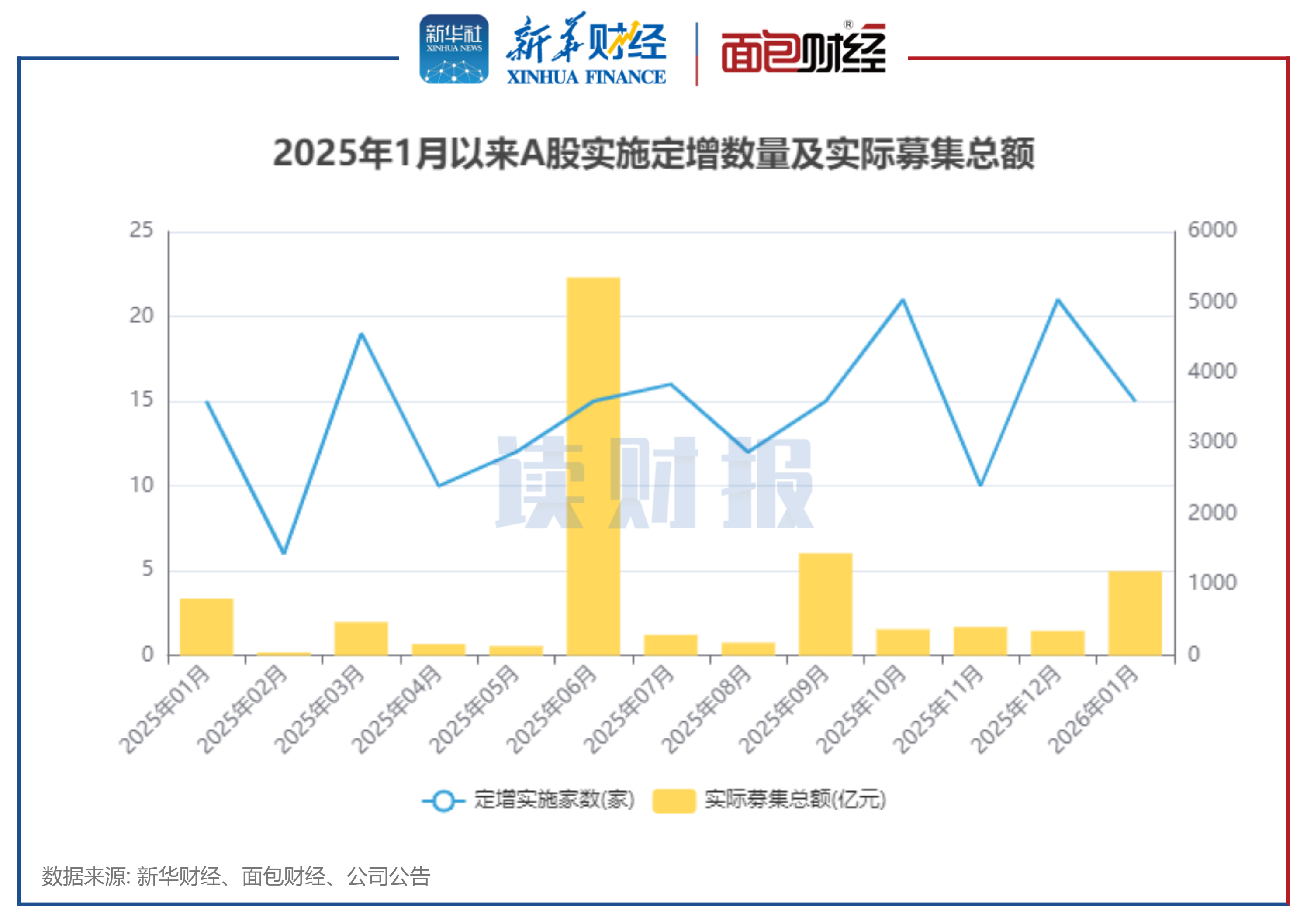
Summary of Key Points Core Viewpoint - In January 2026, A-share listed companies in China executed 15 private placements, raising a total of approximately 119.4 billion yuan, which represents a year-on-year increase of 48% [2][6]. Group 1: Fundraising Activities - The actual fundraising amount in January 2026 was about 1194.03 billion yuan, showing a year-on-year increase of 48% and a month-on-month increase of 242% [2][6]. - Among the companies, Hongqiao Holdings raised the most, with a total of 635.18 billion yuan from issuing 11.895 billion shares at a price of 5.34 yuan per share [6][9]. - Electric Power Investment raised 402.85 billion yuan by issuing approximately 11.99 billion shares at a price of 3.36 yuan per share [6][9]. Group 2: Planned Fundraising - In January 2026, 48 private placement plans were disclosed by A-share listed companies, with a total planned fundraising amount of approximately 43.92 billion yuan, which is a year-on-year decrease of 51% but a month-on-month increase of 20% [10][12]. - The largest planned fundraising was by *ST Songfa, aiming to raise up to 7 billion yuan for various projects related to shipbuilding [12][13]. - Tongfu Microelectronics planned to raise up to 4.4 billion yuan for enhancing production capacity in semiconductor packaging [12][13]. Group 3: Industry Distribution - The materials and industrial sectors each had 5 private placements, with the materials sector raising a total of approximately 673.85 billion yuan, the highest among all sectors [9][10]. - The industrial sector led in the number of planned placements with 16, followed by the information technology sector with 13, and the consumer discretionary sector with 7 [18].


智商比不过机器人,人类怎么办?三名行业记者这样说丨两会碰碰头
Xin Lang Cai Jing· 2026-02-02 15:55
Core Viewpoint - The discussion emphasizes the evolving relationship between humans and artificial intelligence (AI), suggesting that AI should be seen as a collaborator rather than a replacement, enhancing human capabilities and redefining various industries [1][3][6]. Group 1: AI and Human Collaboration - Xu Ke, a prominent figure in the tech industry, predicts that AI, represented by humanoid robots, will surpass human intelligence and capabilities, urging humans to evolve alongside AI [1]. - The conversation highlights that while AI can perform tasks more efficiently, it still requires human direction, positioning AI as a sophisticated tool rather than a direct substitute for human labor [3][4]. - Various sectors, including construction and healthcare, are already integrating AI to enhance safety and efficiency, indicating a trend towards using AI for high-risk or labor-intensive tasks [3][4]. Group 2: Expanding Human Potential - The integration of AI into everyday life is expected to redefine living conditions, making processes faster, cheaper, and more personalized, particularly in construction [5]. - AI is seen as a collaborator that can extend human capabilities across multiple fields, including education, healthcare, and elder care, aiming for a more intelligent and equitable society [5][6]. - The ongoing dialogue emphasizes the need for humans to maintain their unique qualities, such as curiosity and creativity, to thrive in a future where AI plays a significant role [6].

航宇科技(688239):中标中国航发动力股份有限公司采购项目,中标金额为326.59万元
Xin Lang Cai Jing· 2026-02-02 12:33
同壁财经讯,企查查数据显示,根据《【物资】锻件中标结果公告》,贵州航宇科技发展股份有限公司 于2026年2月2日公告中标中国航发动力股份有限公司采购项目,中标金额为326.59万元。 航宇科技(688239.SH)2024年营业收入为18.05亿元,营业收入增长率为-14.19%,归属母公司净利润 为1.89亿元,归属母公司净利润增长率为1.63%,净资产收益率为10.82%。 航宇科技(688239.SH)2024年营业收入为18.05亿元,营业收入增长率为-14.19%,归属母公司净利润 为1.89亿元,归属母公司净利润增长率为1.63%,净资产收益率为10.82%。 2025年上半年公司营业收入为9.14亿元,营业收入增长率为-8.71%,归属母公司净利润为0.90亿元,归 属母公司净利润增长率为-12.76%。 2025年上半年公司营业收入为9.14亿元,营业收入增长率为-8.71%,归属母公司净利润为0.90亿元,归 属母公司净利润增长率为-12.76%。 目前公司属于工业行业,主要产品类型为航空零部件,2024年报主营构成为航空锻件:75.55%;燃气轮机 锻件:11.11%;其他业务:6.55% ...

