管理咨询

Search documents
CRA International (NasdaqGS:CRAI) Conference Transcript
2025-09-17 15:02
Summary of CRA International Conference Call - September 17, 2025 Company Overview - CRA International (NasdaqGS: CRAI) is celebrating its 60th anniversary in 2025, founded in 1965 by professors from Harvard and MIT to provide academic quality research to the business world [1][2] - The company operates primarily in two segments: legal and regulatory (approximately 80% of revenue) and management consulting (approximately 20% of revenue) [2][5] - CRA has over 20 offices in 10 countries, with 80% of revenue coming from North America and 20% from international markets [3] Financial Performance - CRA has experienced consistent revenue growth of approximately 8% to 10% annually over the last 15 years [6] - Profitability has grown at an even faster rate, with no debt and operations fully financed through internal cash flow [7] - The company has returned nearly $200 million to shareholders over the past five years, reducing share count by 13% [13][14] - The average price of share repurchases over the last five years was $88, with current trading over $200, indicating strong intrinsic value [8] Shareholder Returns - CRA initiated a dividend in 2016, which has since tripled to $0.49 per share, contributing to an attractive shareholder yield of approximately 6% [15][16] - The company aims to maximize long-term value per share and has a history of effective capital redistribution [8][12] Market Position and Strategy - CRA has worked with 85 of the Fortune 100 companies and 98 of the top 100 law firms in the past two years, indicating strong client retention and repeat business [5][6] - The firm focuses on high-value services and has not expanded into subscription-based revenue models, believing that quality service provides resilience against economic shocks [21][22] - CRA differentiates itself from larger global firms and specialized boutiques by maintaining a focus on its core competencies at the intersection of economics and regulation [27][29] Industry Dynamics - The regulatory environment remains complex, creating opportunities for CRA to assist clients in navigating these challenges [19] - The company anticipates a potential increase in M&A activity as capital becomes cheaper, although there are other complicating factors in executing large deals [30][31] Key Challenges and Opportunities - CRA is adapting to changing client needs and expanding service depth while maintaining its core focus [19][21] - The firm has not experienced direct impacts from regulatory inquiries but is aware of potential budget reductions from regulatory bodies [24] - Pricing power remains strong, with annual price increases of 2% to 4% without significant pushback from clients [25][26] Conclusion - CRA International is well-positioned for continued growth, with a strong focus on quality service, effective capital management, and a commitment to shareholder returns, despite the complexities of the current regulatory and economic environment [17][31]

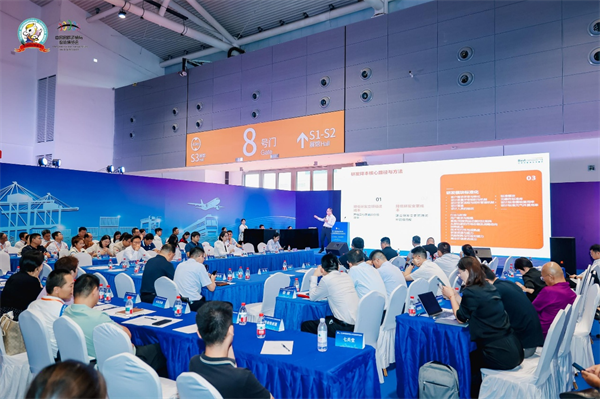
百思特副总裁于兴旺受邀出席第二十届中国国际物流节,共探企业降本增效新路径
Sou Hu Wang· 2025-09-12 03:13
Core Insights - The event highlighted the integration of advanced manufacturing and modern logistics, emphasizing the need for sustainable growth strategies in the current economic environment [1][3] - Companies are facing challenges such as shrinking profits and intense competition, necessitating a shift from external growth to internal excellence [3][10] Industry Challenges - The macroeconomic environment from 2023 to 2025 indicates a continuous decline in the Producer Price Index (PPI), putting pressure on industrial sectors [3] - Specific industries like apparel and automotive are experiencing significant profit margin declines, with the automotive sector seeking solutions to internal competition [3] Strategic Shifts - Companies must transition from seeking external growth to focusing on internal operational excellence as traditional growth models become unsustainable [3][10] - Cost reduction and efficiency improvement should be viewed as a strategic value reconfiguration rather than mere financial cutbacks [3][5] Systematic Approach to Cost Reduction - Many companies mistakenly treat cost reduction as a temporary task, focusing only on visible costs while neglecting hidden costs that significantly impact profitability [5] - A comprehensive approach to cost reduction should encompass organizational processes, digital transformation, and overall capability building [5][10] Practical Methodologies - Three core areas for effective cost reduction include: - **R&D Cost Reduction**: Streamlining product lines to focus on profitable models, as demonstrated by a case where a company improved profits by 50% by eliminating low-performing products [8] - **Procurement Cost Reduction**: Establishing cost models and supplier strategies to identify and eliminate inflated costs, leading to significant savings [8] - **Inventory Cost Reduction**: Optimizing inventory management to enhance cash flow and reduce risks, with a case showing a reduction in inventory turnover days from 22 to 17 [8] Conclusion - In the current volatile environment, companies must adopt long-term strategies for cost reduction and efficiency improvement, building comprehensive operational capabilities [10] - The consulting firm has extensive experience in providing end-to-end solutions for cost reduction and efficiency improvement across various industries [10]

【视频】2025科尔尼全球校友活动周盛大启幕——开放共飨六大线上论坛
科尔尼管理咨询· 2025-09-12 02:12
Group 1 - The seventh Kearney Global Alumni Week will take place from September 15 to 19, with the theme "Shared chapter. Diverse stories. Lifelong impact." inviting Kearney colleagues and alumni worldwide to reflect on their shared journey and diverse growth trajectories [1] - The event will feature global connectivity through virtual dialogues and local in-depth social experiences, along with industry roundtable discussions and expert insights on future trends [1] Group 2 - The forum will address the long-standing underinvestment and limited social attention in women's health, emphasizing the need for equitable health systems and actionable insights from Kearney's "[w]Health" global initiative [3] - Key discussions will focus on how to build an inclusive and effective health ecosystem by leveraging consumer insights, cross-sector collaboration, and measurable change [3] Group 3 - The opening forum will explore four key forces reshaping the global business order, including geopolitical restructuring, regional economic growth disparities, technological revolutions, and the evolving boundaries between government and enterprises [8] - Kearney's global CEO and the chairman of the global business policy committee will provide a framework for understanding macro changes and decision-making for industry leaders [8] Group 4 - A forum will be dedicated to generative AI, addressing the challenges companies face in moving from pilot projects to scalable applications, and providing a clear action framework for decision-makers [12] - The discussion will include identifying high-value applications, designing adaptable technology architectures, and reshaping team capabilities [12] Group 5 - The impact of AI on employee mental health and organizational performance will be a focal point, highlighting how AI can provide predictive and personalized interventions to support employee well-being [17] - The forum will showcase how to translate "human-centered care" into measurable business impacts, leading to lower healthcare costs and higher engagement [17] Group 6 - The role of corporate government affairs in the "Trump 2.0 era" will be examined, emphasizing the need for traditional functions to evolve into core strategic roles amid unprecedented government intervention in business [21] - The forum will discuss how leading companies can turn policy insights into competitive advantages and navigate regulatory uncertainties [21] Group 7 - A forum will focus on building an AI ecosystem that integrates diverse innovation networks, including technology partners, startups, academic institutions, and customer groups [26] - The discussion will cover how to select strategic partners, design win-win mechanisms, and seamlessly integrate external innovations with internal business scenarios [26]

众多企业持续加码布局,陆家嘴迈向全球最佳投资目的地
Sou Hu Cai Jing· 2025-09-11 09:35
Group 1 - Dassault Systèmes has established a strong presence in China over the past 20 years, with business growth exceeding 22 times and a customer base surpassing 60,000 [1] - The newly opened 3DEXPERIENCE Lab in Lujiazui focuses on advanced manufacturing, new materials, and life sciences, aiming to create a collaborative innovation ecosystem [2] - Lujiazui has seen significant foreign investment growth, with 156 new foreign contract projects and a 44.18% increase in actual foreign investment amounting to $633 million in the first seven months of this year [1][2] Group 2 - ABeam Consulting, also established in 1981, has expanded its presence in China, with over 1,100 employees in the Greater China region and a new regional headquarters in Lujiazui [2][3] - Lujiazui contributes nearly 14% of the city's economic output and 40% of the district's, despite only occupying 0.5% of the city's area [3] - The area has become a global investment destination due to its complete market system, open innovation environment, and professional government services [3][4] Group 3 - Lujiazui has achieved several "national firsts" in financial services, including the first wholly foreign-owned public fund and the first foreign-owned securities firm in China [4] - Future plans for Lujiazui include enhancing the international, market-oriented, and legal business environment to better serve foreign enterprises [4] - The area aims to attract high-level international financial organizations and promote investment from countries involved in the Belt and Road Initiative [4]

陆家嘴:“一体四翼”协同发展
Jin Rong Shi Bao· 2025-09-11 02:07
Group 1: Overview of Lujiazui - Lujiazui is a national-level development zone in China, recognized as a financial core area alongside London, New York, and Hong Kong, with a blend of modern prosperity and innovation [1] - The area covers 31.78 square kilometers, housing 285 commercial buildings and over 47,000 enterprises, contributing nearly 14% of the city's economic output and 40% of the district's total [2] - Lujiazui is the most internationally integrated central business district (CBD) in China, hosting 70% of the country's foreign asset management institutions and 55% of foreign-owned public funds [2] Group 2: Economic Contributions and Growth - In the first seven months of the year, Lujiazui attracted 156 new foreign investment projects totaling $9.23 million, marking a 14.37% year-on-year increase, with actual foreign investment reaching $6.33 million, up 44.18% [3] - The area has developed a diversified industrial layout, with financial services as the core supported by information, business, professional, and shipping services [3] Group 3: Foreign Enterprises' Experience - Many foreign enterprises have experienced significant growth in Lujiazui, with Dassault Systemes reporting a 22-fold increase in business over 20 years and the opening of China's first open innovation laboratory [4] - The conducive business environment in Lujiazui, characterized by high efficiency and supportive policies, has fostered confidence among foreign companies to deepen their engagement in the Chinese market [4][5] - The establishment of joint venture law firms has enhanced cross-border legal services, benefiting both foreign and domestic enterprises [5]
活力中国调研行 | 何以陆家嘴
Jin Rong Shi Bao· 2025-09-11 01:21
这里是与伦敦金融城、纽约曼哈顿、香港中环齐名的国际化金融核心区,也是中国唯一以"金融贸 易"命名的国家级开发区——陆家嘴。近日,《金融时报》记者跟随"活力中国调研行"上海采访团来到 了这片充满现代繁华与创新色彩的土地。在这里,历史与现实交织,未来与愿景共生。 何以陆家嘴 用"寸土寸金"来形容陆家嘴并不为过,31.78平方公里的陆家嘴,矗立着285栋商务楼宇,集聚了4.7 万余家企业,经济总量超6000亿元。"陆家嘴以全市0.5%、全区2.6%面积,贡献了全市近14%、全区近 40%的经济总量。"只用几个数据,陆家嘴管理局副局长周海东便将陆家嘴的含金量展现无遗。 何以陆家嘴?国家战略、时代选择,将开放与创新深植于这片土地的血脉中。作为中国改革开放的 重要窗口,陆家嘴的国际化始于规划之初。 "陆家嘴是一个博采众长、经国际方案优化而成的城区。"周海东告诉记者,关于如何建设陆家嘴, 中国、意大利、英国、日本、法国各给出了一个方案,经提炼优化后最终形成一份,而陆家嘴也是依据 这份方案建设至今。 如今的陆家嘴已是国内国际化程度综合水平最高的中央商务区(CBD)。数据显示,这里拥有全 国70%的外资资管机构、55%的外资独 ...

上海美国商会报告:贸易战并未触发大量美企回流美国
Di Yi Cai Jing· 2025-09-11 00:40
Group 1 - The report indicates that 71% of surveyed companies expect to achieve profitability in 2024, an increase from 66% in 2023, with significant differences across industries: 80% in manufacturing, 69% in retail, and 55% in services [1][2] - 48% of surveyed companies perceive the regulatory environment in China as transparent, a notable increase of 13 percentage points from the previous year [2] - 39% of surveyed U.S. companies believe they have benefited from government measures to promote consumption in China, while 37% see positive effects from market opening initiatives [2] Group 2 - Nearly half (48%) of surveyed companies call for the U.S. government to eliminate all tariffs on Chinese goods, with 64% expecting revenue declines due to the tariff war [4][5] - 69% of surveyed companies anticipate negative impacts on their operations if the U.S. were to revoke China's permanent normal trade relations status, with manufacturing being the most affected sector at 78% [5] - The report highlights that only 18% of companies considered relocating investments to the U.S., indicating that the trade war has not significantly triggered a return of U.S. companies [5]
大千生态成立灵宠家管理咨询公司,注册资本1亿元
Zheng Quan Shi Bao Wang· 2025-09-05 04:01
Core Insights - A new company named Hangzhou Lingchongjia Management Consulting Co., Ltd. has been established with a registered capital of 100 million yuan [1] - The legal representative of the company is Qiao Gao [1] - The business scope includes enterprise management consulting, corporate management, corporate image planning, socio-economic consulting services, and conference and exhibition services [1] Company Structure - The company is jointly held by Jiangsu Qianchongjia Technology Co., Ltd., a wholly-owned subsidiary of Daqian Ecology (603955), and Jiangsu Yuechong Investment Partnership (Limited Partnership) [1]

百思特供应链管理咨询案例:乳业千亿征途,供应链如何痛点转为增长支点?
Sou Hu Wang· 2025-08-29 10:10
Core Viewpoint - A leading domestic dairy company (referred to as Company A) is rapidly expanding with a target of reaching a 100 billion scale, but faces significant challenges in its supply chain management as it seeks to transform its supply chain from a traditional support function to a core strategic engine for market expansion and customer experience [1] Group 1: Supply Chain Pain Points - Company A's rapid growth has exposed contradictions between its existing supply chain system and strategic goals, including weak management foundations, insufficient standardized management systems, and inadequate information support [2] - Core capabilities in planning and procurement have not been upgraded in line with rapid expansion, failing to meet the demands for precision, speed, and value creation [3] - The end-to-end customer experience requires optimization due to the increasing diversity and personalization of customer demands, necessitating improvements in order management and delivery service agility and transparency [3] Group 2: Customized Supply Chain Solutions - Best Consulting Company has developed a phased, systematic supply chain capability enhancement blueprint for Company A, focusing on a "1+6+3" strategic framework that includes one control model, six core business areas, and three supporting elements [4] - The "three-in-one" control model aims to clarify responsibilities across supply chain segments, establish an efficient collaborative organizational structure, and standardize core business processes to lay the groundwork for future IT and data governance [5][6] Group 3: Key Business Capability Breakthroughs - The establishment of a Sales and Operations Planning (S&OP) mechanism has significantly improved resource planning and cross-departmental collaboration [7] - Procurement strategies have been redefined to align more closely with the overall company strategy, optimizing category management and enhancing supplier lifecycle management [9][10][11] Group 4: Talent and Digital Foundation Enhancement - A talent development framework has been established to support the strategic and business needs, enhancing the capabilities of the supply chain planning team [12] - The standardization of business processes serves as a prerequisite for the IT transformation and data quality improvement necessary for Company A's digital transformation strategy [12] Group 5: Project Outcomes - The transformation project led by Best Consulting Company has significantly enhanced Company A's supply chain capabilities, laying a crucial foundation for achieving its strategic goal of 100 billion [13] - The establishment of the S&OP mechanism and optimized planning strategies have greatly improved resource coordination and planning effectiveness [14] - Procurement strategy reformation and detailed supplier management have effectively supported cost reduction and resource assurance [15] - The optimization of end-to-end order management has directly improved customer satisfaction and service levels [17][18] - Clear qualification standards and career pathways for talent have stimulated self-improvement among planning personnel, enhancing organizational performance [19][20] - The comprehensive standardization of business processes has accelerated the digital transformation, solidifying the foundation for IT and data quality improvements [20]
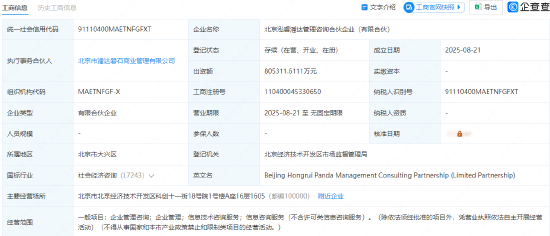
万达、京东合资成立北京泓睿潘达管理咨询企业 出资额高达80亿元
Xin Lang Ke Ji· 2025-08-25 03:33
Group 1 - Wanda and JD have jointly invested 8.053 billion yuan to establish Beijing Hongrui Panda Management Consulting Partnership, aiming to expand their management consulting and related services business [1] - The partnership is backed by companies under Wanda and JD, indicating a strategic collaboration [1] - The business scope includes enterprise management and information technology consulting [1] Group 2 - The partnership is registered in Beijing Daxing District and has a business license valid until August 21, 2025 [2] - The registered capital of the partnership is approximately 805.32 million yuan [2] - The partnership's activities are limited to those not prohibited by national policies [2]