
高端装备

Search documents
“内陆腹地”如何变“开放高地”?湖北省政协委员建言:“枢纽经济”或成“破题之钥”
Zhong Guo Jing Ying Bao· 2026-01-29 15:30
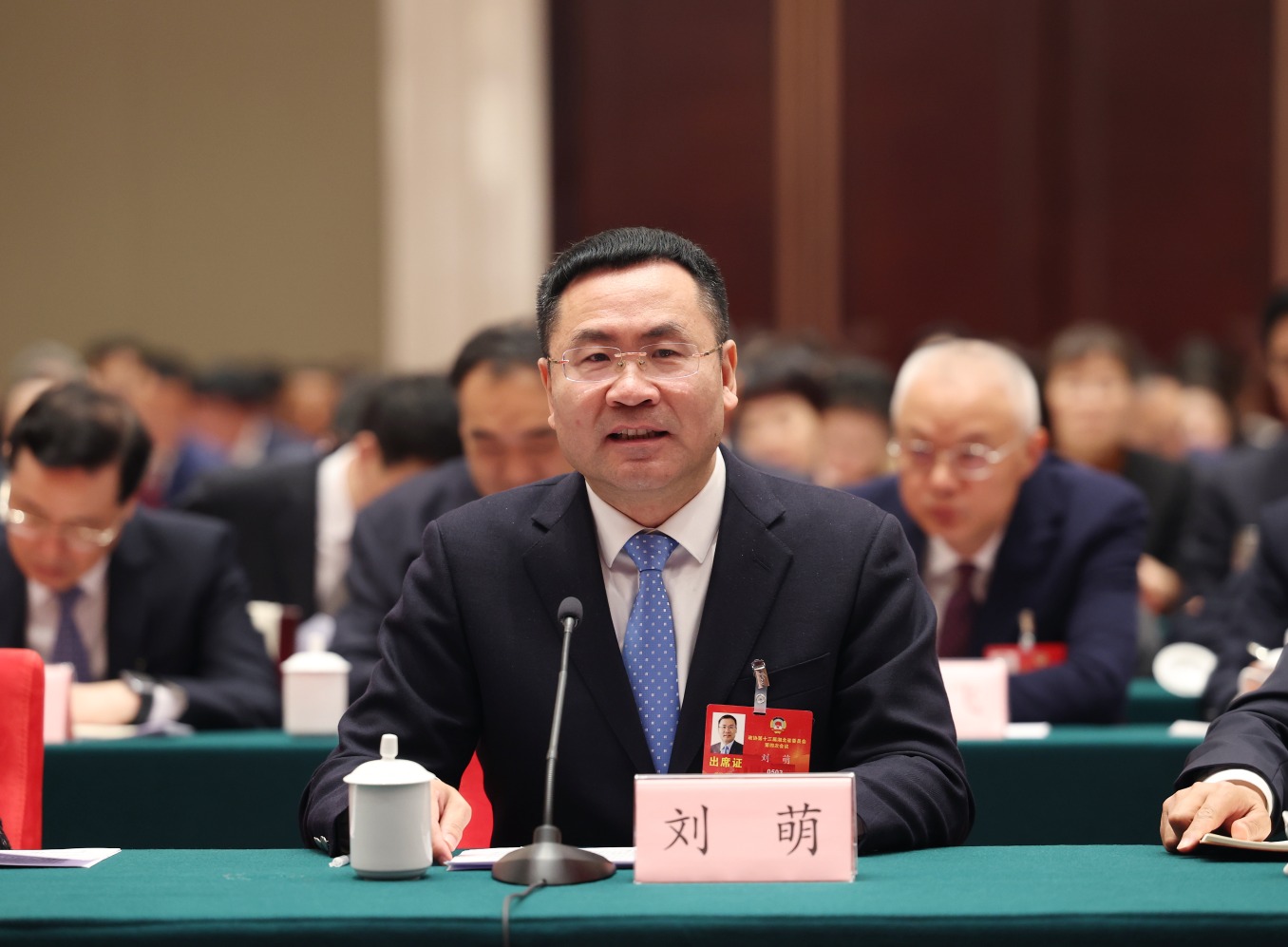
在刘萌看来,湖北省在扩大对外开放、发展开放型经济取得一系列成绩的同时,还客观存在一些短板:一是传统产业占比较高,高端制造与服务贸易竞争力 不够强;二是要素集聚不足,高端人才、核心技术、国际资本集聚能力与沿海相比存在一定差距,制度型开放对标国际高标准仍显不足;三是通道与平台效 能有待提升,铁水公空多式联运"最后一公里"还不够畅通,自贸区、综保区等平台辐射带动力还不够强,通关与物流成本偏高;四是区域竞争压力加剧,内 外贸融合与双向投资活力有待激活。 中经记者张家振武汉报道 素有"九省通衢"之称的湖北省,在串联国内交通和消费市场的同时,如何坚持对内对外开放并重、打造内陆开放高地,把"九省通衢"的区位优势转化为"九 州通衢"的发展优势? 湖北省"十五五"规划建议提出:"坚持对内对外开放并重,深入实施枢纽提能战略,重构开放通道,重塑物流体系,壮大开放型经济规模,推进高标准制度 型开放,做强内循环、做优外循环、畅通双循环,以开放促改革促发展,在更广范围内拓展发展空间、集聚发展要素。" 在2026年湖北"两会"期间,如何更好扩大高水平对外开放,打造内陆开放高地,也成为湖北代表、委员热议的话题。1月29日,湖北省政协委员刘萌 ...

联储证券研究院2026年宏观经济形势展望:2026年GDP增速目标或仍维持5%左右,货币政策将继续保持适度宽松
Jin Rong Jie· 2026-01-29 07:43
Economic Growth and Targets - China's GDP growth target for 2026 is likely to remain around 5%, balancing short-term stability and long-term structural transformation [2][3] - The economic growth in 2025 is expected to achieve a target of 5%, with a quarterly growth rate of approximately 4.6% in Q4, indicating a "high first, low second" trend throughout the year [3] Consumption and Investment Trends - Consumption is expected to see a slight recovery in 2026, but growth will be limited due to policy, income, and balance sheet constraints, with a focus on structural upgrades in service consumption and new consumption scenarios [5][6] - Investment growth is projected to stabilize in 2026, driven by infrastructure and manufacturing sectors, with a notable shift towards new infrastructure projects such as 5G and AI [6][7] Export Performance - China's exports are anticipated to maintain resilience, with a projected growth rate of around 5% for the year, supported by market diversification and product structure upgrades [8][9] Price Trends - CPI is expected to rise moderately in 2026, driven by service price increases, while PPI is projected to see a narrowing of its decline due to rising prices in emerging industries and resource products [10] Monetary and Fiscal Policies - Monetary policy will continue to be moderately accommodative, focusing on precise measures to support the real economy and maintain liquidity [11][12] - Fiscal policy is set to remain actively expansive, with an emphasis on social welfare and debt management, alongside a significant increase in the deficit to support major projects [13][14] Overall Economic Outlook - The Chinese economy is in a phase of moderate recovery and structural adjustment, with new growth drivers such as technological innovation and manufacturing upgrades laying the foundation for long-term growth [15]
A股开年297单并购,跨界扎堆半导体
2 1 Shi Ji Jing Ji Bao Dao· 2026-01-29 00:26
Core Viewpoint - The A-share merger and acquisition (M&A) market remains active in early 2026, with over 297 disclosed M&A cases, including 12 major asset restructurings, highlighting a focus on strategic emerging industries like semiconductors and artificial intelligence [1] Group 1: M&A Activity - In January 2026, several companies, including Yingxin Development, Kangxin New Materials, and Dinglong Co., announced cross-industry M&A plans, particularly traditional manufacturing firms transitioning towards semiconductors and high-end equipment [1] - Notably, four out of eight disclosed cross-industry M&A cases involved semiconductor assets [5] - Companies like Kangxin New Materials and Mingyang Smart Energy are pursuing acquisitions to enhance their capabilities in the semiconductor sector, with Kangxin planning to acquire a 51% stake in Wuxi Yubang Semiconductor Technology for 392 million yuan [6][7] Group 2: Regulatory Scrutiny - Regulatory bodies have heightened scrutiny over cross-industry M&A transactions, focusing on the authenticity of disclosures and the reasonableness of valuations, as seen with inquiries sent to companies like Kangxin New Materials and Windfan Co. [1][10] - The Shanghai Stock Exchange has raised concerns regarding the feasibility of performance commitments made by companies, such as Kangxin's promise of significant profit growth for the acquired company, which exceeds historical performance [11][12] - The regulatory stance indicates a willingness to support beneficial cross-industry mergers while strictly monitoring those that appear speculative or high-risk [2][14] Group 3: Industry Trends and Challenges - Traditional enterprises facing stagnant core business performance are increasingly seeking cross-industry M&A as a means to rejuvenate growth and avoid potential delisting, which could lead to a "zombie" status [8] - Many of the companies engaging in cross-industry M&A have reported declining profits, with firms like Yanjiang Co. and Han Jian Heshan projecting losses in the coming years [7][8] - The trend of cross-industry M&A is seen as a necessary step for companies to enhance their operational quality and adapt to changing market conditions, despite the associated regulatory challenges [8][14]
A股开年297单并购,跨界扎堆半导体
21世纪经济报道· 2026-01-29 00:12
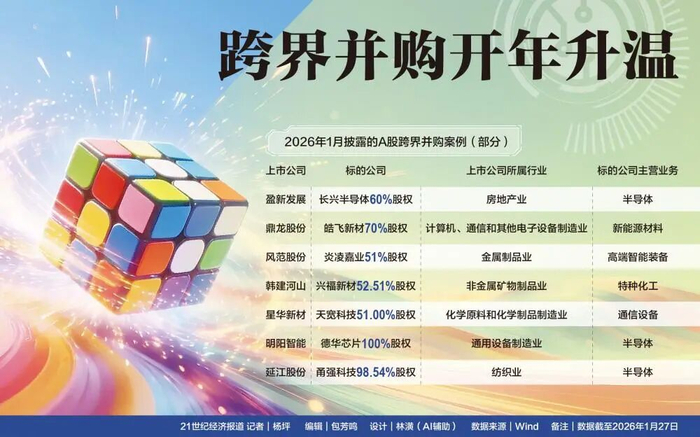
Core Viewpoint - The A-share merger and acquisition (M&A) market remains active in early 2026, with over 297 disclosed M&A cases, including 12 major asset restructurings, particularly in strategic emerging industries like semiconductors and artificial intelligence [1][6]. Group 1: M&A Activity - In January 2026, several companies, including Yingxin Development, Kangxin New Materials, and Dinglong Co., announced cross-industry M&A plans, with many traditional manufacturing firms transitioning towards semiconductors and high-end equipment [1][3]. - Notable cross-industry M&A cases include: - Yingxin Development acquiring 60% of Changxing Semiconductor for 520 million yuan [8]. - Kangxin New Materials planning to acquire 51% of Wuxi Yubang Semiconductor for 392 million yuan [8]. - Mingyang Smart Energy's acquisition of 100% of Dehua Chip Technology [8]. Group 2: Regulatory Scrutiny - Several cross-industry M&A cases have attracted regulatory attention due to concerns over the authenticity of disclosures and valuation rationality, with companies like Kangxin New Materials and Fengfan Co. receiving inquiry letters from regulators [2][12]. - The regulatory stance is supportive of cross-industry M&A that enhances company quality but is strict against speculative and high-risk transactions [2][15]. Group 3: Financial Performance and Challenges - Many companies engaging in cross-industry M&A face challenges in their core business performance, with some reporting continuous losses: - Yanjiang Co. has struggled with net profits below 30 million yuan [9]. - Kangjian Heshan is projected to incur a net loss of 8 to 12 million yuan in 2025 [9]. - Fengfan Co. anticipates a net loss of 320 to 380 million yuan in 2025 [9]. Group 4: Market Dynamics - The recent regulatory framework encourages compliant companies to pursue cross-industry M&A for industrial transformation and growth, reviving interest in cross-industry deals that had previously declined [5][6]. - The market is witnessing a surge in cross-industry M&A cases, with at least eight disclosed in early 2026, four of which involve semiconductor assets [7].

跨界并购开年升温
2 1 Shi Ji Jing Ji Bao Dao· 2026-01-28 23:12
Core Viewpoint - The A-share merger and acquisition (M&A) market remains active in early 2026, with over 297 disclosed M&A transactions, including 12 major asset restructurings, highlighting a focus on strategic emerging industries like semiconductors and artificial intelligence [1] Group 1: M&A Activity - In January 2026, several companies, including Yingxin Development, Kangxin New Materials, and Dinglong Co., announced plans for cross-industry mergers, particularly transitioning from traditional manufacturing to sectors like semiconductors and high-end equipment [1] - Notably, there have been at least eight disclosed cross-industry M&A cases this year, with four involving semiconductor assets [4] - Companies like Kangxin New Materials and Mingyang Smart Energy are actively pursuing acquisitions in the semiconductor sector, indicating a trend of traditional firms seeking new growth avenues through M&A [5][6] Group 2: Regulatory Scrutiny - Regulatory bodies have heightened scrutiny over cross-industry mergers, focusing on the authenticity of disclosures and the reasonableness of valuations, particularly for transactions that appear speculative or high-risk [1][7] - The Shanghai Stock Exchange has issued inquiries regarding the feasibility of performance commitments and the rationale behind significant valuation increases in recent M&A proposals [8][9] - Cases such as Kangxin New Materials' acquisition of Wuxi Yubang Semiconductor have drawn immediate regulatory attention due to concerns over inflated performance promises compared to historical performance [8][10] Group 3: Market Dynamics - The recent regulatory framework encourages well-structured cross-industry mergers that align with business logic and support industry transformation, aiming to revitalize previously stagnant cross-industry M&A activities [3] - Traditional companies facing stagnant core business performance are increasingly turning to cross-industry M&A as a means to rejuvenate growth and avoid potential delisting, despite the inherent risks involved [6][11] - The market is witnessing a shift where companies with weak main business operations are seeking new development momentum through strategic acquisitions, which could enhance the overall quality of listed companies [6]
山东加速济青都市圈联动:推进100个标志性工程 建10个产业协同园区
Jing Ji Guan Cha Wang· 2026-01-28 14:24
Core Viewpoint - The Shandong provincial government is accelerating the integration of urban clusters and the coordinated development of the Jinan and Qingdao metropolitan areas, with plans to implement 100 landmark projects by 2026 to enhance connectivity and industrial collaboration [1][3][6]. Urban Cluster Integration - The Jinan metropolitan area includes Jinan and five other cities, covering 22,300 square kilometers with a population of approximately 18.1 million, while the Qingdao metropolitan area encompasses Qingdao and four other cities, covering 21,500 square kilometers with around 15.6 million residents [3]. - Historically, these two metropolitan areas have developed separately, often competing for resources, but recent national policies promoting a unified market are driving a shift towards closer economic ties [3][4]. - The integration aims to create a commuting circle of one hour within the metropolitan area and 1.5 hours between the two, supported by significant infrastructure improvements [4][5]. Infrastructure Development - Recent advancements in transportation infrastructure, such as the operationalization of the Jinan-Qingdao high-speed rail and other key projects, are facilitating the integration of these metropolitan areas [4][5]. - From 2018 to 2024, the combined GDP of the Jinan and Qingdao metropolitan areas increased from 38.8% to 42.1% of Shandong's total GDP, indicating their growing importance in the province's economic landscape [4]. Industrial Collaboration - The Shandong government emphasizes the need for coordinated industrial development between the two metropolitan areas, with plans to establish ten collaborative industrial parks and a clear industrial development roadmap [6][8]. - Successful examples of industrial collaboration include the relocation of Jinan Steel Group to the Qingdao metropolitan area, which has led to the development of high-end equipment and new materials industries [7][8]. - The government aims to create a win-win situation through shared planning, platform sharing, and integration of industrial chains, positioning the Jinan and Qingdao metropolitan areas as a significant economic growth engine for the region [9].
山东加速济青都市圈联动:推进100个标志性工程 建10个产业协同园区|聚焦2026山东两会
Jing Ji Guan Cha Wang· 2026-01-28 14:03
Core Insights - The Shandong provincial government is accelerating the integration of urban clusters and the coordinated development of the Jinan and Qingdao metropolitan areas, with plans to implement 100 landmark projects by 2026 [2][9] - The Jinan metropolitan area covers 22,300 square kilometers with a population of approximately 18.1 million, while the Qingdao metropolitan area spans 21,500 square kilometers with around 15.6 million residents [4] - The integration of these metropolitan areas is driven by national policies aimed at creating a unified market and enhancing regional economic connections [4][6] Urban Cluster Integration - The Jinan and Qingdao metropolitan areas were approved for construction during the 14th Five-Year Plan period, marking a shift from isolated development to collaborative growth [3][4] - The government emphasizes the importance of urban clusters as a driver for regional coordinated development, with Shandong being the only northern province with two national-level metropolitan areas [6] Infrastructure Development - Significant progress has been made in transportation infrastructure, including the "bus-like" operation of the Jinan-Qingdao high-speed railway, facilitating a one-hour commute within the metropolitan area and 1.5 hours between the two [5][9] - The completion of key projects like the Weifang-Yantai high-speed railway and various highway upgrades supports the connectivity needed for metropolitan integration [5] Economic Impact - From 2018 to 2024, the combined GDP of the Jinan and Qingdao metropolitan areas increased from 38.8% to 42.1% of Shandong's total GDP, with their population share rising from 32.0% to 33.7% [5] - The provincial government aims to enhance policy coordination and deepen collaborative efforts to strengthen the competitive position of the Shandong Peninsula urban cluster [6][7] Industrial Collaboration - The integration of industries between Jinan and Qingdao is crucial, with a focus on creating a collaborative industrial development plan and identifying resource advantages [8][9] - The establishment of joint industrial parks and landmark projects is essential for fostering inter-city investment and ensuring mutual benefits through shared revenue mechanisms [9][10]

A股跨界并购扎堆半导体,监管紧盯并购真实性
2 1 Shi Ji Jing Ji Bao Dao· 2026-01-28 12:15
Core Viewpoint - The A-share merger and acquisition (M&A) market remains active in early 2026, with over 297 disclosed M&A cases, including 12 major asset restructurings, highlighting a focus on strategic emerging industries like semiconductors and artificial intelligence [1] Group 1: M&A Activity - In January 2026, several companies, including Yingxin Development, Kangxin New Materials, and Mingyang Smart Energy, planned cross-industry mergers, particularly transitioning from traditional manufacturing to sectors like semiconductors and high-end equipment [1][4] - Notably, four out of eight disclosed cross-industry M&A cases involved semiconductor assets, indicating a strong interest in this sector [4] - Companies like Yingxin Development and Kangxin New Materials are pursuing acquisitions to enhance their business capabilities amid challenges in their core operations [6][7] Group 2: Regulatory Scrutiny - Regulatory bodies have heightened scrutiny over cross-industry mergers, focusing on the authenticity of disclosures and the reasonableness of valuations, particularly for cases involving Kangxin New Materials and others [2][8] - The Shanghai Stock Exchange issued inquiries regarding the feasibility of performance commitments and the rationale behind significant valuation increases in recent M&A cases [9][10] - There is a clear distinction in regulatory attitudes, supporting beneficial cross-industry mergers while strictly monitoring those perceived as speculative or high-risk [2][8] Group 3: Financial Performance and Challenges - Many companies engaging in cross-industry M&A have faced declining core business performance, with some reporting net profits below 30 million yuan in recent years [6][7] - For instance, Kangxin New Materials and Windfan Co. are expected to incur losses in 2025, raising concerns about the sustainability of their M&A strategies [6][10] - The need for traditional companies to pursue cross-industry mergers is driven by the risk of stagnation or "zombie" status if they fail to adapt and innovate [7]
打造四个万亿级新兴支柱产业
Qi Lu Wan Bao· 2026-01-28 11:05
Group 1 - The core focus is on cultivating and expanding emerging and future industries in Shandong, with a target to develop four trillion-level emerging pillar industries and four hundred billion-level potential industries by 2026 [1] - By 2025, Shandong aims to adjust its industrial structure as a key driver for transformation, promoting intelligent, green, and integrated industrial development, with advanced capacity in key industries exceeding 40% [1] - The province plans to establish eight new provincial-level strategic emerging industry clusters, increasing the total number of such clusters to 50, with a total scale exceeding 3.6 trillion yuan, and a growth rate of 7.1% in high-tech manufacturing value added [1] Group 2 - Shandong is seizing the opportunity of artificial intelligence development by implementing a three-year action plan and a high-quality development promotion scheme, with a provincial fund of 1 billion yuan and a 2 billion yuan industry fund to support initiatives [2] - The province aims to have 1,124 core artificial intelligence enterprises by 2025, with core industry revenue surpassing 120 billion yuan, accounting for approximately 10% of the national total [2] - Digital economy is projected to account for over 50% of Shandong's economy, significantly contributing to the province's economic growth [2]
以资本、生态和校友“三驾马车”驱动湖北新质生产力跃升
Zhong Guo Fa Zhan Wang· 2026-01-28 06:01
Core Viewpoint - The article emphasizes the strategic importance of Hubei Province during the "14th Five-Year Plan" period, highlighting the need for a shift in investment strategies from project-based to ecosystem-focused approaches to foster new productive forces and enhance industrial competitiveness [1][2]. Investment Strategy - Investment in Hubei should transition from "quick investments" to "precise investments," focusing on long-term and systematic approaches that link laboratories, industry chains, and application scenarios [1]. - Key areas for investment include foundational research in hard technology, enhancing industrial chains, and early-stage incubation of future industries [1][2]. Capital Structure - A dual ecosystem of "patient capital + industrial capital" should be established to attract social capital to early-stage innovation projects, encouraging major enterprises to set up corporate venture capital (CVC) funds [2]. - Long-term capital should be introduced to support major technological infrastructure projects through specialized financial tools [2]. Post-Investment Services - A platform for "investment + empowerment" should be created, providing deep services such as technical iteration and market access to invested companies [2]. - The establishment of a "returning alumni" venture capital fund aims to attract local talent back to Hubei, enhancing the connection between talent and capital [2]. Global Business Ecosystem - The establishment of the Yangtze River International Chamber of Commerce serves as a global business ecosystem, facilitating connections between domestic and international resources [3][4]. - This platform plays a crucial role in reducing transaction costs and enhancing the resilience of domestic and international supply chains [4]. Alumni Economy - The "alumni economy" is identified as a strategic resource for Hubei, promoting the integration of talent, innovation, and industry [5][6]. - The province has initiated actions to develop the alumni economy, focusing on overcoming challenges such as resource fragmentation and incomplete service chains [6][7]. Talent Development - A "three-dimensional driving" model is proposed to convert top-tier academic resources into industrial advantages, emphasizing the need for a flexible talent circulation system and innovative institutional reforms [7][8]. - The establishment of a "new engineering education and industry integration base" aims to align talent supply with industry demand [10][12]. Technology and Innovation - The article suggests implementing a "launch empowerment" project to create a seamless connection between research, education, and industry [10]. - A focus on building a "virtual industrial cluster" platform is recommended to facilitate online connections and collaborative innovation across the supply chain [12].
