Futures

Search documents
太强了!金价、银价,再创历史新高!
Mei Ri Shang Bao· 2026-01-12 05:47
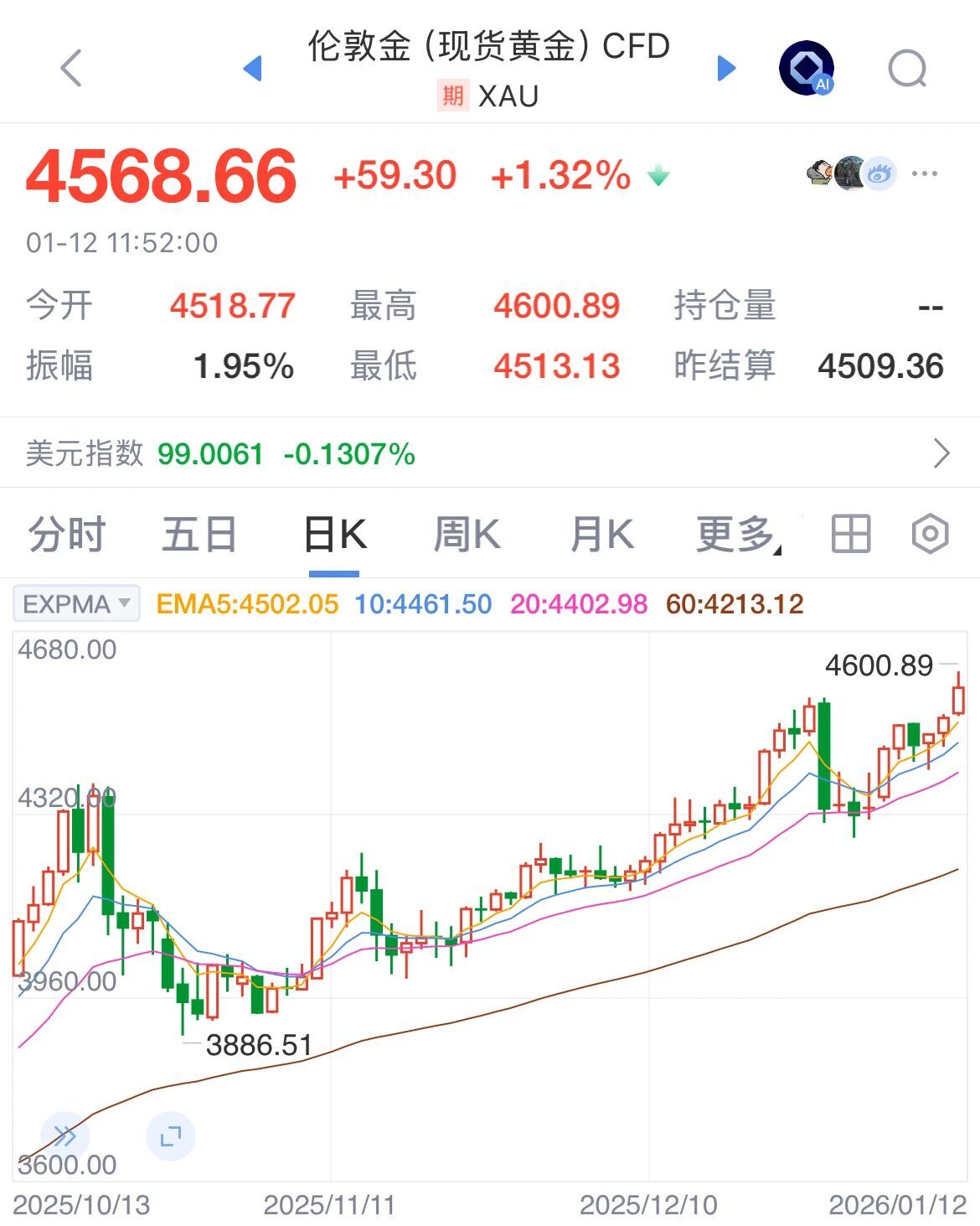
Core Viewpoint - The price of spot gold has surged, breaking historical records and reaching $4568.66 per ounce, reflecting strong demand driven by geopolitical risks and investment trends [1][3][8]. Group 1: Gold Market Performance - Spot gold prices have consistently increased, surpassing key thresholds of $4400, $4500, and $4550, with a recent peak at $4600 per ounce [3]. - The World Gold Council reports that gold has performed exceptionally well in 2025, with expectations of a further increase of 15% to 30% in 2026 [8]. - The recent surge in gold prices is attributed to rising geopolitical risks related to Iran and Venezuela, which have rekindled market demand for gold as a safe-haven asset [6][8]. Group 2: Silver Market Performance - Spot silver has also seen significant gains, with prices approaching $84 per ounce and a reported increase of 4.28% to $83.33 per ounce [4]. Group 3: Domestic Jewelry Prices - Domestic gold jewelry brands have raised their prices in response to the rising gold prices, with brands like Chow Tai Fook and Lao Feng Xiang increasing their gold prices to 1426 RMB and 1428 RMB per gram, respectively [6][7]. Group 4: Future Outlook - Analysts from Saxo Bank suggest that the strong performance of gold, silver, and platinum reflects a combination of geopolitical hedging, financial flows, and structural investment themes [6]. - Citic Securities predicts a high certainty of gold price increases, driven by expectations of dual monetary and fiscal easing in the U.S. and persistent stagflation pressures [9]. - The outlook for gold prices remains optimistic, with projections indicating that international gold prices could exceed $5100 per ounce by the end of 2026 under neutral assumptions [9].

机构看金市:1月12日
Sou Hu Cai Jing· 2026-01-12 03:25
Core Viewpoint - The recent U.S. non-farm payroll data presents a mixed picture, with a decline in unemployment and an increase in average hourly wages, but disappointing job growth, leading to a complex market reaction regarding interest rate expectations and supporting gold and silver prices amid geopolitical tensions [1][2][3]. Group 1: Non-Farm Payroll Data Analysis - The U.S. non-farm payroll data for December showed an increase of only 50,000 jobs, below the expected 60,000, while the unemployment rate fell to 4.4%, lower than the anticipated 4.5% [3]. - The total job growth for 2025 was only 584,000, marking the weakest annual growth since 2020, indicating a persistent weakness in the labor market [2][3]. - The downward revision of job data for October and November by a total of 76,000 further exacerbates concerns about the labor market's structural weaknesses [1][3]. Group 2: Market Reactions and Trends - Gold and silver prices have been rising due to the mixed non-farm data and ongoing geopolitical tensions, particularly in the Middle East, which has heightened market risk aversion [1][2]. - Central banks continue to increase their gold reserves, with a reported increase of 0.93 tons in December, indicating strong demand for precious metals [2]. - The upcoming release of the December CPI data is crucial, as a lower-than-expected core CPI could further support precious metal prices by reinforcing expectations of continued monetary easing [2][3]. Group 3: Geopolitical and Economic Factors - Geopolitical developments, particularly in Iran and the broader Middle East, are driving market sentiment and influencing the strong performance of precious metals [1][3]. - The expectation that the Federal Reserve may not need to tighten monetary policy further due to weak job growth and a declining unemployment rate is providing additional support for gold [4]. - The potential impact of the Supreme Court's decision regarding tariffs on precious metals could introduce short-term volatility, necessitating caution among investors [2].
永安期货大类资产早报-20260112
Yong An Qi Huo· 2026-01-12 02:37
1. Global Asset Market Performance - The latest yields of 10 - year government bonds in major economies: US 4.166, UK 4.374, France 3.522, Germany 2.862, Italy 3.494, Spain 3.247, Switzerland 0.265, Greece 3.351, Japan 2.090, Brazil 6.223, China 1.869, Australia 4.688, New Zealand 4.406 [1] - The latest yields of 2 - year government bonds in major economies: US 3.533, UK 3.638, Germany 2.105, Japan 1.143, Italy 2.205, China (1Y yield) 1.281, Australia 4.011 [1] - The latest exchange rates of the US dollar against major emerging - economy currencies: Brazil 5.366, South Africa zar 16.493, Korean won 1459.400, Thai baht 31.425, Malaysian ringgit 4.073; on - shore RMB 6.978, off - shore RMB 6.976, RMB mid - price 7.013, Dec NDF 6.856 [1] - The latest stock indices of major economies: S&P 500 6966.280, Dow Jones Industrial Average 49504.070, Nasdaq 23671.350, Mexican index 66062.620, UK index 10124.600, France CAC 8362.090, Germany DAX 25261.640, Spanish index 17649.000, Japanese Nikkei 51939.890, Hong Kong Hang Seng Index 26231.790, Shanghai Composite Index 4120.426, Taiwan index 30288.960, South Korean index 4586.320, Indian index 8936.754, Thai index 1254.090, Malaysian index 1686.540, Australian index 9045.917, emerging - economy index 1452.350 [1] - The latest credit - bond indices: Eurozone investment - grade credit - bond index 266.512, Eurozone high - yield credit - bond index 412.380 [1] 2. Stock Index Futures Trading Data Index Performance - Closing prices: A - shares 4120.43, CSI 300 4758.92, SSE 50 3134.32, ChiNext 3327.81, CSI 500 8056.69; percentage changes: A - shares 0.92%, CSI 300 0.45%, SSE 50 0.39%, ChiNext 0.77%, CSI 500 2.05% [2] Valuation - PE(TTM) values: CSI 300 14.41, SSE 50 12.01, CSI 500 36.43, S&P 500 27.82, Germany DAX 19.60;环比 changes: CSI 300 0.06, SSE 50 0.03, CSI 500 0.71, S&P 500 0.17, Germany DAX 0.10 [2] Risk Premium - 1/PE - 10 - year interest: S&P 500 - 0.57, Germany DAX 2.24;环比 changes: S&P 500 - 0.02, Germany DAX - 0.03 [2] Fund Flows - Latest values: A - shares 474.37, main board 104.84, ChiNext 266.81, CSI 300 112.68; 5 - day average values: A - shares 74.03, main board - 105.04, ChiNext 107.99, CSI 300 20.61 [2] 3. Transaction Amount and Other Data - Latest transaction amounts: Shanghai and Shenzhen stock markets 31226.95, CSI 300 6687.89, SSE 50 1777.40, small - and medium - sized board 6596.39, ChiNext 8720.72;环比 changes: Shanghai and Shenzhen stock markets 3224.30, CSI 300 381.33, SSE 50 - 101.56, small - and medium - sized board 696.82, ChiNext 1217.37 [3] - Main contract basis: IF - 15.12 (- 0.32%), IH 0.48 (0.02%), IC - 18.89 (- 0.23%) [3] 4. Treasury Futures Trading Data - Closing prices: T2303 107.77, TF2303 105.57, T2306 107.69, TF2306 105.57; percentage changes: T2303 - 0.02%, TF2303 - 0.03%, T2306 - 0.01%, TF2306 - 0.03% [3] 5. Fund Rates - Fund rates: R001 1.3480%, R007 1.5157%, SHIBOR - 3M 1.5950%; daily changes: R001 - 18.00BP, R007 - 1.00BP, SHIBOR - 3M 0.00BP [3]
上期所:调整白银期货交易规则
Huan Qiu Wang· 2026-01-10 23:52
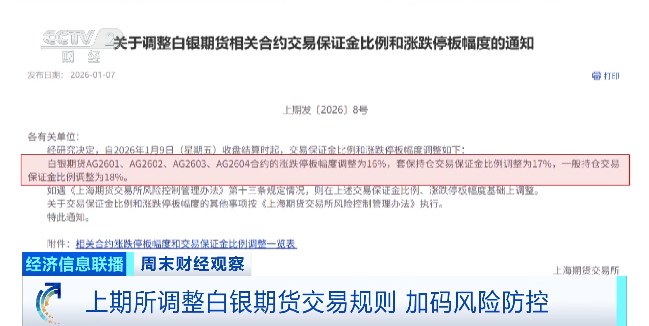
Group 1 - The core viewpoint of the article highlights the significant fluctuations in silver futures prices since the beginning of the year, with the Shanghai Futures Exchange adjusting trading rules for silver futures contracts [1][3]. - The new trading rules effective from January 9 include an increase in the price limit for silver futures contracts to 16% and adjustments in margin requirements to 17% for hedged positions and 18% for general positions [3]. - Analysts indicate that the adjustments in margin and price limits are aimed at addressing market uncertainties and preventing extreme market conditions, as the international silver markets do not have price limits [5]. Group 2 - The recent volatility in global silver prices has heightened speculative trading activity in the market [7]. - As of January 9, domestic silver futures have seen a price increase of over 9%, nearing 10%, with new highs being reached since the contracts were listed [9]. - There has been a noticeable increase in buying activity since October of the previous year, leading to a temporary surge in market demand, although recent trading has shown signs of cooling [11]. - Analysts note that the current gold-silver ratio has dropped to its lowest level in nearly a decade, suggesting that silver prices may be overvalued in the short term, urging investors to approach with caution [11]. - Looking ahead, there is a possibility that silver futures could reach new highs by 2026, although uncertainties in international markets may lead to increased volatility at elevated price levels [13].
申银万国期货员工因年终奖维权遭总经理殴打?当事人还原冲突始末
凤凰网财经· 2026-01-09 10:15
风财眼 . 以下文章来源于风财眼 ,作者凤凰网财经 来源:凤凰网财经《公司研究院》 风财眼致力于银行领域的原创报道,旨在履行媒体监督职责,以期共营健康的金融环境。 近日,一名自称为申银万国期货的员工在社交平台上开设"公司降薪维权专场"直播引发关注。直播画面中,该公司总经理疑似将维权员工推倒。凤凰网财 经《公司研究院》联系到开直播的当事人赵峰(化名),他向我们还原了整个冲突始末。 01 年终奖维权被打 事情的起因源于申银万国期货2025年年终奖分配事宜。赵峰表示,公司员工对年终奖分配存在质疑。"大家都在讨论这件事,我便在公司群里向公司管理层 进行询问。"他说。 公司群聊截图内容显示,赵峰要求公司管理层对于"一级部门领导获30万元、普通员工仅1万元"的年终奖差距,给出明确说法。 在群消息发出去不久,赵峰的企业微信便被公司关停,人事部门通知他去会议室沟通。 "我拿着手机开了直播进入到会议室,人事看见我在直播,就去找总经理汇报。汇报之后,他们就说不聊了,但我就再开着直播直接去总经理室找其沟 通。"赵峰向凤凰网财经《公司研究院》还原了当时的经过。 进入总经理办公室后,对方要求赵峰关闭直播遭拒,便疑似动手将赵峰推倒,导致 ...

视频|申银万国期货被曝年终奖分配差异县殊 一级部门领导拿30万 员工1万元,员工直播讨说法被领导打成脑震荡
Xin Lang Cai Jing· 2026-01-09 02:00
新浪声明:此消息系转载自新浪合作媒体,新浪网登载此文出于传递更多信息之目的,并不意味着赞同 其观点或证实其描述。文章内容仅供参考,不构成投资建议。投资者据此操作,风险自担。 责任编辑:宋雅芳 炒股就看金麒麟分析师研报,权威,专业,及时,全面,助您挖掘潜力主题机会! 来源:齐鲁晚报 炒股就看金麒麟分析师研报,权威,专业,及时,全面,助您挖掘潜力主题机会! 来源:齐鲁晚报 新浪声明:此消息系转载自新浪合作媒体,新浪网登载此文出于传递更多信息之目的,并不意味着赞同 其观点或证实其描述。文章内容仅供参考,不构成投资建议。投资者据此操作,风险自担。 责任编辑:宋雅芳 ...
大类资产早报-20260109
Yong An Qi Huo· 2026-01-09 01:12
| 冠 永安期货 | | --- | 大类资产早报 研究中心宏观团队 2026/01/09 股 指 期 货 交 易 数 据 | 全 球 资 产 市 场 表 现 | | | | | | | | | | --- | --- | --- | --- | --- | --- | --- | --- | --- | | 主要经济体10年期国债 | | | | | | | | | | 美国 | | 英国 | 法国 | 德国 | 意大利 | 西班牙 | 瑞士 | 希腊 | | 最新 | 4.168 | 4.404 | 3.528 | 2.862 | 3.508 | 3.254 | 0.261 | 3.370 | | 日本 | | 巴西 | 中国 | 韩国 | 澳大利亚 | 新西兰 | | | | 最新 | 2.073 | 6.234 | 1.882 | - | 4.668 | 4.429 | | | | 主要经济体2年期国债 | | | | | | | | | | 美国 | | 英国 | 德国 | 日本 | 意大利 | 中国(1Y收益 率) | 韩国 | 澳大利亚 | | 最新 | 3.489 | 3.650 | 2.09 ...
下游冬季节前仍有补库意愿 硅铁下方空间或有限
Jin Tou Wang· 2026-01-08 06:02
Group 1 - The main contract for silicon iron futures experienced a sharp decline, reaching a low of 5686.00 yuan, with a current price of 688.00 yuan, reflecting a drop of 2.84% [1] - Institutions have varying views on the future of silicon iron prices, with expectations of price fluctuations around cost valuation levels due to high overall costs and seasonal demand pressures [2] - The overall trend of silicon iron prices is heavily dependent on energy price changes, with current coal prices providing some support to costs [3] Group 2 - The production of silicon iron is currently low, and major steel mills are still showing a willingness to replenish stocks before the winter season [3] - Despite an increase in iron alloy production and inventory accumulation, the downside for iron alloys is limited due to cost support and recent positive trends in bulk commodities [3] - The market outlook suggests a cautious approach to bearish positions, considering the potential for cost support and disruptions in coal production [3]

瑞达期货玉米系产业日报-20260106
Rui Da Qi Huo· 2026-01-06 08:56
Report's Industry Investment Rating No investment rating mentioned in the report. Core Viewpoints of the Report - For the corn market, the US corn is in the export peak season with high short - term supply pressure, but good export conditions support the price. In the domestic market, the acquisition progress in the Northeast has passed half, and after the New Year's Day, the release of reserve corn and the directional release of imported corn continue. The feed enterprise inventory is at a normal level, and the deep - processing enterprise inventory is relatively low year - on - year. In the Huabei and Huanghuai regions, as the Spring Festival approaches, the willingness to sell grain increases, and the market supply is abundant. The corn futures price is relatively volatile recently, and it is advisable to wait and see [2]. - For the corn starch market, with the increase in the supply of new - season corn, the supply pressure remains. The starch inventory has increased week - on - week, month - on - month, and year - on - year. However, after the large increase in the price of tapioca starch, some downstream customers have repurchased corn starch, increasing the demand. The starch price has been oscillating recently, and short - term waiting and seeing is recommended [3]. Summary by Relevant Catalogs Futures Market - Corn futures: The closing price of the active contract is 2222 yuan/ton, the monthly spread (5 - 9) is - 27 yuan/ton, the open interest of the active contract is 994015 lots (down 7328 lots), the net long position of the top 20 holders is - 167858 lots (up 1031 lots), the registered warehouse receipts are 31655 lots (down 7740 lots), and the CS - C spread of the main contract is 313 yuan/ton (down 8 yuan/ton) [2]. - Corn starch futures: The closing price of the active contract is 2501 yuan/ton (down 8 yuan/ton), the monthly spread (3 - 5) is - 44 yuan/ton (down 1 yuan/ton), the open interest of the active contract is 193513 lots (down 3295 lots), the net long position of the top 20 holders is - 33413 lots (down 1803 lots), and the registered warehouse receipts are 12355 lots (unchanged) [2]. - CBOT corn futures: The closing price of the active contract is 444.5 cents/bushel (up 7.5 cents), the total open interest is 1543015 contracts (up 26463 contracts), and the non - commercial net long position is 53192 contracts (down 11680 contracts) [2]. Spot Market - Corn: The average spot price is 2354.51 yuan/ton (down 1.96 yuan/ton), the FOB price at Jinzhou Port is 2310 yuan/ton (unchanged), and the CIF price of imported corn is 2051.05 yuan/ton (up 3.76 yuan/ton) [2]. - Corn starch: The ex - factory price in Changchun is 2570 yuan/ton (unchanged), in Weifang is 2800 yuan/ton (unchanged), and in Shijiazhuang is 2730 yuan/ton (unchanged). The basis of the main corn starch contract is 69 yuan/ton (up 8 yuan/ton), and the basis of the main corn contract is 132.51 yuan/ton (up 0.04 yuan/ton) [2]. Upstream Situation - Corn production forecasts: The predicted annual production in the US is 425.53 million tons (down 1.58 million tons), in Brazil is not mentioned, in Argentina is 53 million tons (unchanged), in China is 295 million tons (unchanged), and in Ukraine is 32 million tons (unchanged) [2]. - Corn planting areas: The predicted planting areas in the US is 36.44 million hectares (up 0.55 million hectares), in Brazil is not mentioned, in Argentina is 7.5 million hectares (unchanged), in China is 44.3 million hectares (unchanged), and in Ukraine is not mentioned [2]. - Corn inventory: The inventory at southern ports is 65.8 tons (up 15.6 tons), at northern ports is 157 tons (down 31 tons), and the deep - processing corn inventory is 349.4 tons (up 11.6 tons) [2]. Industry Situation - Corn: The monthly import volume is 36 tons (up 30 tons), the monthly feed production is 2977.9 tons (up 20.9 tons), and the sample feed corn inventory days are 29.92 days (up 0.04 days) [2]. - Corn starch: The monthly export volume is 19.17 tons (up 6.39 tons), the starch enterprise inventory is 112.3 tons (up 2.1 tons, with a week - on - week increase of 1.91%, a month - on - month increase of 3.09%, and a year - on - year increase of 24.64%) [2][3]. Downstream Situation - Corn: The deep - processing corn consumption is 138.28 tons (down 1.42 tons), and the alcohol enterprise operating rate is 63.5% (down 1.38%) [2]. - Corn starch: The starch enterprise operating rate is 59.86% (down 0.6%), the processing profit in Shandong is - 8 yuan/ton (unchanged), in Hebei is 65 yuan/ton (unchanged), and in Jilin is - 56 yuan/ton (unchanged) [2]. Option Market - For corn options, the 20 - day historical volatility is 11.08% (down 0.32%), the 60 - day historical volatility is 9.29% (down 0.01%), and the implied volatility of at - the - money call and put options is 10.02% (up 0.53%) [2]. Industry News - As of the week ending January 1, 2026, the US corn export inspection volume was 1,206,913 tons, compared with the revised 1,335,028 tons last week and 877,214 tons in the same period last year [2]. - As of the week ending December 25, 2025, the net sales volume of US corn in the 2025/26 season was 756,419 tons, compared with 2,202,287 tons in the previous week [2].

用5000元分仓软件撬动4.37亿元交易额,组织非法期货交易,两人获刑
Huan Qiu Wang Zi Xun· 2026-01-06 03:16
Core Viewpoint - The article highlights the increasing sophistication and concealment of financial crimes, particularly in the context of illegal futures trading facilitated by a low-cost software tool, which has led to significant financial transactions without proper regulatory oversight [1][4]. Group 1: Financial Crime Trends - Financial crimes are evolving with new methods that enhance their concealment and professionalism, as evidenced by a case involving illegal futures trading with a total transaction amount of 437 million yuan [1][4]. - The use of a 5,000 yuan software tool allowed individuals to split a main account into 15 independent trading ports, bypassing essential identity verification processes required by legitimate futures companies [3][4]. Group 2: Case Details - The illegal trading operation was initiated by individuals with prior experience in the futures industry, who sought to create a trading team and expand into leveraged trading services [3][8]. - The operation involved recruiting traders under the guise of offering substantial capital for trading, while the actual business model was centered around illegal futures trading and collecting excessive fees [7][8]. Group 3: Regulatory Response - The case reflects a broader initiative to strengthen financial regulation in response to emerging financial crimes, aligning with the government's goal of building a robust financial system [1][9]. - The prosecution of the individuals involved was based on the illegal nature of their activities, which included conducting futures trading without the necessary regulatory approvals [9][13]. Group 4: Implications for the Market - The case serves as a warning against the misuse of technology to circumvent financial regulations, emphasizing the need for vigilance in the financial market to prevent similar illegal activities [10][13]. - The actions taken by the authorities aim to enhance compliance awareness among market participants and address regulatory loopholes exposed by such illegal operations [10][13].