美联储宽松政策预期

Search documents
贺博生:2.6黄金原油晚间行情价格涨跌趋势分析及周五收官操作建议指导
Sou Hu Cai Jing· 2026-02-06 12:25
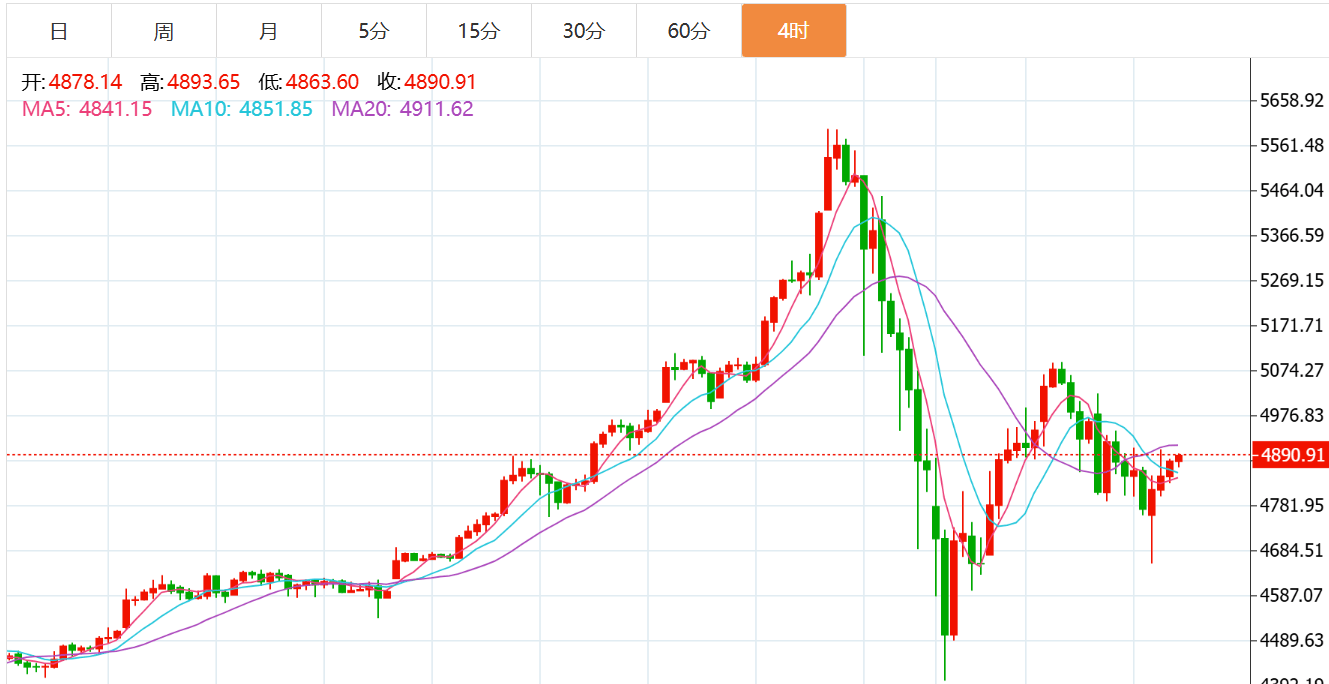
Group 1: Gold Market Analysis - The international gold price reported at $4888.29 per ounce with a 2.01% increase, recovering from a previous drop of 3.8% [1] - The decline in gold prices reflects a market reassessment of asset values due to easing geopolitical fears and rising expectations for the Federal Reserve's easing policies [1] - Short-term gold price movements will depend on upcoming U.S. economic data and developments in Middle Eastern diplomatic negotiations [1] Group 2: Technical Analysis of Gold - Gold is currently experiencing a volatile trading environment, with significant fluctuations due to mixed market sentiments and geopolitical tensions [3] - The price has shown a resistance level around $5000, with support levels identified between $4830 and $4780 [3] - The suggested trading strategy is to focus on buying on dips and selling on rebounds, with key resistance at $4900-$5000 and support at $4680-$4700 [3] Group 3: Oil Market Analysis - Oil prices are trading around $63.27 per barrel, with reduced concerns over potential military conflicts in the Middle East following confirmed negotiations between Iran and the U.S. [4] - The easing of geopolitical risk premiums has led to profit-taking by investors, contributing to downward pressure on oil prices [4] - Weak private sector employment data from the U.S. has raised concerns about economic growth, further impacting oil demand outlook [4] Group 4: Technical Analysis of Oil - The oil market has ended a series of upward price movements, with a significant bearish candle indicating a potential shift in momentum [5] - The short-term outlook suggests a return to a range-bound trading pattern, with resistance levels identified at $64.5-$65.5 and support at $62.0-$61.0 [5] - The recommended trading approach is to sell on rebounds while considering buying on dips, as the market navigates through current volatility [5]

长江有色:锌估值补涨叠加供紧支撑 30日锌价或续涨
Xin Lang Cai Jing· 2026-01-30 05:09
Group 1 - The core viewpoint of the articles indicates that the continuous decline in US dollar credit, coupled with speculative capital inflows, has led to a six-day rise in London zinc prices, with a 2.3% increase [1][2] - The overnight London zinc price opened at $3,396 per ton, peaked at $3,575.5, and closed at $3,453, marking a $77 increase and a 2.30% rise, with trading volume increasing significantly [1] - The macroeconomic environment shows persistent geopolitical risk premiums driving demand for physical assets, while expectations of a potential dovish shift in US monetary policy could further support commodity prices [1][2] Group 2 - On the fundamental side, domestic refined zinc exports are replenishing overseas inventories, and the LME premium has significantly decreased, indicating a reduction in the divergence between domestic and international markets [2] - Despite a cyclical increase in global zinc supply, the transmission of increased mining output to smelting capacity is slowing due to reductions in overseas smelting operations, leading to a forecast of continued low smelting profits until 2026 [2] - Overall, the combination of a declining dollar, expectations of Federal Reserve easing, geopolitical risk premiums, and sustained demand for quality metal assets supports the outlook for continued increases in zinc prices [2]

机构看金市:1月12日
Sou Hu Cai Jing· 2026-01-12 03:25
Core Viewpoint - The recent U.S. non-farm payroll data presents a mixed picture, with a decline in unemployment and an increase in average hourly wages, but disappointing job growth, leading to a complex market reaction regarding interest rate expectations and supporting gold and silver prices amid geopolitical tensions [1][2][3]. Group 1: Non-Farm Payroll Data Analysis - The U.S. non-farm payroll data for December showed an increase of only 50,000 jobs, below the expected 60,000, while the unemployment rate fell to 4.4%, lower than the anticipated 4.5% [3]. - The total job growth for 2025 was only 584,000, marking the weakest annual growth since 2020, indicating a persistent weakness in the labor market [2][3]. - The downward revision of job data for October and November by a total of 76,000 further exacerbates concerns about the labor market's structural weaknesses [1][3]. Group 2: Market Reactions and Trends - Gold and silver prices have been rising due to the mixed non-farm data and ongoing geopolitical tensions, particularly in the Middle East, which has heightened market risk aversion [1][2]. - Central banks continue to increase their gold reserves, with a reported increase of 0.93 tons in December, indicating strong demand for precious metals [2]. - The upcoming release of the December CPI data is crucial, as a lower-than-expected core CPI could further support precious metal prices by reinforcing expectations of continued monetary easing [2][3]. Group 3: Geopolitical and Economic Factors - Geopolitical developments, particularly in Iran and the broader Middle East, are driving market sentiment and influencing the strong performance of precious metals [1][3]. - The expectation that the Federal Reserve may not need to tighten monetary policy further due to weak job growth and a declining unemployment rate is providing additional support for gold [4]. - The potential impact of the Supreme Court's decision regarding tariffs on precious metals could introduce short-term volatility, necessitating caution among investors [2].
铜冠金源期货商品日报-20260108
Tong Guan Jin Yuan Qi Huo· 2026-01-08 02:26
Report Industry Investment Rating No relevant content provided. Report's Core View - The main theme of cooling employment in the US remains unchanged, but the resilience of the service industry offsets the downward pressure. In the domestic market, the upward momentum of the A - share market has weakened, and the market has entered a stage of differentiated game. Precious metals are facing increased short - term adjustment pressure, while various industrial metals and agricultural products show different trends based on their respective fundamentals and market factors [2][3][5] Summary by Related Catalogs Macro - Overseas: In December, the US ADP employment number turned positive but was lower than expected. The JOLTS job openings in November dropped to a more - than - one - year low, and the number of job openings was lower than the number of unemployed for the first time in four years, indicating a slowdown in recruitment. However, the ISM service industry PMI in December rose to a more - than - one - year high of 54.4, with a significant rebound in new orders, driving a phased recovery in service - industry employment and a slowdown in price increases. The US dollar index rebounded to 98.7, and the upward momentum of metals paused. Oil prices continued to adjust [2] - Domestic: On Wednesday, the A - share market fluctuated widely, with the Shanghai Composite Index hitting 4100 points but failing to break through, closing at 4085 points, showing a marginal weakening of upward momentum. The broad - based index structure was differentiated, and the market entered a stage of differentiated game. In January, domestic economic data and policies are in a relatively empty period, and the market depends more on the self - evolution of capital structure and risk preference [3] Precious Metals - On Wednesday, precious metals futures showed high - level fluctuations during the day session. At night, the Shanghai Futures Exchange further tightened the supervision of silver futures, leading to a sharp decline in precious metal prices. The COMEX gold futures fell 0.65% to $4467.1 per ounce, and the COMEX silver futures fell 3.77% to $77.98 per ounce. The exchange continued to strengthen risk - control measures. The Bloomberg Commodity Index will conduct an annual weight rebalancing from January 8th to 14th, which may cause a "technical sell - off" by passive funds. Although the long - term bullish logic for precious metals remains unchanged, short - term adjustment pressure has increased [4][5] Copper - On Wednesday, the main contract of Shanghai copper continued to rise strongly, while LME copper adjusted to around $12800 last night. The domestic spot market for electrolytic copper had poor trading, and downstream buyers were hesitant due to high prices. The LME inventory decreased to 143,000 tons, while the COMEX inventory continued to rise to 512,000 tons. After copper prices hit a new high the day before, overseas funds' long - positions took profits and sold off. The high copper prices continued to suppress consumption in major demand countries. Fundamentally, the global concentrate remained in a tight pattern, and the shortage at the cost - end would support copper prices. It is expected that copper prices will maintain a high - level shock in the short term and enter a valuation - repair range [6][7] Aluminum - On Wednesday, the main contract of Shanghai aluminum closed at 24,410 yuan/ton, up 1.16%. The LME aluminum closed at $3083.5 per ton, down 1.61%. The electrolytic aluminum ingot inventory increased, and the aluminum rod inventory in the main domestic consumption areas also increased. After a significant increase, there was profit - taking. However, the weak employment data strengthened the market's expectation of the Fed's further easing policy, and the price rebounded at night. Fundamentally, the continuous and rapid increase in aluminum prices suppressed downstream demand, and the social inventory of aluminum ingots was expected to continue to accumulate. The market's long - positions showed signs of convergence, and there may be a need for price repair [8][9][10] Alumina - On Wednesday, the main contract of alumina futures closed at 2938 yuan/ton, up 4.97%. The national average spot price of alumina decreased by 1 yuan/ton. The market's macro sentiment and the expectation of alumina production cuts in January led to a rebound in the futures price first, resulting in a divergence between futures and spot prices and the appearance of an inter - period arbitrage window. Fundamentally, the supply - demand situation has not changed much recently, and the theoretical production capacity is still in excess. In the short term, the supply is still in excess, and a short - position thinking after the rebound is recommended, with attention paid to the resistance level around 3000 yuan/ton [11] Cast Aluminum - On Wednesday, the main contract of cast aluminum alloy futures closed at 23,035 yuan/ton, up 0.7. The rapid increase in cast aluminum prices has made downstream buyers hesitant, with most of them maintaining rigid - demand purchases. Some enterprises have production - cut plans, and the pre - Spring Festival stocking is slow, restricting consumption. The supply side is relatively stable due to the limitation of scrap aluminum. In the short term, the macro sentiment dominates, and cast aluminum is relatively strong, but the poor price transmission between upstream and downstream will put pressure on prices in the future [12] Zinc - On Wednesday, the main contract of Shanghai zinc fluctuated horizontally during the day and moved down at night, and LME zinc closed down. The spot market supply was limited, with high premiums. Downstream buyers were still hesitant due to high prices. The overall economic data in the US was mixed, the US dollar strengthened, and the enthusiasm of funds to go long cooled down, with the main contract reducing positions for adjustment. Fundamentally, the zinc - ore processing fee decline slowed down, and the supply of refined zinc increased month - on - month. Consumption remained in the off - season, and terminal orders were limited. It is expected that zinc prices will continue to fluctuate at a high level in the short term [13][14] Lead - On Wednesday, the main contract of Shanghai lead fluctuated strongly during the day and first declined and then rebounded at night, and LME lead fluctuated weakly. The spot market had limited circulating supply, and downstream enterprises generally adopted a wait - and - see attitude, mainly making long - term contract purchases. The US dollar strengthened, and lead prices adjusted with the reduction of positions in the non - ferrous metal sector. Fundamentally, the production of primary lead smelters increased slightly month - on - month, while the production of secondary lead smelters decreased slightly. The overall supply pressure was limited, and low inventory would support lead prices. It is expected that lead prices will remain at a high level in the short term [15] Tin - On Wednesday, the main contract of Shanghai tin continued to be strong during the day, once reaching the 360,000 - yuan line, and fluctuated horizontally at night, and LME tin fluctuated narrowly. Both at home and abroad maintained a wide - range expectation, providing a bullish atmosphere for commodities. The non - ferrous metal sector has been rising in rotation since the New Year. Fundamentally, the production of refined tin in January decreased slightly month - on - month, demand was in the off - season, and the negative feedback of high - price raw materials was expected to deepen. After the New Year's Day stocking benefits were realized, social inventory was expected to increase again. In the short term, the US economic data was mixed, the US dollar closed up, and Shanghai tin adjusted with a reduction of positions. Attention should be paid to high - level risks [16] Industrial Silicon - On Wednesday, the main contract of industrial silicon rebounded slightly. The supply side showed a marginal contraction, with the operating rate in Xinjiang remaining at around 90%, low production in the southwest region in the off - season, and limited overall increases in Inner Mongolia and Gansu. On the demand side, the supply of polysilicon was converging, and the inventory pressure of silicon - wafer enterprises was effectively relieved after production cuts. The production capacity of battery - cell enterprises did not show significant fluctuations, and the increase in silver prices was expected to drag down the production plan. The demand for components was weak near the end of the year. The social inventory of industrial silicon decreased to 553,000 tons last week, and it is expected that the futures price will maintain a relatively strong shock in the short term [17][18] Steel (Screw and Coil) - On Wednesday, steel futures rose. The short - term sharp rise in coking coal and coke drove the rise of steel prices. The supply and demand of steel were in a weak balance, with off - season demand suppressing and inventory reduction supporting, and the macro expectation was relatively positive. The supply and demand of rebar fluctuated at a low level and continued the de - stocking pattern, while the production of hot - rolled coil increased, and the de - stocking slowed down and remained at a high level. It is expected that the supply - demand pattern will remain weak, and attention should be paid to high - level risks [19] Iron Ore - On Wednesday, iron - ore futures rose. The supply side saw a surge in overseas miners' shipments at the end of the year, with global shipments hitting a new high for the year, and port inventories continued to accumulate, maintaining a loose supply. The demand side showed a slight decline in the blast - furnace operating rate of steel mills, and pig - iron production hovered at a low level, with low factory inventories. The short - term strong performance of coking coal and coke provided support, and the futures price was relatively strong [20] Coking Coal and Coke - On Wednesday, coking coal and coke futures hit the daily limit and continued to rise sharply at night. The news that Yulin City removed 26 coal mines from the coal - supply guarantee list and reduced the production capacity by 19 million tons, combined with multiple factors such as positive macro - policy expectations, steel mills' winter - storage replenishment demand, and capital - sector rotation, drove the strong rise of coking coal and coke futures. However, the fundamental support was limited. Currently, domestic coal production has recovered after the holiday, and the inventory of imported coal is high, while the inventory pressure of downstream finished products is high in the off - season, restricting the upward space of prices. In the short term, strong expectations dominate, and prices may maintain a relatively strong shock pattern, but the risk of chasing high is relatively large [21] Soybean and Rapeseed Meal - On Wednesday, the soybean - meal 05 contract closed up 1.74% at 2811 yuan/ton, and the rapeseed - meal 05 contract closed up 1.72% at 2419 yuan/ton. The precipitation in the Argentine production area has continuously improved, and the crop conditions in the South American production areas are good. Currently, soybeans and soybean meal are in a high - inventory situation, and the suspension of the state - reserve imported - soybean auction and the expected decrease in future soybean arrivals may accelerate inventory depletion, with tight - supply expectations providing support. The basis is strong, and the spot price is stable with a slight increase. Combined with the strong bullish sentiment in the commodity market, long - position funds entered the market, and the soybean - meal 05 contract broke through the short - term resistance range. It is expected that soybean and rapeseed meal will fluctuate strongly in the short term [22][23] Palm Oil - On Wednesday, the palm - oil 05 contract closed up 0.66% at 8562 yuan/ton. The production of palm oil in Malaysia decreased by 4.64% in December. Indonesia plans to confiscate 4 - 5 million hectares of oil - palm plantations in 2026, which may disrupt production and push up prices. The US economic data showed that demand is relatively stable, and the US dollar index fluctuated and closed up. The market is waiting for the report's guidance, and it is expected that palm oil will fluctuate within a range in the short term [24][25]
周五决战:非农与关税裁决直接对决,委内瑞拉只是背景噪音
Sou Hu Cai Jing· 2026-01-07 06:08
Group 1 - The U.S. Treasury market is currently more focused on upcoming economic data, particularly the non-farm payroll report, rather than geopolitical events such as U.S. intervention in Venezuela [1][2] - Economists predict that the U.S. economy added 73,000 jobs last month, an increase from 64,000 in November, with the unemployment rate expected to drop from 4.6% to 4.5% [1] - The market's reaction to the situation in Venezuela is muted as it has not significantly altered the inflation narrative, according to market analysts [2][3] Group 2 - The recent sell-off in the U.S. Treasury market is attributed to random fluctuations and a return to normal trading volumes at the beginning of the year [3] - Analysts do not foresee the Venezuelan situation causing significant disruptions akin to Middle Eastern conflicts, as there is no immediate risk of geopolitical instability or oil price spikes [3] - The U.S. Treasury market is nearing a milestone, with the 10-year Treasury yield reaching its highest level relative to the 2-year yield in nearly nine months, indicating expectations of a Fed rate cut in 2026 [3][4] Group 3 - The yield curve has steepened, with the 10-year Treasury yield briefly exceeding the 2-year yield by 72 basis points for the first time since April, driven by expectations of further Fed easing [4] - The increase in corporate bond issuance at the beginning of the year has put upward pressure on long-term yields, exacerbating the steepening of the yield curve [4] - The yield curve is expected to become steeper as economic conditions remain strong, despite a weak labor market, with the Fed continuing to play a significant role [5]
现货金银周二上涨 分析师称地缘局势叠加美联储宽松预期激活需求
Sou Hu Cai Jing· 2026-01-06 03:37
Core Viewpoint - The recent increase in spot gold and silver prices is attributed to heightened geopolitical tensions, particularly due to U.S. actions against Venezuela, which have enhanced gold's appeal as a safe-haven asset [1] Group 1: Gold Market - Spot gold rose by 0.4% to $4,466 per ounce, reflecting increased demand for safe-haven assets amid geopolitical concerns [1] - Alexander Zumpfe, a precious metals trader, noted that the situation in Venezuela has clearly revived safe-haven demand for gold [1] - There is speculation that if geopolitical tensions escalate further or if upcoming U.S. data suggests a need for more aggressive monetary easing by the Federal Reserve, gold prices may approach record highs [1] Group 2: Silver Market - Spot silver experienced a significant increase, rising nearly 3% to approach $79 per ounce [1] - Silver prices are projected to soar by 147% by 2025, driven by its designation as a critical mineral in the U.S. and structural market shortages due to rising demand [1]
金价,还在涨
Xin Lang Cai Jing· 2025-12-23 09:01
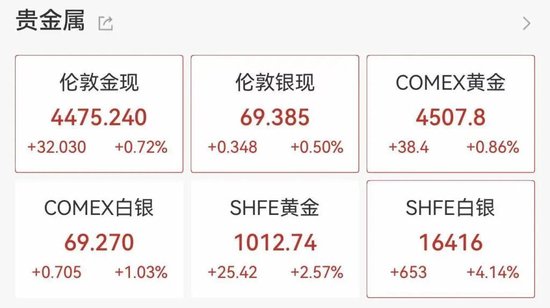
Core Viewpoint - The price of spot gold continues to rise, reaching a new historical high of $4497.754 per ounce, with a current price of $4475.24 per ounce, reflecting a 0.72% increase [1][8]. Gold Market Performance - COMEX gold futures initially broke through the $4500, $4510, and $4520 per ounce levels before retreating, currently priced at $4507.8 per ounce, up 0.5% [3][8]. - On December 22, spot gold surpassed $4400 per ounce, with COMEX gold futures rising by 2.13% to $4480.6 per ounce, and COMEX silver futures increasing by 2.37% to $69.09 per ounce, indicating the potential for the largest annual gains since 1979 [3][9]. Domestic Gold Jewelry Prices - Domestic gold jewelry prices have surged, with several brands exceeding 1400 yuan per gram. For instance, Chow Tai Fook and Chow Sang Sang have raised their prices to 1403 yuan per gram, while Lao Miao Gold has increased its price to 1402 yuan per gram [3][10]. Other Precious Metals - Other precious metals have also seen significant increases, with spot silver reaching $70 per ounce for the first time on December 23. Additionally, platinum and palladium futures on the Guangzhou Futures Exchange hit their daily limit of 10%, marking new highs since their listing [10]. Market Regulation Measures - In response to the overheated trading environment, the Guangzhou Futures Exchange has set a position limit of 500 contracts for non-futures company members or clients for platinum and palladium contracts [10]. - The Shanghai Futures Exchange has implemented several risk prevention measures for silver futures, including adjustments to trading limits and transaction fees, aimed at cooling the market and promoting rational trading [11]. Economic Indicators and Predictions - Analysts note that the U.S. November CPI and core CPI growth rates have dropped to multi-year lows, reinforcing expectations for a dovish Federal Reserve policy, alongside geopolitical risks and central bank gold purchases supporting rising precious metal prices [11]. - According to Bloomberg's forecast, both gold and silver are expected to experience their strongest annual gains since 1979, with gold prices having surged approximately two-thirds this year due to central bank purchases and inflows into exchange-traded funds (ETFs) [11][12]. Investor Behavior - Investors are increasingly turning to gold as a hedge against concerns over the value of sovereign bonds and currencies, driven by "devaluation trades" [12]. - Goldman Sachs predicts that gold prices could reach $4900 per ounce by the end of 2026, suggesting that current forecasts may underestimate risks and highlighting a potential shift towards broader asset diversification among private investors [12][13]. Risks and Market Dynamics - Morgan Stanley warns that high silver prices may negatively impact photovoltaic demand, while cautioning about potential technical selling pressure from the Bloomberg Commodity Index rebalancing starting January 8, which could lead to significant forced selling in silver and gold [13].
汇率、股市与扩大内需
2025-12-22 15:47
Summary of Key Points from Conference Call Records Industry Overview - The records discuss the impact of currency exchange rates, stock market performance, and domestic demand expansion policies on the Chinese economy and its sectors, particularly focusing on consumption and service industries [1][2][3]. Core Insights and Arguments 1. **Currency and Stock Market Dynamics** - Despite a stronger RMB, the stock market has underperformed, which is an unusual occurrence historically. This divergence is attributed to concerns over domestic economic growth and corporate profitability, particularly in the consumption sector [2][5]. - The recent U.S. non-farm employment data and CPI figures have influenced market expectations for the Federal Reserve's monetary policy, maintaining a dovish outlook [1][2]. 2. **Domestic Demand Expansion Policies** - The focus on expanding domestic demand is critical, with an emphasis on improving income expectations and total income rather than merely reducing savings rates. Specific measures include fiscal stimulus, monetary easing, and industry support [3][4][15]. - The government aims to enhance consumer confidence and increase disposable income, which is essential for reviving the consumption sector [3][15]. 3. **Service Consumption Trends** - Service consumption is expected to gain significant traction, with government policies increasingly supporting this sector. The rising concentration and chain rate in service industries, such as hotels and duty-free shops, indicate a positive trend [23][24]. - The records highlight that service consumption currently accounts for 47% of per capita spending in China, suggesting substantial room for growth compared to developed countries [23]. 4. **Investment Opportunities** - Key sectors to watch include hotels, duty-free, and the restaurant industry, with expectations of stabilization and potential recovery in these areas. High-quality leading companies are likely to expand their market share [24][26][27]. - The records suggest that while the restaurant sector faces challenges, segments like coffee and tea are experiencing rapid growth, presenting investment opportunities [26][28]. Additional Important Insights 1. **Consumer Behavior and Economic Confidence** - The high savings rate among Chinese consumers indicates a lower propensity to consume, which is a concern for economic growth. The records suggest that merely lowering savings rates may not effectively boost consumption [18][19][21]. - The Engel coefficient has risen, indicating that essential goods are taking a larger share of total consumption, reflecting a lack of consumer confidence in making discretionary purchases [20][21]. 2. **Long-term Economic Outlook** - The U.S. credit cycle is expected to begin recovery by 2026, which may influence the RMB's strength and overall market conditions. However, the records caution against assuming a significant long-term decline in the dollar [6][8]. 3. **Policy Implementation and Market Reactions** - The effectiveness of policies aimed at stimulating domestic demand will depend on their implementation and the broader international economic environment. The records emphasize the need for dynamic adjustments to maximize policy impact [3][4][15]. 4. **Market Sentiment and Risk Appetite** - Short-term market movements may be influenced by breaking key resistance levels, which could enhance risk appetite among investors. However, the sustainability of such trends is contingent upon underlying economic fundamentals [8][9]. This summary encapsulates the critical insights and arguments presented in the conference call records, focusing on the interplay between currency dynamics, domestic policies, and sectoral performance in the Chinese economy.
贵金属强势上扬 关注阻力突破
Jin Shi Shu Ju· 2025-11-11 02:17
Core Viewpoint - The precious metals market has experienced a strong breakout, with significant price increases in gold and silver, driven by policy expectations and geopolitical risks [1][2]. Market Performance - New York gold futures rose by 2.8% to $4122 per ounce, marking a two-week high; Shanghai gold also increased by 2.23% to 944.76 yuan per gram [1]. - New York silver futures surged by 4.51% to $50.311 per ounce, while Shanghai silver rose by 3.09% to 11868 yuan per kilogram, indicating strong upward momentum [1]. Market Drivers - The U.S. government shutdown discussions have resumed with positive signals from both parties in the Senate, boosting market risk sentiment [1]. - Diverging views among Federal Reserve officials regarding interest rate policies are contributing to market uncertainty, with some advocating for a cautious approach while others support maintaining a dovish stance [1]. - The latest data shows the U.S. consumer confidence index dropped to a two-year low of 50.3, while inflation expectations remain high at 4.7%, reinforcing expectations for continued accommodative policies from the Federal Reserve [1]. Central Bank Activity - Global central banks are increasing gold purchases, providing solid support for the market; China's central bank has increased its gold holdings for 12 consecutive months [1]. - The World Gold Council reported that global central banks net purchased 220 tons of gold in the third quarter, a 28% increase compared to the previous quarter [1]. Short-term Outlook - The precious metals market is expected to maintain a strong oscillating trend driven by policy expectations and geopolitical risks [2]. - Technically, if New York gold stabilizes around the $4100 level, the next resistance may be around $4150; silver could aim for $52 if it holds above the $50 mark [2]. - There remains uncertainty regarding the U.S. government shutdown resolution, which could impact market sentiment [2].
金荣中国:现货黄金维持震荡,目前暂交投于4020美元附近
Sou Hu Cai Jing· 2025-10-09 06:00
Fundamental Analysis - Gold prices maintained fluctuations around $4020 after reaching a historical high of $4059.07 per ounce on October 8, driven by geopolitical tensions in the Middle East and a subsequent ceasefire agreement between Hamas and Israel, which cooled market risk aversion [1][5] - The uncertainty in U.S. economic policy, particularly the expectation of further monetary easing by the Federal Reserve, has been a core driver for the rise in gold prices, with a projected 25 basis point rate cut at the end of October and a 78% probability of another cut in December [3] - Year-to-date, gold prices have surged by 52%, significantly outperforming global stock markets, with spot gold closing at $4041.45 on October 8, reflecting strong demand for safe-haven assets amid rising interest in gold due to anticipated U.S. rate cuts [3][4] Market Dynamics - The dynamics of the U.S. bond market and foreign exchange market are closely linked to gold's price movements, with a recent increase in the 10-year Treasury yield indicating cautious investor sentiment regarding the U.S. economic outlook [4] - Geopolitical risks, including tensions in the Middle East and significant central bank purchases, have provided solid support for gold prices, with global gold ETF inflows reaching $64 billion this year, including a record $17.3 billion in September alone [4] - The recent ceasefire agreement in the Middle East has the potential to increase outflows from gold, putting downward pressure on prices if the situation stabilizes further [5] Technical Analysis - The short-term outlook for gold remains bullish, with prices recently breaking above the $4000 mark, although traders are advised to be cautious of potential short-term corrections [7] - Current trading strategies suggest entering long positions around $3970 or $3950 with specific stop-loss and target levels, while monitoring resistance around $4030 for potential short positions [7]