
消费金融

Search documents
金融黑灰产破坏力加大 市场机构探索联合治理
Zhong Guo Jing Ying Bao· 2025-06-12 11:10
Core Insights - The rise of black and gray market activities such as "debt collection avoidance," "credit repair," and "agent rights protection" is increasingly troubling financial institutions and harming consumer rights [1][2][3] - In Q1 2023, the National Financial Regulatory Administration reported a 50.8% year-on-year increase in consumer complaints, totaling 104,909 cases [1] - The internet has facilitated the rapid growth of financial black and gray market activities, with the number of practitioners reaching 5.871 million in 2023, a 141% increase from 2022 [2] Regulatory Actions - The National Internet Information Office and financial management departments have recently taken action against numerous accounts and websites spreading illegal financial advice, including shutting down accounts like "Xiao Bei You" on Xiaohongshu [1] - A six-month crackdown on black and gray market activities in the financial sector was launched by the Ministry of Public Security and the National Financial Regulatory Administration, focusing on loan intermediaries and malicious debt evasion [3] Industry Response - The industry is evolving to combat black and gray market activities through enhanced cooperation between police and enterprises, with the establishment of the "Anti-Financial Black Market Alliance" (AIF) involving 146 members [5] - Companies are implementing technology-driven solutions, such as voiceprint recognition and machine learning algorithms, to identify fraudulent activities and improve consumer protection [6][7] Consumer Impact - The proliferation of black and gray market activities not only infringes on consumer privacy and financial security but also disrupts the financial ecosystem and market order [2][3] - A significant portion of complaints received by financial institutions, approximately 30%, are identified as malicious, further complicating the regulatory landscape [2] Technological Developments - The AIF alliance is utilizing multi-source data integration and automated complaint handling to create a comprehensive governance framework against black and gray market activities [6] - Companies are developing advanced identification technologies to detect fraudulent behaviors in consumer protection, enhancing the overall integrity of the financial system [7]

点评报告:票息为盾,提前“卡位”利差压缩行情
Changjiang Securities· 2025-06-12 02:45
1. Report Industry Investment Rating - Not provided in the content 2. Core Viewpoints of the Report - In the context of a volatile bond market and a passive widening of credit spreads, investors should prioritize high - coupon assets for certain returns and prepare in advance for the spread compression market driven by the seasonal inflow of wealth management funds in July [1][5]. - The current core contradiction in the credit bond market is the co - existence of weakening allocation demand and a passive widening of spreads in a volatile environment. Investors should seize pricing deviation opportunities under the protection of coupon safety cushions [5]. - The volatile market pattern caused by the interplay of multiple factors will continue, providing tactical opportunities for layout during market adjustments [6]. - The coupon strategy is the optimal solution in a volatile market, and portfolios should be constructed in a stratified manner according to the characteristics of liabilities [7]. - Investors should "pre - position" for the seasonal spread compression market in July and seize structural opportunities in specific bond varieties [8]. 3. Summary by Relevant Catalog 3.1 Yield and Spread Overview 3.1.1 Yields and Changes of Each Tenor - Yields of various types of bonds at different tenors are presented, along with their weekly changes and historical percentiles. For example, the 0.5 - year Treasury yield is 1.41%, down 4.0bp from last week, with a historical percentile of 8.4% [14]. 3.1.2 Spreads and Changes of Each Tenor - Credit spreads of various types of bonds at different tenors are shown, including their weekly changes and historical percentiles. For instance, the 0.5 - year credit spread of public non - perpetual urban investment bonds is 25bp, up 2.1bp from last week, with a historical percentile of 12.7% [16]. 3.2 Yields and Spreads of Credit Bonds by Category (Hermite Algorithm) 3.2.1 Yields and Spreads of Urban Investment Bonds by Region - **Yields and Changes of Each Tenor**: Yields of public non - perpetual urban investment bonds in different provinces at key tenors, their weekly changes, and historical percentiles are provided. For example, the 0.5 - year yield of Anhui's public non - perpetual urban investment bonds is 1.77%, up 2.6bp from last week, with a historical percentile of 1.1% [19]. - **Spreads and Changes of Each Tenor**: Credit spreads of public non - perpetual urban investment bonds in different provinces at key tenors, their weekly changes, and historical percentiles are given. For example, the 0.5 - year credit spread of Anhui's public non - perpetual urban investment bonds is 30.41bp, up 4.6bp from last week, with a historical percentile of 7.2% [22]. - **Yields and Changes of Each Implied Rating**: Yields of public non - perpetual urban investment bonds in different provinces for each implied rating, their weekly changes, and historical percentiles are presented. For example, the AAA - rated yield of Anhui's public non - perpetual urban investment bonds is 1.80%, up 3.8bp from last week, with a historical percentile of 5.1% [26]. - **Spreads and Changes of Each Implied Rating**: Credit spreads of public non - perpetual urban investment bonds in different provinces for each implied rating, their weekly changes, and historical percentiles are shown. For example, the AAA - rated credit spread of Anhui's public non - perpetual urban investment bonds is 28.96bp, up 4.8bp from last week, with a historical percentile of 32.2% [31]. - **Yields and Changes of Each Administrative Level**: Yields of public non - perpetual urban investment bonds in different provinces at each administrative level, their weekly changes, and historical percentiles are provided. For example, the provincial - level yield of Anhui's public non - perpetual urban investment bonds is 1.80%, up 3.5bp from last week, with a historical percentile of 3.7% [35].
年内ABS发行近85亿元,两极分化下,消金机构猛抢融资“话语权”
Bei Jing Shang Bao· 2025-06-11 15:21
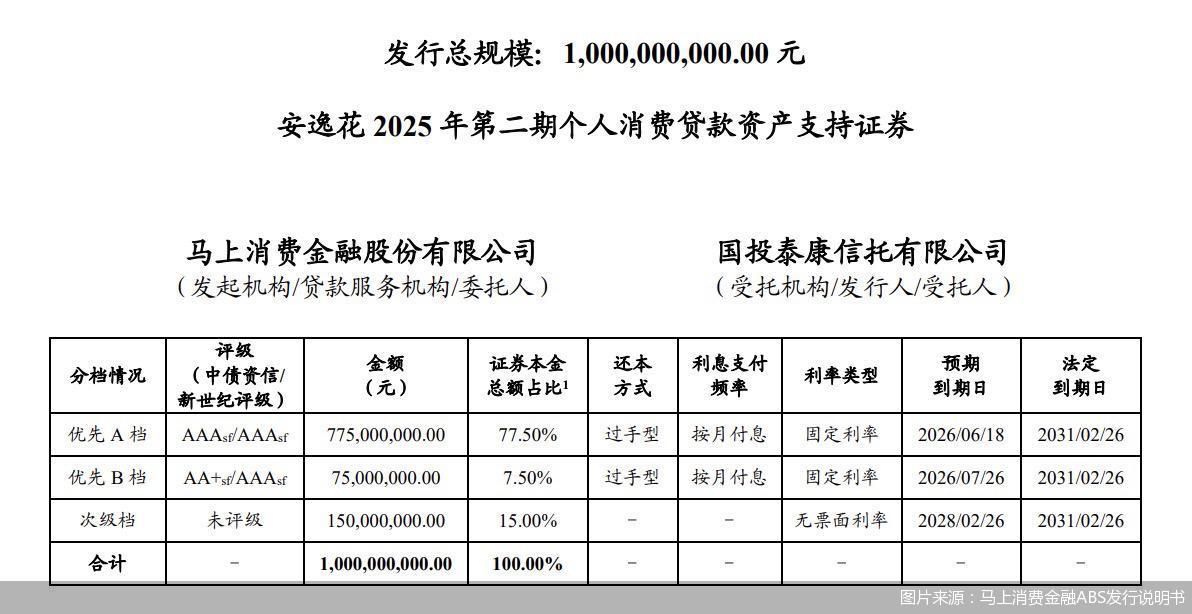
Core Viewpoint - The leading consumer finance institution, Ma Shang Consumer Finance, is actively seeking to raise funds through the issuance of asset-backed securities (ABS) to support its operations and enhance its market competitiveness [1][7]. Group 1: ABS Issuance Details - Ma Shang Consumer Finance plans to issue the "An Yi Hua" 2025 second phase personal consumption loan ABS with a total scale of 1 billion RMB, scheduled for issuance on June 17, 2025 [2]. - The ABS structure includes 775 million RMB in priority A shares, 75 million RMB in priority B shares, and 150 million RMB in subordinated shares, with a total of 1 billion RMB [4]. - The asset pool for this ABS involves 233,700 borrowers with a total initial contract amount of 1.18 billion RMB, and the average outstanding principal balance per borrower is 4,300 RMB [5][6]. Group 2: Industry Trends and Performance - In 2025, four consumer finance institutions have issued a total of 8.458 billion RMB in ABS, showing growth compared to the previous year [1][8]. - The consumer finance industry is experiencing a trend of financing polarization, with some institutions successfully issuing ABS while others struggle to do so [9][10]. - Regulatory support has been a significant factor in the growth of ABS issuance, with policies encouraging consumer finance companies to expand their funding capabilities [8][12]. Group 3: Financial Performance of Ma Shang Consumer Finance - As of the end of 2024, Ma Shang Consumer Finance reported total assets of 65.56 billion RMB, total liabilities of 52.14 billion RMB, and net profit of 2.281 billion RMB [6]. - The company’s loan issuance decreased by 8.57% in 2024 compared to 2023, indicating a reduction in lending activity [6]. - The non-performing loan ratio remained stable at 2.49% as of the end of 2024, with a capital adequacy ratio of 14.25% [6][12]. Group 4: Importance of Low-Cost Funding - Access to low-cost funding through ABS is crucial for consumer finance companies to enhance their market competitiveness and pricing power [12][13]. - The ability to continuously secure low-cost funds is a key dimension for measuring the competitiveness of consumer finance companies in the market [12][13]. - The current environment emphasizes the need for consumer finance companies to diversify their funding sources to strengthen their financial position [12][13].

消费金融牌照审批收紧、小额信贷纠纷处置难,如何破局?
Nan Fang Du Shi Bao· 2025-06-11 07:38
Core Viewpoint - The consumption finance industry is facing new opportunities and challenges amid a backdrop of increased consumer spending and regulatory policies, with a focus on balancing compliance and innovation for high-quality development [2] Group 1: Legal Challenges - The consumption finance industry in China is encountering four main legal challenges: insufficient market access, imprecise regulatory standards, limited flexibility in interest rate restrictions, and ineffective debt recovery mechanisms [5][6] - Current market access is overly restrictive, with only 31 licensed consumption finance companies and no new licenses issued for auto finance companies since 2016, leading to structural shortages in consumer credit supply [5] - Existing regulatory standards do not adequately reflect the unique risk characteristics and development needs of consumption finance companies, as they are held to the same capital adequacy and leverage ratios as commercial banks [5][6] Group 2: Recommendations for Improvement - It is recommended to lower market access conditions for consumption finance companies and allow them to engage in auto loans within certain limits, as well as to raise the maximum loan amounts [7] - The establishment of specialized regulatory standards for consumption finance companies is suggested, allowing conditional financing for capital supplementation [7] - There is a call to enhance interest rate flexibility, particularly for small and short-term loans, to improve pricing mechanisms and facilitate inclusive finance [7] - The need for improved judicial remedies and a rapid dispute resolution mechanism for small credit disputes is emphasized, addressing issues such as high costs and lengthy processes [7]

政策助力 服务消费量质齐升
Jin Rong Shi Bao· 2025-06-11 01:44
Group 1: Service Consumption Growth - Service consumption is a crucial area for future consumption growth, with significant development potential and space [1] - In Q1 2025, per capita service consumption expenditure increased by 5.4% year-on-year, accounting for 43.4% of total per capita consumption expenditure, up 0.1 percentage points from the previous year [1] - Long-term trends indicate that service consumption will evolve towards intelligence, personalization, and sustainability, enhancing domestic demand and improving economic structure [1] Group 2: County-Level Market Opportunities - Service consumption is accelerating its penetration into county-level markets, presenting new opportunities [2] - In 2024, rural retail sales reached 66,729 billion, growing by 4.3%, with rural market sales growth consistently outpacing urban areas [2] - The proportion of county and rural retail sales in total social retail sales reached 38.8%, an increase of 0.4 percentage points from the previous year [2] Group 3: Urban Service Consumption Demand - Urban areas also show significant potential for service consumption, with education (30.5%), healthcare (29.9%), tourism (25.2%), and social culture and entertainment (23.7%) being the top areas for increased spending [3] - The demand for productive services is expected to grow, driven by innovation and the need for improved logistics services [3] Group 4: Consumer Finance Innovations - Consumer finance companies are expanding their services through collaboration with various sectors, creating diverse consumption scenarios [4] - Companies are leveraging digital technology to enhance service efficiency and user experience, which is essential for meeting diverse consumer needs [4] - New models like "Tianjing" and "Zhaolian Zhilu" are being developed to optimize service delivery and improve user experience [5] Group 5: Policy and Environment for Service Consumption - Supporting service consumption is vital for unleashing domestic demand and promoting high-quality economic development [6] - Continuous optimization of the consumption environment and strengthening digital technology empowerment are necessary to stimulate consumption vitality [6]
消金公司如何优化业务布局
Jin Rong Shi Bao· 2025-06-11 01:42
Core Viewpoint - The primary task for the year is to boost consumption and expand domestic demand, with consumer finance companies playing a crucial role in activating potential consumer spending through flexible credit supply and professional services [1] Group 1: Asset Quality Improvement - Consumer finance companies have accelerated the disposal of non-performing assets since 2025, with over 10 companies currently listing non-performing assets for transfer, characterized by "large volume and low price," with transfer prices generally around 10% of the original value, and some as low as 1.9% [2] - In May 2025, the monthly scale of non-performing asset transfers in the consumer finance industry approached 8 billion yuan, marking a new high for the year, with eight companies involved in the transfer [2] - Notably, Zhongyin Consumer Finance has been active in transferring non-performing assets, with 20 announcements in early June totaling over 1.3 billion yuan, with discounts as low as 1.9% [2] Group 2: Cost Management and Risk Mitigation - The decision to directly transfer non-performing assets is primarily driven by cost-saving considerations, as collection and litigation processes are complex and time-consuming, which can severely impact the efficiency of capital turnover [3] - The urgency to recover funds and the increasing pressure on asset quality have led consumer finance companies to strongly favor the accelerated disposal of risk assets [3] Group 3: Regulatory Compliance and Collaboration - In response to regulatory scrutiny, consumer finance companies have begun to disclose lists of cooperative lending institutions, with a focus on improving management and compliance in their collaborative efforts [4] - The establishment of a list management system for cooperative institutions aims to protect consumer rights while providing better safeguards for licensed institutions and their partnerships [6] - Several consumer finance companies have revealed that their cooperative partners are highly concentrated among major internet firms such as Ant Group, JD.com, ByteDance, Du Xiaoman, and Meituan [5][6] Group 4: Market Dynamics and Future Outlook - As competition in the consumer finance market intensifies, companies are optimizing their business layouts, strengthening risk management, and enhancing compliance levels to ensure stable development in a complex market environment [6] - Continuous attention to market dynamics and regulatory changes, along with innovation in business models and service quality, will be essential for consumer finance companies to meet the increasingly diverse financial needs of consumers [6]
消费金融从业机构信息保护待加强
Jin Rong Shi Bao· 2025-06-11 01:38
Group 1 - Recently, Yixin Microfinance and Haier Microfinance were penalized for violating credit information management regulations, drawing industry attention [1] - Yixin Microfinance was fined 625,000 yuan, with an additional penalty of 100,000 yuan for its former general manager, totaling 725,000 yuan [1] - Haier Microfinance faced a fine of 480,000 yuan, with its responsible person fined 71,000 yuan; this is not the first compliance risk incident for Haier Microfinance [1] Group 2 - The increasing frequency of compliance issues related to credit information management has been noted, with several licensed consumer finance companies facing penalties [1] - The Ministry of Public Security's Cybersecurity Bureau reported multiple financial apps for illegal collection and use of personal information, indicating a tightening regulatory environment [2] - The regulatory framework for microfinance companies emphasizes the need for legal, legitimate, and necessary collection of customer information, highlighting the importance of compliance in the digital age [3] Group 3 - The Financial Regulatory Administration's revised guidelines for consumer finance companies stress the establishment of a risk management system aligned with information technology operations to ensure data security [3] - Experts suggest that companies must learn from past experiences and strengthen their information security and compliance measures to thrive in a regulated market [3] - In the digital era, data security and compliance management are essential for sustainable business development, and neglecting consumer rights can lead to severe consequences [3]
乐信(LX.US)旗下分期乐商城618迎开门红: 成交金额、成交用户数、成交订单数同比均超100%
Zhi Tong Cai Jing· 2025-06-09 07:13
Group 1 - The core viewpoint of the articles highlights the significant growth in transaction volume and user engagement during the 618 shopping festival, particularly for Lexin's Fenqile Mall, which saw a 145% year-on-year increase in transaction amount and a 122% increase in active users [1][2] - Fenqile Mall's success is attributed to its improved supply chain and independent risk control system, which enhances the shopping experience for young consumers, particularly those born in the 90s and 95s [1][2] - The 618 shopping festival this year is the longest and most substantial for Fenqile Mall, featuring various promotional activities such as "official discounts up to 50%" and "daily coupon packages worth 680 yuan" [1] Group 2 - The first phase of the 618 event saw a record number of products participating, with significant sales growth in quality brands and lower prices driving young consumer enthusiasm [2] - The independent risk control system implemented by Fenqile Mall has improved credit granting and order approval rates, enhancing user experience through real-time risk assessment across various transaction stages [2] - Lexin's Q1 2025 financial report shows a revenue of 3.104 billion yuan and a net profit of 430 million yuan, marking a 113.43% year-on-year increase, with plans to increase the dividend payout ratio from 25% to 30% starting in the second half of 2025 [3]

消费金融生态重构进行时:监管、科技与市场格局演进
Sou Hu Cai Jing· 2025-06-08 08:38
Core Insights - The 2025 Consumer Finance Ecological Conference held in Chongqing focused on the transformation and upgrading of the consumer finance industry in the new era, with various stakeholders discussing the impact of technology and regulatory changes on the sector [2] - The consumer finance market in China is undergoing profound changes, driven by stricter regulatory policies and rapid advancements in financial technology, which are reshaping customer acquisition, risk control, and operational processes [2][5] Industry Evolution - The modern consumer finance system in China has developed over 40 years, starting from the issuance of the first credit card in 1985, evolving through various phases including the "emergence period" (1985-2009), "pilot period" (2009-2013), and "development period" (2014-2017) [3][4] - The "regulatory period" began in 2017, characterized by increased regulatory scrutiny and the need for compliance, leading to a more mature and technology-driven industry [5] Regulatory Impact - Regulatory policies have been strengthened to address issues such as high-interest lending, capital adequacy, and data security, creating a more equitable competitive environment [6] - These regulations have shifted competition towards service efficiency, risk management, and product innovation, allowing institutions with core competencies to thrive [6] Technological Transformation - The application of financial technology, including big data, artificial intelligence, and cloud computing, is fundamentally changing the competitive landscape of consumer finance [7] - Technology enables institutions to better understand customers, streamline processes, and enhance service delivery, while also lowering barriers for smaller financial entities to enter the market [7] Competitive Landscape - The consumer finance market is experiencing a phase of "survival of the fittest," with increased competition and a need for enhanced capabilities among market participants [8] - Companies like Ma Shang Consumer Finance are leveraging technology to innovate and improve service offerings, while traditional banks are lagging in their strategic responses to industry changes [10] Future Trends - The consumer finance industry is expected to see intensified "Matthew Effect," differentiated technology investments, and a focus on specific consumer scenarios, necessitating the construction of unique competitive barriers within regulatory frameworks [11]

中国消费金融法治研究中心揭牌 专家解析新的需求大场景
Zhong Guo Xin Wen Wang· 2025-06-07 04:59
Core Insights - The 2025 Consumer Finance Ecological Conference was held in Chongqing, highlighting new opportunities arising from emerging demand scenarios [1] - The establishment of the China Consumer Finance Legal Research Center aims to address legislative challenges and enhance consumer protection in the finance sector [1] Group 1: New Demand Scenarios - New urbanization is generating significant demand for consumer finance, particularly in housing, education, healthcare, and social security [2] - Investment in human capital is leading to increased consumer finance needs, such as adult education and vocational training [2] - An aging society is creating unique demands for diverse financial services tailored to elderly consumers, including various forms of housing-related financial services [2] - The resurgence of inbound tourism is prompting the development of new consumer finance products and services to cater to foreign visitors [2] Group 2: Strategic Focus of the Research Center - The center will work on addressing legislative gaps and promoting stable legal frameworks for consumer finance [1] - It aims to lead institutional innovation to enhance the scientific, normative, and efficient management of financial services [1] - The goal is to establish a leading domestic and internationally influential research hub for financial law, providing intellectual support for national decision-making and industry development [1]