油气

Search documents
业绩预告无惊喜 杰富瑞给予道达尔(TTE.US)“持有”评级
智通财经网· 2025-10-17 09:03
Core Viewpoint - TotalEnergies (TTE.US) is expected to report its Q3 earnings on October 30, with Jefferies maintaining a "Hold" rating and a target price of €57. The market consensus for net operating income is largely reflected in the trading updates, despite some positive signals [1] Group 1: Performance Expectations - The company's upstream production growth remains strong, with a year-on-year increase of +4%, although actual realized oil prices appear slightly lower than expected [1] - Liquefied natural gas (LNG) prices are weaker than Jefferies' expectations, and planned maintenance at the Ichthys LNG project is expected to have a negative impact [1] - European refining margins are a highlight, significantly exceeding consensus expectations and showing a quarter-on-quarter increase [1] Group 2: Financial Metrics - Overall, TotalEnergies' business segments and cash flow are projected to grow by 0-5% year-on-year, with consensus expectations at $4.73 billion, implying a +2% year-on-year growth compared to $4.64 billion in Q3 2025 [1] - Net capital expenditures are estimated at $3 billion, which is $1 billion lower than Jefferies' expectations, along with an operational capital inflow that will improve the net debt ratio by 0.5% to 1% compared to Q2 2025 [1] - Operational capital inflow is expected to be around $1-2 billion, with the net debt ratio improving by 0.5-1% from 17% in Q2 [1]

油气板块逆市走高 首华燃气涨超10%
Xin Lang Cai Jing· 2025-10-17 03:13
Core Viewpoint - The oil and gas sector is experiencing an upward trend despite market conditions, with significant gains observed in various companies [1] Company Performance - Shouhua Gas has seen an increase of over 10% [1] - Tongyuan Petroleum has risen by more than 5% [1] - Other companies such as Zhun Oil, Beiken Energy, and Zhongman Petroleum are also following the upward trend [1]



新华社︱我国油气市场化改革取得重要进展 “管住中间”迎来首个部门规章
国家能源局· 2025-10-17 01:50
Core Viewpoint - The recent release of the "Regulatory Measures for Fair Access to Oil and Gas Pipeline Facilities" marks a significant milestone in China's oil and gas market reform, enhancing the legal framework for pipeline regulation and promoting a fair and transparent industry environment [2][3]. Group 1: Regulatory Framework - The new regulatory measures elevate the status from normative documents to departmental regulations, increasing the authority and deterrent effect of regulatory actions [3]. - The revised measures introduce specific penalties for violations, thereby standardizing enforcement actions and reducing discretionary power, which helps to mitigate enforcement disputes [3][4]. - The measures address current regulatory challenges by clarifying rights and obligations of all parties involved, empowering government regulators with enforcement and administrative penalty capabilities [4]. Group 2: Market Access and Transparency - The new regulations define "fair access" to oil and gas pipeline facilities, mandating operators to provide services to qualified users without discrimination [4]. - The measures introduce a dual approach to information disclosure, categorizing it into "proactive disclosure" and "disclosure upon request," which aims to balance information security and user needs [4]. - Pipeline operators are required to establish user registration procedures and service acceptance criteria, promoting transparency and accessibility in service provision [4][5]. Group 3: Capacity Allocation and Service Efficiency - The regulations require pipeline operators to create detailed guidelines for capacity allocation, ensuring fair distribution based on various factors, thus preventing opaque practices [5]. - The response time for capacity service requests has been reduced from 15 working days to 5 working days, enhancing service efficiency [6]. - The measures expand the scope of entities eligible for fair access, optimizing service standards and facilitating market transactions [7].

我国首个油气部门规章《油气管网设施公平开放监管办法》发布 民企使用油气管网设施将更加便利
Yang Guang Wang· 2025-10-17 00:41
Core Viewpoint - The release of the "Regulatory Measures for Fair Access to Oil and Gas Pipeline Facilities" marks the first departmental regulation in China's oil and gas pipeline supervision, aiming to enhance market competition and promote the participation of private enterprises in the sector [1]. Group 1: Regulatory Framework - The new regulatory measures establish standardized service processes for fair access to oil and gas pipelines, including user registration, service acceptance, and information disclosure [1]. - The measures introduce administrative penalties for violations of fair access, enhancing the enforcement of regulations in the sector [1]. Group 2: Market Impact - The regulatory measures are expected to stimulate the construction of an oil and gas market system, increasing competitive vitality in both upstream and downstream markets [1]. - The number of private enterprise users of oil and gas pipeline facilities is projected to exceed 740 by the end of this year, representing a year-on-year growth of 30% [1]. Group 3: Energy Security - The measures will facilitate the entry of diverse oil and gas resources into the main pipeline network, allowing for flexible allocation through a unified national network [1]. - This initiative is anticipated to significantly enhance China's energy security capabilities [1].
油气管网公平开放进入强监管新阶段
中国能源报· 2025-10-16 08:59
Core Viewpoint - The implementation of the "Regulations on Fair and Open Supervision of Oil and Gas Pipeline Facilities" marks a significant step in the deepening of market-oriented reforms in China's oil and gas industry, providing a solid institutional guarantee for efficient allocation of oil and gas resources and the establishment of a "national unified network" [1][3]. Group 1: Regulatory Framework - The new regulations upgrade the previous versions from 2014 and 2019, responding to the requirements of the Energy Law of the People's Republic of China [1]. - The regulations aim to strengthen the supervision of natural monopoly sectors, improve the efficiency of oil and gas pipeline facilities, and ensure stable supply [1][3]. - The establishment of the National Pipeline Network Group has increased the number of active shippers from 5 to over 200, enhancing the efficiency of infrastructure usage [3]. Group 2: Challenges and Necessity for Upgrading - Existing regulatory shortcomings have become apparent, including insufficient industry transparency and inadequate regulatory rules [3]. - Local monopolies in gas transmission and sales limit consumer choice, and the lack of transparency in operational information affects market transaction efficiency [3]. - The urgency for regulatory upgrades is highlighted by the need for improved legal protections and enforcement mechanisms [3][6]. Group 3: Key Innovations in the New Regulations - The new regulations enhance the operational feasibility and legal enforceability of fair access to pipeline facilities, emphasizing non-discriminatory principles [5]. - The response time for capacity service requests has been reduced from 15 to 5 working days, facilitating market transactions [5]. - The regulations empower pipeline facility operators to define user registration processes and capacity allocation methods, respecting their market position [5]. Group 4: Strengthening Supervision and Legal Accountability - The regulations are now classified as departmental rules, introducing specific legal responsibilities and penalties, marking a shift from policy guidance to enforceable regulations [6]. - This change reduces discretionary enforcement space, helping to curb the risk of monopolistic practices [6]. Group 5: Impact on Market Dynamics - The implementation of the regulations is expected to enhance participation from oil and gas production, urban gas, and retail enterprises, particularly benefiting private companies [8]. - The regulations will act as a catalyst for the construction of an oil and gas market system, promoting fair competition and improving resource allocation efficiency [8]. - The anticipated increase in the number of shippers participating in supply assurance by 2025-2026 is projected to exceed 230, a 7% increase year-on-year [8]. Group 6: Future Directions - There is a call for further refinement of service contracts and the establishment of standardized contract models to enhance market efficiency [9]. - The need for higher requirements in information disclosure and the introduction of supporting documents for regulatory practices is emphasized [9]. - The oil and gas industry is expected to evolve towards a more equitable, efficient, and secure future as market and regulatory maturity progresses [9].
《油气管网设施公平开放监管办法》院士解读︱强化自然垄断环节监管 助力全国统一大市场建设
国家能源局· 2025-10-16 08:06
Core Viewpoint - The article emphasizes the importance of regulating natural monopoly segments in the oil and gas pipeline network to support the construction of a unified national market, enhancing energy security and optimizing resource allocation [2][3]. Group 1: Breaking Down Monopoly Barriers - The new regulatory measures focus on dismantling monopoly barriers in the oil and gas pipeline facilities, promoting a fair and just competitive environment for various market entities, which will significantly enhance resource allocation efficiency [4]. - This initiative is a crucial support for the construction of a unified national market, aiming for free flow of factors, unified rules, and fair competition [4]. Group 2: Strengthening Natural Monopoly Regulation - The new regulatory framework clarifies the scope and operational rules for fair access to natural monopoly segments, facilitating the optimization of energy resource allocation and contributing to the modern energy market system [5]. - The previous regulatory measures laid a foundation for stable pipeline services, which are essential for energy supply security and fostering a competitive market environment [5]. Group 3: Improving Fair Access Mechanisms - The new regulations enhance the framework for fair access to oil and gas pipeline facilities, aiming to improve service levels and ensure comprehensive planning to avoid resource waste and market imbalance [6]. - This approach considers various factors such as resource distribution and market demand, aligning with the current development stage of the oil and gas industry in China [6]. Group 4: Introducing Penalties for Fair Access - The new regulations represent a significant legal advancement by introducing penalty clauses that align with the Energy Law, creating a comprehensive legal responsibility system [7]. - This innovation aims to regulate the behavior of pipeline facility operators and ensure orderly market participation, thereby preventing resource misuse and unhealthy competition [7].

能源领域自然垄断环节监管迈向全品种
Zhong Guo Dian Li Bao· 2025-10-16 06:53
Core Viewpoint - The release of the "Regulatory Measures for Fair Access to Oil and Gas Pipeline Facilities" marks a significant shift in the regulatory framework for the oil and gas sector in China, transitioning from policy guidance to legally binding regulations, aimed at creating a fair and competitive market environment [1][4][8] Group 1: Regulatory Framework - The "Regulatory Measures" is the first departmental regulation in the oil and gas pipeline sector, establishing a legal framework to prevent unfair practices and ensure transparency [1][3] - The measures include clear definitions of regulatory scope, requirements, responsibilities, and penalties, thereby enhancing the legal governance of natural monopoly sectors in the oil and gas industry [3][4] - The introduction of administrative penalties for violations of fair access principles signifies a move towards a more enforceable regulatory environment [4][5] Group 2: Market Impact - The total length of China's oil and gas long-distance pipelines is projected to reach 195,000 kilometers by 2024, indicating a shift from a "single point connection" to a "comprehensive network" [2] - The new regulatory framework is expected to facilitate the participation of various market players, including private enterprises, in the oil and gas market, transforming them from passive observers to active participants [6][8] - The number of operators participating in supply assurance by the National Pipeline Group is anticipated to increase to over 230 by the 2025-2026 heating season, reflecting a 7% year-on-year growth [7] Group 3: Industry Development - The regulatory measures are seen as a milestone in the market-oriented reform of the oil and gas sector, which is essential for fostering a vibrant industry capable of contributing to national energy security and economic development [6][8] - The measures aim to enhance the efficiency of resource allocation and improve energy security by allowing diverse sources of oil and gas to enter the main pipeline network [6]


我国油气市场化改革取得重要进展 “管住中间”迎来首个部门规章
Xin Hua She· 2025-10-16 06:30
Core Viewpoint - The release of the "Regulatory Measures for Fair and Open Access to Oil and Gas Pipeline Facilities" marks a significant milestone in China's oil and gas market reform, enhancing the legal framework and regulatory authority in the sector [1] Regulatory Framework - The new regulatory measures elevate the previous normative documents to departmental regulations, which strengthens the authority and deterrent effect of regulatory actions [1][1] - The measures introduce specific penalties for various violations, thereby standardizing enforcement actions and reducing discretionary power in law enforcement [1][1] Market Structure - The regulatory framework aims to create a fair, transparent, and competitive environment in the oil and gas industry, which is crucial for the efficiency of product circulation, public welfare, energy security, and economic operation [1][1] - The "X+1+X" market structure is being developed, which includes multiple upstream suppliers, a unified midstream pipeline system, and a fully competitive downstream market [1][1] Information Transparency - The new measures define "fair access" and categorize information disclosure into "proactive disclosure" and "disclosure upon request," addressing the issue of information asymmetry that hinders fair access [1][1] - Pipeline operators are required to establish user registration procedures and service acceptance conditions, promoting transparency and accessibility [1][1] Capacity Allocation - The measures mandate that pipeline operators create detailed rules for capacity allocation and streamline the response time for service requests from 15 working days to 5 working days [1][1] - This aims to prevent "dark box operations" and discriminatory practices in capacity allocation [1][1] Future Outlook - The National Energy Administration plans to closely monitor the implementation of the new regulatory measures and refine regulatory requirements based on practical experiences [1][1]
3900点关口后市如何演绎?招商基金四季度投资观点上新
Jing Ji Guan Cha Wang· 2025-10-16 03:00
Core Viewpoint - The market is experiencing increased volatility and differentiation, with a cautious short-term outlook but positive long-term fundamentals for the stock market [1] Domestic Macroeconomics - The macroeconomic environment is under pressure, with ongoing profitability recovery and continued liquidity easing [2] - Industrial profits saw a significant year-on-year increase of 20.4% in August, the highest growth rate since December 2023, driven by low base effects and policy changes [2] - Micro liquidity remains ample, supporting the market, while macro liquidity continues to be loose, with no immediate expectations for interest rate cuts unless external conditions change [2] Market Outlook - The current market rally is supported by long-term narratives, but the sources of incremental capital appear insufficient [3] - Key upcoming events include the Fourth Plenary Session and the China-US summit, which may boost market sentiment and create investment opportunities [3] Equity Investment - The stock market's underlying fundamentals are improving in the long term, but the short-term outlook is cautious due to declining valuation attractiveness [4] - Focus on low-value and cyclical sectors such as real estate, new energy, and high ROE large-cap companies, while being cautious of risks in strong sectors [4] - Key sectors to watch include technology, robotics, and innovative pharmaceuticals, with a focus on structural opportunities [4] Fixed Income Investment - The bond market is not expected to enter a sustained bear market, with credit bonds still offering spread value [5][6] - The 10-year government bond yield rose from 1.65% to 1.86%, with a potential for further fluctuations due to market conditions [5] - Credit bonds are expected to follow market trends without independent bullish movements, but there may be some recovery potential after short-term adjustments [6] Global Asset Allocation - Uncertainty surrounding Trump's policies remains high, leading to a preference for global diversification [7] - Short-term opportunities are seen in US stocks and bonds, but macroeconomic volatility may increase [7] - Continued focus on structural opportunities in the US AI sector and real estate recovery during the interest rate cut cycle [7] Hong Kong and Other Markets - The Hong Kong market is viewed positively due to liquidity catalysts and structural opportunities, though domestic and overseas influences must be monitored [8] - There is optimism for Japan's market to emerge from deflation and enter a phase of sticky service inflation [8] - Gold is favored as a hedge against fiscal and equity market risks, with strong potential for growth [8]
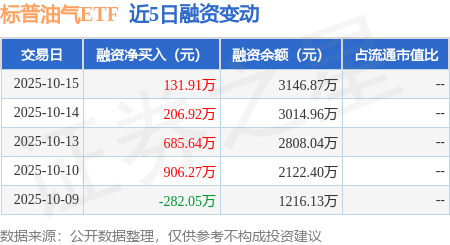
标普油气ETF:10月15日融资净买入131.91万元,连续3日累计净买入1024.48万元
Sou Hu Cai Jing· 2025-10-16 02:35
Core Insights - The S&P Oil and Gas ETF (513350) experienced a net financing purchase of 1.3191 million yuan on October 15, 2025, following a trend of continuous net purchases over the past three trading days totaling 10.2448 million yuan [1][2] Financing Activity Summary - On October 15, 2025, the financing balance reached 31.4687 million yuan, reflecting an increase of 4.38% from the previous day [2][3] - The financing net purchases for the previous trading days were as follows: - October 14: 2.0692 million yuan - October 13: 6.8564 million yuan - October 10: 9.0627 million yuan - October 9: -2.8205 million yuan [2][3] - The financing balance has shown a consistent upward trend, with notable increases of 32.31% on October 13 and 74.52% on October 10 [3] Market Sentiment Analysis - An increase in financing balance indicates a bullish sentiment among investors, suggesting a strong market [4]