
私募

Search documents
美团独家战投自变量机器人!巴菲特首季大手笔减持银行股,高瓴减持阿里巴巴、百济神州…… 私募透视镜
Jin Rong Jie· 2025-05-16 10:49
Group 1 - Meituan leads a Series A funding round for Zivariable Robotics, which has raised over 1 billion yuan since its establishment [1] - Zivariable Robotics focuses on "end-to-end large model" technology, integrating multimodal information for a complete feedback loop from perception to execution [1] - Meituan aims to build a comprehensive technology system in the robotics field by investing in various companies with different technological paths [1] Group 2 - HHLR Advisors reported a significant increase in total market value of holdings from $2.89 billion to $3.54 billion, a nearly 23% rise [2] - The top ten holdings of HHLR Advisors are dominated by Chinese companies, with nine out of ten being Chinese stocks [2] - HHLR reduced its positions in Alibaba and BeiGene, while Alibaba's stock price increased by 56% and BeiGene's by 47% during the first quarter [2] Group 3 - Berkshire Hathaway, led by Warren Buffett, significantly reduced its bank stock holdings while maintaining its position in Apple, valued at $66.6 billion [3] - Berkshire increased its stake in Constellation Brands by over 113% and doubled its holdings in Pool Corp [3] - Buffett indicated a lack of attractive investment opportunities currently, with cash reserves reaching $347.7 billion [3]


最高法、证监会联合发布!完善资本市场司法规则纲领性文件出炉
券商中国· 2025-05-15 15:54
Core Viewpoint - The article discusses the release of the "Guiding Opinions on Strict and Fair Law Enforcement and Judicial Services to Ensure the High-Quality Development of the Capital Market" by the Supreme People's Court and the China Securities Regulatory Commission, which aims to enhance investor protection and improve the legal framework for capital markets [1][2]. Group 1: Investor Protection - The "Guiding Opinions" emphasize the need to strengthen investor protection awareness and legally safeguard investors' rights, including the right to information, participation in corporate governance, and fair market participation [3][4]. - The introduction of representative litigation for securities disputes aims to facilitate investors in protecting their legal rights and reduce the costs associated with investor rights protection [3]. - The document highlights the importance of high-quality information disclosure as a foundation for the registration system, with a commitment to strictly combat fraudulent issuance and financial disclosure violations [3]. Group 2: Market Participant Behavior - The "Guiding Opinions" call for the regulation of behavior among market participants, promoting stable operations of securities, futures, and fund management institutions [5]. - It outlines the need for judicial bodies to report any irregularities, such as circular financing or false capital contributions, to regulatory authorities during the handling of shareholder rights disputes [5]. - The document also emphasizes the need for proper adjudication of disputes between private fund managers and investors, ensuring the protection of investors' legitimate rights [5]. Group 3: Judicial and Administrative Coordination - The "Guiding Opinions" propose enhancing the mechanism for judicial and administrative coordination, promoting a multi-faceted dispute resolution mechanism [8]. - It encourages the use of non-litigation methods, such as mediation, to resolve securities disputes and improve the efficiency of judicial and regulatory processes [8]. - The establishment of a comprehensive information-sharing mechanism between judicial and regulatory bodies is highlighted to enhance cooperation and improve the quality of judicial execution and administrative penalties [8].

私募指增逆市大赚9%超额收益 百亿私募全员正超额
Shen Zhen Shang Bao· 2025-05-15 06:54
Core Insights - Despite overall poor performance of major indices this year, index-enhanced private equity products have shown strong investment capabilities, with an average return of 6.42% and an average excess return of 9.10% as of April 30 [1] - A significant 95.53% of the 649 index-enhanced products reported positive excess returns, indicating robust performance across the board [1] Performance by Management Scale - Top-tier private equity firms have excelled, with 148 index-enhanced products managed by firms with over 10 billion in assets achieving an average return of 7.53% and an average excess return exceeding 10%, with all products reporting positive excess returns [1] - Mid-sized private equity firms also demonstrated strong competitiveness, with products in the 5-10 billion, 20-50 billion, and 0-5 billion asset ranges showing average returns of 6.42%, 6.73%, and 6.20% respectively, all with positive excess returns [1] Performance by Product Size - Products from private equity firms with 50-100 billion in assets showed average returns of 6.51% and excess returns of 8.70%, while those from firms with 10-20 billion in assets had lower performance, with average returns of 4.26% and excess returns of 6.86% [2] Strategy Type Performance - "Other index-enhanced" products emerged as the top performers, with 56 products reporting an average return of 9.69% and an average excess return of 14.47%, all achieving positive excess returns [2] - Air index-enhanced products also performed well, with 240 products showing an average return of 7.10% and an average excess return of 11.02%, with 92.92% of these products achieving positive excess returns [2]
天风策略 谁在卖?
2025-05-14 15:19
Summary of Key Points from Conference Call Records Industry Overview - The records primarily discuss the performance of the public fund market, private equity funds, and various financial instruments in the Chinese market for 2025, with a focus on equity funds and capital flows. Core Insights and Arguments - In April 2025, new equity fund subscriptions reached 74 billion units, with a total net subscription of 1,551 billion units since March, indicating strong investor interest in equity markets [1][2] - The net subscription for stock ETFs in April was 197.3 billion yuan, showing an increase of over 230 billion yuan from the previous month, with major inflows into broad-based ETFs like CSI 300 and CSI 1000 [1][2] - As of March 2025, the scale of private equity funds exceeded 50 trillion yuan, although there was a slight decrease in their positions [3] - The margin trading balance as of the end of April was 1.78 trillion yuan, down 6.9% month-over-month, with a net outflow of 131.5 billion yuan in April [6] - The average daily trading volume of northbound capital in April was over 155 billion yuan, a decrease from over 180 billion yuan in the previous month, but the proportion of total equity trading increased to 12.32% [5] Important but Overlooked Content - The insurance sector saw a net decrease of over 8 billion yuan in asset holdings in Q4 2024, but a cumulative net increase of 630 billion yuan for the entire year, with potential for increased investment due to policy changes in May 2025 [7] - The issuance of bank wealth management products in April approached 6,000, a decrease of 3.36% from the previous month, while the proportion of newly issued equity wealth management products rose to 0.52%, an increase of 0.44% [8] - Industrial capital showed a net decrease of 370 million yuan in April, with a forecasted unlock scale of 110 billion yuan and 247.5 billion yuan for May and June respectively, indicating significant pressure in the electronics and machinery sectors [4][10] - Overall, the market sentiment appears cautious, with a decrease in leveraged funds and a healthy development of public funds, bank wealth management, and private equity products, suggesting a potential shift from small-cap to value styles in the market [11]
私募合规再升级!多地下发通知自查自纠
21世纪经济报道· 2025-05-14 09:47
Core Viewpoint - Recent regulatory scrutiny has intensified across multiple regions in China, focusing on self-assessment and compliance within private equity firms, with specific deadlines set for completion of these evaluations [1][4][5]. Group 1: Self-Assessment Requirements - The self-assessment process includes three main areas: company basic conditions, fund operation conditions, and the status of unregistered partnership enterprises [1][2]. - For company basic conditions, firms must verify their office space, employee count, and compliance with registration requirements for changes in key personnel [1]. - Fund operation conditions cover compliance in areas such as promotional activities, risk assessment, and investment operations, with specific requirements for different types of funds [1][2]. Group 2: Regulatory Notifications - Various regions, including Guangdong and Zhejiang, have issued notifications requiring private equity firms to complete self-assessments by specific dates, focusing on compliance in fundraising, investment operations, and internal controls [4][5]. - The notifications emphasize the importance of accurate information disclosure and the need for firms to address any potential compliance issues [4][5]. Group 3: Compliance and Enforcement - The regulatory bodies plan to conduct random checks on the self-assessment results, with a focus on ensuring that firms adhere to legal and regulatory standards [6][7]. - There is an expectation that firms will maintain thorough documentation of their compliance efforts, as failure to do so may result in stricter penalties [7]. Group 4: Industry Trends - The tightening of regulations is seen as a move to eliminate non-compliant small and micro private equity firms, with a significant number of firms already having been deregistered this year [7][8]. - The revised regulations from the Asset Management Association of China have increased the minimum fundraising requirements for single funds, further constraining the operational space for smaller firms [8].
4月近千只私募产品净值创历史新高 股票策略最多
Shen Zhen Shang Bao· 2025-05-14 06:34
Market Performance - In April, the A-share market exhibited a V-shaped trend, but all three major indices closed lower, with the Shanghai Composite Index down by 1.70%, the Shenzhen Component Index down by 5.75%, and the ChiNext Index down by 7.40% [1] Private Fund Performance - Despite the market downturn, many private fund products reached historical highs in net value in April, with 974 private fund products achieving this milestone [1] - Among these, 406 were quantitative products and 568 were non-quantitative products [1] - The most common product strategy was equity strategy, with 333 products, followed by futures and derivatives strategy with 282 products, multi-asset strategy with 168 products, bond strategy with 160 products, and combination fund products with 31 products [1] Billion-Level Private Funds - A total of 71 products from billion-level private funds reached historical highs in April, with quantitative products making up 49 of these, nearly 70% [1] - The equity strategy was the most prevalent among these products, with 29 products, accounting for nearly 40% [1] Top Performers - Ten billion-level private funds had three or more products reaching new highs, with notable contributions from博润银泰投资 (9 products), 合晟资产 (7 products), and others [2] - The threshold for the top 10 private fund products in terms of returns over the past year was close to 26%, with four of these being quantitative long products [2] - The top five products in terms of returns came from博润银泰投资, 泓湖私募, 乐瑞资产, and宽德私募, with the latter holding two positions [2] Overall Private Fund Market - As of April 30, the average return for all private securities funds was 2.52%, with 8,758 products, or 69.82%, achieving positive returns, indicating a strong profit-making effect [2] - Quantitative long strategies significantly outperformed subjective long strategies, with an average return of 4.77% for 1,424 quantitative long products compared to 1.95% for 5,994 subjective long products [2] - The issuance of private fund products has seen a recovery, with nearly 3,500 new private securities investment funds registered this year, representing a nearly 40% increase compared to the same period last year [2]
财达证券每日市场观察-20250514
Caida Securities· 2025-05-14 05:11
Market Overview - The market experienced fluctuations with a trading volume of 1.33 trillion, slightly down by approximately 100 billion from the previous trading day, with over half of the sectors showing gains, particularly in banking, pharmaceuticals, and transportation, while military, computing, machinery, and electronics sectors faced declines [1] - The positive developments in trade negotiations have been quickly reflected in the market, although the absolute tariff levels remain high, indicating ongoing uncertainties in future negotiations [1] - Despite the high opening and subsequent decline, the potential for continued upward movement in the market remains significant, as the trade war and its dynamics may be long-term, with the recent rebound reflecting the market's recognition of these factors [1] Sector Performance - The photovoltaic sector saw some gains but experienced a pullback, driven by rumors of production cuts and supply preservation in the silicon material industry, which have not been officially confirmed, suggesting that this sector may only offer short-term trading opportunities until a significant improvement in the industry fundamentals is observed [2] - The military sector's short-term adjustments have not altered its main position in the market, with the logic for mid-term valuation restructuring becoming stronger [3] Fund Flow - On May 13, the net outflow of funds from the Shanghai Stock Exchange was 6.58 billion, while the Shenzhen Stock Exchange saw a net outflow of 96.72 billion. The sectors with the highest inflows included large state-owned banks, photovoltaic equipment, and joint-stock banks, while the sectors with the largest outflows were military electronics, consumer electronics, and semiconductors [5] Industry Dynamics - The release of the "Precision Denitrification Technology for Magnesium Smelting Industry" marks a global innovation, filling a gap in China's magnesium smelting industry regarding flue gas denitrification technology, with the potential to reduce nitrogen oxide emissions by approximately 10,000 tons annually, achieving a 70% reduction in emissions [11] - The Civil Aviation Administration of China is focusing on optimizing domestic transfer services and enhancing the quality of international route operations, aiming to boost market consumption vitality in the civil aviation sector [12] - Sichuan Province has introduced policies to support the development of low-altitude economy, providing financial support of up to 30% for projects related to large drones, eVTOLs, and flying cars, with a maximum funding limit of 20 million [13] Fund Dynamics - The private equity market is showing signs of recovery, with the number of billion-level private equity firms reaching 87, an increase of 3 since the end of March, driven by a gradual recovery in the issuance market [14] - The Shenzhen Semiconductor and Integrated Circuit Industry Investment Fund has been established with a total scale of 5 billion, primarily investing in key projects and leading enterprises in Shenzhen's semiconductor industry [15][16]
私募行业变局加速 两大趋势深化演进
Zhong Guo Zheng Quan Bao· 2025-05-13 20:29
● 本报记者王辉 根据中国证券投资基金业协会最新数据,截至4月末,国内百亿级证券私募管理人数量为87家,较3月小 幅增长。与此同时,第三方机构最新监测显示,4月私募证券基金管理人数量减少34家。在备案门槛提 升、运营成本增长的背景下,一些小私募不断离场。另外,在多家私募机构跻身"百亿俱乐部"的同时, 量化私募管理人成为了主力军。整体来看,私募行业的头部化趋势、量化策略的强势复苏,正在深化演 进。 百亿级私募增至87家 值得注意的是,来自第三方机构的监测数据进一步显示,在4月跻身百亿级阵营的私募机构中,量化私 募成为主力军。 朝阳永续基金研究院的研究数据显示,在4月新晋百亿级私募的8家机构中,量化私募占据6席。同期掉 出百亿级阵营的私募管理人,大部分则是主观多头机构。此外,截至4月末,在百亿级私募阵营中,量 化机构数量为39家,占比超过四成,基本与主观私募"平分秋色"。 中国证券报记者近期从上海地区私募业内和渠道方面了解到,春节假期之后,A股市场的赚钱效应一度 强势复苏,上海有多家头部、腰部主观私募均在3月以来展开新产品发行,但最终实际的募资规模明显 弱于先前预期。 上海某百亿级主观私募市场负责人表示,尽管今年 ...
监管最新通报!
Zhong Guo Ji Jin Bao· 2025-05-13 08:38
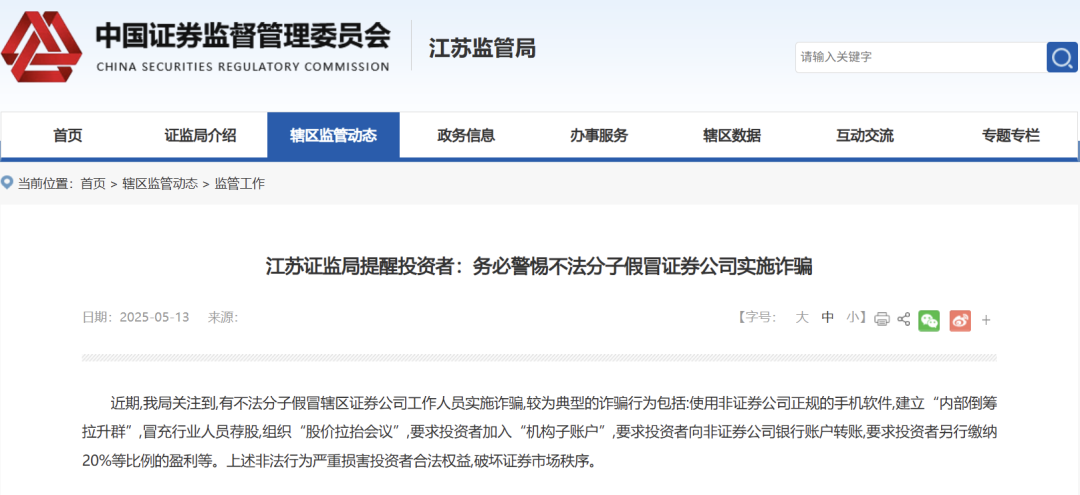
近期,多地证监局纷纷发文,提醒投资者注意防范冒充证券公司人员、私募机构等实施诈骗活动的风险。投资者应提高警惕、明辨真伪,远离非法证券活 动,切实保护自身权益,谨防上当受骗。 江苏证监局最新提醒 警惕不法分子假冒证券公司实施诈骗 【导读】江苏证监局提醒投资者:务必警惕不法分子假冒证券公司实施诈骗 中国基金报记者晨曦 投资需谨慎,监管最新通报来了! 5月13日,江苏证监局发文称,近期关注到有不法分子假冒辖区证券公司工作人员实施诈骗,相关非法行为严重损害投资者合法权益,破坏证券市场秩 序。 第三,对于声称能提供高额回报或无风险投资机会,并以此为由收取咨询费、会员费、盈利分成等行为,应保持警惕,防止上当受骗。 四.如果发现可疑的证券活动或诈骗行为,请及时拨打证券公司官方网站公布的客服热线进行核实。如不慎遭遇诈骗遭受损失,及时向公安机关报案。 多地证监局提示风险 值得关注的是,近期已有多地证监局发文,提醒投资者注意防范冒充证券公司、期货公司、私募机构等工作人员实施诈骗活动的风险。 4月24日,深圳证监局发布公告称,关注到一些不法分子冒充期货公司工作人员,利用假冒的期货公司App、投资群,对投资者实施诈骗。深圳证监局提 ...
招商证券:副总裁张浩川辞职;多只红利基金限购
Mei Ri Jing Ji Xin Wen· 2025-05-13 01:07
Group 1: Management Changes in Securities Firms - Zhang Haochuan, Vice President of China Merchants Securities, resigned for personal reasons, and will not hold any position after resignation [1] - The resignation follows the retirement of President Wu Zongmin, who announced his retirement due to age on May 7, leading to concerns about management stability [1] - The company confirmed that there are no significant disagreements with the board and has completed the necessary work handover, indicating limited long-term impact [1] Group 2: Technology Innovation Bonds - The People's Bank of China and the China Securities Regulatory Commission announced support for the issuance of technology innovation bonds, including securities firms as eligible issuers [2] - Eleven securities firms, including CITIC Securities and China Merchants Securities, have confirmed the issuance of technology innovation bonds, with a total scale exceeding 10 billion [2] - This initiative is expected to enhance financing channels for securities firms and direct more funds towards technology innovation, benefiting related industry sectors [2] Group 3: Growth of Billion-Level Private Equity Firms - As of May 12, the number of billion-level private equity firms reached 87, an increase of 3 since the end of March, indicating a recovery in the issuance market [3] - Four firms exited the billion-level category while seven new firms entered, reflecting increased competition in the industry [3] - The growth in both subjective and quantitative billion-level private equity firms suggests a restoration of market confidence and potential for increased capital inflow [3] Group 4: Restrictions on Dividend Funds - Several dividend-themed equity funds have announced subscription limits due to increased interest in low-valuation, stable assets amid market fluctuations [4] - China Europe Fund and Western Li De Fund have implemented subscription limits to protect the interests of fund holders and ensure stable operations [4] - The restrictions may lead investors to reassess dividend assets, potentially impacting market fund flows and increasing attention on related industry sectors [4]
