
保险业

Search documents
潘功胜:做好房地产金融宏观审慎管理工作
Bei Jing Shang Bao· 2025-10-27 12:48
Core Viewpoint - The speech by the Governor of the People's Bank of China emphasizes the importance of establishing a comprehensive macro-prudential management system to enhance risk prevention measures in key institutions and sectors [1] Group 1: Macro-Prudential Management System - The construction of a comprehensive macro-prudential management system is being accelerated [1] - There will be improvements and strengthening of risk prevention measures for key institutions and sectors [1] - The additional supervision of systemically important banks will be reinforced, utilizing counter-cyclical capital buffers and recovery and resolution plans [1] Group 2: Financial Market Stability - The central bank's role in maintaining financial market stability will be expanded through macro-prudential management [1] - Attention will be focused on the leverage levels and maturity mismatches of financial institutions to prevent the accumulation of liquidity and interest rate risks [1] - Measures will be taken to curb the "herd effect" in financial markets [1] Group 3: Financial Infrastructure and Cross-Border Capital - The regulation of financial market infrastructure will be improved, establishing liquidity risk constraints and support mechanisms for central counterparties [1] - Continuous enhancement of macro-prudential management of cross-border capital flows will be implemented, with counter-cyclical adjustments as necessary to maintain overall stability [1] Group 4: Real Estate Financial Management - Macro-prudential management of real estate finance will be prioritized, with the establishment of a robust analytical framework for real estate finance [1] - The foundational systems for real estate finance will be optimized [1]
国联人寿总经理赵雪军辞职 任职获批尚不满一年
Xin Lang Cai Jing· 2025-10-27 05:29
Core Insights - Zhao Xuejun resigned as the General Manager of Guolian Life Insurance less than a year after his appointment, citing personal reasons [1] - Guolian Life has appointed Niu Leilei as the interim head following Zhao's resignation [1] - The company has faced significant financial challenges, with cumulative losses of 1.278 billion yuan from 2015 to 2023, except for two profitable years [3][4] Company Leadership Changes - Zhao Xuejun was appointed as General Manager in January 2023, shortly after the retirement of the previous chairman, Ding Wubin [2] - Qian Fang, previously the Vice President of Wuxi Guolian Development Group, is set to take over as the new chairman [2][3] Financial Performance - Guolian Life's registered capital increased from 2.1 billion yuan to 4.6586 billion yuan following a capital injection of 2.5586 billion yuan from existing and new shareholders [3] - The company reported an insurance operating income of 4.462 billion yuan and a net loss of 236 million yuan in the first half of the year [3] - In Q1 2023, Guolian Life recorded a net loss of 202 million yuan, with significant monthly fluctuations in performance [4]
让金融“活水”精准滴灌“产业之树”
Jin Rong Shi Bao· 2025-10-27 00:36
Group 1 - The core message emphasizes the importance of high-quality development as a guiding principle for China's economic and social progress over the next five years, as outlined in the 14th Five-Year Plan [1] - The focus is on transforming the high-quality development blueprint into actionable steps, including setting clear targets, addressing issues, and fostering collaboration [1] - Key strategies include promoting innovation, coordination, green development, openness, and shared benefits, while strengthening the real economy [1] Group 2 - The financial sector is highlighted as essential for supporting the real economy, with significant growth in loans to technology-driven SMEs and green financing during the 14th Five-Year Plan, averaging over 20% annual growth [2] - Financial institutions provided a total of 170 trillion yuan in new funds to the real economy, demonstrating their role in stabilizing supply chains and supporting strategic national initiatives [2] - Looking ahead, the financial sector aims to provide targeted support for the construction of a modern industrial system, ensuring sustainable high-quality development [2] Group 3 - Strengthening institutional mechanisms is crucial for aligning financial services with industrial needs, including the development of specialized financial service frameworks and risk assessment mechanisms [3] - Financial and industrial policies must work in tandem to ensure resources are effectively allocated, with differentiated credit policies tailored to specific industries and growth stages [3] - Clear guidance on technology and industry development paths is necessary to help financial institutions identify quality projects and reduce service costs [3] Group 4 - Resources should be directed towards emerging productive forces and weak links in industrial development, focusing on areas like artificial intelligence and aerospace [4] - Financial support for technology research and development, as well as risk compensation for small and micro enterprises in manufacturing, is essential for fostering growth [4] - The goal is to create a robust modern industrial system by ensuring that financial resources flow into advanced manufacturing and green sectors [4][5]
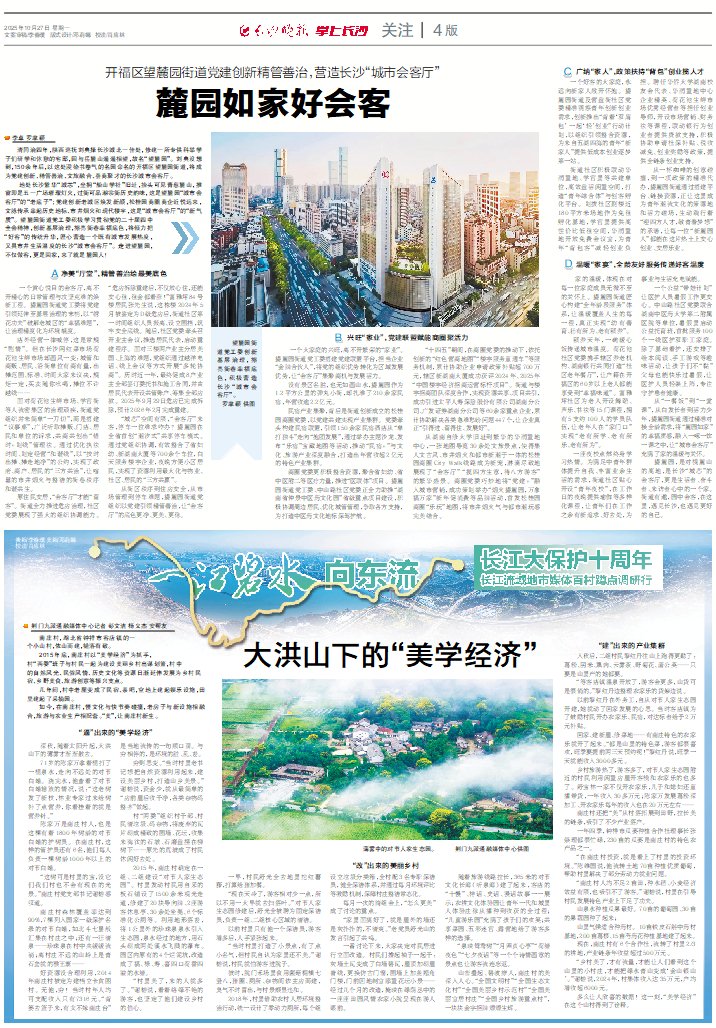
开福区望麓园街道党建创新精管善治,营造长沙“城市会客厅”
Chang Sha Wan Bao· 2025-10-27 00:02
Core Viewpoint - The article highlights the transformation of the Wangluoyuan Street in Changsha into a vibrant "city living room" through innovative governance, community engagement, and economic development initiatives, emphasizing the integration of culture, tourism, and local business growth [7][10][12]. Group 1: Urban Development and Governance - The Wangluoyuan Street has been revitalized as a "city living room," combining historical significance with modern urban life, showcasing a blend of cultural heritage and contemporary amenities [7]. - The local party committee has implemented innovative grassroots governance strategies, such as the "timed + delineated" management method, to address market management issues while fostering community collaboration [8]. - The street has initiated a "tidy and beautiful" environment through meticulous daily management and renovation projects, enhancing the overall aesthetic and livability of the area [8][10]. Group 2: Economic Growth and Business Development - The Wangluoyuan area has seen the establishment of over 210 homestays, generating annual revenues exceeding 2.2 billion yuan, driven by a collaborative approach among local businesses [10][11]. - The establishment of a party-led business alliance has facilitated resource sharing and collective marketing efforts, significantly boosting local tourism and hospitality sectors [10][11]. - The street has successfully attracted over 60 key enterprises, including major insurance and securities firms, through strategic partnerships and support initiatives [11]. Group 3: Community Engagement and Social Services - The local government has launched initiatives to support youth entrepreneurship, providing low-cost startup resources and mentorship programs to foster innovation [12]. - A comprehensive service system has been developed to cater to all age groups, ensuring that community members receive appropriate support and engagement throughout their lives [13][14]. - The implementation of a public childcare program during summer has provided essential support for healthcare workers, demonstrating the community's commitment to family welfare [14].

小微金融托举致富梦想(深度观察·做好金融“五篇大文章”) ——对山东省博兴县普惠金融发展的调研
Ren Min Ri Bao· 2025-10-26 22:21
Core Viewpoint - The development of inclusive finance in China has made significant progress, establishing a multi-level supply structure that enhances financial service coverage, accessibility, and satisfaction for the public and small enterprises [1][4]. Group 1: Inclusive Finance Development - The implementation plan for high-quality development of inclusive finance aims to establish a comprehensive system within five years, optimizing service systems and improving credit and insurance frameworks [1][3]. - The focus is on meeting diverse financial needs of the public and the real economy, addressing issues like high loan costs and accessibility [1][4]. Group 2: Local Case Study - In Jinqiu Street, Shandong Province, the local rush grass weaving industry has flourished with the support of inclusive finance, with over 300 enterprises and more than 12,000 direct employees [1][2]. - The introduction of tailored loan products like "Liu Bian Loan" has helped small business owners like Zhang Huihua secure necessary funds quickly, often with same-day disbursement [2][3]. Group 3: Financial Products and Services - Various specialized loans have been developed, including "Greenhouse Loan," "Prawn Loan," and "Catering Loan," to cater to the specific needs of local industries [3][5]. - The "Family Affinity Loan" allows family members to act as guarantors, addressing the challenge of finding collateral in rural areas [5][6]. Group 4: Insurance Role - Insurance products such as employer liability insurance and property insurance have been introduced to protect small businesses and their workers from risks, ensuring stability in production [8][9]. - The plan emphasizes the need for diverse insurance offerings that are affordable and easy to understand, enhancing the security of small enterprises [9]. Group 5: Accessibility of Financial Services - Local banks have established service stations in villages, providing essential banking services and facilitating easier access to financial products for residents [10][11]. - Initiatives like "Financial Night School" have been launched to educate the community on financial literacy, enhancing the overall understanding of financial products and services [11].
挺膺担当拓新局(学习贯彻党的二十届四中全会精神)
Ren Min Ri Bao· 2025-10-26 22:19
Group 1 - The 14th Five-Year Plan has seen significant achievements in China's modernization efforts, with a focus on high-quality development and addressing major challenges [2][4][5] - The Long March 5 rocket has successfully launched, symbolizing China's advancements in space technology and its commitment to becoming a space power [2][3] - China Huadian has increased its installed capacity to over 250 million kilowatts, a 50.6% increase from the end of the 13th Five-Year Plan, emphasizing renewable energy development [3] Group 2 - The China Construction Bank has added over 2 trillion yuan in manufacturing loans during the 14th Five-Year Plan, with a target to exceed 5 trillion yuan in the next three years [5][6] - China Mobile is focusing on 6G technology and AI, aligning with national goals for technological self-reliance and innovation [6][7] - The National Energy Investment Group is committed to enhancing clean energy transitions and contributing to a modern industrial system [7] Group 3 - The China Agricultural Development Bank is prioritizing rural revitalization and agricultural modernization, reflecting the importance of addressing rural issues in national policy [3][8] - The Hainan Free Trade Port is set to enhance financial openness, with banks like the Bank of China leading initiatives to support this development [8][9] - The construction of the Sichuan-Tibet Railway is a key project aimed at promoting high-quality regional development and modernization [10]
周末影响A股的3件大事,金融监管发声力挺,稳市箭在弦上!
Sou Hu Cai Jing· 2025-10-26 17:20
Core Viewpoint - The A-share market experienced significant volatility, with retail investors aggressively buying while institutional investors were quietly reducing their positions, raising questions about the sustainability of the recent market rally [1][7]. Group 1: Economic Policies and Market Signals - The State Council emphasized the need for impactful policies and reforms to stimulate economic growth, indicating a commitment to maintaining economic momentum [3]. - The "15th Five-Year Plan" is expected to focus on sectors like infrastructure, new energy, and high technology, which are likely to benefit from government support [3]. - Financial regulatory bodies collectively stressed the importance of market stability, with the central bank injecting liquidity through a 900 billion MLF operation [5]. Group 2: Market Dynamics and Investor Behavior - There is a notable divergence between retail and institutional investor behavior, with retail investors betting on short-term gains while institutions remain cautious, leading to a net sell-off by active funds [7]. - The recent U.S. CPI data suggests potential interest rate cuts by the Federal Reserve, which could influence A-share market dynamics, although foreign investment remains hesitant [9][10]. - The current market environment is characterized by a tug-of-war between policy support and institutional caution, indicating a complex trading landscape for investors [12].

固定收益定期:资产的缺口与久期的压力
GOLDEN SUN SECURITIES· 2025-10-26 13:03
1. Report Industry Investment Rating The report does not mention the industry investment rating. 2. Core View of the Report The bond market will continue to oscillate and recover. It is believed that the interest rate decline will be smoother in the second half of the fourth quarter. The 10 - year Treasury bond rate is expected to recover to the pre - adjustment level of 1.6% - 1.65% by the end of the year [5][19]. 3. Summary by Related Catalog 3.1 Market Performance and Interest Rate Trend - This week, funds remained loose, and the bond market declined slightly. The R007 was stable below 1.5%, and R001 was below 1.4%. The yields of 10 - year and 30 - year Treasury bonds rose by 2.4bps and 1.2bps to 1.85% and 2.21% respectively, and the yields of 3 - year and 5 - year secondary capital bonds rose by 2.9bps and 0.8bps [1][8]. - Fundamentally and in terms of funds, the trend supports the decline of interest rates. The slight adjustment of interest rates last week was driven by the increase in risk appetite such as the rise of the stock market. The GDP real and nominal growth rates in the third quarter slowed down, and the real growth rate may further decline in the fourth quarter [1][8]. 3.2 Bond Market Fund Supply and Demand - The bond market shows a situation where the source of funds is greater than the supply of assets, and the gap has recently widened. Except for funds, the liability - side growth rates of financial institutions such as banks, insurance, and wealth management have increased. The total growth rate of relevant items increased from 10.5% in May to 11.5% in September [2][9]. - Due to the insufficient supply of other fixed - income assets such as loans and non - standard assets, financial institutions need to allocate more bonds. The non - government bond social financing growth rate in September was 5.9%, significantly lower than the 11.5% growth rate of the liabilities of financial institutions. The gap may continue to widen in the future [3][12]. 3.3 Asset - Liability Mismatch in Duration - Although the bond market is in a state of increasing asset shortage in terms of total volume, the pressure of duration mismatch is increasing. The liability side of financial institutions shows a short - term characteristic, while the duration of the asset side is lengthening, especially in banks [3][15]. - The proportion of current deposits in total deposits of banks increased from 19.5% in May to 20.1% in September, while the average issuance period of local bonds in the first nine months was 15.6 years, significantly higher than the 13.1 - year level of the same period last year [3][15]. 3.4 Response to Duration Pressure - The increase in duration pressure should be viewed dynamically. The rise in long - term bond yields has partially reflected this situation. The rise in long - term interest rates may also lead to dynamic changes in supply and demand and adjustments in institutional allocation behavior [4][17]. 3.5 Outlook for the Bond Market - The bond market will continue to oscillate and recover. In the second half of the fourth quarter, as the bond - selling pressure of banks fades and the risk of public offering fee reform is settled, the decline of interest rates will be smoother [5][19]. - It is recommended to adopt a dumbbell - shaped strategy, which can control risks through duration and obtain double benefits from the overall decline of interest rates and the narrowing of spreads [5][19].
港股市场速览:市场整体回升,互联网板块领先
Guoxin Securities· 2025-10-26 01:33
Investment Rating - The report maintains an "Outperform" rating for the Hong Kong stock market [4] Core Insights - The overall market has rebounded, with the technology sector leading the gains, as evidenced by the Hang Seng Index rising by 3.6% and the Hang Seng Composite Index also increasing by 3.6% [1] - The valuation levels have returned to a relatively high level, with the Hang Seng Index's forward P/E ratio increasing by 3.4% to 12.1x [2] - Earnings expectations have been rapidly revised upwards, with the Hang Seng Index's EPS increasing by 0.5% [3] Summary by Sections Market Performance - The Hang Seng Index increased by 3.6%, with large-cap stocks outperforming mid and small-cap stocks [1] - The Hang Seng Internet Index rose by 5.9%, while the Hang Seng Biotechnology Index fell by 0.9% [1] Valuation Levels - The forward P/E ratio for the Hang Seng Index is now at 12.1x, reflecting a 3.4% increase [2] - The Hang Seng Internet Index saw a significant valuation increase of 5.9%, reaching 19.0x [2] Earnings Expectations - The EPS for the Hang Seng Index has been revised upwards by 0.5% [3] - The largest upward revision in EPS was seen in the Hang Seng Consumer Index, which increased by 1.8% [3]
市场是当今世界最稀缺的资源!保险业视角下的“十五五”,未来5年发展方向就隐藏在这些论断之中
Sou Hu Cai Jing· 2025-10-24 15:32
Core Insights - The article discusses the significance and challenges of formulating the "15th Five-Year Plan" for the insurance industry, emphasizing the need for high-quality development and strategic planning in response to national directives [1][2][3] Group 1: Importance of the "15th Five-Year Plan" - The "15th Five-Year Plan" is crucial for achieving socialist modernization and will shape the future direction and performance targets of insurance companies [1][2] - The period from now until 2035 is critical for establishing a solid foundation for modernization, requiring proactive and strategic planning [3] Group 2: Key Themes from the National Guidelines - The guidelines emphasize high-quality development, with a focus on economic construction, innovation, and meeting the growing needs of the population [4][6] - The plan outlines six major principles for economic and social development, including the importance of high-quality growth and comprehensive reforms [6] Group 3: Focus on High Technology - The plan highlights the goal of creating a new high-tech industry in China over the next decade, indicating a strong emphasis on technological advancement [7][9] - It aims to foster emerging industries and future sectors, such as renewable energy and advanced manufacturing, which are expected to generate significant market opportunities [9][10] Group 4: Domestic Market Emphasis - The strategy prioritizes the domestic market as a key driver of economic growth, with a focus on expanding domestic demand and enhancing consumer spending [11][12] - Efforts will be made to eliminate barriers to market access and improve the efficiency of the domestic economic cycle [12] Group 5: High-Level Opening Up - The plan calls for a shift from a "follower" to a "leader" in terms of international trade and investment, promoting a more proactive approach to global economic engagement [13][14] - It includes measures to enhance trade innovation and expand investment cooperation, particularly in high-standard free trade zones [14][15] Group 6: Social Welfare and Population Development - The guidelines advocate for a supportive environment for families and the elderly, aiming to improve social welfare and promote a high-quality population development strategy [16][17] - Key initiatives include enhancing childcare support, optimizing retirement policies, and developing the silver economy [17] Group 7: Agricultural Modernization - The plan emphasizes the modernization of agriculture and rural areas, aiming to increase agricultural productivity and improve living conditions in rural communities [18][19] - It includes policies to support farmers' income and enhance the effectiveness of agricultural support measures [19] Group 8: Regional Coordination - The strategy focuses on optimizing regional economic layouts and promoting coordinated development across different areas of the country [20][21] - It highlights the importance of new urbanization and marine economy development as part of the overall growth strategy [21]