绿色金融产品与服务

Search documents
绿色金融筑底色 北京农商银行连续两年入选ESG百强榜单
Jin Rong Jie Zi Xun· 2026-02-09 10:20
Core Viewpoint - Beijing Rural Commercial Bank has been recognized for its outstanding ESG practices, being included in the "2025 China Enterprise ESG 100 Index" for the second consecutive year, highlighting its commitment to green finance and sustainable development [1][2]. Group 1: ESG Recognition - The "2025 China Enterprise ESG 100 Index" was released at the "Third China Brand Image Overseas Communication Forum," selecting the top 100 companies from over 5,000 based on ESG performance [1]. - The evaluation process involved major domestic and international ESG assessment frameworks and was independently verified by the China Quality Certification Center, focusing on environmental performance, social responsibility, and corporate governance [1]. Group 2: Green Finance Practices - Beijing Rural Commercial Bank integrates green development into its business strategy, actively responding to the national "dual carbon" goals and enhancing its green finance product and service system [1]. - The bank's innovative financial product design combines ESG principles with business development, creating a unique green finance service model that meets the financing needs of enterprises undergoing green transformation [1]. Group 3: Future Plans - Looking ahead to 2026, Beijing Rural Commercial Bank plans to deepen the integration of ESG with business development, focusing on key areas such as energy conservation and environmental protection, and launching more innovative financial products [2]. - The bank's green finance innovations are expected to provide valuable insights for the financial industry in supporting ecological protection and addressing climate change, contributing to the green transformation and high-quality development of the economy and society [2].
用金融之手“贷”动绿色发展
Ren Min Ri Bao· 2025-10-20 00:07
Core Insights - Green finance is becoming a crucial financial force in promoting high-quality economic and social development in China, connecting industrial structural transformation with harmonious coexistence between humans and nature [1][2] - As of the end of Q2 this year, the balance of green loans in China reached 42.4 trillion yuan, reflecting a 14.4% growth since the beginning of the year, indicating a positive momentum in green finance development [1] Group 1 - Green finance serves as both a standard and direction, with financial tools being the means of support for sustainable development [1] - The implementation plan for high-quality development of green finance in the banking and insurance sectors emphasizes institutional innovation to promote green finance [1][2] - Financial institutions are encouraged to innovate green financial products and services tailored to local industrial characteristics and customer needs [2] Group 2 - The focus of green finance is on supporting projects with high upfront costs and long return cycles, which traditional credit models may struggle to accurately price [2] - There is a growing necessity to provide reasonable funding support for industries and projects with carbon reduction benefits, as well as for low-carbon transitions in high-emission sectors [2] - Future efforts should include summarizing effective practices in green finance and applying them to the design of transition finance policies and tools [2]
以旧换新添力 绿色消费升温
Jin Rong Shi Bao· 2025-10-15 02:17
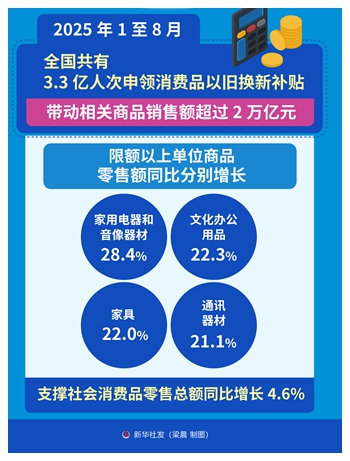
Core Insights - The article highlights the significant impact of the "trade-in" policy on consumer behavior and the economy, showcasing impressive statistics that reflect its success in promoting green consumption and economic stability [5][9]. Group 1: Trade-in Program Statistics - 8.3 million trade-in applications for vehicles have been recorded since 2025 [2]. - 8.465 million electric bicycles have been exchanged in the first half of this year [2]. - Over 110 million units of 12 major categories of home appliances have been traded in this year [3]. Group 2: Growth in Recycling and Recovery - The recycling and dismantling rates of waste home appliances have increased by 14.83% and 20% year-on-year, respectively [4]. - The Ministry of Finance has allocated 69 billion yuan for the third batch of trade-in funds [5]. Group 3: Economic Impact and Consumer Reach - The trade-in program has generated over 1.9 trillion yuan in sales related to consumer goods, benefiting more than 320 million people [5]. - The combination of government subsidies, financial support, and merchant discounts has created a powerful effect in stimulating consumption [5][6]. Group 4: E-commerce Platform Innovations - E-commerce platforms are enhancing consumer experience through various incentives, such as JD's dual subsidies and Pinduoduo's additional recycling subsidies [6]. - Tmall's trade-in program covers over 1,600 categories and 20,000 products, with daily visits exceeding 150 million [6]. Group 5: Financial Services and Consumer Demand - Financial services are crucial for supporting the trade-in program, with a focus on consumer needs for simple, safe, and low-cost options [7]. - Green consumption is increasingly driven by consumer preferences for energy-efficient and environmentally certified products, with over 90% of home appliance sales being of first-level energy efficiency [7]. Group 6: Supply Chain and Green Transformation - The trade-in policy is fostering a closed-loop system in production, with a significant increase in the recycling of waste electrical and electronic products [8]. - Companies are integrating recycled materials into their production processes, enhancing product sustainability [8]. Group 7: Challenges and Future Directions - Challenges remain in the form of high pricing for green products and inadequate recycling networks [9]. - A collaborative effort among government, financial institutions, businesses, and consumers is necessary to enhance the effectiveness of the trade-in program and promote green consumption [9].


服贸会|北京发布140个招商项目,涉新一代信息技术、医药健康等领域
Zhong Guo Jing Ying Bao· 2025-09-12 16:45
Group 1: Investment Opportunities in Beijing - Beijing has released 140 investment cooperation projects, focusing on new generation information technology and healthcare sectors [1] - Key projects include the Changping Life Valley International Precision Medicine Industrial Park and Huairou Science City Industrial Transformation Demonstration Zone [1] - Various districts in Beijing, including Chaoyang, Fengtai, and Changping, have introduced 20 "Artificial Intelligence+" application scenarios to facilitate technology transfer [1] Group 2: Green Finance Initiatives - The Tongzhou District is actively promoting green finance, with the financial sector contributing approximately 10% to the district's GDP [2] - The Beijing Green Exchange has facilitated carbon emissions trading, with a cumulative transaction volume of 1.1 million tons [2] - Over 470 financial enterprises have been established in the district, including six specialized green finance institutions [2][3] Group 3: Economic Growth in Chaoyang District - Chaoyang District aims for a GDP of 923 billion yuan by 2024, accounting for nearly one-fifth of the city's total [4] - The district's GDP reached 462 billion yuan in the first half of this year, with a year-on-year growth of 5.1% [4] - The information service and technology service sectors contribute 23.7% to the district's GDP, with over 30% contribution to growth [4] Group 4: Policies and Support in Haidian District - Haidian District plans to release a series of policies aimed at funding and talent support for enterprises [5] - The district's GDP is projected to reach 1.29 trillion yuan in 2024, contributing 26.5% to the city's economy [5] - Haidian is focusing on building a modern industrial system centered around artificial intelligence and strategic emerging industries [5][6] Group 5: Digital Economy Development in Shijingshan District - Shijingshan District aims to establish a future digital space innovation experimental zone within three years [7] - The district's GDP is projected to reach 131.29 billion yuan in 2024, with a digital economy value added accounting for 57.4% of the total GDP [7] - By 2027, the district aims to become a hub for digital economy innovation, targeting a digital economy scale exceeding 220 billion yuan [7]
聚焦价值创造,上海农商银行实现投资价值与社会效益双丰收
Huan Qiu Wang· 2025-05-13 07:40
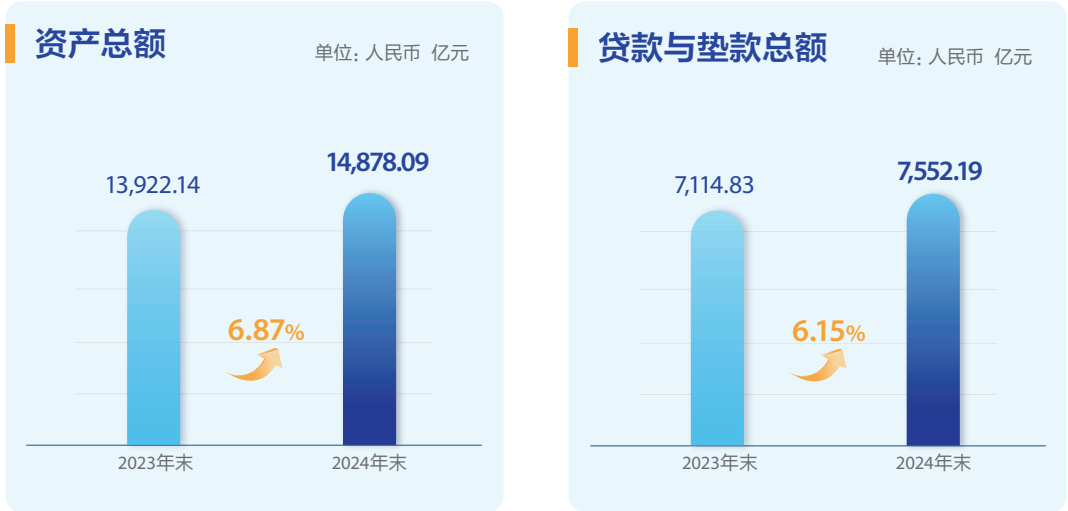
Core Viewpoint - Shanghai Rural Commercial Bank reported steady growth in revenue and profit for 2024, with a focus on enhancing asset quality and optimizing business structure [1][3] Financial Performance - The bank achieved a net operating income of 26.641 billion yuan, a year-on-year increase of 0.9% [1] - The net profit attributable to shareholders was 12.288 billion yuan, up 1.2% year-on-year, with a non-recurring net profit growth of 2.75% [1] - Total assets reached 1.49 trillion yuan, a 6.87% increase from the previous year [1] Asset Quality - Non-performing loan balance stood at 7.295 billion yuan, with a non-performing loan ratio of 0.97%, unchanged from the previous year [3] - The bank's net capital amounted to 145.266 billion yuan, an increase of 11.748 billion yuan year-on-year, with a capital adequacy ratio of 17.15%, up from 15.74% [3] Business Strategy - The bank emphasizes "value creation" and aims to balance business performance with social responsibility [3] - It has developed a comprehensive financial service system focusing on agriculture, technology, and green finance [4][5] Technology and Innovation - The bank's loans to technology enterprises reached 114.984 billion yuan, a 24.29% increase year-on-year, with the number of technology clients growing by 30.63% [4] - Digital financial services have been enhanced, with online channel users increasing to 6.4963 million, a growth of 5.93% [7] Social Responsibility and Community Engagement - The bank has established a robust inclusive finance service system, with microloans for small and micro enterprises reaching 86.608 billion yuan, an 11.14% increase [6] - It has also focused on pension finance, with a client base of 1.2751 million for pension distribution [6] Market Position and Recognition - Shanghai Rural Commercial Bank ranked 128th in the "2024 Global Bank 1000" and 23rd in the "2024 China Banking Top 100" [8] - The bank has received multiple awards for its stability and innovation in financial technology [9] Shareholder Returns - The bank proposed a cash dividend of 1.93 yuan per 10 shares, totaling 1.861 billion yuan, with a cumulative dividend payout of 4.166 billion yuan for 2024 [9][11] - The dividend payout ratio increased to 33.91%, up 3.81 percentage points from the previous year [9][11] Future Outlook - Analysts expect steady growth in net profit for 2025-2027, with a focus on maintaining high dividend rates [12]