乳饮

Search documents
2026年伊始,星城大地涌动着项目建设的热潮,各大产业园区一个个重大项目加速推进
Chang Sha Wan Bao· 2026-01-18 02:31
Core Viewpoint - The article highlights the vigorous construction activities and economic initiatives in Changsha at the beginning of 2026, showcasing a strong start for the local economy through various major projects and government measures aimed at ensuring stable economic growth. Group 1: Economic Initiatives - The provincial government has issued measures to promote a stable economic start in the first quarter of 2026, focusing on accelerating project construction among other areas [2] - The Changsha government projects an average GDP growth of 5% to 5.5% over the next five years, with R&D expenditure expected to grow by approximately 8.5% annually [3] Group 2: Project Developments - Major projects are being rapidly advanced, including the headquarters of the Changsha Beidou Industrial Safety Technology Research Institute and the Xiangjiang Intelligent Connected Transportation Industrial Park, with a total investment of about 6.58 billion yuan [5] - The construction of the Chang-Gan High-Speed Railway, a key part of the national railway network, is progressing, with significant work underway on the Liuyang section [5] Group 3: Infrastructure and Water Management - A flood control project along the Jinjiang River, spanning 21.06 kilometers, is being expedited with a total investment of approximately 5.89 billion yuan, aiming for completion before the flood season [6] Group 4: Industrial Growth - Changsha's industrial parks are focusing on signing and launching projects quickly, with a total investment of 10.2 billion yuan for the Fangheng New Materials R&D Center, showcasing the area's strong industrial momentum [7] - The Hunan Hengyu Carbon Materials Technology Co., Ltd. has also made significant progress, with its headquarters and production line construction entering the installation phase [5] Group 5: Efficient Governance - The Changsha Economic Development Zone has optimized its service efficiency, achieving a record of 57 days from project signing to groundbreaking for the Hipris Global R&D Center [8] - The region has established a robust innovation ecosystem, housing numerous national and provincial-level research platforms and high-tech enterprises [8] Group 6: Future-Oriented Initiatives - The Changsha Economic Development Zone has launched an "Artificial Intelligence + Manufacturing" action plan to enhance the manufacturing sector through AI integration [9] - The establishment of the Health Industry Innovation Center in Yuhua Economic Development Zone aims to integrate traditional Chinese medicine with modern health management, with 11 key projects signed [10]
乳饮“老江湖”的三场仗
Bei Jing Shang Bao· 2025-12-25 16:02
Group 1: Industry Overview - The Chinese food and beverage industry is undergoing significant transformation, with traditional brands facing challenges such as channel restructuring, product upgrades, and public relations issues, while emerging brands are rapidly rising through differentiated positioning and digital marketing [1] - The year 2025 is seen as a pivotal moment for established brands like Wahaha, Huiyuan, and Sanyuan, reflecting the industry's need for new strategies amidst changing market dynamics [1] Group 2: Wahaha's Challenges - Wahaha is currently embroiled in an asset dispute involving the "Zong Family Siblings" and Zong Fuli, with the company's trademark still locked in a shareholder deadlock [2] - Zong Fuli resigned from her leadership roles at Wahaha but retains a 29.4% stake, indicating a complex transition as she attempts to modernize the company while facing historical governance issues [3] - Wahaha's revenue slightly decreased from 51.2 billion yuan in 2022 to 50 billion yuan in 2023, but is projected to rebound to 70 billion yuan in 2024, showcasing a potential recovery strategy [3] Group 3: Wahaha's Strategic Moves - Wahaha has initiated a "surgical" channel reform, consolidating its distribution network to enhance control over core markets, which marks a significant shift in its long-standing channel management structure [4] - The company is focusing on professional and market-oriented adjustments, aiming to replace inertia with mechanisms that align the team closer to market demands [4] - However, internal conflicts persist, as evidenced by the registration of the "Wah Xiaozong" trademark, which has not been utilized effectively, and competition from the "Zong Sheng" brand [4][5] Group 4: Huiyuan's Capital Struggles - Huiyuan is facing a capital struggle, with its e-commerce presence severely impacted due to a control dispute that has escalated into judicial confrontations [6][8] - The company has accused its investment partner of failing to fulfill financial commitments, leading to operational difficulties and product shortages on major e-commerce platforms [8] - Huiyuan's management is actively pursuing legal action to enforce contractual obligations and restore operational stability [8] Group 5: Sanyuan's Strategic Focus - Sanyuan has shifted its strategy from scale expansion to focusing on high-margin, high-loyalty products, particularly in the low-temperature fresh milk segment [10] - The company reported sales of 2.28 billion yuan in Beijing for the first three quarters, despite a 14.6% decline compared to the previous year, indicating resilience in a challenging market [11] - Sanyuan is also expanding its product offerings to cover all life stages, aiming to create a comprehensive nutritional ecosystem [11] Group 6: Industry Trends and Future Outlook - The transformation in the beverage industry reflects a broader shift from extensive growth to refined, digital operations, highlighting the need for traditional companies to address governance, brand aging, and channel rigidity [12] - The challenges faced by established brands like Wahaha and Huiyuan signal the beginning of an industry reshuffle, emphasizing the importance of governance restructuring and adapting to consumer trends [12]

乳饮2025 | 传承、资本与产品力 老品牌的“三场仗”
Bei Jing Shang Bao· 2025-12-24 16:44
Core Insights - The Chinese food and beverage industry is undergoing significant transformation in 2025, with traditional companies facing challenges such as channel restructuring, product upgrades, and public relations issues, while emerging brands are rapidly rising through differentiated positioning and digital marketing [1] Wahaha - Wahaha is experiencing a complex situation in 2025, with its founder, Zong Fuli, resigning from key positions while retaining a 29.4% stake, indicating a struggle with historical legacy issues [2][3] - The company's revenue showed a decline from 512 billion yuan in 2022 to 500 billion yuan in 2023, followed by a rebound to 700 billion yuan in 2024, with a slight increase to 705 billion yuan in 2025, reflecting a market-driven approach under Zong Fuli's leadership [3] - Wahaha has implemented a "surgical" channel reform, consolidating its distribution rights under the "Hongsheng system" to achieve vertical control over sales terminals, marking a significant shift in its long-standing channel management structure [4] - The brand's transformation highlights the challenges of transitioning from a family-owned business to a modern corporate governance structure, with experts suggesting the need for professional management teams to rejuvenate the brand [5] Huiyuan - Huiyuan is embroiled in a capital struggle, with its e-commerce presence severely impacted, reflecting a broader control dispute that has escalated into judicial confrontations [6][8] - The company faced significant operational challenges due to a lack of funding from its restructuring investor, leading to a reliance on pre-restructuring funds and resulting in production capacity shrinkage and supply chain disruptions [8][9] - Despite these challenges, Huiyuan is attempting to pivot its strategy by launching new product lines aimed at health-conscious consumers, indicating a shift from being a raw material supplier to an integrated industry player [9] Sanyuan - Sanyuan has shifted its focus from scale expansion to high-margin, high-loyalty products, particularly in the low-temperature fresh milk segment, positioning itself strategically in the market [10] - The company reported a sales figure of 2.28 billion yuan in Beijing for the first three quarters, reflecting a decline compared to the previous year, yet it remains competitive among A-share dairy companies [11] - Sanyuan's strategy includes a localized service approach and a product matrix that caters to various life stages, aiming to create a comprehensive nutritional ecosystem [11][12] Industry Trends - The industry is transitioning from extensive growth to refined, digital operations, with traditional companies facing governance, brand aging, and channel rigidity issues, while new brands capitalize on trends like health consciousness and online shopping [12]
传承、资本与产品力:老品牌的“三场仗”
Bei Jing Ri Bao Ke Hu Duan· 2025-12-24 16:26
Core Insights - The Chinese food and beverage industry is undergoing significant transformation in 2025, with traditional brands facing challenges such as channel restructuring, product upgrades, and public relations issues, while emerging brands are rapidly rising through differentiated positioning and digital marketing [1] Group 1: Wahaha - Wahaha is experiencing a complex situation with leadership changes and unresolved trademark issues, as the new general manager faces a plan without trademark authorization [3] - Revenue for Wahaha decreased slightly from 512 billion yuan in 2022 to 500 billion yuan in 2023, but rebounded to 700 billion yuan in 2024, with a further increase to 705 billion yuan projected for 2025 [3] - The company has initiated a "surgical" channel reform, consolidating its distribution network to enhance vertical control over sales, particularly in key markets [4] Group 2: Huiyuan - Huiyuan is embroiled in a capital struggle that has escalated into a judicial confrontation, highlighting issues of corporate governance and the failure of contractual obligations by its investors [6][8] - The company has faced significant operational challenges, including a cash flow crisis and product shortages on e-commerce platforms due to unfulfilled investment commitments from its restructuring investors [7] - Despite these challenges, Huiyuan is attempting to pivot its strategy by launching new product lines aimed at health-conscious consumers and signing a major investment agreement to transform into an industry integrator [8][9] Group 3: Sanyuan - Sanyuan has shifted its focus from scale expansion to high-margin, high-loyalty products, particularly in the low-temperature fresh milk segment, positioning itself strategically in the market [10] - The company reported sales of 22.8 billion yuan in Beijing for the first three quarters, reflecting a decline compared to the previous year, but it remains competitive among A-share dairy companies [10] - Sanyuan's strategy includes localized services and a focus on product innovation across different consumer life stages, aiming to create a comprehensive nutritional ecosystem [11]

乳饮2025|传承、资本与产品力,老品牌的“三场仗”
Bei Jing Shang Bao· 2025-12-24 15:35
Core Insights - The Chinese food and beverage industry is undergoing significant transformation in 2025, with traditional brands facing challenges such as channel restructuring, product upgrades, and public relations issues, while emerging brands are rapidly rising through differentiated positioning and digital marketing [1] - The cases of Wahaha, Huiyuan, and Sanyuan illustrate the struggles and adaptations of established dairy companies in this changing landscape [1] Wahaha - In 2025, Wahaha is embroiled in a complex ownership dispute, with its brand name locked in a stock equity deadlock, impacting its operational plans [3][4] - The company experienced a revenue decline from 512 billion yuan in 2022 to 500 billion yuan in 2023, followed by a rebound to 700 billion yuan in 2024, and a slight increase to 705 billion yuan in 2025, reflecting a market-driven approach under the leadership of Zong Fuli [4] - Wahaha has initiated a "surgical" channel reform, consolidating its distribution rights under the "Hongsheng system" to enhance vertical control over sales terminals [6] - The brand's transformation is hindered by unresolved historical issues and competition from emerging brands like "Wawa Xiaozong" and "Wawa Xiaozhi" [6][7] Huiyuan - Huiyuan is facing a capital struggle, with its e-commerce presence severely impacted due to a control dispute that has escalated into judicial confrontations [8][9] - The company has accused its investment partner, Wensheng Assets, of failing to fulfill financial commitments, leading to operational difficulties and product shortages [9][10] - Despite these challenges, Huiyuan is attempting to pivot its strategy by launching new product lines aimed at health-conscious consumers, while also signing a significant investment agreement to transition from a raw material supplier to an industry integrator [10][11] Sanyuan - Sanyuan has shifted its focus from scale expansion to high-margin, high-loyalty products, particularly in the low-temperature fresh milk segment, which has become a strategic priority [12] - The company reported a sales figure of 2.28 billion yuan in Beijing for the first three quarters of the year, reflecting a decline compared to the previous year, yet it remains competitive among A-share dairy companies [12] - Sanyuan's localized strategy includes re-establishing its brand presence in urban areas, transforming traditional stores into cultural landmarks that foster community engagement [13] - The industry is experiencing a shift from extensive growth to refined, digital operations, highlighting the need for traditional companies to adapt their governance structures and product offerings to meet evolving consumer demands [13]
乳饮板块走强,欢乐家股价创新高
Bei Jing Shang Bao· 2025-12-16 03:10
Group 1 - The core viewpoint of the article highlights the strong performance of the dairy beverage sector, particularly the significant stock price increase of Huanlejia, which rose nearly 12% to a record high of 32.48 yuan per share on December 16 [1] - Huanlejia's main business includes canned fruits and coconut juice beverages, with reported revenue and net profit attributable to shareholders for the first three quarters at approximately 1.042 billion yuan and 11 million yuan, respectively, reflecting year-on-year declines of 22.25% and 87.43% [1] - Since October 16 of this year, Huanlejia's stock price has surged nearly 100% [1] Group 2 - The dairy beverage sector's growth is not limited to Huanlejia; on the morning of December 16, Huangshi Group reached a trading limit, marking its second consecutive day of gains [1] - Other companies in the sector, including Hezhima, Andeli Juice, Sunshine Dairy, Panda Dairy, Western Pastoral, Knight Dairy, Junyao Health, Yiming Foods, and Pinwo Foods, also experienced stock price increases [1]
积极看涨!今日情绪指数来了
Di Yi Cai Jing Zi Xun· 2025-09-05 14:02
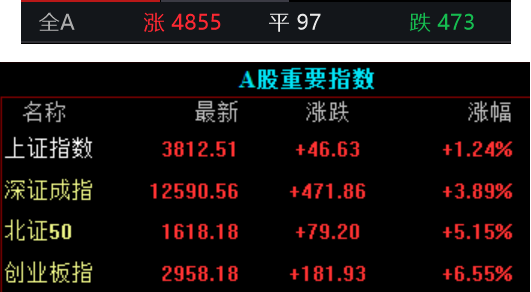
Market Overview - The market experienced a broad-based rally with 4,855 stocks rising and only 5 out of 100 stocks declining, indicating a strong profit-making effect [5] - The trading volume in both markets was 2.30 trillion yuan, down 9.42%, suggesting a "volume contraction rebound" characteristic, with overall market activity remaining low [6] Fund Flow - There was a net outflow of 42.783 billion yuan from institutional funds, while retail investors showed a net inflow, indicating a shift in investment strategy [7] - Institutional funds moved significantly from defensive sectors into high-growth sectors like new energy and AI computing, which are supported by clear industrial trends and policy catalysts [7] Investor Sentiment - Retail investor sentiment was notably high, with 75.85% of participants showing a positive outlook [8] - A significant portion of investors increased their positions, with 25.69% adding to their holdings, while 21.26% reduced their positions, reflecting a mixed sentiment among investors [13] Sector Performance - Key sectors that performed well included solid-state batteries, photovoltaics, wind power, silicon energy, and CPO, while banking stocks saw a correction and the dairy beverage sector experienced a slight decline [5]

收盘|创业板指大涨6.55% 固态电池、光伏板块爆发
Di Yi Cai Jing· 2025-09-05 08:01
Market Overview - The three major stock indices collectively rose, with the Shanghai Composite Index closing at 3812.51 points, up 1.24% [1][2] - The Shenzhen Component Index closed at 12590.56 points, up 3.89%, and the ChiNext Index closed at 2958.18 points, up 6.55% [1][2] - The total trading volume in the Shanghai and Shenzhen markets reached 2.3 trillion yuan, with over 4800 stocks rising [1] Sector Performance - Solid-state batteries, photovoltaic, wind power, silicon energy, and CPO sectors saw significant gains, while bank stocks adjusted and the dairy beverage sector experienced a slight decline [4] - The solid-state battery sector surged, with Tianhong Lithium Battery hitting a 30% limit up, and several other stocks like Jinhai Galaxy and Tianshuan New Energy also reaching 20% limit up [5] - The photovoltaic sector also performed well, with Jinao Technology hitting a 20% limit up and several other companies like Jing Sheng Machinery and Sunshine Power rising over 10% [5] Individual Stock Movements - Postal Savings Bank and Agricultural Bank fell nearly 3%, while CITIC Bank and Jiangyin Bank dropped over 2% [6] - Notable individual stock performances included Zhongji Xuchuang rising 10.26% with a trading volume exceeding 30 billion yuan, and Ningde Times increasing nearly 7% with over 22 billion yuan in trading volume [6] Capital Flow - Main capital flows showed a net inflow into sectors such as power equipment, electronics, and machinery, while there was a net outflow from non-bank financials and computers [7] - Specific stocks with significant net inflows included Xiandai Intelligent, Shenghong Technology, and Wolong Electric Drive, receiving 1.929 billion yuan, 1.338 billion yuan, and 1.223 billion yuan respectively [8] - Conversely, Pacific Securities, Supply and Marketing Cooperative, and Seres faced net outflows of 1.019 billion yuan, 571 million yuan, and 553 million yuan respectively [9] Institutional Insights - Dexion Securities noted that the Shanghai Composite Index is experiencing strong fluctuations around the 3800-point mark, with low-valuation sectors gaining strength, which may limit the adjustment space for the index [10] - Guojin Securities indicated that the recent pullback in previously strong sectors is not indicative of a market peak, but rather a technical correction due to profit-taking, with no substantial negative news affecting the market [10] - Shenwan Hongyuan emphasized strong support at 3731 points, predicting that the market will not experience a unilateral adjustment pattern [11]