
家政养老

Search documents
新政加码银发经济:4亿老年市场潜力如何释放?
Sou Hu Cai Jing· 2026-02-26 13:16
Core Viewpoint - The State Council of China emphasizes the need to develop the silver economy and elderly care services, aiming to enhance consumption among the elderly and create new consumption scenarios and business models [2] Group 1: Demographic Trends - By the end of 2025, the population aged 60 and above in China is projected to reach approximately 320 million, accounting for 23% of the total population, with those aged 65 and above reaching about 224 million, or 15.9% [2] - It is predicted that by around 2035, the elderly population (60 and above) will exceed 400 million, representing over 30% of the total population, marking a transition to a severely aging society [2] Group 2: Economic Impact - The silver economy in China is currently valued at approximately 7 trillion yuan, with projections estimating it could grow to 19.1 trillion yuan by 2035, and potentially reach 30 trillion yuan according to other studies [5][6] - From 2025 to 2040, the total consumption expenditure of individuals aged 60 and above is expected to increase by over 300%, while the overall population's consumption expenditure is projected to grow by 136% [5][6] Group 3: Elderly Care Services - The current elderly care system in China is still in the exploratory phase, with about 90% of elderly individuals opting for home care [4] - As of the end of 2025, there are approximately 41,700 elderly care institutions in China, employing around 722,000 people, with private institutions making up 52.2% of the total [8] Group 4: Policy and Support Measures - The government has introduced various fiscal, land, tax, and financial support policies to promote the integration of public and private elderly care institutions [5] - Recent measures include enhancing the supply of elderly care services and supporting technology-driven solutions in elderly care [10] Group 5: Market Dynamics - The rapid economic growth over the past 40 years has led to increased savings among the elderly, with a notable shift in their consumption patterns towards health, culture, tourism, and smart products [10] - The elderly population's consumption is expected to become a significant growth point for the national economy in the coming years, with a focus on health, wellness, and leisure spending [10]


玄元投资2026年市场展望及投资策略:跃龙在渊 进无咎 重点关注的三大方向
Xin Lang Cai Jing· 2025-12-26 03:07
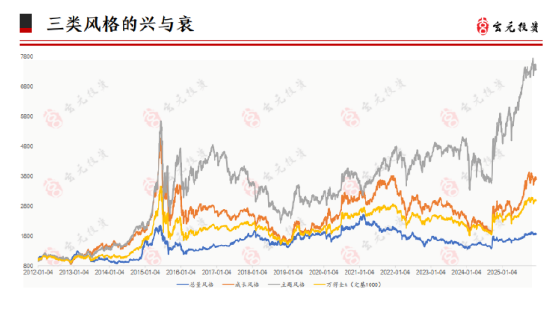
Core Viewpoint - The market is currently in a position where it can either advance or retreat, with the emphasis on the need for economic fundamentals to improve for sustained growth [1][4]. Investment Framework and Style Tracking - The investment framework is based on the equation "Stock Price = EPS × PE," highlighting that valuation (PE) fluctuations are typically larger than earnings (EPS) changes in the A-share market [2][20]. - The market opportunities can be categorized into three styles: macro style, growth style, and thematic style, with macro style being influenced by the China-US interest rate differential [2][21]. Judgments for 2026 - The market is still in a bull phase, but the rhythm of growth will differ from the past, with the current A-share market capitalization to household savings ratio at approximately 0.65, indicating that the bull market is not over yet [7][25]. - The current market is driven by liquidity and risk appetite, but this type of market has a clear "ceiling," as seen in historical liquidity-driven markets [8][26]. - Economic fundamentals are expected to gradually improve in the second half of next year, which may trigger a style switch from growth and thematic to value and cyclical stocks [9][27]. - Bull markets may experience more severe pullbacks, with historical data showing that pullbacks in bull markets are typically around 10% at the index level, but certain broad indices may see declines exceeding 20% [9][28]. Key Areas for Fundamental Improvement - Exports have been growing, but the "price for volume" model is unsustainable, with China's export price index down approximately 20% compared to developed countries, which may suppress long-term profit margins [11][28]. - Fixed asset investment has seen a decline for the first time in 36 years, influenced by various factors including a significant drop in land revenue [11][28]. - The real estate market shows high inventory levels, particularly in second-tier cities, indicating a need for stronger demand-side policies [11][29]. - There is a shift towards service consumption, with a focus on sectors such as cultural tourism, elderly care, and emotional consumption [11][29]. Policy Perspective - The current policy focus includes addressing "involution" competition, promoting technological innovation, and expanding domestic demand, with expectations for substantial policy implementation around mid-next year [14][33]. - Historical patterns suggest that policy effects are gradual and may take time to manifest, as seen in past housing reform policies [12][31]. Style Switching Considerations - A sustainable style switch from growth and thematic to value requires solid fundamental data support, as historical trends indicate a strong correlation between total style relative returns and revenue growth rates [15][34]. - Short-term style switches may occur due to trading factors, but these are often less sustainable without fundamental backing [16][34]. Focus Areas for 2026 - Key investment opportunities will revolve around three main themes: addressing involution competition, fostering new productive forces, and expanding domestic demand, with a particular emphasis on service consumption [17][35][36].
刚刚!利好,来了!
Zhong Guo Ji Jin Bao· 2025-11-18 11:23
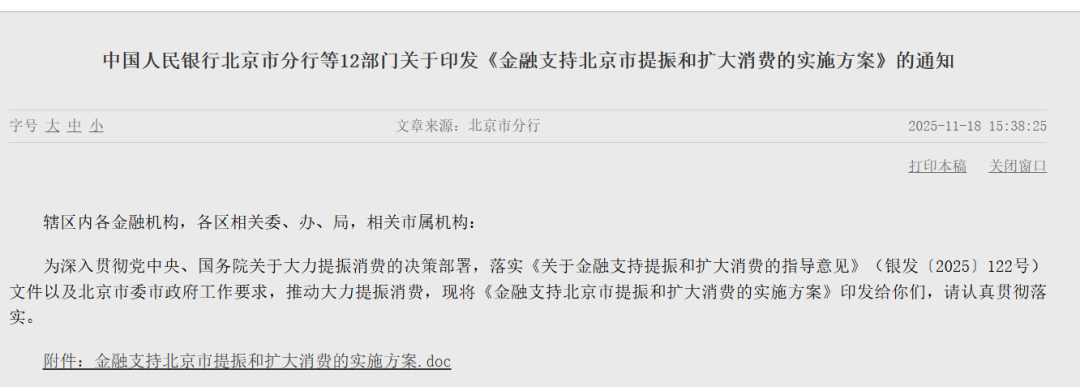
Core Viewpoint - The People's Bank of China and 12 other departments have issued a plan to enhance and expand consumption in Beijing, aiming to improve financial services in various sectors by 2030, thereby supporting the city's development as an international consumption center [2][18]. Group 1: Overall Goals - The plan aims to enhance financial service levels in Beijing's consumption sector by 2030, focusing on increasing loan balances and credit support in areas such as accommodation, dining, cultural tourism, education, and elder care [4][18]. Group 2: Financial Support for Key Areas - Increased credit support for consumer goods, particularly in automotive loans, with incentives for new energy vehicles and reduced penalties for early loan settlements [5][19]. - Promotion of cultural tourism and sports consumption by leveraging Beijing's status as a "Double Olympic City," encouraging financial institutions to innovate financing models [7][19]. - Expansion of financial services in the accommodation and dining sectors, supporting the development of local brands and themed consumption districts [8][20]. - Support for the growth of domestic services such as housekeeping and elder care, including innovative financial solutions for service providers [9][20]. - Encouragement of infrastructure development and trade circulation systems to enhance consumption [10][21]. Group 3: Support for Employment and Specific Demographics - Continued support for small and micro enterprises through interest subsidies on initial loans, aimed at boosting employment [11][22]. - Optimization of financial services for the elderly, including the issuance of dedicated cards to facilitate their consumption [12][22]. - Improvement of consumption services for foreign visitors, focusing on payment service enhancements in key areas [13][22]. Group 4: Enhancing Financial Institution Services - Financial institutions are encouraged to provide differentiated and convenient services to meet diverse consumer needs, including collaboration with e-commerce platforms [14][23]. - Increased support for bond market financing for cultural, tourism, and educational enterprises, promoting quality upgrades in consumer products [15][24]. - Development of equity financing options for quality enterprises in the consumption industry through various market mechanisms [16][24]. Group 5: Policy Coordination and Consumer Environment - Strengthening the role of monetary policy to encourage financial institutions to increase credit in key consumption sectors [25][26]. - Implementation of fiscal policies to reduce consumer credit costs and support small businesses [26][27]. - Enhancing the payment environment to stimulate consumption, including promoting digital currency initiatives [27][28]. Group 6: Organizational Support - Emphasis on coordination among financial departments and relevant authorities to ensure effective implementation of the consumption support plan [28][29]. - Financial institutions are urged to promote policies and products related to consumption support to ensure widespread access to financial services [28][29].
央行北京分行等12部门,最新发布!
券商中国· 2025-11-18 08:28
Core Viewpoint - The article outlines a comprehensive plan to enhance financial support for consumption in Beijing, aiming to boost various sectors such as accommodation, dining, cultural tourism, education, and elder care, in alignment with national policies and local government directives [1][2]. Group 1: Overall Goals - The plan aims to improve financial service levels in Beijing's consumption sector by 2030, with a focus on increasing loan balances and credit investments in key areas like accommodation, dining, and elder care [2]. Group 2: Financial Support for Key Areas - Increased credit support for goods consumption, particularly in automotive loans, with incentives for purchasing new and electric vehicles [3]. - Promotion of cultural and sports consumption through innovative financing models and increased credit investment in cultural events and tourism [4]. - Expansion of financial services in the accommodation and dining sectors, supporting local brands and themed events [5]. - Development of financial services for domestic help and elder care, aiming to reduce entry costs for service workers [6]. Group 3: Enhancing Services for Key Groups - Support for employment and income growth through reduced financing costs for small and micro enterprises [6]. - Optimization of financial services for the elderly, including tailored financial products and payment conveniences [7]. - Improvement of consumption services for foreign visitors, enhancing payment options and user experience [8]. Group 4: Enhancing Financial Institution Services - Financial institutions are encouraged to provide differentiated and convenient services, focusing on credit products for service consumption [9]. - Support for bond market financing for cultural, tourism, and educational sectors to enhance credit supply [10]. - Promotion of equity financing for quality enterprises in the consumption industry [10]. Group 5: Policy Coordination and Support - Strengthening monetary policy to encourage financial institutions to increase credit in key consumption sectors [10]. - Implementation of fiscal policies to lower consumer credit costs and support small enterprises [10]. - Development of insurance products tailored to the needs of the elderly and low-income groups [11]. Group 6: Strengthening Basic Financial Services - Continuous improvement of the payment environment to stimulate consumption, including the promotion of digital currency [12]. - Establishment of a rapid dispute resolution mechanism for financial consumer rights protection [13]. Group 7: Organizational Support - Enhanced coordination among financial departments and relevant government agencies to support consumption initiatives [14]. - Promotion of financial policies and products to ensure timely access to information and services for consumers and businesses [14].
坚定不移办好自己的事——4月政治局会议精神学习理解
申万宏源宏观· 2025-04-25 09:57
贾东旭 高级宏观分析师 侯倩楠 宏观分析师 联系人: 贾东旭 报告正文 事件:中共中央政治局4月25日召开会议,分析研究当前经济形势。 下一步政策如何定?"坚定不移办好自己的事","根据形势变化及时推出增量储备政策"。 会议对外部风险保持高度警惕,对内强调"办好自己的事"的战略定力,将"稳就业"置于"四稳"之首。 针对 当前国际形势,政治局会议首次采用"国际经贸斗争"表述,与"反腐败斗争"措辞一致。在外部环境高度不确 定背景下,会议聚焦内部高质量发展,强调"坚定不移办好自己的事","着力稳就业、稳企业、稳市场、稳 预期"。 政策工具箱将呈现灵活性与超常规双重特征,会议提出"根据形势变化及时推出增量储备政策,加强超常规 逆周期调节"。 鉴于美国关税政策不确定性加剧对我国经济预测的扰动,叠加会议"强化底线思维,备足政 策预案"的要求,预计后续政策将密切跟踪高频经济数据边际变化,在波动窗口期适时加大调节力度,确保 经济运行在合理区间。 宏观政策有何新动向?财政政策加快债务发行和使用,货币政策创设新的结构性工具。 会议要求强化政策执行效率,明确提出"加紧实施","既定政策早出台早见效"。 一方面,政治局会议敦促 既定 ...