影视动漫

Search documents
CHINA LIT(00772) - 2025 Q4 - Earnings Call Transcript
2026-03-17 13:02
Financial Data and Key Metrics Changes - In 2025, total revenues were RMB 7.37 billion, a decrease from RMB 8.12 billion in 2024 [20] - Online business revenues were RMB 4.05 billion, slightly up from RMB 4.03 billion in 2024 [20] - Revenues from IP operations decreased 20% year-over-year to RMB 3.19 billion, primarily due to scheduling delays [23] - Gross profit was RMB 3.4 billion, down from RMB 3.9 billion in 2024, with a gross margin of 46.1% compared to 48.3% in 2024 [24] - The net loss to shareholders was RMB 776 million in 2025, compared to a loss of RMB 209 million in 2024 [26] Business Line Data and Key Metrics Changes - The AI-animated drama business generated over RMB 100 million in revenue in the second half of 2025, indicating strong market potential [13][20] - The number of new titles on the QiDian reading app with over 100,000 subscriptions per chapter grew 40% year-over-year [8] - The IP merchandise products business achieved GMV exceeding RMB 1.1 billion, more than double the figure of 2024 [23] Market Data and Key Metrics Changes - The total average MAUs were 137.8 million in 2025, down from 166.6 million in 2024 [21] - MAUs on self-operated channels on Tencent products decreased to 33.7 million from 62.8 million in 2024 [22] - AI translated works contributed over 1/3 of Webnovel's total revenue, with revenue up 39% year-over-year [17] Company Strategy and Development Direction - The company aims to leverage AI to enhance content production efficiency and unlock new value growth opportunities for premium IPs [4][5] - The strategy includes deepening the content ecosystem and promoting AI integration to improve IP development efficiency [8] - The company plans to release no fewer than 200 short dramas in 2026, focusing on high-quality content [35] Management Comments on Operating Environment and Future Outlook - Management highlighted the importance of high-quality content in a competitive landscape shifting from capacity to value competition [5] - The company sees significant potential in the short drama market, emphasizing premiumization and high-quality content production [30] - The synergy between IP and AI is expected to drive sustainable long-term growth [18] Other Important Information - The company launched AI-animated drama assistant, Manju Zhushou, to boost creator productivity and enhance visual expression [7] - The company has partnered with international players like Disney and Netflix to expand its global IP footprint [38] Q&A Session Summary Question: What is the long-term opportunity in the short drama industry? - Management noted a trend towards premiumization in the short drama market, focusing on high-quality content to deliver strong returns [30] Question: What is the strategy for international markets? - Management highlighted the rapid growth in global expansion through AI, with significant contributions from AI translated works [36] Question: What are the commercialization pathways for AI animated dramas? - Management explained that AI animated drama is a new content format, with a focus on script development and partnerships for production [42]
CHINA LIT(00772) - 2025 Q4 - Earnings Call Transcript
2026-03-17 13:00
Financial Data and Key Metrics Changes - In 2025, total revenues were RMB 7.37 billion, a decrease from RMB 8.12 billion in 2024 [19] - Online business revenues were RMB 4.05 billion, slightly up from RMB 4.03 billion in 2024 [19] - Revenues from IP operations decreased 20% year-over-year to RMB 3.19 billion, primarily due to scheduling delays [23] - Gross profit was RMB 3.4 billion, down from RMB 3.9 billion in 2024, with a gross margin of 46.1% compared to 48.3% in 2024 [24] - The net loss to shareholders was RMB 776 million in 2025, compared to a loss of RMB 209 million in 2024 [26] Business Line Data and Key Metrics Changes - The AI-animated drama business generated over RMB 100 million in revenue in the second half of 2025, indicating strong market potential [12][23] - The number of new titles on the QiDian reading app with over 100,000 subscriptions per chapter grew 40% year-over-year [7] - The number of post-2000 writers earning over RMB 1 million annually increased by 150% [8] - The IP merchandise products business achieved GMV exceeding RMB 1.1 billion, more than double the figure of 2024 [23] Market Data and Key Metrics Changes - The total average MAUs were 137.8 million in 2025, down from 166.6 million in 2024 [20] - MAUs on self-operated channels on Tencent products decreased to 33.7 million from 62.8 million in 2024 [21] - AI-translated works contributed over 1/3 of Webnovel's total revenue, with revenue up 39% year-over-year [17] Company Strategy and Development Direction - The company aims to leverage AI to enhance content production efficiency and unlock new value growth opportunities for premium IPs [4][5] - The strategy includes deepening the content ecosystem and promoting AI integration to improve IP development efficiency [7] - The company plans to release no fewer than 200 short dramas in 2026, focusing on high-quality content [35] Management Comments on Operating Environment and Future Outlook - Management highlighted the profound impact of AI on the content industry and the shift from capacity competition to value competition [4][5] - The company believes that high-quality content will remain the core of its strategy, with AI serving as an engine for growth [17] - Management expressed optimism about the growth potential of the IP merchandise business and the overall IP ecosystem [56] Other Important Information - The company launched AI-animated drama assistant, Manju Zhushou, to boost creator productivity and enhance visual expression [6] - The company has partnered with international players like Disney and Netflix to expand its global IP footprint [39] Q&A Session Summary Question: What is the long-term outlook for the short drama business? - Management noted a trend towards premiumization in the short drama market, emphasizing the importance of high-quality content [30] Question: What is the strategy for international markets? - Management highlighted significant progress in global expansion, with AI translation contributing to revenue growth and market penetration [36][37] Question: What are the commercialization pathways for AI animated dramas? - Management explained that AI animated dramas are a new content format, focusing on script development and leveraging a vast IP library [42][43]
《霍去病》爆火,短剧之后又一个风口已来
第一财经· 2026-03-10 04:56
Core Viewpoint - The article discusses the rapid rise of AI-generated short films, particularly the success of the AI short film "Huo Qubing," which has garnered significant attention and sparked discussions about the potential of AI in the film industry. The production cost is highlighted as being low, but the actual costs include more than just computational expenses, indicating a shift towards industrialized production in the AI film sector [3][5]. Industry Overview - The AI short film "Huo Qubing" is produced using the "Nano Comic Drama Production Line," which is the first industrial-grade AI production platform in China. This platform has quickly become a benchmark in the AI comic drama sector, demonstrating efficiency, quality, and cost-effectiveness in production [5]. - The market for micro-short dramas and comic dramas has surpassed 100 billion yuan, nearly double the total box office of national films in the same period. The domestic comic drama market is expected to grow from approximately 168 billion yuan in 2025 to over 240 billion yuan in 2026, with a year-on-year growth rate exceeding 40% [5][6]. Technological Impact - AI comic dramas are transforming the industry by significantly reducing the time and expertise required for production. New entrants to the field can quickly learn to use AI tools, allowing for a diverse range of professionals to contribute to the creation of comic dramas [7][8]. - The production process involves using AI to analyze and generate content from existing literature, enabling rapid creation of episodes. This has led to a dramatic increase in production capacity, with individual creators able to produce 10-20 episodes per day [8][18]. Market Dynamics - The year 2025 is referred to as the "Year of AI Comic Dramas," with a significant increase in the number of AI-generated short films on platforms like Douyin. The number of AI-generated micro-short dramas surged from 4 in January to 217 by November [15][17]. - Major internet companies are entering the AI comic drama space, with platforms like Youku and iQIYI launching collaborative initiatives. The competition is intensifying, with high revenue-sharing models being offered to attract quality creators [17][18]. Future Outlook - The introduction of advanced AI models is expected to further reduce production costs from 1,500-2,500 yuan per minute to 400-1,000 yuan, potentially tripling production capacity within six months [18]. - Despite the rapid growth and interest in AI comic dramas, concerns remain about content quality and originality. The industry may face challenges related to content saturation and the need for compelling storytelling to engage audiences [20][22].


AI漫剧:百亿风口下90%在亏损,一场内卷和突围的战争
虎嗅APP· 2026-03-09 10:33
Core Viewpoint - The AI video generation industry is experiencing rapid growth, with significant advancements in technology leading to increased efficiency and reduced costs, particularly in the production of AI-generated short dramas and animations [4][13][19]. Group 1: Market Dynamics - The year 2025 is anticipated to be the "AI Manhua Year," with the number of AI-generated micro-dramas increasing from 4 in January to 217 by November, indicating a substantial market shift [6][7]. - The market for manhua is projected to exceed 22 billion by 2026, contributing 50% of the growth in the short drama sector, with user numbers expected to rise from approximately 120 million in 2025 to 280 million [7][10]. - The influx of various players from traditional media, animation, and technology sectors into the manhua space is creating a competitive environment, with over 80,200 new registrations in 2025, marking a 37.1% increase [7][9]. Group 2: Technological Advancements - The introduction of Seedance 2.0 has significantly improved production efficiency, reducing costs from 1,500-2,500 yuan per minute to 400-1,000 yuan, and increasing daily output to 10-20 episodes [14][15]. - Major advancements in AI video models have led to breakthroughs in character consistency and audio-visual synchronization, enabling the production of high-quality content with fewer resources [14][16]. - The emergence of one-stop production tools has streamlined the creation process, covering 80% of the workflow from script to final output, thus enhancing overall productivity [15][18]. Group 3: Industry Challenges - Despite the rapid growth, the industry faces intense competition, with a low success rate for new entries; only 0.16% of the 60,946 manhua produced in 2025 achieved over 100 million views [20][21]. - Many creators are struggling to monetize their content, with reports indicating that 90% of non-top-tier companies are operating at a loss [21][22]. - The market is characterized by a high degree of content homogeneity, leading to challenges in attracting and retaining viewers [20][21]. Group 4: Future Trends - The industry is expected to evolve towards a hybrid model combining live-action and AI-generated elements, with a focus on high-quality productions [22][23]. - There is a growing emphasis on international expansion, with predictions that China's short drama export revenue will reach $2.38 billion by 2025, driven by demand in Southeast Asia and other regions [23][24]. - The talent gap in the industry remains a significant challenge, with a shortage of professionals skilled in both AI tools and visual storytelling [23][24].






AI+内容系列(一):复盘2025,AI漫剧如何撬动百亿级内容生态
Changjiang Securities· 2026-03-06 01:20
Investment Rating - The report maintains a positive investment rating for the industry [10] Core Insights - The AI comic drama market is expected to experience explosive growth in 2025, with market size projected to reach 168 billion, potentially exceeding 240 billion as AI technology evolves [6][20] - The supply side of the comic drama market is diversifying, with a significant increase in production capacity and a variety of content types emerging [6][22] - Demand is driven by a young male demographic, primarily under 30, with a strong willingness to pay for content [30][31] Summary by Sections Market Overview - Prior to 2025, the comic drama market had fewer than 1,000 works. By the end of 2024, initial supply efforts began, but significant scale effects were not yet realized. The market is expected to explode in 2025 due to advancements in AI technology [3][20] Supply and Demand Dynamics - The supply side is characterized by diverse sources, including novels, comics, and live-action dramas, with a notable potential for adaptation from existing successful formats [22] - The demand side shows a robust growth trend, with a projected monthly compound growth rate of approximately 12% from June to December 2025 [6][30] Production Efficiency - AI technology is expected to reduce production cycles by over 50%, from 50-60 days to under 30 days, significantly lowering costs to 10-30% of traditional dynamic comics [7][36] - The integration of AI tools allows production teams to focus on core creative tasks, enhancing overall efficiency [7][36] Commercialization and Revenue Models - The industry is evolving towards a commercialized closed-loop model, with distinct monetization paths for each role in the value chain, including copyright holders, producers, distributors, and platforms [45] - Various monetization strategies are being employed, including multi-platform revenue sharing, copyright licensing, and long-term IP development [44][45] Competitive Landscape - Major platforms are actively supporting the comic drama sector with comprehensive policies that include traffic, funding, and technology support [8] - The market is witnessing a significant increase in the number of new works, with a projected total of 37,583 new comic dramas in 2025, indicating a competitive and rapidly evolving landscape [51][56]
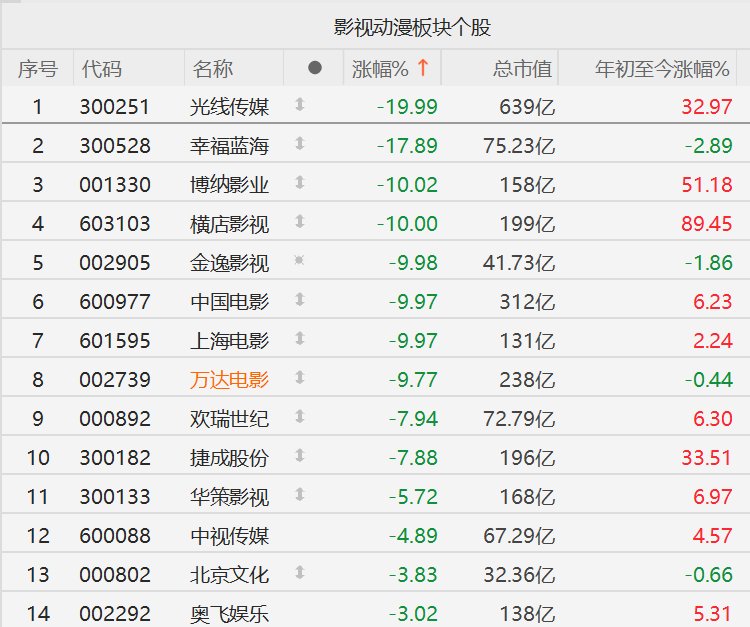
A股影视动漫股跌幅进一步扩大,光线传媒、横店影视、中国电影等多股跌停
Ge Long Hui· 2026-02-24 02:46
Core Viewpoint - The A-share market for film and animation stocks has seen a significant decline, with multiple companies experiencing substantial drops in their stock prices, indicating a bearish trend in the sector [1]. Group 1: Stock Performance - Light Media (光线传媒) has hit the daily limit down of 20%, with a total market value of 639 billion and a year-to-date increase of 32.97% [2]. - Happy Blue Sea (幸福蓝海) has dropped nearly 18%, with a market value of 75.23 billion and a year-to-date decrease of 2.89% [2]. - Bona Film Group (博纳影业) has decreased by 10.02%, with a market value of 158 billion and a year-to-date increase of 51.18% [2]. - Hengdian Film (横店影视) has also fallen by 10%, with a market value of 199 billion and a year-to-date increase of 89.45% [2]. - China Film (中国电影) and Golden Eagle (金逸影视) both experienced a drop of nearly 10%, with market values of 312 billion and 4.173 billion respectively [2]. - Shanghai Film (上海电影) and Wanda Film (万达电影) are close to hitting the limit down, with declines of 9.97% and 9.77% respectively [2]. - Other companies like Huanrui Century (欢瑞世纪) and Jiecheng Co. (捷成股份) have seen declines of over 7% and 5% respectively [2].


《熊出没》系列票房破90亿!春节档“钉子户”继续揽财,母公司亏惨,高管一周跑仨
新浪财经· 2026-02-22 07:05
Core Viewpoint - The article highlights the contrasting performance of the "Boonie Bears" franchise, which continues to thrive at the box office, against the struggling financial performance of its parent company, Huasheng Fantawild [3][12]. Box Office Performance - The total box office for the 2026 Spring Festival period exceeded 4.6 billion, with "Boonie Bears: Year of the Bear" ranking fourth and grossing over 570 million [3][5]. - The cumulative box office for the "Boonie Bears" series has surpassed 9 billion, making it one of the most successful animated film series in Chinese cinema history [7]. Company Financial Performance - Huasheng Fantawild's financial health has been under pressure, with a reported revenue of approximately 6.33 billion from its animation segment, which is significantly lower than expected [13]. - The company's total revenue for 2024 was about 69.1 billion, showing a year-on-year growth of 3.62%, but net profit dropped by 11.19% to approximately 7.11 billion [13]. - In 2025, the box office for "Boonie Bears: Rebooting the Future" fell to 821 million, and the company reported a revenue decline of 17.87% in the first half of the year [14]. Management and Operational Challenges - Huasheng Fantawild has faced high levels of debt, with a debt ratio of 50.51%, and has over 10 billion in liabilities [14]. - The company has experienced significant management instability, with three key executives resigning within a week in early 2026, raising concerns about governance and operational continuity [19][20]. Market Position and Consumer Perception - The "Boonie Bears" franchise is perceived as a family-friendly film suitable for children, which has contributed to its consistent attendance during the Spring Festival [8]. - Despite its popularity among younger audiences, the franchise faces challenges in retaining older viewers, as the content is often seen as too juvenile for adults [11].

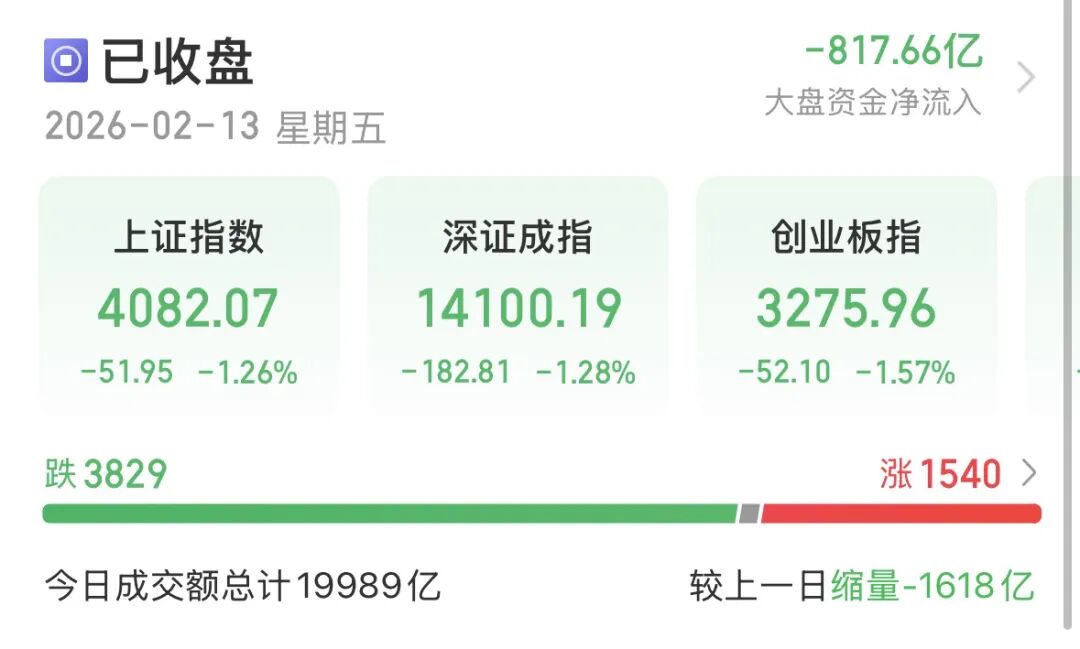
A股缩量回调收官,资源和科技股领跌,节后行情可期
Guo Ji Jin Rong Bao· 2026-02-14 01:12
Market Overview - The last trading day before the Spring Festival on February 13 saw a significant decline in trading volume, dropping below 2 trillion yuan, with 3,829 stocks closing lower [1][4] - The Shanghai Composite Index fell by 1.26% to 4,082.07 points, while the ChiNext Index decreased by 1.57% to 3,275.96 points [4] Sector Performance - Resource and technology stocks led the decline, with significant drops in sectors such as non-ferrous metals, building materials, and oil and petrochemicals, all falling over 3% [8] - Natural gas, gold concepts, and rare earth permanent magnets were among the hardest-hit resource stocks [5][8] Trading Dynamics - The market exhibited typical defensive adjustment characteristics, with increased caution among investors as they prepared for the holiday [3][12] - The trading volume decreased significantly, with only three stocks exceeding 100 million yuan in daily trading volume [5][11] Investment Sentiment - Analysts noted that the market is currently in a phase of stock selection and defensive positioning, with a focus on technology growth and policy-supported sectors [11][14] - There is an expectation for increased market activity post-holiday, contingent on external market conditions remaining stable [3][13] Future Outlook - Historical data suggests that the A-share market tends to perform better after the Spring Festival, with potential for upward movement if trading volume rebounds [13][14] - Key sectors to watch include technology, AI, and high-end manufacturing, which are expected to benefit from ongoing trends and policy support [14][15]


A股缩量回调收官 节后行情可期
Guo Ji Jin Rong Bao· 2026-02-14 00:19
Market Overview - The market is experiencing a defensive adjustment ahead of the holiday, with increased capital speculation, indicating preparation for new capital inflows post-holiday [2][11][13] - Major indices closed lower, with the Shanghai Composite Index down 1.26% at 4082.07 points, and the ChiNext Index down 1.57% at 3275.96 points, reflecting a general downward trend [4] Sector Performance - Resource and technology stocks led the decline, with significant drops in sectors such as non-ferrous metals, construction materials, and oil and petrochemicals, all falling over 3% [5][8] - Conversely, sectors like aerospace equipment and film and animation showed positive performance, indicating sector-specific resilience [5] Trading Volume and Market Sentiment - Trading volume decreased significantly, with a total daily turnover of 161.9 billion yuan, marking a drop below 2 trillion yuan across the three major markets [4][7] - The market sentiment is cautious, with a notable retreat of leveraged funds as investors seek to avoid risks associated with the long holiday [12][13] Investment Recommendations - Analysts suggest focusing on technology growth sectors, particularly AI and power equipment, which are expected to benefit from global capital expenditure expansion and domestic infrastructure investments [16][17] - There is a recommendation to adopt a balanced investment strategy, combining offensive positions in technology with defensive assets like high-dividend stocks to mitigate volatility [17]
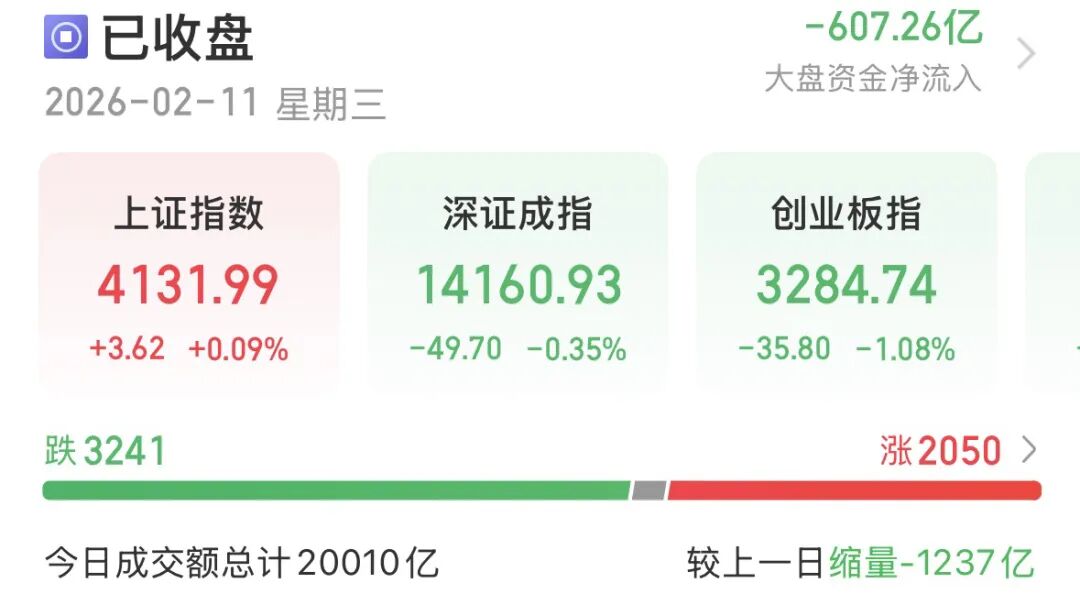
A股“春节效应”显现 持股还是持币过节?
Guo Ji Jin Rong Bao· 2026-02-11 13:42
Core Viewpoint - The A-share market continues to experience a shrinking volume and differentiated fluctuations, with a trading volume dropping to 2 trillion yuan, reflecting a cautious sentiment among investors ahead of the holiday [4][12][13]. Market Performance - On February 11, the Shanghai Composite Index rose by 0.09% to 4131.99 points, while the ChiNext Index fell by 1.08% to 3284.74 points, indicating mixed performance across indices [4][5]. - A total of 2050 stocks rose, with the building materials sector leading the gains, while resource stocks such as non-ferrous metals, coal, and chemicals performed well [4][5][9]. Trading Volume and Investor Sentiment - The trading volume across the three markets decreased by 123.7 billion yuan compared to the previous trading day, reaching 2 trillion yuan, as investor trading willingness declined [4][12]. - Margin financing balances in the Shanghai and Shenzhen markets fell to 2.66 trillion yuan, indicating a decrease in leveraged trading activity [4]. Sector Performance - The building materials sector saw a rise of 3.29%, with six stocks hitting the daily limit, while the non-ferrous metals sector increased by 2.39% [9][10]. - The communication sector experienced a decline of 2.08%, reflecting a broader trend of sectoral differentiation [7][8]. Investment Strategy - Analysts recommend maintaining a position of around 70% in stocks during the holiday, focusing on a "high-dividend blue-chip + technology growth" barbell strategy [4][18]. - Suggested sectors for investment include traditional consumption, traditional manufacturing, and high-dividend stocks, which are expected to provide stability during potential market fluctuations [18][19].