
存量资金博弈

Search documents
A股“春节效应”显现 持股还是持币过节?
Guo Ji Jin Rong Bao· 2026-02-11 13:42
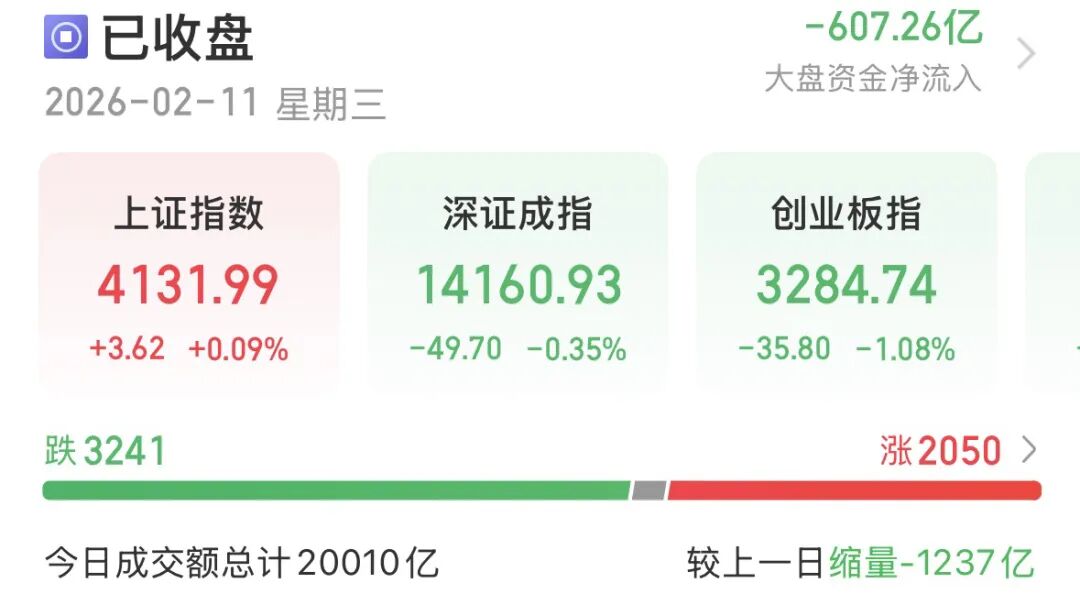
Core Viewpoint - The A-share market continues to experience a shrinking volume and differentiated fluctuations, with a trading volume dropping to 2 trillion yuan, reflecting a cautious sentiment among investors ahead of the holiday [4][12][13]. Market Performance - On February 11, the Shanghai Composite Index rose by 0.09% to 4131.99 points, while the ChiNext Index fell by 1.08% to 3284.74 points, indicating mixed performance across indices [4][5]. - A total of 2050 stocks rose, with the building materials sector leading the gains, while resource stocks such as non-ferrous metals, coal, and chemicals performed well [4][5][9]. Trading Volume and Investor Sentiment - The trading volume across the three markets decreased by 123.7 billion yuan compared to the previous trading day, reaching 2 trillion yuan, as investor trading willingness declined [4][12]. - Margin financing balances in the Shanghai and Shenzhen markets fell to 2.66 trillion yuan, indicating a decrease in leveraged trading activity [4]. Sector Performance - The building materials sector saw a rise of 3.29%, with six stocks hitting the daily limit, while the non-ferrous metals sector increased by 2.39% [9][10]. - The communication sector experienced a decline of 2.08%, reflecting a broader trend of sectoral differentiation [7][8]. Investment Strategy - Analysts recommend maintaining a position of around 70% in stocks during the holiday, focusing on a "high-dividend blue-chip + technology growth" barbell strategy [4][18]. - Suggested sectors for investment include traditional consumption, traditional manufacturing, and high-dividend stocks, which are expected to provide stability during potential market fluctuations [18][19].

警报!A股资金像无头苍蝇乱撞,指数一调整,个股就普跌,资源股暴涨,科技股就崩盘
Sou Hu Cai Jing· 2026-02-01 09:05
Market Overview - The A-share market is experiencing a chaotic state, with major indices showing little decline while most individual stocks are significantly down, leading to investor frustration [1] - On January 26, 2026, despite minor index declines, over 3,700 stocks fell, while resource stocks like gold and coal surged, indicating a lack of coherent market direction [1][3] Capital Flow Dynamics - The chaotic market reflects intense but disorganized capital battles among several key sectors, including high-position cyclical stocks and technology growth sectors [3][4] - High-position cyclical stocks, particularly in non-ferrous metals, saw significant price fluctuations driven by speculative capital, leading to market panic when these stocks dropped [3][4] - Funds exiting high-position stocks did not disappear but shifted towards technology sectors like semiconductors and AI, which are supported by clear industrial policies, although this transition was weak due to overall market fear [4][5] Investment Behavior - As high-position and growth sectors underperformed, some funds moved towards undervalued stocks in sectors like liquor, real estate, and finance for safety, but this was more of a technical rebound rather than a fundamental recovery [5][10] - The current market is characterized by a "stock selection" approach rather than a focus on index performance, emphasizing the importance of individual stock value assessments [13] Market Sentiment and Valuation - The extreme volatility is exacerbated by a lack of new capital entering the market, leading to a "stockholder's game" where existing funds are aggressively reallocated, causing erratic price movements [6][8] - Many high-flying stocks have reached historical valuation peaks, creating bubbles that are vulnerable to rapid declines upon any negative news, while traditional sectors remain undervalued but lack growth expectations [8][9] Sector Analysis - For high-position cyclical products like non-ferrous metals and precious metals, the risk-reward ratio has deteriorated significantly, making further investment risky [9] - In contrast, sectors like semiconductors and robotics, despite recent adjustments, have strong long-term growth prospects supported by domestic demand and favorable policies, presenting potential investment opportunities [11] Strategic Recommendations - Investors are advised to manage their positions carefully, maintain a comfortable cash reserve, and avoid impulsive trading behaviors in a volatile market [13][14] - A balanced investment strategy should include both growth sectors with clear performance expectations and stable dividend-paying stocks to mitigate volatility [14][16] - Reducing trading frequency and focusing on long-term fundamentals rather than short-term market fluctuations is recommended for navigating the current market environment [16] Broader Market Context - The Hong Kong stock market is showing different characteristics, with technology indices at historically low valuations and increasing international capital interest, providing an alternative investment avenue [16]
加密币连续下跌,“数字黄金”为何难创新高?
Guo Ji Jin Rong Bao· 2026-01-22 04:29
Group 1 - The cryptocurrency market experienced a corrective downturn after a significant recovery, with Bitcoin peaking near $98,000 before falling to $88,900, reflecting a 4.66% drop in 24 hours [1][2] - Ethereum also faced a decline, dropping 7.98% in the same period, while other cryptocurrencies like BNB and Solana saw similar downturns [2] - The primary driver of this downturn is attributed to external macroeconomic factors, including a recent escalation in the US-EU tariff conflict and a significant drop in major US stock indices [2][4] Group 2 - The recent surge in Bitcoin's price was largely influenced by an improved macroeconomic environment in the US, including a more dovish stance from the Federal Reserve and the initiation of a Reserve Management Plan [4] - The current market phase is characterized by a digestion of previous gains, with institutional investors adjusting their positions based on risk assessments rather than emotional trading [5][6] - Bitcoin's volatility is heightened due to its reliance on institutional capital and the constraints imposed by global liquidity conditions, making it less of a pure safe-haven asset compared to gold [6]
4000点 :“ETC”收费站?| 谈股论金
水皮More· 2025-11-14 09:59
Market Overview - The A-share market experienced a collective decline today, with the Shanghai Composite Index falling by 0.97% to close at 3990.49 points, the Shenzhen Component Index dropping by 1.93% to 13216.03 points, and the ChiNext Index decreasing by 2.82% to 3111.51 points [3] - The trading volume in the Shanghai and Shenzhen markets reached 1.9581 trillion, a decrease of 83.9 billion compared to the previous day [3] Banking Sector Performance - The banking sector has been a key beneficiary during market fluctuations, with Agricultural Bank of China and Industrial and Commercial Bank of China both reaching historical highs, at 8.68 yuan and 8.38 yuan per share respectively [4] - The strategy of boosting bank stocks is aimed at attracting investor attention, leveraging the high weight of the banking sector to uplift related sectors and indices, and creating a positive market sentiment [5] Market Dynamics - Despite initial gains in the indices, significant declines were observed, with the Shanghai Composite Index down 0.97% and the Shenzhen Component Index down approximately 1.93% [6] - The primary reason for the A-share market's low opening was the sharp decline in the US stock market, particularly in the technology sector, with semiconductor stocks experiencing notable drops due to poor earnings reports from major companies [6] Investor Behavior - The current fluctuations around the 4000-point mark are considered normal, attributed to a phase of stock market competition among existing funds [7] - The frequent entry and exit of quantitative funds are intensifying market volatility, which may lead to a depletion of market vitality over the long term [7] - If retail investor funds continue to dwindle, the market's ability to maintain stability around the 4000-point level will face significant challenges [8]

A股“4000点关口”博弈!基金经理激辩科技股估值
Cai Jing Wang· 2025-11-03 11:00
Core Viewpoint - The A-share market is experiencing intensified competition and divergence among fund managers following the Shanghai Composite Index's rise above 4000 points, with varying strategies and performances reflecting differing market outlooks [1][2][3] Market Dynamics - The Shanghai Composite Index reached 4000 points for the first time in a decade, but market enthusiasm remains subdued, with trading volumes around 2 trillion yuan and significant adjustments in high-position sectors [2][3] - Fund managers exhibit a cautious stance, with over 40% of actively managed equity funds reducing stock positions despite the rising market, indicating a deep-seated market divergence [2][3] - The total share of actively managed equity funds decreased by 163.4 billion units in Q3, with net redemptions reaching 216.2 billion units, highlighting investor caution amid rising fund values [2] Fund Manager Perspectives - Fund managers express varied opinions on the market, with some suggesting a potential pause in the bull market while others remain optimistic about long-term growth driven by economic recovery and supportive policies [3][4] - The technology sector is a focal point of debate, with some managers advocating for cautious investment due to high valuations, while others emphasize the sector's long-term potential [4][5] Performance Disparity - There is a stark performance divide among fund managers, with over 40 funds doubling their performance in the past year, while more than 200 funds remain in a loss position [7] - Investment strategies significantly influence performance, with growth-oriented managers benefiting from emerging industries, while those adhering to value investing principles lag behind [7] Future Outlook - Market predictions are mixed, with expectations of continued liquidity but potential volatility due to changes in high-risk funding sources [8] - The technology sector is viewed as a key driver for market growth, with recommendations to focus on sectors aligned with national strategies and industry trends, such as semiconductors and renewable energy [8]
10年新高!一波大行情要来了?
大胡子说房· 2025-10-30 11:07
Core Viewpoint - The Shanghai Composite Index has reached 4000 points for the first time in 10 years, indicating a gradual increase in market enthusiasm, despite a lack of strong profit-making effects for investors [1][2][28]. Market Performance - The Shanghai Composite Index closed at 4002.83, with a gain of 14.61 points (+0.37%), while the Shenzhen Component Index and the ChiNext Index also saw increases of 120.55 points (+0.90%) and 43.70 points (+1.35%) respectively [2]. - The index has risen from a low of 3100 points this year, reflecting a warming market sentiment [2]. Investor Sentiment - Many investors are conflicted about entering the market, fearing they might buy at a peak while also wanting to capitalize on the ongoing bull market [3][4]. - The current market reaction to the index reaching 4000 points is notably subdued compared to previous instances, with less media excitement and fewer discussions [6][8]. Market Dynamics - The speed of retail investors moving their deposits has decreased compared to previous bull markets, indicating a lack of confidence in sustained upward movement [7]. - The primary reason for the lack of enthusiasm is that while the index has risen, the actual account balances of many investors have not increased, leading to a disconnect between index performance and individual investor returns [9][10][12]. Market Control - The new high in the index is largely attributed to government intervention rather than an influx of new capital, suggesting that the market is currently in a phase of stock selection rather than broad-based growth [15][18]. - The absence of sufficient incremental capital means that the market is characterized by a struggle between existing funds, often resulting in larger funds dominating smaller ones [19][21]. Future Outlook - Historically, the Shanghai Composite Index has previously surpassed 4000 points in 2007 and 2015, both times leading to further increases towards 5000 points [26][28]. - Current monetary policies, both domestically and internationally, are supportive of continued upward movement in the index, which could enhance profit-making opportunities in the future [30][31]. Investment Strategy - Investors are advised to identify undervalued sectors and stocks that may attract large capital flows as the index continues to rise [36]. - The expectation is that as the index approaches 5000 points, the profit-making effect will gradually improve, although this process may take time and require patience [35].

大A突破新高!一波大行情要来了?
大胡子说房· 2025-10-29 04:23
Core Viewpoint - The Shanghai Composite Index has reached 4000 points for the first time in 10 years, indicating a gradual increase in market enthusiasm, despite the lack of strong market reactions and profit-making opportunities for investors [1][2][6][9]. Market Performance - The Shanghai Composite Index closed at 4002.83, with a 0.37% increase, while the Shenzhen Component Index and the ChiNext Index also saw gains of 0.90% and 1.35% respectively [2]. - The index has risen from a low of 3100 points this year, reflecting a warming market sentiment [2]. Investor Sentiment - Many investors are conflicted about entering the market, fearing they might buy at a peak and face subsequent declines [3][4]. - The current market reaction to the index reaching 4000 points is muted compared to previous instances, with less media excitement and fewer discussions [6][8]. Profitability Concerns - Despite the index reaching new highs, the overall market has not shown strong profit-making effects, with many investors' account balances remaining stagnant since August or September [9][10][12]. - The divergence between index performance and individual stock profitability is attributed to a lack of incremental capital entering the market, leading to a scenario where large funds dominate the trading landscape [18][21]. Historical Context - Historically, the Shanghai Composite Index has reached 4000 points twice before, in 2007 and 2015, both times followed by a rise to 5000 points [26][27]. - Current government policies continue to support the capital market, suggesting potential for further upward movement in the index [27][30]. Future Outlook - The market is expected to transition from a phase of stock selection to one where larger funds will begin to invest in undervalued sectors and stocks, potentially improving the overall profitability for investors [32][34]. - Investors are advised to identify undervalued sectors and stocks that may attract large funds as the index continues to rise [36].

冲上4000点之后,接下来大A会是什么走势?
大胡子说房· 2025-10-28 11:50
Core Viewpoint - The Shanghai Composite Index has reached 4000 points for the first time in 10 years, indicating a gradual increase in market enthusiasm, despite concerns about potential market peaks and the lack of strong profit-making effects for investors [1][2][4]. Market Performance - The Shanghai Composite Index closed at 3988.22, down 0.22%, while the Shenzhen Component Index and the ChiNext Index also experienced declines [2]. - The index has risen from a low of 3100 points this year, reflecting a warming market sentiment [2]. Market Sentiment - Unlike previous instances when the index reached 4000 points, there is less media excitement and public discussion this time, attributed to a slower pace of retail investors moving their deposits [3][4]. - The lack of strong profit-making effects is a significant factor, as many investors have not seen corresponding increases in their account balances despite the index's rise [4][5]. Market Dynamics - The recent index highs are believed to be driven by government intervention rather than new capital inflows, leading to a situation where market dynamics are characterized by existing funds competing against each other [5][6]. - The focus of large funds is on stocks that significantly contribute to the index, resulting in a lack of broad market participation and profit-making opportunities for smaller stocks [6][7]. Future Outlook - Historical patterns suggest that after reaching 4000 points, the index has previously moved towards 5000 points, supported by government policies favoring the capital market [6][7]. - The current monetary environment, both domestically and internationally, is conducive to further index growth, with expectations of increased capital flow into previously undervalued stocks as the market stabilizes [7][8]. Investment Strategy - Investors are advised to identify undervalued sectors and stocks that may attract large funds as the index approaches 5000 points, as this could present significant profit opportunities [7][9]. - The upcoming months are seen as a transitional phase, where patience and strategic positioning in the market will be crucial for maximizing returns [7][8].

早盘直击 | 今日行情关注
申万宏源证券上海北京西路营业部· 2025-07-10 02:00
Market Overview - The Shanghai Composite Index approached 3500 points on Tuesday, leading to a bullish market on Wednesday with a strong opening and a successful breakthrough of the 3500 mark [1] - However, the market was primarily driven by existing funds, with no significant increase in new capital, affecting trading volume [1] - Market hotspots were rapidly rotating, but the afternoon session saw the insurance sector hit new daily lows, negatively impacting the performance of major weighted stocks [1] Trading Dynamics - In the final trading phase, key sectors such as banks, coal, and oil quickly weakened, with increased trading volume suggesting institutional funds were exiting, causing the index to decline [1] - The overall market exhibited characteristics of being driven by existing funds, with a lack of new capital impacting trading volume [1] - Short-term market trends showed weak sustainability and a noticeable disconnect from fundamental support, indicating speculative trading behavior [1] Future Outlook - The short-term market is expected to remain in a consolidation phase, with any upward movement being gradual and characterized by a steady, cautious approach [1] - Key factors to monitor include macroeconomic data for the second quarter and international trade relations, as well as trading volume and intra-day hotspot changes in the Shanghai and Shenzhen markets [1]

票房崩了
猫笔刀· 2024-12-25 14:17
今天看到一个数据,昨晚平安夜的电影票房只有3800多万,呈现断崖式下跌。。 我下载了专门查票房的app灯塔,它有专门的圣诞档(12月24日+12月25日)统计,今年的圣诞档到目前为止 7629万,还有几个小时,最后大概是8000万出头。 2023年的圣诞档是25541万、2022年是22200万、2021年是30406万、2020年是44059万、2019年是26628万、2018 年是22045万、2017年是50540万、2016年是57718万、2015年是58544万、2014年23135万。 再往前就没了,过去10年最低的也超过2亿,今年只有8000万+。导致这个结果的原因很复杂,我能想到的就有 五六个。比如今年电影消费整体低迷(-25%)、比如近期电影质量不佳、比如社会正在有意的淡化西方文化节 日影响。 哦对了,有个数据大家感受一下,2010年中国电影院2000家左右,银幕6256块。2024年中国电影院1.3万家,银 幕86300+块,增长了13倍。这其实又是一个供给过剩行业内卷的故事,现在又叠加消费滑坡,后面必然是衰退 周期。 …… 今天a股成交1.28万亿,量能持续低迷,就算考虑到圣诞节港股 ...