IT咨询

Search documents
华钦科技子公司拟赴美IPO,公司预计下财年营收增长10%-15%
Jing Ji Guan Cha Wang· 2026-02-13 18:58
Group 1 - The core viewpoint is that JAJI Global Incorporation, a subsidiary of Huachin Technology, has submitted an F-1 registration statement to the SEC for a proposed IPO, which could enhance the subsidiary's value and expand its global brand influence [1] Group 2 - The company expects a revenue growth of 10%-15% for the next fiscal year (FY2026), driven by sustained demand for IT consulting services and the advancement of its globalization strategy [2] - The company plans to continue deepening technological innovation in areas such as AI and automation, including the promotion of its RPA product Nibot and Web3 digital asset platform [2] Group 3 - The company aims to expand its market presence outside mainland China, particularly in Southeast Asia and North America, while strengthening its cross-industry business layout, including fintech and e-commerce, to enhance revenue resilience [3] - The overseas revenue is projected to grow approximately 90.5% year-on-year in FY2025, indicating a potential for further deepening of this strategic initiative [3]
正值12月财报季!期权可以怎么操作放大你的收益?看这篇就够了!
贝塔投资智库· 2025-12-09 08:45
Core Viewpoint - The article emphasizes the significance of the upcoming earnings season in December for U.S. stocks, highlighting the potential for significant stock price volatility and the effectiveness of options as a tool for investors to amplify returns during this period [1][2]. Earnings Calendar - A detailed schedule of key U.S. companies' earnings releases for December 2025 is provided, including companies like AutoZone, GameStop, Adobe, and Nike, with specific dates and times for earnings announcements [1][2]. Options Strategies - The article outlines five classic options strategies that can be employed during earnings season: - **Buy Call**: A strategy for bullish investors expecting significant price increases [4][6]. - **Bull Call Spread**: A moderate bullish strategy with limited upside potential [7]. - **Buy Put**: A strategy for bearish investors anticipating significant price declines [9]. - **Bear Put Spread**: A moderate bearish strategy with limited downside potential [11]. - **Long Straddle**: A strategy for investors expecting high volatility in either direction [13]. Strategy Details - Each strategy includes specific scenarios for application, initial costs, potential returns, and risk profiles: - **Buy Call**: High potential returns with unlimited upside and maximum loss equal to the premium paid [6]. - **Bull Call Spread**: Limited risk and reward, with a defined maximum profit and loss [7]. - **Buy Put**: Limited maximum profit with a defined risk equal to the premium paid [9]. - **Bear Put Spread**: Similar to the Buy Put but with reduced risk and capped profit [11]. - **Long Straddle**: Captures significant price movements in either direction, with defined risk limited to the total premium paid [13]. Trading Considerations - The article advises investors to focus on the breakeven points of their strategies and to select options with sufficient time until expiration to avoid liquidity issues and time decay [4][6].



“AI重塑劳动力市场”引美多方讨论
Sou Hu Cai Jing· 2025-09-30 04:12
Group 1 - The development of artificial intelligence (AI) is expected to significantly impact the labor market, with Walmart's CEO stating that "AI will change almost every job" and acknowledging that some positions will disappear while new ones will emerge [1][2] - Walmart plans to maintain its employee count stable over the next five years, which has sparked discussions about AI potentially limiting job growth [1] - The impact of AI on employment is anticipated to gradually manifest over the next 18 to 36 months, according to OpenAI's chief economist [1] Group 2 - Corporate leaders, including those from Ford and JPMorgan, have rapidly shifted their views on AI's potential to cause job losses, with Ford's CEO suggesting that AI could replace nearly half of white-collar jobs in the U.S. [2] - Accenture's CEO indicated that the company is "eliminating" employees who cannot adapt to the AI era while continuing to hire talent skilled in generative AI [2] - Walmart's CEO has expressed confidence that the number of employees will not fall below current levels, although job content will change, and new roles will be created in the next two years [2] Group 3 - The influence of AI on the labor market poses new challenges for U.S. financial policymakers, with concerns that AI may increase unemployment rates [3] - The Federal Reserve has shifted its focus from controlling inflation to stabilizing employment, acknowledging the uncertainty surrounding AI's impact on the job market [3] - Experts suggest that while AI's current impact on employment is limited to specific industries, its long-term effects could be more significant and widespread [3] Group 4 - A Morgan Stanley report indicates that the rise of AI is disrupting traditional employment models but is expected to create new opportunities and enhance productivity over time [4] - Historical technological breakthroughs have not led to large-scale unemployment; instead, they have reduced costs and transformed economic demand patterns [4] - Analysts from Bank of America have noted that while AI will inevitably replace some jobs, it will also create new opportunities for efficiency and employment [4] Group 5 - Long-term impacts of AI on the labor market are expected to be comprehensive, affecting various sectors and potentially surpassing the effects of the information technology revolution [5] - The impact of AI may be polarized, with high-end and basic physical jobs being less affected, while middle-tier jobs face the greatest risk [5] - Despite the potential for job displacement, AI is also expected to gradually create numerous new job opportunities [5]

“AI重塑劳动力市场”引美多方讨论:“AI改变几乎每一份工作”VS“今日颠覆,明日增长”
Huan Qiu Shi Bao· 2025-09-29 22:46
Group 1 - The core viewpoint is that AI will significantly change almost every job, with some positions disappearing while new ones will emerge, as stated by Walmart's CEO Doug McMillon [1][2] - Walmart plans to maintain its employee count stable over the next five years, which has sparked discussions about AI potentially limiting job growth [1] - The impact of AI on the labor market is expected to gradually manifest over the next 18 to 36 months, according to OpenAI's chief economist [2] Group 2 - Other major companies like Ford and JPMorgan have acknowledged that AI will lead to job losses and are advising employers to prepare for this change [2] - Walmart is increasingly adopting AI technologies, including providing an "AI toolkit" for its employees, and anticipates creating jobs that do not currently exist within the next two years [3] - The Federal Reserve faces new challenges due to AI's potential to increase unemployment, which may not have been adequately considered in their policy-making [4] Group 3 - A report from Morgan Stanley suggests that while AI disrupts traditional employment models, it will ultimately create new opportunities and enhance productivity, similar to past technological advancements [5] - The impact of AI on the job market is expected to be comprehensive, affecting various sectors and potentially leading to a polarization of job impacts, with high-end and low-end jobs being less affected compared to middle-tier jobs [6]
“美国最大雇主”未来三年“不加人”!沃尔玛CEO“坦言”:AI将改变所有岗位
美股IPO· 2025-09-29 00:18
Core Viewpoint - Walmart's CEO Doug McMillon stated that AI will change every job, indicating a significant shift in corporate attitudes towards the impact of AI on employment [3][6] Group 1: Impact of AI on Workforce - Walmart plans to maintain its global workforce of approximately 2.1 million employees over the next three years, but the composition of jobs will undergo significant changes [3][6] - The company is actively assessing the impact of AI on its workforce in high-level planning meetings, tracking which job types will decrease, increase, or remain stable [4] - AI-related job reductions have already occurred due to warehouse automation, while new positions, such as "agent builders" for developing AI tools, have been created [6] Group 2: Industry Response to AI - Other companies, including Ford and JPMorgan, are also predicting AI-related layoffs and advising employers to prepare for workforce changes [3][10] - The broader industry is embracing AI transformation, with executives pushing for the creation of internal "heat maps" to identify roles that may be automated [7] - Despite concerns about job losses, many executives believe the U.S. labor market remains healthy and do not anticipate large-scale unemployment due to AI [10][11]

“美国最大雇主”:未来三年“不加人”
Hu Xiu· 2025-09-28 09:34
Core Viewpoint - Walmart, the largest private employer in the U.S., is facing challenges from AI-driven labor transformation, with executives indicating that AI will eliminate certain jobs and reshape the workforce, marking a significant shift in corporate attitudes towards AI's impact on employment [1][2]. Group 1: AI's Impact on Workforce - CEO Doug McMillon stated that "AI will change every job," suggesting a comprehensive transformation across all roles [2]. - Walmart plans to maintain its global workforce of approximately 2.1 million employees over the next three years, although the composition of jobs will undergo significant changes [2][4]. - The company is actively assessing which job types will decrease, increase, or remain stable, to identify areas needing additional training and preparation [4]. Group 2: Job Creation and Transformation - Walmart has already automated many warehouse operations with the help of AI, leading to some job reductions [6]. - New positions, such as "agent builders," have been created to develop AI tools for assisting employees [7]. - The company anticipates increasing personnel in delivery and high-contact customer service roles, as well as adding maintenance technicians and truck drivers [8]. Group 3: Industry-Wide AI Adoption - Other companies, including Ford and JPMorgan, are also predicting AI-related layoffs and advising employers to prepare for workforce changes [3][11]. - Executives across various sectors are pushing for full adoption of AI technologies, with some creating internal "heat maps" to identify roles or tasks that may be automated [11][12]. - Despite concerns about job losses, many executives believe the U.S. labor market remains healthy and do not expect large-scale unemployment due to AI [15].
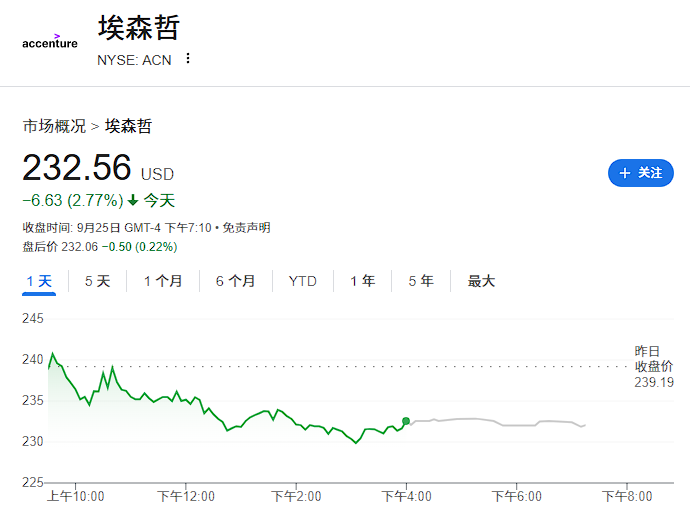
三个月裁了11000人,IT咨询巨头埃森哲警告员工:若无法接受AI时代“再培训”,就有更多人离职
Hua Er Jie Jian Wen· 2025-09-26 00:21
Core Insights - Accenture has laid off over 11,000 employees in the past three months, warning that further layoffs may occur if employees do not adapt their skills for the AI era [1][5] - The company announced a restructuring plan worth $865 million, emphasizing its commitment to transforming for the AI age [1][5] Employee Changes - As of the end of August, Accenture's total employee count was 779,000, down from 791,000 three months prior [1] - The layoffs are part of a strategy to maintain historical profit growth, with the company paying $615 million in severance and related costs in the last quarter and expecting to pay an additional $250 million in the current quarter [1][6] Financial Performance - Accenture's revenue grew by 7% to $69.7 billion, and net income increased by 6% to $7.83 billion for the fiscal year ending in August [6] - The company anticipates revenue growth to slow to between 2% and 5% in the current fiscal year, impacted by reduced federal government spending, which historically accounts for about 8% of its revenue [6] AI Transformation - The company currently employs 77,000 AI or data professionals, a significant increase from 40,000 two years ago [5] - Generative AI projects generated $5.1 billion in new orders in the last fiscal year, up from $3 billion the previous year [5] Strategic Focus - Accenture's CEO stated that the company is investing in enhancing the skills of its workforce, positioning this as a primary strategic direction [6] - The company aims to maintain a historical profit growth target, with plans to expand operating margin by at least 10 basis points in the next fiscal year [6]