
《哪吒之魔童降世》

Search documents
从“单点爆款”走向“体系化出圈”(深观察)
Ren Min Ri Bao Hai Wai Ban· 2026-02-03 22:56
Core Insights - The core viewpoint of the article highlights the significant growth of Chinese content in international markets, driven by a 114.5% year-on-year increase in viewership for iQIYI's international version, with Chinese content being the main driver of this growth [4][12]. Group 1: Growth and Trends in Chinese Content - The "iQIYI International Version 2025 Global Content Hot List" indicates that various types of Chinese programs are achieving good international dissemination effects, with the platform expanding beyond Southeast Asia into higher-value markets [4][6]. - The top 10 Chinese drama series on the list cover diverse genres, including urban romance, fantasy, and suspense, with "Love You" leading the list by integrating traditional Chinese medicine with modern love narratives [6][7]. - In the animation sector, "Lingwu Continent" topped the Chinese animation hot list, while films related to "Nezha" dominated the Chinese film rankings, showcasing the emotional resonance and visual innovation that appeal to global audiences [7][8]. Group 2: Localization and Cultural Adaptation - The article emphasizes the importance of content localization, which involves not just language translation but also cultural adaptation to resonate with local audiences [9][10]. - In Thailand, for instance, eight out of the top ten local hot dramas on iQIYI's international version are Chinese dramas dubbed in Thai, demonstrating the effectiveness of localized content [9]. - The article also notes that user preferences vary significantly across different markets, with North American audiences favoring diverse genres and high-quality production, while East Asian viewers prioritize narrative logic and emotional expression [10]. Group 3: Strategic Recommendations for Future Growth - Key recommendations for sustaining the momentum of Chinese content overseas include focusing on high-quality content production, enhancing international collaboration, and leveraging social media marketing [11][12]. - iQIYI's strategy involves using profits from established markets to support the cultivation of new markets, creating a virtuous cycle of content production, global distribution, user interaction, and industry feedback [13].



快时代的慢公司——长期主义者的艰辛之旅
3 6 Ke· 2026-02-03 10:31
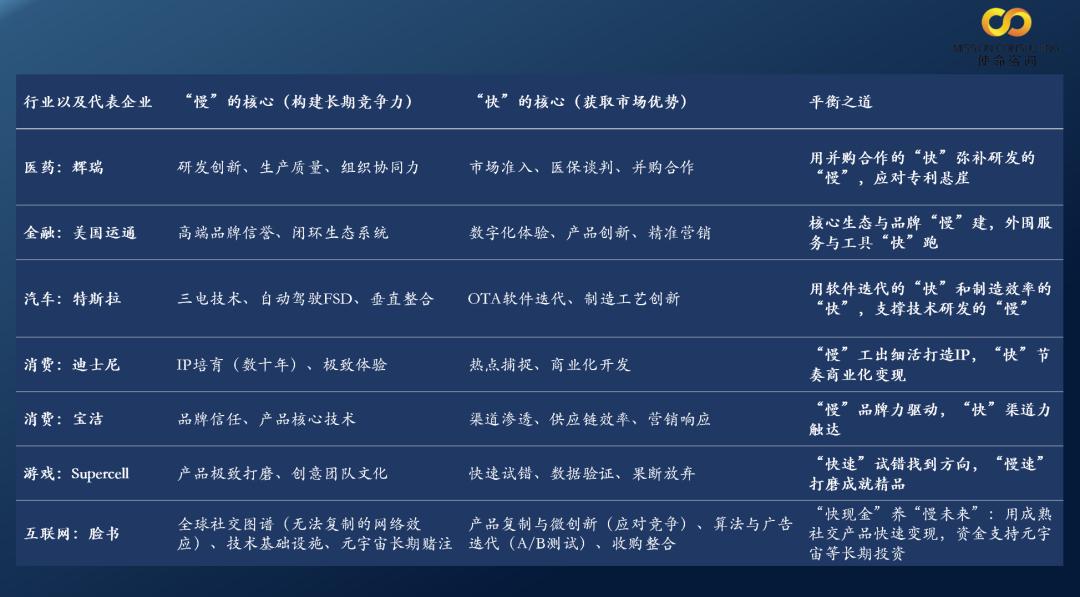
Core Concept - The article emphasizes the importance of "slow companies" in China, advocating for a balance between speed and depth in business strategies, where "slow" represents foundational strength and "fast" signifies market agility [1][4][72]. Group 1: Fast vs. Slow in Business Strategy - "Slow" refers to long-term investments in core competencies such as technology, brand value, and organizational culture, which require time and cannot be rushed [1][3]. - "Fast" indicates the need for agile responses to market demands, including product iterations and capturing market opportunities quickly [2][3]. - Successful companies master the combination of "fast" and "slow," using "slow" to build a solid foundation while leveraging "fast" to seize market opportunities [3][4]. Group 2: Global and Chinese Examples of Slow Companies - Pfizer exemplifies the pharmaceutical industry's balance of "slow" drug development and "fast" market entry strategies, often relying on acquisitions to fill gaps in their pipeline [5][6][10]. - American Express focuses on building a strong brand and ecosystem slowly while rapidly innovating in digital experiences and product offerings [12][16]. - Tesla invests heavily in long-term technology development while maintaining rapid product iterations and manufacturing innovations to capture market share [17][22]. - Disney and Procter & Gamble illustrate the consumer sector's balance, with Disney cultivating IP over decades while quickly monetizing it, and P&G focusing on brand trust and product technology while ensuring efficient market penetration [23][24]. - Supercell emphasizes quality through meticulous product development while employing rapid testing and iteration to find successful game concepts [25][30]. Group 3: Characteristics of Founders and Teams in Slow Companies - Founders of slow companies often exhibit traits such as strategic patience, deep focus, and a mission-driven approach, which guide their long-term decision-making [72][97]. - Teams in these companies are structured to ensure stability and cultural alignment, often combining diverse skills to achieve a common mission [98]. Group 4: Education and Talent Development for Slow Companies - The article discusses the need for educational reforms to cultivate leaders with a long-term vision, emphasizing the importance of foundational knowledge and craftsmanship in training [77][78]. - Innovative educational practices, such as problem-based learning and dual mentorship systems, are highlighted as methods to develop future leaders capable of sustaining slow company principles [79][82].
播放量翻番背后:爱奇艺国际版在海外为华语内容搭台
Mei Ri Jing Ji Xin Wen· 2026-01-28 13:18
Core Insights - The article highlights the significant growth of iQIYI's international platform, with a 114.5% year-on-year increase in content viewership, driven primarily by Chinese-language content [1][3][4] Group 1: Content Performance - The 2025 global content popularity list shows a diverse range of genres, including urban romance, historical fantasy, and traditional cultural adaptations, indicating a shift from reliance on single blockbuster hits to a more varied content strategy [3][4] - The top Chinese-language series, "Love You," achieved the highest viewership, showcasing the ability of modern themes to resonate across cultures by integrating traditional Chinese medicine into its narrative [4][12] - Other successful series like "White Olive Tree" and "Dual Track" demonstrate the innovative diversity of Chinese-language dramas, appealing to global audiences through emotional resonance and cultural themes [12][13] Group 2: Market Expansion and Localization - iQIYI has expanded its international reach to over 190 countries, distributing more than 8,000 episodes of Chinese-language content and over 500 films, with a focus on localized operations to cater to regional preferences [20][21] - The platform's success in Thailand, where 8 out of the top 10 dramas are dubbed in Thai, illustrates the effectiveness of localized content strategies in reducing language barriers and enhancing viewer engagement [21][24] - iQIYI's multi-faceted revenue model, including AVOD, SVOD, and TVOD, allows for tailored monetization strategies across different markets [21][25] Group 3: Financial Growth - Financial reports indicate steady growth in iQIYI's international membership and advertising revenue, with membership income increasing by over 40% year-on-year in key markets like Brazil and Mexico [24][25] - The international business is emerging as a second growth curve for iQIYI, with record highs in daily membership numbers and revenue growth in recent quarters [24][25] Group 4: Competitive Strategy - iQIYI's strategy focuses on producing original Asian content, particularly from East and Southeast Asia, rather than competing directly with global giants like Netflix [26][29] - The platform's emphasis on understanding and operating within Asian cultural contexts positions it uniquely in the market, allowing for sustainable content ecosystems rather than relying solely on blockbuster hits [26][29]

爱奇艺国际版2025全球内容热播榜发布:播放量同比增长114.5% 本土化精耕成效显著
Xin Hua Wang· 2026-01-21 06:51
Core Insights - The 2025 Global Content Popularity List for iQIYI International Edition shows a significant growth in the consumption of Chinese content, with a 114.5% year-on-year increase in content views, driven primarily by diverse Chinese-language offerings [1][3][4] Group 1: Chinese Content Performance - The top Chinese drama of the year is "Love You," which integrates elements of traditional Chinese medicine, resonating with global audiences [1][4] - iQIYI's self-produced content dominates the Chinese drama popularity list, accounting for 90% of the top ten [4] - The success of Chinese dramas is attributed to innovative themes and a deep integration of Eastern aesthetics [4] Group 2: Animation and Film Success - "Lingwu Dalu" and "Nezha: The Devil Child Comes to the World" lead the popularity charts for Chinese animation and film, respectively [9][12] - The Chinese animation genre shows a strong preference for Eastern fantasy themes, with eight out of ten top titles in this category [9] - Classic cultural IP adaptations, particularly those related to "Nezha," demonstrate significant global appeal, with "Nezha: The Devil Child Comes to the World" having nearly three times the viewership of the top non-Chinese film [12] Group 3: Regional Preferences and Localization - iQIYI International's growth is supported by localized operations tailored to regional market preferences, with Southeast Asia showing a strong demand for dubbed Chinese content [16] - In North America, the top ten popular series include six Chinese dramas and four Thai dramas, indicating a diverse content consumption pattern [16] - East Asian audiences exhibit a higher interest in mystery and detective stories, while Middle Eastern and North African viewers prefer military-themed Chinese content [16] Group 4: Future Strategies - In 2026, iQIYI International plans to deepen its strategy of promoting Chinese content while connecting with diverse global markets and supporting creative talent [17]

爱奇艺国际版2025年度内容热播榜发布,华语内容全球升温
Nan Fang Du Shi Bao· 2026-01-21 05:17
Core Insights - The 2025 Global Content Hit List by iQIYI International shows a significant growth in the consumption of Chinese content globally, with a year-on-year increase of 114.5% in content viewership, driven primarily by diverse Chinese content [1] - The list highlights the popularity of various genres, including urban romance dramas, anime, and films, with distinct viewing preferences observed across regions such as Southeast Asia, North America, East Asia, and the Middle East and North Africa [1][4] Group 1: Chinese Content Performance - The top Chinese drama on the list is "Love You," which integrates traditional Chinese medicine culture into modern storytelling, resonating with global audiences [2] - iQIYI's self-produced works dominate the top 10 Chinese drama list, accounting for 90% of the entries, showcasing the success of innovative themes and Eastern aesthetics [2] - The anime and film categories also perform well, with "Lingwu Continent" and "Nezha: Birth of the Demon Child" leading their respective categories [2][3] Group 2: Regional Consumption Preferences - Southeast Asia shows a strong preference for localized content, with eight out of ten top dramas being Chinese dramas dubbed in Thai, indicating the importance of local adaptation [4] - In North America, the top 10 popular series include six Chinese dramas and four Thai dramas, reflecting a diverse content consumption landscape [4] - East Asian audiences exhibit a higher interest in mystery and detective stories, while the Middle East and North Africa favor military-themed Chinese content [5]
爱奇艺(IQ.US)国际版2025年度全球内容热播榜发布 华语内容全球升温
智通财经网· 2026-01-21 03:10
Core Insights - The 2025 Global Content Popularity List by iQIYI International shows a significant growth in the consumption of Chinese content globally, with a 114.5% year-on-year increase in viewership [1][3] Group 1: Chinese Content Performance - Chinese content is the main driver of growth, with the urban romance drama "Love You" topping the Chinese drama list, showcasing the integration of traditional Chinese medicine culture [1][4] - iQIYI's self-produced content dominates the Chinese drama popularity list, accounting for 90% of the top ten shows, indicating a strong global influence [4] - The success of Chinese dramas is attributed to innovative themes and the deep integration of Eastern elements and aesthetics, resonating with global audiences [4] Group 2: Animation and Film Success - In the animation and film categories, "Lingwu Continent" and "Nezha: The Devil's Child" lead the popularity charts, highlighting the appeal of Chinese animation and films overseas [8][11] - The top ten Chinese animated shows are characterized by a predominance of Eastern fantasy themes, successfully attracting global anime fans [8] - Classic cultural IP adaptations in Chinese films, particularly those related to "Nezha," demonstrate strong global appeal, with "Nezha: The Devil's Child" having nearly three times the viewership of the top non-Chinese film [11] Group 3: Regional Preferences and Localization - iQIYI International's growth is supported by localized operations tailored to key overseas markets, revealing distinct consumption preferences across regions [15] - In Southeast Asia, local language adaptations are crucial, with a significant number of popular shows being dubbed in Thai, indicating a strong local engagement [15] - North American audiences show a diverse content consumption pattern, with a mix of Chinese dramas and Thai shows in the top ten, while East Asian viewers favor mystery and detective stories [15]

动画电影出海的进阶逻辑
Xin Lang Cai Jing· 2026-01-14 18:39
Core Insights - The article discusses the rising prominence of animated films in China and globally, highlighting the significant box office success and cultural impact of these films [3][4]. Group 1: Industry Performance - In 2022, animated film box office revenue in China exceeded 25 billion yuan, marking the highest annual revenue for animated films in Chinese film history [3]. - Globally, animated films contributed approximately 24% to the total box office revenue, indicating a strong market presence [3]. Group 2: Cultural Significance - Successful animated films often possess high recognition, which is supported by unique symbolic systems and cultural values that resonate with audiences [3][4]. - The deep recognition of Chinese animated films is rooted in contemporary values that evoke shared human emotions, as exemplified by the narratives in films like "Ne Zha" [4]. Group 3: Strategies for Global Expansion - Chinese animation should adopt an open mindset towards cultural adaptation to enhance the effectiveness of its global communication [5]. - There is a need for Chinese animated films to balance visible symbols with meaningful narratives, allowing for localized storytelling that resonates with diverse cultural audiences [5]. - The industry should innovate in genre and brand management, focusing on creating internationally competitive original IPs and developing a comprehensive system for derivative products [5]. Group 4: Future Outlook - The Chinese animation industry is encouraged to maintain a spirit of exploration in creativity to better position itself on the global stage in the coming year [6].

从“哪吒”到“浪浪山”,国产动画电影靠什么“破圈”
Xin Lang Cai Jing· 2026-01-12 00:26
Group 1 - The core viewpoint is that by 2025, China's animation film industry is expected to achieve significant milestones, with box office revenues surpassing 25 billion yuan, marking a historic record for the country [1] - In 2021, animation films contributed 6.2% to the domestic box office, which is projected to approach 50% by 2025, indicating a substantial growth in the sector's influence [1] - The rise of Chinese animation films reflects the robust power of open innovation and cultural creativity [1] Group 2 - Chinese animation serves as an important artistic medium for the transmission and development of traditional culture, blending ancient stories with modern narratives [3] - Successful animation projects involve extensive collaboration, as seen in "Ne Zha," which brought together 138 animation companies and over 4,000 creators, showcasing the industry's collaborative nature [3] - The advancement of technology and talent accumulation has led to iterative upgrades in creative planning, production, and distribution methods, expanding the cultural creation boundaries [3] Group 3 - The market's prosperity is driven by diverse offerings, with both domestic and international films competing, which enhances audience engagement [4] - Chinese animated films are increasingly reaching international markets, with titles like "Big Fish & Begonia" and "White Snake: Origin" gaining traction abroad [4] - There is still room for improvement in areas such as original IP development, industry chain integration, and international communication capabilities [4] Group 4 - The rise of animation IP has led to the creation of theme parks, cultural tourism routes, and popular merchandise, contributing to the cultural industry's growth [5] - The development of the animation sector is a long-term process that requires sustained innovation and support from policies such as tax incentives and financial subsidies [4][5] - The potential for Chinese animation films remains vast, with ongoing opportunities for growth and cultural confidence enhancement [5]

一个人废掉的最大原因:执行间隙太长
洞见· 2025-12-11 12:20
Core Viewpoint - The article emphasizes the importance of taking action rather than overthinking, suggesting that many people fail due to hesitation and excessive planning instead of executing their ideas [13][28]. Group 1: Stories of Action - The first story illustrates the journey of a director who transitioned from a medical background to animation, ultimately creating a successful short film and a blockbuster movie, highlighting the principle of "just do it" [20][23][25]. - The second story recounts how Mark Zuckerberg quickly developed a website, demonstrating that immediate action can lead to significant success, contrasting with those who overthink [26][27][28]. Group 2: Strategies to Overcome Hesitation - The article suggests breaking down large goals into smaller, manageable tasks to reduce the perceived difficulty of execution, making it easier to start [36][39]. - It introduces the "5-minute rule," encouraging individuals to commit to just starting a task for five minutes, which often leads to continued effort [41][43]. - Creating a sense of urgency by publicly committing to deadlines can motivate individuals to act and avoid procrastination [49].

《疯狂动物城2》进入中国影史动画电影票房前三
Di Yi Cai Jing· 2025-12-01 08:52
Core Insights - The film "Zootopia 2" has achieved a box office revenue of 1.984 billion yuan within six days of its release, placing it among the top three animated films in Chinese box office history [1] Group 1 - "Zootopia 2" surpassed "Boonie Bears: The Big Shrink" to enter the top three animated films in China [1] - The film's box office performance is only behind "Ne Zha" and "Ne Zha: The Devil's Child" [1]