
三星Galaxy Z Fold7

Search documents
体验消费至上,折叠屏卷向主力机|世研消费指数品牌榜Vol.89
3 6 Ke· 2025-12-08 03:07
Group 1 - The 3C industry is experiencing a "downward" and "upward" strategic competition, with OPPO focusing on affordable cooling technology for budget phones, while Honor and Samsung are emphasizing lightweight foldable screens and AI integration for high-end devices [1][4][5] - In the budget segment, OPPO launched the K13 Turbo series featuring a "wind cooling engine" that enhances cooling efficiency by 120%, targeting a price point under 2000 yuan [4] - Honor's new foldable phone, Magic V5, is positioned as the thinnest and lightest in the industry, featuring advanced AI capabilities and priced starting at 8999 yuan, marking a significant step in its high-end strategy [4] Group 2 - The tablet market is evolving with Huawei's MatePad Pro 12.2, which integrates HarmonyOS 5 and focuses on professional software and AI functionalities, catering to mobile office and creative needs [6] - The wearable segment is also expanding, with iQOO launching the iQOO WATCH GT and OnePlus introducing the OnePlus Watch 3, both targeting specific niches in the market [6] - The competitive landscape is shifting towards technology experience, innovative forms, and ecosystem collaboration, moving beyond traditional parameter comparisons [1]

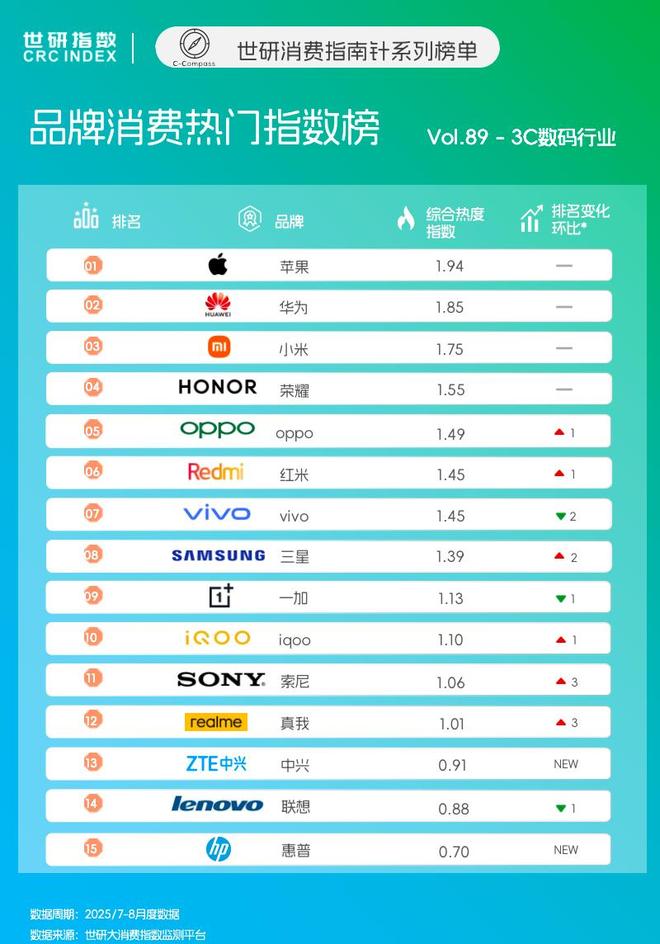
全球折叠屏手机出货新高:三星独大,华为增长10%,vivo增长67%
Guan Cha Zhe Wang· 2025-12-03 05:57
Core Insights - The global foldable smartphone market is projected to see a 14% year-on-year increase in shipments by Q3 2025, reaching a historical quarterly high for this category [1] - Samsung leads the market with a 64% share in Q3, experiencing a 32% increase in shipments compared to the previous year [1][3] - Huawei holds the second position with a 15% market share, growing by 10% year-on-year, while Motorola ranks third with a 7% share and a 16% increase [1][3] Market Performance - The foldable smartphone segment now accounts for 2.5% of global smartphone shipments, driven by the popularity of book-style models and the launch of Samsung's Galaxy Z Fold7 and Huawei's Mate series [3] - The Galaxy Z Fold7's features, such as a thinner body and improved durability, have significantly enhanced its appeal in the high-end market, contributing to unexpected growth [3] - Motorola's competitive pricing and strong channel partnerships have effectively expanded its user base in the foldable segment [3] Future Projections - Counterpoint Research anticipates a 16% year-on-year growth for the foldable market by the end of 2025, with high-end users increasingly favoring larger screens for productivity [4] - The market is expected to enter a significant expansion phase in 2026, driven by improvements in durability, thinner designs, and enhanced AI-driven software experiences [4] - Apple is expected to enter the foldable market in the second half of 2026, leveraging its large iPhone user base to initiate a new high-end product upgrade cycle [4] Competitive Landscape - The importance of technological innovation is increasing as existing manufacturers accelerate the development of multi-form factor products in anticipation of Apple's entry [5] - Companies are focusing on enhancing their technological leadership and product differentiation strategies, with foldable designs evolving beyond traditional book-style formats [5] - Samsung's upcoming tri-fold device is positioned as a pilot product to validate durability and software optimization before larger-scale commercialization [5]
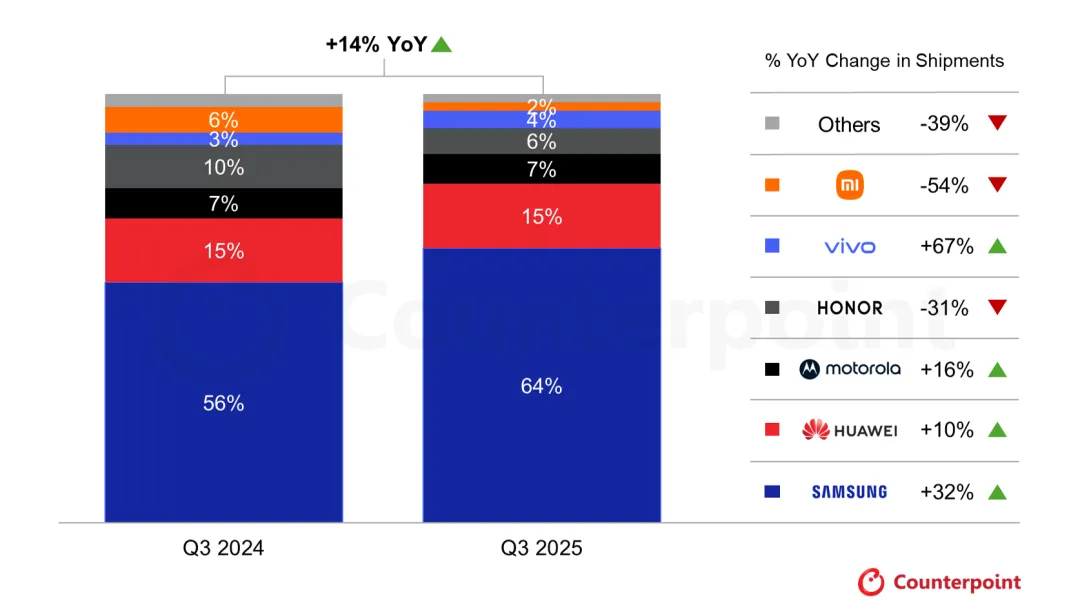
全球折叠屏出货新高:三星独大,华为增长10%,vivo增长67%
Guan Cha Zhe Wang· 2025-12-03 05:56
Core Insights - The global foldable smartphone market is projected to see a 14% year-on-year increase in shipments by Q3 2025, reaching a historical high for the category [1] - Samsung leads the market with a 64% share in Q3, showing a 32% increase compared to the same period last year [1] - Huawei holds the second position with a 15% market share, growing by 10% year-on-year [1] - Motorola ranks third with a 7% share, experiencing a 16% increase [1] - Vivo and Xiaomi follow in fourth and fifth places, with Vivo showing a significant growth of 67%, while Xiaomi's shipments declined by 54% year-on-year [1] Market Trends - Foldable smartphones now account for 2.5% of global smartphone shipments, driven by the popularity of book-style models and the launch of Samsung's Galaxy Z Fold7 and Huawei's Mate series [3] - The Galaxy Z series, particularly the Z Fold7, has enhanced its appeal in the high-end market due to its thinner design, lighter weight, and improved durability [3] - Motorola's competitive pricing and strong channel partnerships have effectively expanded its user base in the foldable segment [3] Future Projections - The foldable smartphone market is expected to close 2025 with a stable growth rate of around 16% year-on-year [4] - By 2026, the market is anticipated to enter a significant expansion phase, driven by improvements in durability, thinner designs, and enhanced AI-driven software experiences [4] - Apple is expected to enter the foldable market in the second half of 2026, potentially reshaping the competitive landscape [4][5] Technological Developments - Major smartphone brands are intensifying their focus on technological leadership and product differentiation, with foldable designs evolving beyond traditional book-style formats [5] - Samsung's new triple-foldable model is positioned as a pilot product to validate durability and software optimization before larger-scale commercialization [5] - The entry of Apple into the foldable market is anticipated to bring substantial changes to the competitive dynamics [5]


折叠屏手机之争持续升级
Zheng Quan Ri Bao· 2025-08-27 16:12
Core Insights - Huawei is set to launch a new tri-fold smartphone on September 4, marking a significant development in the foldable smartphone market [1] - The competition in the foldable smartphone sector is intensifying, with major players like Samsung and Apple also entering the fray, each adopting different folding designs [1][2] - The foldable smartphone market is transitioning from a luxury segment to a more mainstream consumer product, driven by competitive pricing and innovative features from various brands [2] Industry Trends - The foldable smartphone market is expected to see a shipment volume of 9.47 million units in China by 2025, with a year-on-year growth of 3.3% [3] - Huawei currently holds a 75% market share in China's foldable smartphone market, a record high [3] - The global foldable smartphone market is projected to exceed $40 billion by 2025, with China accounting for 45% of the global market share [3] Competitive Landscape - The competition is shifting from hardware to a comprehensive evaluation of form factors, software, and ecosystem integration [2] - Companies are increasingly focusing on core components like hinges and materials, leading to deeper collaborations between terminal manufacturers and supply chain companies [4] - Major suppliers, such as Jiangsu Jingyan Technology and Guangdong Lingyi Technology, are actively engaging in the foldable screen sector, providing essential components for leading brands [4] Market Outlook - The foldable smartphone market is entering a more mature phase, with increased user acceptance and a more refined supply chain [5] - Analysts predict that the introduction of multiple new foldable models by Huawei in the second half of the year will further stimulate market growth [5] - The ongoing innovation in product forms and components is expected to significantly boost the overall smartphone consumption market [5]
折叠屏拐点,始于「0.1mm」的战争
36氪· 2025-08-01 13:34
Core Viewpoint - The article discusses the evolution of the foldable screen industry, highlighting the advancements made by Samsung with its Galaxy Z Fold7 and Z Flip7, marking a shift towards a new era of foldable devices that prioritize lightweight, thin designs, and enhanced user experience [2][25]. Group 1: Foldable Screen Market Evolution - The foldable screen market has entered an era of "hundred flowers blooming," with major smartphone manufacturers investing heavily in this technology, leading to a "millimeter war" focused on achieving lighter, thinner, and larger devices [2]. - By 2025, the market is expected to evolve rapidly towards the ultimate goal of "lighter, thinner, larger," with competition centered around minute improvements of "0.1mm" [2]. - Samsung's Galaxy Z Fold7 has achieved a weight of 215 grams and a thickness of 8.9mm when folded, representing the most significant upgrade in the series' history [2][5]. Group 2: Technological Innovations - The Z Fold7 features a redesigned waterdrop hinge that compresses the bearing part to 1.2mm, achieving a 23% reduction in thickness, and the support arm part has seen a 39% thickness reduction [9]. - Samsung has introduced a titanium alloy foil as a stress-dispersing skeleton beneath the UTG inner screen, enhancing flexibility while increasing resistance to bending and cracking [9][10]. - The new structure of the Z Fold7 has passed 200,000 folding tests and extreme temperature cycling tests, confirming its physical stability under harsh conditions [10]. Group 3: Competitive Advantages - Samsung's advancements in materials science and industrial design have widened the gap between it and many domestic manufacturers, showcasing its superior manufacturing capabilities [11]. - The Z Fold7 maintains flagship specifications while achieving a 10% increase in strength through the use of Advanced Armor Aluminum and Corning Gorilla Glass Victus 2, ensuring durability against drops from 1 meter [11]. - The integration of a 200-megapixel main camera with advanced autofocus and OIS structure has allowed the Z Fold7 to excel in photography, addressing previous limitations in foldable devices [13]. Group 4: User Experience Enhancements - The Z Flip7 features a 4.1-inch external screen that maximizes visibility and allows for quick interactions, with software optimizations enhancing the external screen experience [15]. - The Z Flip7's main camera can shoot 10-bit HDR videos, catering to content creators' demands for high-quality visuals [17]. - AI capabilities have been deeply integrated into the Z series, transforming the devices into intelligent platforms that enhance user interaction and productivity [21]. Group 5: Industry Implications - The foldable screen industry is shifting from a focus on hardware specifications to user experience, with the next battleground being the seamless integration of foldable technology into daily life [24]. - Samsung's ability to control the entire supply chain for foldable screens positions it as a leader in the market, creating a competitive landscape characterized by "one strong leader and many strong challengers" [24]. - The launch of the Z Fold7 signifies a pivotal moment in the industry, marking the transition of foldable devices from novelty items to essential mainstream products [25].

领益智造(002600.SZ):为三星Galaxy Z Fold7供应超薄钛合金支撑件等零部件
Ge Long Hui· 2025-08-01 07:13
Core Viewpoint - The company, Lingyi Zhizao (002600.SZ), is supplying ultra-thin titanium alloy support components and other parts for the Samsung Galaxy Z Fold7 [1] Company Summary - Lingyi Zhizao is involved in the supply chain for high-end smartphone components, specifically for Samsung's latest foldable device [1]

国产电池大容量,三星和iPhone用不上
Hu Xiu· 2025-07-18 13:49
Core Viewpoint - The article discusses the disparity in battery capacities between domestic Chinese smartphone brands and international brands like Apple and Samsung, attributing it to technological advancements in battery technology and international shipping regulations rather than a lack of desire or capability from the latter [3][10][36]. Group 1: Battery Technology Advancements - Domestic smartphone brands have made significant advancements in battery technology, with flagship models approaching or exceeding 6000mAh, while international brands like Apple and Samsung are limited to around 4400mAh [3][4]. - The rise of high-density silicon-carbon anode lithium batteries has been a key factor in this development, with companies like Huawei, Vivo, and OPPO adopting these technologies across various models [5][6]. - The theoretical capacity of silicon anodes can reach up to 4200 mAh/g, significantly higher than traditional graphite anodes, which are nearing their theoretical limits [6][7]. Group 2: Market Dynamics and Regulations - The intense competition in the domestic market, combined with consumer demand for higher specifications and a robust battery supply chain, has led to the widespread adoption of high-capacity batteries in Chinese smartphones [8]. - International brands face logistical challenges due to regulations such as the UN Special Provision 188, which classifies batteries over 20 watt-hours as hazardous materials, increasing shipping costs and complicating logistics [10][11][15]. - Apple and Samsung prioritize maintaining lower shipping costs and profit margins, which leads them to opt for smaller batteries despite their technological capabilities [17][19]. Group 3: Battery Durability and Consumer Behavior - While silicon-carbon batteries offer high capacity, they also present challenges in durability and lifespan, with issues such as physical expansion and faster capacity degradation [26][29][32]. - The average consumer in China tends to replace their smartphones frequently, which may mitigate concerns over battery longevity, allowing manufacturers to focus on high-capacity solutions [34][35]. - The international market's stringent regulations and the need for longer-lasting products may prevent Apple and Samsung from adopting larger batteries in the near future [19][36].
业绩连续承压,传音发布全球最薄三折叠手机
Guan Cha Zhe Wang· 2025-07-18 11:32
Core Viewpoint - Transsion is set to launch its first tri-fold smartphone, the Phantom Ultimate G Fold Concept, following similar products from Huawei and Samsung, indicating a competitive push in the foldable smartphone market [1][7]. Group 1: Product Features - The Phantom Ultimate G Fold Concept features a G-shaped folding design with an internal dual-hinge structure, offering a 9.94-inch display when unfolded and a battery capacity exceeding 5000mAh [1][7]. - In its folded state, the device measures only 11.49mm thick, and 3.49mm when unfolded, making it thinner than competitors like Huawei Mate XT Ultimate and Samsung Galaxy Z Fold 7 [3][5]. - The device utilizes a custom dual-hinge system, which includes a droplet-shaped hinge for folding and a larger main hinge that allows for partial folding, enabling functionalities like video calls [5][7]. Group 2: Market Context - The global smartphone market experienced a 1% year-on-year decline in Q2 2025, marking the first drop in six consecutive quarters, attributed to cautious consumer sentiment amid economic uncertainty [7]. - Samsung maintained its market leadership with a 19% share, followed by Apple at 16%, Xiaomi at 15%, and Transsion at 9%, which saw a 2% decline in market share [7][9]. - Transsion's performance has been under pressure, with a significant revenue drop of 25.45% year-on-year in Q1 2025, and a net profit decline of 69.87%, attributed to market competition and supply chain costs [8][9]. Group 3: Financial Performance - In 2024, Transsion reported a revenue of 68.715 billion yuan, a 10.31% increase, but this was a significant slowdown from the previous year's 33.69% growth, marking the second-lowest growth rate since its listing [8]. - The net profit for 2024 was 5.549 billion yuan, a slight increase of 0.22%, while the non-recurring net profit fell by 11.54% [8].


电子行业周报:端侧AI厂商中报业绩亮眼,多模态大模型Grok4正式发布-20250714
Donghai Securities· 2025-07-14 09:28
Investment Rating - The report suggests a positive outlook for the electronic sector, indicating a gradual recovery in demand and price stabilization, recommending a slow accumulation of positions in the market [5][6]. Core Insights - The electronic sector is experiencing a mild recovery, driven by strong downstream demand from AIOT and accelerated product penetration by companies like Lexin Technology and Rockchip, which are expected to report impressive half-year results [5][6]. - The release of the multi-modal model Grok 4 by xAI has significantly enhanced reasoning capabilities, potentially opening new application scenarios [5][11]. - The report highlights four main investment themes: AIOT, AI-driven technologies, equipment materials, and consumer electronics [5][6]. Summary by Sections Industry Overview - The report notes that the semiconductor sector is entering a period of intensive earnings forecasts, with companies like Lexin Technology and Rockchip expected to show substantial revenue growth due to ongoing demand in AIOT and other emerging fields [5][6]. Company Performance - Lexin Technology anticipates a revenue of CNY 1.22-1.25 billion for the first half of 2025, a year-on-year increase of 33%-36%, with net profit expected to rise by 65%-78% [5][17]. - Rockchip expects to achieve approximately CNY 2.045 billion in revenue, reflecting a year-on-year growth of about 64%, with net profit projected to increase by 185%-195% [5][17]. Market Trends - The report indicates that the electronic industry outperformed the broader market, with the Shenzhen and Shanghai 300 Index rising by 0.82% and the Shenwan Electronics Index increasing by 0.93% [19][21]. - The semiconductor sub-sector showed a positive trend, with a 1.07% increase in semiconductor stocks [21][26]. Investment Recommendations - The report recommends focusing on companies benefiting from strong domestic and international demand in the AIOT sector, such as Lexin Technology and Rockchip [5][6]. - It also suggests monitoring AI innovation-driven sectors, including computing chips and optical devices, as well as upstream supply chain components [5][6].


轻薄上下功夫,重量仅为215克!三星发布Galaxy Z Fold7
Guang Zhou Ri Bao· 2025-07-12 11:36
Core Viewpoint - Samsung Electronics has launched the new foldable flagship Galaxy Z Fold7, which integrates Galaxy AI with advanced hardware, setting a new benchmark for foldable smartphones and enhancing user experience through innovative design and technology [1]. Group 1: Product Features - The Galaxy Z Fold7 is lighter than the Galaxy S25 Ultra, weighing only 215 grams, with a thickness of 8.9 mm when folded and 4.2 mm when unfolded [1]. - The external display features a 6.5-inch second-generation dynamic AMOLED screen with a new 21:9 aspect ratio, providing a wider field of view [1]. - The main screen size has increased by 11% compared to the previous model, enhancing multitasking capabilities [2]. Group 2: Structural and Durability Enhancements - The main screen structure has been upgraded with a titanium metal protective layer, increasing structural strength while maintaining a lightweight design [2]. - The thickness of the UTG (Ultra Thin Glass) has been increased by 50%, making the screen more durable [2]. Group 3: Imaging and AI Capabilities - The Galaxy Z Fold7 incorporates professional-grade imaging capabilities, delivering high-resolution and stable imaging through advanced hardware and intelligent imaging [2]. - The device features enhanced Galaxy AI integration, providing a more intuitive and efficient user interaction experience, optimized for the foldable form factor and large screen [3]. - Samsung One UI 8 includes context awareness and natural response capabilities, significantly reducing app interface transitions and improving productivity [3]. Group 4: Pricing and Availability - The Galaxy Z Fold7 is available in four colors: Shadow Blue, Night Silver, Phantom Black, and Frost Green (exclusive to Samsung Mall), with a suggested retail price starting at 13,999 yuan [3].