
国股银票转贴现

Search documents
票据利率创年内新高至1.33%,击穿国债利率!
Xin Lang Cai Jing· 2026-02-26 10:21
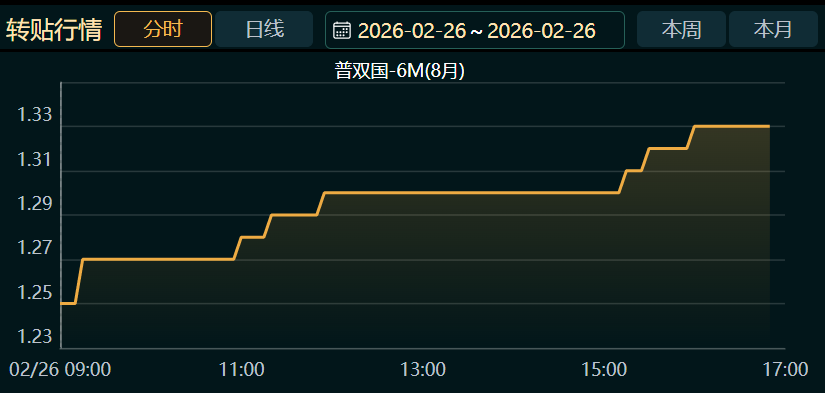
Core Viewpoint - After a brief stabilization, the bill rates have significantly increased over two consecutive working days, with the 6-month government bank bill discount rate rising to 1.33% on February 26, marking a new high for the year and surpassing government bond rates for the first time this year [1][13]. Market Performance on February 26 - On February 26, the 3-month government bank bill rate rose by 45 basis points (BP) to 1.50%, while the 7-month and 8-month rates increased by 6 BP to 1.30% and 1.33%, respectively [6][15]. - The trading range for various maturities showed significant upward movement, with the 1-month rate reaching a high of 1.50% [4][18]. Historical Trends - The bill rates experienced a notable drop at the beginning of February, with the 7-month rate falling by 28 BP to 0.83% on the first working day. However, a rebound began shortly after, with the 8-month rate rising to 1.15% by February 14 [5][19]. - By February 26, the 8-month rate had increased by 48 BP since the beginning of the month, reflecting a strong upward trend [19][22]. Supply and Demand Dynamics - The supply of bills in the primary market has been recovering, but demand from banks remains weak, leading to a situation where supply significantly exceeds demand. Many banks are not only refraining from purchasing bills but are also actively selling their inventory [12][24]. - The overall market conditions have contributed to the substantial rise in bill rates, reaching new highs for the year [12][24]. Interest Rate Comparisons - As of February 26, the spread between bill rates and government bond rates was 4 BP, while the spread with interbank certificates of deposit was -24 BP, indicating that bill rates have surpassed government bond rates for the first time this year [10][23].

节后第一天票据利率走平,后市分歧较大
Xin Lang Cai Jing· 2026-02-24 11:06
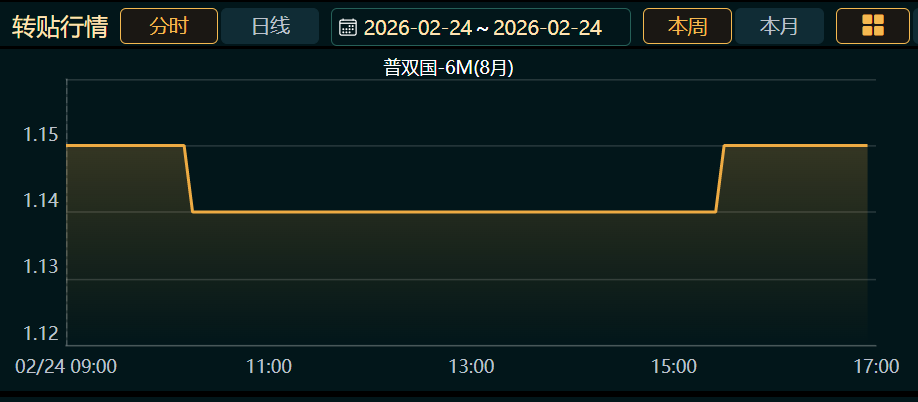
Market Overview - On February 24, 2026, the first working day after the Spring Festival, the bill rates remained stable, experiencing a slight decline before rebounding [1][11] - There is significant divergence in market expectations regarding the bill rates for the end of February [1][19] Daily Trading Activity - In the morning session, trading was light with both buyers and sellers in a wait-and-see mode, leading to a slight decrease in rates for certain maturities [5][13] - By midday, the rates for 3-month bills decreased by 5 basis points (BP) to 0.85%, while 7-month bills increased by 1 BP to 1.07%, and 8-month bills decreased by 1 BP to 1.14% [5][13] - In the afternoon, selling pressure increased for 6-month and 8-month bills, causing slight upward movement in rates towards the end of the session [5][13] Historical Trends - The bill rates opened significantly lower on the first working day of February, with the 7-month bill rate dropping 28 BP to 0.83% and the 8-month bill trading around 0.85% [4][15] - Following this, the rates began to rebound, with the 8-month bill rate rising to 1.15% by February 14 [4][15] - As of February 24, the 8-month bill rate remained stable at 1.15% [4][15] Interest Rate Spreads - As of February 24, the spread between bills and government bonds was -15 BP, while the spread between bills and interbank certificates of deposit was -42 BP, indicating a return to levels seen in late January [6][17] Market Sentiment - In the last week of February, both demand and supply in the market were weak, with greater uncertainty regarding demand [8][19] - A recent poll indicated that 31% of participants expect the closing rate to remain between 1.1% and 1.2%, while 27% anticipate a closing rate between 1.0% and 1.1% [8][19] - There is a slight majority expecting a downward trend in bill rates [8][19]
票据利率继续攀升,站上1.10%!
Xin Lang Cai Jing· 2026-02-12 12:12
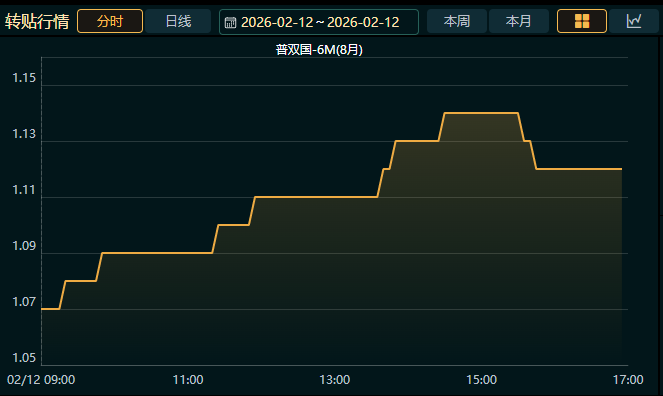
Core Viewpoint - The bill discount rates have significantly increased, with the August maturity national bank bill discount rate rising from approximately 0.85% to 1.12% within a short period, indicating a shift in market dynamics due to unexpected supply levels [1][4][18]. Group 1: Market Trends - On February 1, 2026, the bill discount rate opened low at 0.85% for August maturity national bank bills, but subsequently increased due to higher-than-expected supply [1][4]. - By February 10, the discount rate surpassed 1.00%, and on February 12, it further increased to 1.12% [1][4][13]. - The average daily discount volume in the first week of February was close to 250 billion, with a total of 1.86 trillion in discounted bills by February 11 [18]. Group 2: Daily Market Activity - On February 12, the market saw a rise in rates, with the March maturity national bank bill increasing by 20 basis points to 0.70%, and the August maturity bill reaching 1.12% at closing [5][14]. - The trading activity showed that major banks were actively raising prices for bills, while demand from the market was relatively weak, leading to an overall increase in bill rates [5][14]. Group 3: Historical Context - The initial drop in bill rates was attributed to banks' concerns over credit issuance, prompting them to lower prices for bill purchases [18]. - The supply of bills in February was significantly higher than expected, with non-bank entities contributing 300 billion in sell orders, and the acceptance and discounting volumes at historical highs [18]. Group 4: Interest Rate Spreads - As of February 12, the spread between bills and government bonds was -18 basis points, while the spread with interbank certificates of deposit was -46 basis points, indicating a narrowing trend in spreads [7][16].
月初票据利率大幅低开,随后探底回升
Xin Lang Cai Jing· 2026-02-06 11:26
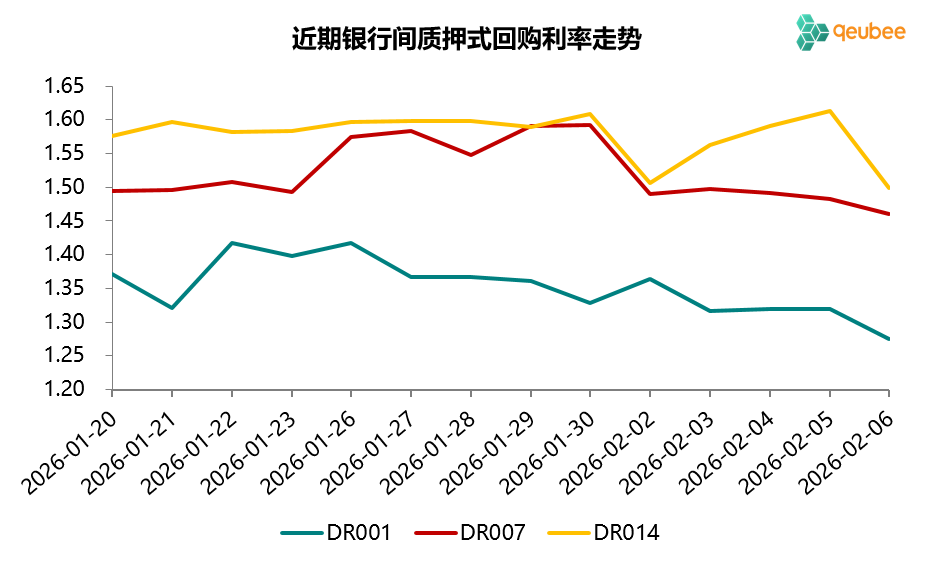
Group 1: Funding Situation - The central bank's reverse repos maturing this week amount to 17,615 billion yuan, with a buyout reverse repo of 7,000 billion yuan maturing; the central bank conducted reverse repo operations of 10,055 billion yuan and buyout reverse repos of 8,000 billion yuan, resulting in a net withdrawal of 6,560 billion yuan this week [1][14] - The funding environment is becoming more relaxed at the beginning of the month, with DR001 decreasing by 5 basis points to 1.28% and DR007 decreasing by 13 basis points to 1.46%, slightly above the 7-day reverse repo rate of 1.40% [1][14] Group 2: Bill Market Trends - On the first trading day of February, the expectation of a significant drop in bill rates led to state-owned banks lowering prices to collect bills, resulting in a decline in the 7-month maturity state-owned bank bill rate to 0.83% by the end of the day [3][14] - The bill rates continued to decline on Tuesday, with the 7-month maturity state-owned bank bill rate reaching a low of 0.75% before rebounding to 0.80% [3][14] - On Wednesday, state-owned banks raised prices significantly, causing the 7-month maturity state-owned bank bill rate to rise to 0.90%, but later fell back as demand returned [4][15] - By Thursday, the overall bill rates increased due to high supply, with the 8-month maturity bill leading the rise [5][16] - On Friday, the 8-month maturity state-owned bank bill rate rose to 0.97%, but some demand was released, leading to a slight decline in rates for the 7-month maturity bill [5][16] Group 3: Yield Comparisons - This week, the yield on 6-month government bonds and interbank certificates of deposit decreased by 2 basis points and 1 basis point, respectively, while the yield on 6-month bill discount rates dropped significantly by 15 basis points [9][20] - The yield spread between 6-month bills and government bonds was -37 basis points, and -62 basis points with interbank certificates of deposit, indicating an expansion of the spread compared to the previous week [9][20] Group 4: Bill Rate Outlook - The expected maturity amount of discounted bills in February is around 26,000 billion yuan, with a rapid increase in the discount volume, averaging 2,390 billion yuan over the first four working days [11][22] - The demand for bills remains high as banks have entered the market early to collect bills at lower prices, although the number of effective working days in February is limited, which may increase credit pressure [11][22] - The upcoming week before the Spring Festival may cause fluctuations in bill supply and demand, impacting bill rate trends [12][23]
月末票据利率不升反降,信贷“开门红”成色不足?
第一财经· 2026-02-03 13:58
Core Viewpoint - The article discusses the cautious expectations for credit growth in January, highlighting the unusual decline in bill rates as a potential indicator of weaker credit demand [2][4]. Group 1: January Credit Market Overview - January is traditionally a strong month for credit issuance, but expectations for this year are subdued due to factors like the smoothing of credit issuance ahead of 2025 [2][5]. - A senior financial analyst predicts that new credit in January will be roughly in line with last year, with some institutions forecasting it to be below 5 trillion yuan [2][8]. - The bill rates showed an unusual downward trend in January, with the six-month bill rate dropping from 1.29% to a low of 1.07%, indicating weaker credit demand [3][4]. Group 2: Bill Rate Trends - The trend of bill rates in January has been declining over the years, with the six-month bill rate decreasing from around 2.5% in 2023 to below 2% in 2025 [3]. - The last week of January saw a notable decline in bill rates, which is interpreted as a sign of insufficient credit demand [3][4]. - The report suggests that the decline in bill rates, coupled with falling interbank certificate of deposit rates, indicates that banks may have sufficient liabilities but are lacking in assets [5]. Group 3: Future Outlook - Looking ahead to February, historical trends suggest that bill rates typically rise before falling back [6]. - Regulatory guidance has encouraged banks to maintain balanced loan issuance, which has led to a more stable growth in credit volume [6][7]. - The article notes that the first month of the year usually sees the highest credit issuance, with January data often serving as a peak for the year [7][8].

开年上涨100BP!票据利率飙升
Zhong Guo Jing Ying Bao· 2026-01-09 09:20
Core Viewpoint - The article discusses the significant fluctuations in bill discount rates at the beginning of 2026, highlighting a sharp increase in rates compared to the end of 2025, driven by changes in credit supply and demand dynamics in the banking sector [1][2][3]. Group 1: Bill Discount Rate Trends - As of January 8, 2026, the 6-month and 3-month national bank bill discount rates rose to 1.24% and 1.50%, respectively, marking increases of 29 basis points (BP) and 100 BP from December 31, 2025 [1]. - On December 30, 2025, the 6-month and 3-month national bank bill discount rates hit their lowest points at 0.6% and 0.3%, respectively, before experiencing a rebound at the end of the year [2]. - The 6-month bill discount rate increased by 60 BP to 1.20% on January 4, 2026, and the 3-month rate rose by 100 BP to 1.30% on the same day, indicating a strong recovery in the market [3]. Group 2: Market Dynamics and Influences - In December 2025, banks proactively adjusted their configurations, leading to a buyer-dominated market and a subsequent decline in bill prices, which were later slightly supported by year-end trading [1][2]. - The performance assessment of banks is shifting from a focus on quantity to quality, which may reduce the impact of volume-driven factors on bill discount rate trends in the future [4]. - The structure of social financing is evolving from being primarily credit-based to incorporating bonds and equity financing, suggesting a potential decrease in the influence of credit volume on bill rates [4].
票据利率开年跳升高开,信贷开门红稳了?
Di Yi Cai Jing· 2026-01-07 12:32
Group 1 - The core viewpoint of the article highlights the significant fluctuations in the bill discount rates at the beginning of 2026, with a notable increase in rates following a sharp decline at the end of 2025 [2][3] - As of January 6, 2026, the 6-month and 3-month national bank bill discount rates rose to 1.29% and 1.47%, respectively, marking an increase of 69 basis points (BP) and 117 BP from the low points at the end of December 2025 [3] - The volatility in bill rates is attributed to the imbalance in supply and demand, particularly influenced by the pressure of bank credit expansion at year-end [2][3] Group 2 - Historical data indicates that the beginning of the year often sees a pattern of rising bill rates, with the first half of January typically experiencing a consistent upward trend [3] - The demand for bills is expected to remain cautious due to the anticipated credit "opening red" effect, which may lead to a decrease in the supply of lower-yielding bill assets as institutions focus on higher-yield loans [4] - Market participants are closely monitoring the upcoming financial data for December 2025, with conservative expectations for credit demand recovery and bill financing increments [5][6] Group 3 - The forecast for December indicates a bill financing increment of 0.35 trillion yuan, a year-on-year decrease of 0.1 trillion yuan, while the increment for real entity loans is expected to be 0.44 trillion yuan, showing a year-on-year increase of 0.05 trillion yuan [6] - The relationship between credit indicators and bill rates may shift, as the significance of credit metrics compared to overall social financing data diminishes, potentially altering the dynamics of bill demand and pricing [6] - Analysts suggest that if social financing data meets expectations, the necessity for banks to increase bill allocations may decrease, limiting the downward pressure on bill rates [6]
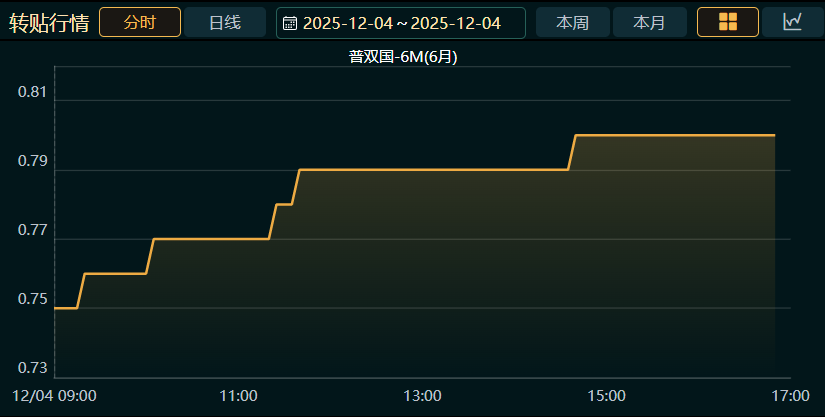
月初上行,票据利率升至0.80%关口!
Xin Lang Cai Jing· 2025-12-04 11:25
Core Viewpoint - The recent increase in the discount rate for government bonds and bank bills has exceeded market expectations, with the rate for June 2024 government bank bills reaching 0.80% [1][11]. Market Trends - On December 4, the discount rate for June 2024 government bank bills rose by 5 basis points (BP) to 0.80%, following a significant increase in supply and demand dynamics in the market [4][15]. - The market saw a daily discount volume of 150 billion yuan, indicating a robust supply side, while demand from major banks remained limited [5][13]. - The rates for different maturities showed varied movements, with the 3-month bill rate slightly decreasing by 1 BP to 0.42%, while the 5-month and 6-month rates increased to 0.91% and 0.80%, respectively [5][13]. Historical Context - The ticket rates at the beginning of December showed a significant increase compared to the end of November, with the 5-month bill rate rising by 8 BP to 0.81% and the 6-month bill rate trading around 0.75% [4][15]. - The overall trend in December appears to mirror that of the previous year, with initial increases followed by potential fluctuations towards the end of the month, influenced by credit and supply factors [9][19]. Interest Rate Differentials - As of December 4, the interest rate differential between tickets and government bonds was -62 BP, while the differential with interbank certificates of deposit was -84 BP [7][17].
流动性与同业存单跟踪:10月初票据利率快速下行
ZHESHANG SECURITIES· 2025-10-12 08:05
Report Industry Investment Rating No relevant content provided. Core Viewpoints - In early October, the bill rate dropped rapidly. The transfer and discount yield of 3M state-owned and joint-stock bank drafts across the year was only 0.47%. The expectation of real - economy credit supply within the year still needs to be boosted, and narrow - sense liquidity has an endogenous basis for loosening [1][2][10]. - Although narrow - sense liquidity has an endogenous basis for loosening, the central bank still emphasizes "preventing capital idling" in the third - quarter monetary policy meeting. The situation of a "lower limit" for repo rates still holds, and the yield range of 1 - year state - owned and joint - stock bank inter - bank certificates of deposit may be between 1.6% - 1.65% [3][11]. Summary by Directory 1. 10 - early - October Bill Rate Rapid Decline - The "five - factor method" shows that central bank investment, commercial bank credit supply, and fiscal factors may all be favorable to the capital market in the fourth quarter, indicating an endogenous basis for loosening of narrow - sense liquidity. The rapid decline in the transfer and discount yield of 3M state - owned and joint - stock bank drafts across the year in early October implies poor expectations for real - economy credit supply in the fourth quarter by commercial banks, which is favorable to narrow - sense liquidity. On October 9, the transfer and discount yields of overnight, 7 - day, 1M, 3M, and 6M state - owned and joint - stock bank drafts were 1.28%, 1.28%, 1.19%, 0.47%, and 0.77% respectively [2][10]. 2. Narrow - sense Liquidity 2.1 Central Bank Operations: Continuous Net Investment in Outright Repos - Short - term liquidity: In the past week (October 9 - 10), the central bank's pledged repos had a net withdrawal of 16423 billion yuan. As of October 10, the central bank's repo balance was 10210 billion yuan, significantly lower than on September 30 but still slightly higher than the seasonal level in previous years. The commercial bank system's excess reserves still depend on central bank investment [12]. - Medium - term liquidity: In October, the total maturity amount of outright repos was 13000 billion yuan, and the MLF maturity was 7000 billion yuan. On October 9, the central bank renewed 11000 billion yuan of 3M outright repos, with an excess renewal of 3000 billion yuan [13]. 2.2 Institution's Fund Lending and Borrowing Situation: Strong Supply and Demand - Fund supply: On October 10, large - scale banks' net fund lending (flow concept) was 38608 billion yuan, an increase of 14269 billion yuan compared to September 30. The net lending balance of large - scale banks was 45983 billion yuan, an increase of 3652 billion yuan compared to September 30. The net lending balance of money market funds was 18758 billion yuan, a decrease of 437 billion yuan compared to September 30. In early October, joint - stock commercial banks had large - scale net borrowing, and the net borrowing amount was at a relatively high level in the same period of previous years [16]. - Fund demand: On October 10, the balance of inter - bank pledged repurchase of bonds in the whole market was about 11.7 trillion yuan, an increase of 3358 billion yuan compared to September 30. The whole - market leverage ratio was 107%, an increase of 0.15 percentage points compared to September 30. The leverage ratio of non - legal person products was 112%, a decrease of 0.44 percentage points compared to September 30 [26]. 2.3 Repo Market Transaction Situation: Volume Increase and Price Decrease at the Beginning of the Month - Fund volume and price: In the past week, the volume of the inter - bank pledged repo market increased while the price decreased, in line with the seasonal pattern at the beginning of the month. The median daily trading volume of inter - bank pledged repos was 7.5 trillion yuan, an increase of 24969 billion yuan compared to September 29 - 30. The median R001 was 1.37%, a decrease of 9bp compared to September 29 - 30. The median spread between R001 and DR001 was 4.4bp, a decrease of 6.3bp; the median spread between GC001 and R001 was 13.2bp, an increase of 2.3bp, indicating small liquidity friction [28][30]. - Fund sentiment index: At the beginning of the month, the fund market was seasonally loose, and the fund sentiment index was around 50, generally loosening in the afternoon [32]. 2.4 Interest Rate Swaps: Slight Increase The 1 - year FR007 IRS interest rate decreased compared to last week. The median 1 - year FR007 IRS this week was 1.56%, a decrease of 2bp compared to last week, and the interest rate was at the 12% quantile since 2020 [33]. 3. Government Bonds: Low Net Payment Pressure for Government Bonds in the Coming Week 3.1 Next Week's Net Payment of Government Bonds - Affected by the holiday, the net payment of government bonds was small in the past week. In the coming week, the expected net payment of government bonds is 852 billion yuan, with a relatively low overall net payment pressure. Among them, the net payment of treasury bonds is 1261 billion yuan, and local bonds have a net repayment of 409 billion yuan. The net payment pressure is relatively large on Monday, and small on other weekdays [37]. 3.2 Current Issuance Progress of Government Bonds - As of October 11, the net financing progress of treasury bonds was 83.8%, an increase of 2.8% in the past week, with about 1.08 trillion yuan of remaining net financing space in 2025. The issuance progress of new local bonds was 83.6%, with 0.85 trillion yuan of remaining issuance space in 2025. The issuance progress of refinancing special bonds was 99.8%. Recently, the net supply scale of treasury bonds and special refinancing bonds has slowed down, but the issuance rhythm of new local bonds may still be relatively fast in October [38]. 4. Inter - bank Certificates of Deposit: Significant Decline in Net Financing Scale, and the Pressure on Banks' Long - term Liabilities May Be Controllable 4.1 Absolute Yield - On October 10, the SHIBOR quotes for overnight, 7 - day, 1M, 3M, 6M, 9M, and 1Y were 1.32%, 1.45%, 1.56%, 1.58%, 1.64%, 1.67%, and 1.68% respectively. Among them, overnight, 7 - day, and 1M increased by - 6bp, 5bp, and - 1bp respectively compared to September 30, and other terms remained unchanged. The yields to maturity of 1M, 3M, 6M, 9M, and 1Y inter - bank certificates of deposit of AAA - rated commercial banks on October 10 were 1.84%, 2.07%, 2.19%, 2.27%, and 2.33% respectively. Among them, 1M and 3M decreased by 1bp and 6bp respectively compared to September 30, and other terms remained unchanged [42]. 4.2 Issuance and Stock Situation - In the past week (October 9 - 10), the total primary issuance volume of inter - bank certificates of deposit was 16.52 billion yuan. In terms of issuance terms, the proportions of 1M, 3M, 6M, 9M, and 1Y were 70%, 7%, 5%, 8%, and 10% respectively. Among them, 1M increased by 59.19 percentage points compared to last week, while 3M, 6M, 9M, and 1Y decreased by 16.75 percentage points, 13.39 percentage points, 13.11 percentage points, and 15.93 percentage points respectively compared to last week [46]. 4.3 Relative Valuation - On October 10, the spread between the yield to maturity of 1 - year AAA - rated inter - bank certificates of deposit and R007 was 18bp, at the 37% quantile since 2020. The spread between the yield to maturity of 10 - year treasury bonds and 1 - year AAA - rated inter - bank certificates of deposit was 18bp, at the 41% quantile since 2020 [49].
月末银票转贴利率 大跳水
Sou Hu Cai Jing· 2025-07-30 16:41
Core Viewpoint - The article discusses the significant fluctuations in the bill discount rates in the market, particularly highlighting the sharp decline on July 30, 2023, and the implications for credit demand and supply dynamics in the banking sector [1][2][3]. Group 1: Market Dynamics - On July 30, the central bank conducted a reverse repurchase operation of 309 billion yuan, resulting in a net injection of 158.5 billion yuan after accounting for maturing reverse repos [1]. - The bill discount rates experienced a dramatic drop, with the 6-month bill discount rate falling to 0.2%, marking a 30 basis point decrease from the previous day [2]. - The 3-month and 6-month bill discount rates rebounded significantly in the afternoon after reaching historical lows, indicating a volatile supply-demand balance in the market [2][3]. Group 2: Seasonal Trends - July is traditionally a "small month" for credit, leading to expectations of a seasonal decline in credit issuance, which is reflected in the lower bill discount rates [4][5]. - The 6-month bill discount rate has shown a downward trend throughout July, dropping from 1.19% at the end of June to 0.41%, a decrease of 78 basis points [3][4]. Group 3: Credit Demand and Supply - The article notes that the bill discount rates have been influenced by banks' shifting preferences towards short-term loans, which have reduced the demand for bills [5][6]. - The analysis indicates that the recent fluctuations in bill rates are symptomatic of a broader imbalance in supply and demand within the market, exacerbated by seasonal factors and changing lending practices [5][6]. Group 4: Financial Data Insights - In June, the total new corporate loans reached 1.77 trillion yuan, with short-term loans contributing significantly to this figure, reflecting a trend towards short-term financing over bill financing [5][6]. - The current spread between bill rates and other financial instruments, such as government bonds and interbank certificates of deposit, has reached new highs, indicating a potential misalignment in market pricing [6].