夸克AI浏览器

Search documents
美团AI浏览器,被龙虾截胡了
Sou Hu Cai Jing· 2026-03-09 02:17
Core Viewpoint - Meituan has launched its AI browser Tabbit, entering a competitive market dominated by established tech giants, despite lacking a history in browser products or search services [2][3]. Group 1: Product Launch and Controversy - Tabbit was launched on March 2 and quickly faced plagiarism allegations from an independent developer regarding similarities to an open-source project [2]. - The controversy was resolved after Tabbit acknowledged its misunderstanding of the GPL open-source license and removed the disputed code [2]. Group 2: Strategic Positioning - Meituan's entry into the AI browser market raises questions about its competitive edge, given its background in local services rather than technology [3]. - The AI browser concept has gained traction, differing from traditional browsers by providing direct answers to user queries instead of links [3]. Group 3: Technical Capabilities - Tabbit claims to offer features such as intelligent dialogue, smart agents, and tag management, but lacks significant innovation compared to existing products [4]. - Testing showed that Tabbit performed adequately in basic tasks but struggled with complex operations and cross-platform interactions [15][12]. Group 4: Market Context and Competition - The AI browser market is seen as technically complex and immature, with unclear business models, yet Meituan aims to establish a presence in the AI consumer product space [16][20]. - Competitors like ByteDance and Alibaba are advancing their AI products, shifting focus from basic functionality to user experience and integration into daily tasks [16]. Group 5: Future Prospects - The potential of AI browsers to connect B-end merchants with C-end consumers could create a complete information-to-transaction loop if developed successfully [18]. - Tabbit's ability to showcase agent capabilities is crucial for Meituan, as it seeks to demonstrate its AI model's effectiveness in real-world applications [19].



美团发布AI浏览器
3 6 Ke· 2026-03-02 11:07
Core Viewpoint - Meituan's Tabbit AI browser has entered public beta, aiming to redefine the browsing experience by integrating AI capabilities deeply into its functionality, targeting office workers, students, and content creators [1][2]. Group 1: Product Overview - Tabbit AI browser supports both macOS and Windows platforms and is currently available for free without an invitation code [1]. - The browser is designed to automate tasks such as opening web pages, extracting information, filling forms, and integrating data across platforms, enhancing user efficiency [1][2]. - Unlike traditional browsers that primarily serve as web browsing tools, Tabbit aims to achieve "human-machine collaboration" through features like "smart agents," "tips," and "scripts" [1]. Group 2: Market Context - The browser market is dominated by Microsoft IE/Edge and Google Chrome, but the rise of generative AI presents an opportunity for tech companies to innovate traditional browsers [1]. - Many existing AI browsers in the market add AI functionalities on top of traditional browser architectures, maintaining the core browsing logic [1][3]. Group 3: Competitive Landscape - Other players in the AI browser space include Alibaba's Quark AI browser and a Silicon Valley startup, The Browser Company, which is developing an AI-native browser that eliminates traditional tabs [3]. - Meituan's Tabbit is part of a broader trend where companies are integrating AI deeply into browser functionalities to enhance user experience [3]. Group 4: Company Strategy - Meituan's "Light Year Beyond" team, which developed Tabbit, was founded by Meituan's co-founder Wang Huiwen and has received significant investment, with a valuation exceeding $600 million [3]. - Meituan's CEO Wang Xing has expressed a strong interest in AI, outlining a three-tier AI strategy focusing on workplace efficiency, product enhancement, and building internal language models [4]. Group 5: Challenges and Opportunities - Despite the potential of AI browsers, Meituan has faced challenges in gaining market presence, especially in the C-end AI application space, where competitors have been more aggressive [6][7]. - The launch of Tabbit may not immediately change Meituan's position in the AI landscape, but it signals the company's commitment to C-end AI applications [7].

AI进入生态对决,大厂们的明牌与暗战
3 6 Ke· 2026-01-22 04:59
Core Insights - The article discusses the competitive landscape among major tech companies in the AI sector, particularly focusing on Alibaba, ByteDance, and Tencent as they prepare for the upcoming Spring Festival and the AI application race [1][3][12] Group 1: AI Competitive Landscape - Alibaba has launched the Qianwen App, achieving over 100 million daily active users within two months, and has integrated it with its ecosystem, enhancing its AI capabilities [2][3] - ByteDance's Doubao has also surpassed 100 million daily active users and is expanding into various smart devices, indicating a strong push in AI hardware and software integration [4][8] - Tencent is taking a more cautious approach, focusing on internal restructuring and gradual development of its AI capabilities, with recent organizational changes and the introduction of new AI models [6][10] Group 2: Strategic Approaches - Alibaba's strategy involves rapid deployment and integration of AI across its business lines, aiming to enhance user experience and operational efficiency [7][12] - ByteDance leverages its existing user base and ecosystem to minimize costs and maximize the impact of its AI applications, positioning itself as a major player in the AI hardware market [8][9] - Tencent's strategy appears to be more conservative, focusing on building a robust AI infrastructure and integrating AI into its existing services, particularly within the WeChat ecosystem [11][12] Group 3: Market Dynamics and Future Outlook - The competition for AI market share is intensifying, with all players needing to ensure user engagement and retention rather than just focusing on user acquisition [12] - The article suggests that the upcoming Spring Festival may serve as a pivotal moment for these companies to showcase their AI advancements and marketing strategies [2][5]


实测夸克「千问划词快捷指令」,这7个邪修Prompt,建议收藏
机器之心· 2026-01-15 03:52
Core Viewpoint - The article discusses the challenges and solutions related to effectively using AI for understanding complex information, emphasizing the importance of well-structured prompts to enhance AI responses [6][8]. Group 1: AI Interaction Challenges - Many users struggle to communicate effectively with AI, leading to frustration and doubts about AI's intelligence [5][6]. - The quality of AI responses often depends on the clarity and structure of the user's prompts, suggesting that refined instructions can significantly improve outcomes [6][10]. Group 2: Quark AI Browser Features - The Quark AI Browser has introduced a feature called "Thousand Questions Highlighting," which allows users to create custom shortcut commands for frequently used prompts, streamlining the interaction process [8][10]. - Users can set up specific commands for tasks like translation and content optimization, making it easier to achieve precise results without repetitive input [11][12]. Group 3: Practical Applications of AI Prompts - The article highlights various effective prompt categories, such as "Evil Master Prompts" that encourage AI to ask for necessary information to fulfill tasks effectively [15][16]. - A "Human Language Translator" prompt is suggested for simplifying complex academic papers, allowing users to receive clear explanations [25][27]. - The "Citation Source Finder" prompt aids in quickly identifying relevant research sources, significantly reducing the time spent on literature review [30][33]. Group 4: Content Creation Enhancements - Content creators can utilize tailored prompts for different platforms, ensuring that the tone and style match the audience's preferences, thus enhancing engagement [35][39]. - Specific prompts for platforms like Xiaohongshu and Weibo are provided, demonstrating how to adapt content for various social media environments [39][42]. Group 5: Future of AI Browsers - The Quark AI Browser aims to evolve into a comprehensive application, integrating various AI models and supporting multimodal inputs, which enhances user experience and functionality [45][46]. - The browser's capabilities are designed to create a seamless workflow for users, enabling them to perform tasks more efficiently and effectively [48][51].

AI浏览器杀疯了,创业者的机会窗口在哪?
3 6 Ke· 2026-01-05 13:00
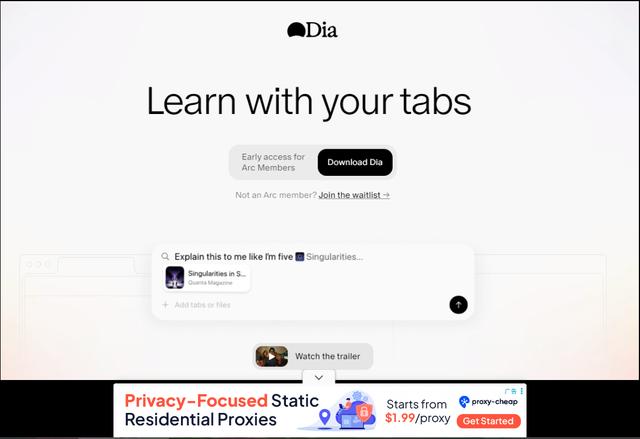
Core Insights - The traditional browser market has been stagnant for years, dominated by Microsoft’s IE and Google’s Chrome, with little innovation beyond cosmetic changes and plugins [1] - The emergence of generative AI has disrupted this stagnant market, leading to the development of AI-driven browsers like Dia and Quark, which aim to redefine user interaction with web information [2][3] Group 1: Transformation of Browsers - The core transformation of AI browsers is shifting from merely being "information windows" to becoming "execution agents" that can perform tasks for users [3] - Dia, an AI browser, exemplifies this shift by automatically gathering and summarizing information from multiple sources, allowing users to receive direct answers without manual searching [3][4] - The ambition of Dia extends to becoming a "Web operating system," integrating various applications and services directly within the browser, thus enhancing user productivity [4] Group 2: Different Approaches in the Market - In the U.S., companies like Dia are pursuing a disruptive approach by completely overhauling traditional browser interfaces and deeply integrating AI [6][9] - In contrast, Chinese players like Quark and 360 AI Browser focus on enhancing existing browser frameworks with AI tools to address specific user needs, which may lead to quicker commercialization [10][11] - Quark has transformed into a "mobile intelligent laboratory," providing various AI functionalities tailored for students and professionals, leveraging its ecosystem for data storage and processing [13] Group 3: Challenges for Entrepreneurs - The AI browser market faces significant challenges, including competition from tech giants like Google and Apple, which are integrating AI features into their existing browsers [16] - The high computational costs associated with AI functionalities pose a financial risk for startups, necessitating innovative monetization strategies beyond traditional advertising [17] - Ethical concerns regarding content scraping and potential copyright issues may arise as AI browsers generate summaries from original web content, impacting the overall web ecosystem [20] Group 4: Future Outlook - The evolution of AI browsers represents a significant opportunity for investment, as they are seen as the next step in human-computer interaction rather than mere upgrades to existing browsers [21][22] - Entrepreneurs are encouraged to explore niche markets and specific user pain points rather than replicating existing models like Chrome, as the landscape is shifting towards more integrated and intelligent solutions [22]




大厂AI to C战事升级:腾讯阿里合围,豆包迎战
3 6 Ke· 2025-12-25 11:35
Core Insights - The competition for AI to C has become a central battleground for internet giants, with Tencent and Alibaba making significant strategic shifts to secure their future in the face of declining mobile internet growth [1][2][4] Group 1: Strategic Shifts - Tencent and Alibaba are transitioning from a conservative approach to a proactive strategy in AI, focusing on ecosystem traffic rather than just technology reserves [2] - The timing of this shift coincides with advancements in large model technology, which has reached a stage ready for widespread application [2][11] - Alibaba faces challenges in its e-commerce dominance as Douyin's e-commerce GMV grows at a rate of 30%, necessitating a search for new growth avenues [2][12] Group 2: Competitive Landscape - Tencent's daily active users for its product Yuanbao are significantly lower at 30 million compared to Douyin's 100 million for its product Doubao, highlighting a competitive gap [7][10] - The urgency to capture the AI to C entry point stems from the need to control traffic distribution rights, which have evolved from PC to mobile internet and now to AI interfaces [7][11] Group 3: Ecosystem Development - Both companies aim to create a full-loop ecosystem from traffic to conversion, with Tencent leveraging its social platforms and Alibaba focusing on e-commerce and local services [8][12] - Tencent's Yuanbao is designed to integrate with its existing services, while Alibaba's strategy involves a dual approach with its Qianwen app and Quark browser [8][10] Group 4: Technological and Market Dynamics - The competition hinges on three critical factors: technology, application scenarios, and user perception, with each company having its strengths [11][15] - Alibaba's Tongyi Qianwen model has surpassed Meta in open-source model downloads, establishing itself as a leader in this space [11][12] - Both companies are significantly increasing their capital investments in AI, with Alibaba's AI and cloud Capex reaching 38.6 billion yuan in Q1 of FY2026, and Tencent's capital expenditure increasing by 221% year-on-year [8][11] Group 5: Future Outlook - The battle for AI to C will not only be about technology but also about how well companies can convert that technology into user value and loyalty [15] - By 2025, the AIGC market in China is expected to reach a user base of 483 million, indicating a shift from novelty to mainstream application [12][15]

“AI时代的未来之战”!阿里加码千问C端
新华网财经· 2025-12-10 04:55
Group 1 - Alibaba has established the Qianwen C-end business group, led by Vice President Wu Jia, resulting from the merger of the original Intelligent Information and Intelligent Connectivity groups [2] - The primary goal of the Qianwen C-end business group is to develop Qianwen into a super app, aiming to be the primary entry point for users in the AI era [2] - Qianwen is expected to evolve into an omnipresent AI assistant, integrating into various scenarios such as glasses, PCs, and cars, allowing users to access AI anytime and anywhere [2] Group 2 - In the past month, Qianwen has experienced rapid growth in the C-end market, with over 10 million downloads within a week of public testing, exceeding user growth and retention expectations [2] - The product has been deeply integrated with Quark AI browser and Quark AI glasses, expanding into more user scenarios [2] - Alibaba's core management views the Qianwen project as a "future battle of the AI era," planning to integrate various life scenarios such as maps, food delivery, ticket booking, office work, learning, shopping, and health into Qianwen [2]

阿里成立千问C端事业群:“智能信息”“智能互联”二合一
Xin Jing Bao· 2025-12-09 09:57
Group 1 - Alibaba has established a new consumer-facing business group called Qianwen, led by Vice President Wu Jia, which merges the previous Intelligent Information and Intelligent Connectivity groups [1] - The primary goal of the Qianwen group is to develop Qianwen into a super app, serving as the primary entry point for users in the AI era, and to create an omnipresent AI assistant accessible across various devices and scenarios [1] - In the past month, Qianwen has seen significant growth in the consumer market, with over 10 million downloads within a week of public testing, exceeding user growth and retention expectations [1] Group 2 - Alibaba's organizational restructuring is aimed at enhancing its AI business, with key adjustments made by the end of 2024 to early 2025, including the integration of the Tongyi AI application team into the Intelligent Information group [2] - The Tmall Genie team has merged with the Quark team to explore hardware directions, while a dedicated AI to C team has been formed, managed by Wu Jia [2] - The newly formed teams are specifically divided into the Intelligent Information group and the Intelligent Connectivity group for better operational efficiency [2]
阿里巴巴成立千问C端事业群
Xin Lang Cai Jing· 2025-12-09 08:09
Group 1 - Alibaba has established the Qianwen C-end business group, led by Vice President Wu Jia, resulting from the merger of the original Intelligent Information and Intelligent Connectivity groups, encompassing Qianwen APP, Quark, AI hardware, UC, and Shuqing businesses [2][4] - The primary goal of the Qianwen C-end business group is to develop Qianwen into a super APP, aiming to be the primary entry point for users in the AI era, with plans to evolve it into an omnipresent AI assistant across various devices such as glasses, PCs, and cars [5][3] - In the past month, Qianwen has seen rapid growth in the C-end market, with over 10 million downloads within a week of public testing, exceeding expectations in user growth and retention, and achieving a product launch trifecta last week with rapid iterations in core capabilities for creation, learning, and office tasks [5][3] Group 2 - Alibaba's core management views the Qianwen project as a "future battle of the AI era," planning to integrate various life scenarios such as maps, food delivery, ticket booking, office work, learning, shopping, and health into Qianwen, enhancing its operational capabilities [5][3]
苹果担心的事,还是发生了…
Xin Lang Cai Jing· 2025-12-08 01:33
Core Insights - OpenAI is preparing to launch its own AI hardware, having recently acquired io Products for $6.5 billion and recruited dozens of hardware engineers from Apple [1][3][5] - The company aims to create an AI version of the iPhone, recognizing the need to establish a hardware ecosystem to compete with rivals like Google [5][41] - OpenAI's hardware team includes experts in various fields, indicating a significant investment in hardware design and development [3][39] Group 1: OpenAI's Hardware Strategy - OpenAI has been aggressively hiring from Apple, focusing on building a team that covers industrial design, hardware engineering, and supply chain management [3][39] - The acquisition of io Products allows OpenAI to leverage Jony Ive's design expertise, which has shaped Apple's product aesthetics for decades [1][37] - OpenAI's shift towards hardware is seen as a response to the increasing competition in the AI space, particularly from companies that have established hardware products [5][41] Group 2: Competitive Landscape - Other AI companies, particularly in China, are advancing faster in hardware integration, with ByteDance's AI Phone and Alibaba's AI initiatives already in the market [47][48] - ByteDance's AI Phone, developed in collaboration with ZTE, showcases the potential of AI in mobile technology, while Alibaba's strategy focuses on creating an AI operating layer across devices [48][54] - Baidu is positioning its AI products as central to smart home ecosystems, emphasizing a long-term strategy to integrate AI into everyday life [58][60] Group 3: Future of AI Hardware - The competition for AI hardware is intensifying, with major players like Google, Microsoft, and Meta also investing in their own AI ecosystems [71][72] - Google is leveraging its Android ecosystem and Pixel devices to create a unified AI experience, while Microsoft is integrating AI capabilities into its Windows operating system [61][64] - Meta is focusing on AI glasses as the next human-computer interaction interface, highlighting the diverse approaches companies are taking in the AI hardware space [68][70]