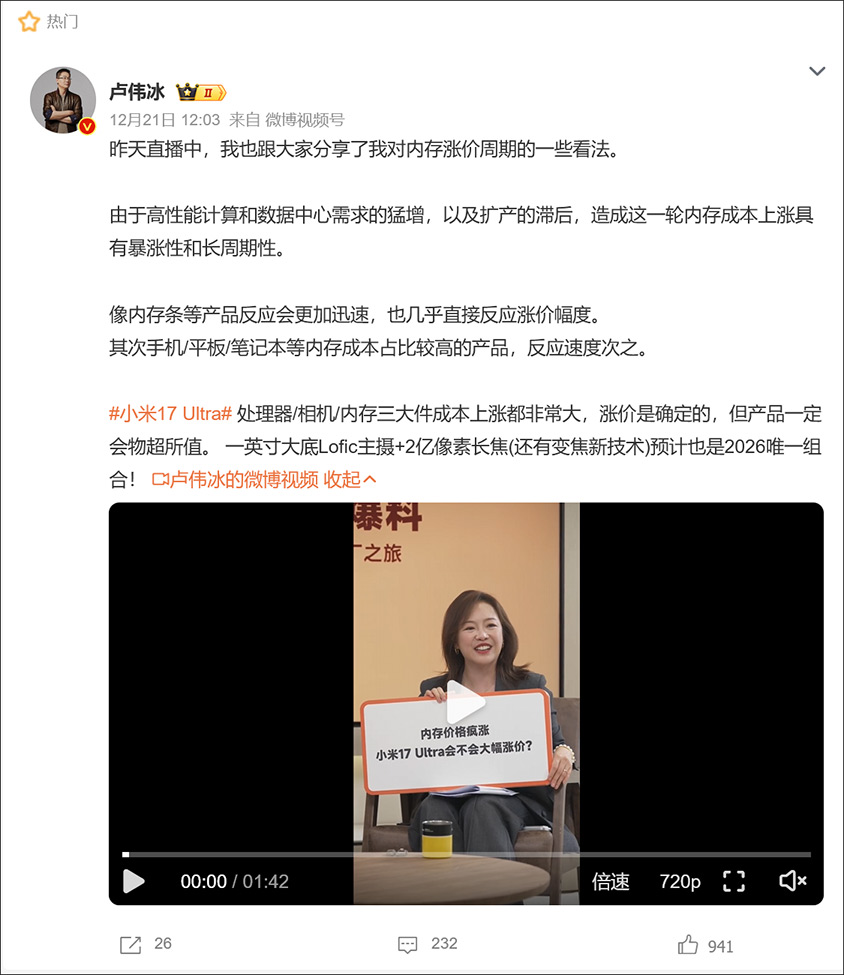
小米17 Ultra系列

Search documents
智能手机2026:变局中的挑战与曙光
3 6 Ke· 2026-02-01 06:26
Core Insights - The smartphone industry is experiencing a significant downturn in expected shipments for 2026, with major manufacturers like Xiaomi and OPPO reducing their forecasts by over 20% [1][2] - The decline in shipments is primarily attributed to rising storage chip prices and supply shortages, leading to a strategic shift towards higher-value products [2][6] Group 1: Industry Dynamics - In 2025, the global smartphone shipment reached 1.26 billion units, with a 1.9% year-on-year growth, while China's market saw a slight decline of 0.6% [3] - Huawei regained its position as the leading smartphone manufacturer in China with a shipment of 46.7 million units, capturing a market share of 16.4% [3] - Apple and Vivo closely followed Huawei, with shipments of 46.2 million and 46.1 million units, respectively, indicating a highly competitive landscape [3][4] Group 2: Market Challenges - The price of storage chips is expected to rise significantly, with a projected increase of 40% to 50% in Q1 2026, further impacting manufacturers' cost structures [6][8] - The cost increase is particularly pronounced in low-end models, which may deter price-sensitive consumers from upgrading their devices [7][8] Group 3: Future Trends - The integration of AI into smartphones is anticipated to be a major trend, with new AI-enabled smartphone shipments expected to reach 147 million units in China, accounting for over 50% of the market [9] - The development and application of 2nm chips are also on the horizon, promising enhanced performance and efficiency for future smartphones [10]



中国手机厂商撑起全球六成市场,海外出货结构进入重构期
Di Yi Cai Jing· 2026-01-14 12:41
Core Insights - The overseas expansion of Chinese manufacturers continues, but the competitive strategies and target price segments are undergoing significant changes [1][2][4] - The global smartphone industry is entering a new structural adjustment cycle, driven by rising storage chip prices and supply chain costs [1][6] Market Trends - According to IDC, global smartphone shipments are projected to grow by 2.3% year-on-year in Q4 2025, reaching 1.26 billion units, with an annual growth of 1.9% [1] - The growth is primarily driven by high-end models, foldable phones, and consumers' anticipation of future price increases [1][2] - Apple and Samsung are the fastest-growing manufacturers among the top five, with year-on-year growth rates of 6.3% and 7.9%, respectively, increasing their combined market share to 39% from 37% in 2024 [2] Competitive Landscape - Chinese manufacturers are facing structural pressures as the market shifts towards higher price segments, which have traditionally been their stronghold in overseas markets [2][4] - Honor is noted as the fastest-growing Chinese manufacturer overseas, with a year-on-year growth of approximately 55% in the first three quarters of 2025, focusing on the $300 to $500 price range [4][5] - Other Chinese brands like OPPO and Xiaomi are also adjusting their strategies to target mid-range markets, with OPPO moving from entry-level products to more mid-range offerings [5] Cost and Supply Chain Challenges - The uncertainty in 2026 is largely centered around costs and supply chain issues, particularly the volatility in storage prices [6][7] - Counterpoint Research predicts a 40% to 50% increase in storage chip prices in Q1 2026, with further increases expected in Q2 [6] - The rising costs of components are significantly impacting the pricing and sales of low-end models, making the business model for sub-$100 devices increasingly fragile [7]

轻工新消费行业周报:26H2别样消费长牛有望开启,四大新消费主线领航-20260111
SINOLINK SECURITIES· 2026-01-11 13:48
Investment Rating - The report maintains a "Buy" rating for the durable consumer goods industry [1] Core Insights - The report anticipates a long-term consumer bull market driven by new consumption trends, with four main themes expected to lead the way: AI+ consumption, overseas expansion, emotional value, and silver economy [1][8] - Historical cycles indicate that the A-share market exhibits 3-4 year cyclical fluctuations, with technology, cyclical consumption, and manufacturing rotating sequentially [1] - The report draws parallels between the upcoming "anti-involution" reforms starting in July 2025 and the "supply-side" reforms initiated in October 2015, suggesting similar transmission paths despite differing contexts [1] Summary by Sections 1. Consumer Outlook for 2026 - The report highlights that the consumer bull market led by new consumption will differ from the 2016-2019 period, focusing on AI+ consumption, overseas expansion, emotional value, and silver economy as key growth areas [8] - AI+ consumption is expected to be a major opportunity throughout 2026, with significant advancements in technology and consumer engagement [12] - The overseas expansion of brands is seen as a critical growth driver, particularly as urbanization rates plateau and the focus shifts to international markets [23] - Emotional value consumption is projected to grow significantly, driven by changing demographics and economic conditions, with sectors like pet care and collectibles gaining traction [28] - The silver economy is anticipated to reach a market size of 71 trillion yuan by 2023, with substantial growth expected as the aging population increases [40] 2. Sector Performance Tracking - The report tracks various sectors, indicating a mixed outlook: - Trend toys are showing upward momentum, with companies like Pop Mart leading the market [43] - The new tobacco sector is expected to benefit from regulatory tightening, favoring compliant manufacturers [45] - The home goods sector is experiencing pressure from weak real estate transactions, but there are signs of stabilization [47] - The paper and packaging sector is seeing price fluctuations, with expectations of recovery as supply tightens [49] - The pet food market is evolving, with a shift towards premium products and increased focus on health and wellness [31] 3. Key Data and Trends - The report provides insights into key data trends, such as the significant growth in the 3D printing market, which is projected to reach $24.61 billion by 2024 [17] - The export of 3D printers from China has seen substantial increases, with a year-on-year growth of 136.2% in export value [25] - The emotional value market is expected to continue expanding, with pet care and collectibles being highlighted as key areas of growth [28]

回到台前的雷军 回应一切的小米
Bei Jing Shang Bao· 2026-01-04 15:57
Core Viewpoint - Xiaomi is actively addressing product-related controversies and shifting its communication strategy to regain control over its narrative, as demonstrated by a recent live-streamed event where CEO Lei Jun and other executives responded to public concerns and showcased the YU7 vehicle [1][3][4]. Group 1: Live Stream Event - The live stream, initially scheduled for New Year's Eve, featured a detailed disassembly of the YU7 vehicle, allowing Xiaomi's engineers to explain design concepts and technical details [1][3]. - Lei Jun acknowledged the company's previous reluctance to respond to product criticisms, emphasizing a new approach to engage with consumers and address their concerns directly [3][4]. - The event lasted over four hours and included a segment dedicated to addressing various criticisms that had circulated online, marking a strategic shift for the company [1][4]. Group 2: Communication Strategy - Xiaomi's new communication strategy aims to proactively address public concerns and clarify misconceptions, with Lei Jun stating that this is just the beginning of a series of planned responses [4][5]. - The company is encouraging open discussions and evaluations from industry peers, with executives like Xu Jieyun advocating for transparency in product assessments [5][6]. - Lei Jun and Xu Jieyun highlighted the importance of combating misinformation and malicious attacks, revealing that legal actions have been taken against individuals spreading false information about the company [6][7]. Group 3: Future Strategy and Investment - Xiaomi has committed to investing over 200 billion yuan in research and development over the next five years, focusing on generative AI and enhancing its product ecosystem [8][9]. - The company reported a 30% increase in sales for the new 17 series compared to the previous 15 series, indicating strong market performance and consumer interest [9].

2025年,国产手机在哪些地方走在了前面?丨唐探
Xin Lang Cai Jing· 2025-12-28 14:15
Core Insights - The Chinese smartphone market is expected to see significant growth in 2025, with a reported shipment of 282 million units from January to November, maintaining a year-on-year growth trend [1] - Innovations in the industry are shifting focus from hardware competition to enhancing user experience and addressing user pain points [1][2] Group 1: Innovations and Product Launches - Xiaomi's latest 17 Ultra series emphasizes color accuracy and creative photography experiences, featuring a collaboration with Leica to enhance user shooting experiences [4] - Honor's new WIN series gaming phone incorporates an active cooling fan within the body, addressing the critical need for heat management during high-performance gaming [4] - The sales success of these new models reflects a broader trend among Chinese manufacturers to prioritize practical user experiences over mere technical specifications [4] Group 2: Market Dynamics and User Trends - The saturation of mobile internet users and smartphone penetration indicates a need for growth strategies within a mature market [5][6] - Companies are moving away from numerical parameter competition to genuinely understanding and meeting user needs, as seen with Huawei's innovative folding phone designed for productivity [7] - The integration of AI capabilities in smartphones, such as Honor's AI system for business applications, highlights the industry's focus on enhancing functionality for specific user groups [7][8] Group 3: Standardization and Future Outlook - The adoption of China's UFCS fast charging protocol as a global standard by the International Telecommunication Union marks a significant milestone in addressing compatibility issues across different brands [11] - The ongoing emphasis on user experience-driven innovation is expected to lead the industry towards a more mature and rational development phase [11] - The competitive landscape in 2026 is anticipated to be dynamic, with various players vying for market leadership [11]
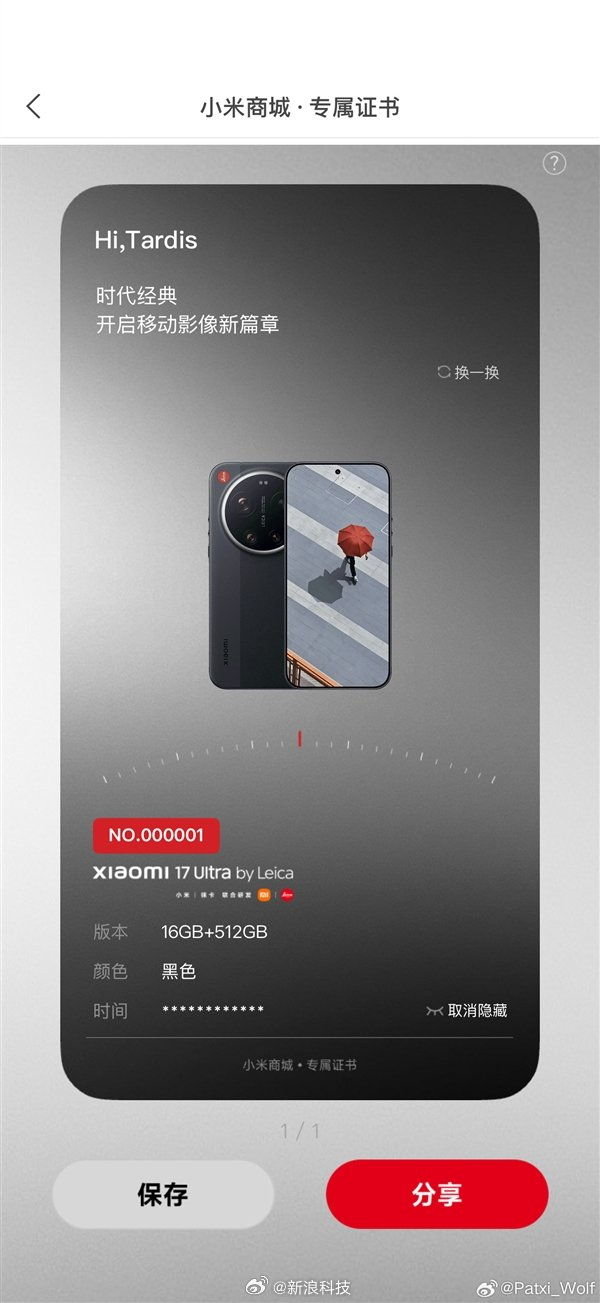
米粉抢到编号000001小米17Ultra徕卡版,首台零售版现身
Xin Lang Ke Ji· 2025-12-26 01:54
Group 1 - The core product launched is the Xiaomi 17 Ultra series, which includes the standard version and the Leica version [1] - The Leica version is priced starting at 7999 yuan and has sold out quickly, indicating strong demand [1] - A notable customer shared an order screenshot of the first retail version, numbered 000001, which features 16GB RAM and 512GB storage [1]

手机成本趋势非常恶劣?小米、荣耀再发声:刚需别等了
Guan Cha Zhe Wang· 2025-12-23 03:45
Group 1 - The global memory chip market is experiencing a significant price increase due to tight supply from DRAM manufacturers, impacting consumer electronics pricing [1][4] - Major smartphone manufacturers like Xiaomi, OPPO, and Honor have raised prices for new models by 100 to 600 yuan, with predictions of further price hikes in 2024 [1][3] - Xiaomi's president confirmed that the price of the Xiaomi 17 Ultra series will increase significantly due to rising memory costs, with estimates suggesting a 500 yuan increase to a starting price of 6999 yuan [1][3] Group 2 - The overall cost pressure in the electronics industry is severe and expected to persist for at least one to two years, leading to potential price increases for previously released products [3][4] - TrendForce forecasts a 30.9% increase in DRAM industry revenue in Q3 2025, with contract prices expected to rise by 45-50% in Q4 2025 [4] - Counterpoint Research predicts a 2.1% decline in global smartphone shipments in 2026 due to memory chip shortages and rising prices, with Apple and Samsung positioned to better withstand these challenges [5][7] Group 3 - The rising memory costs are forcing manufacturers to either increase product prices or reduce specifications, with a focus on optimizing product structure to mitigate losses [7][8] - PC manufacturers like Dell have already announced price increases of 10% to 30% for commercial PCs, with other brands likely to follow suit [8][9] - The DIY market is also affected, with some companies offering "no memory" options for custom builds due to skyrocketing memory prices [9][10] Group 4 - The decline in motherboard sales by 40% to 50% indicates a broader impact on the sales of CPUs and SSDs, as consumers are hesitant to purchase components amid rising prices [10] - The consensus within the industry suggests that a price increase across consumer electronics is inevitable, leading to a potential missed opportunity for consumers who delay purchases [11]