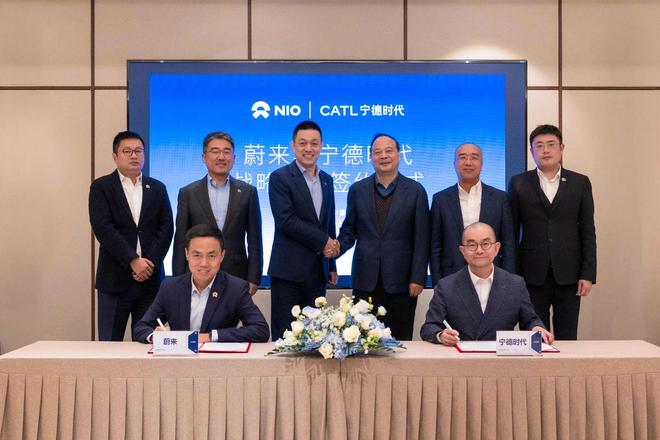
巧克力换电方案

Search documents
换电模式能否走通?
Zhong Guo Qi Che Bao Wang· 2026-02-10 07:58
Core Viewpoint - The article discusses the challenges and potential of the battery swapping model in the electric vehicle (EV) industry, highlighting the investments made by companies like NIO and CATL, and the financial viability of this model. Investment and Cost Analysis - NIO's first-generation battery swapping station cost approximately 3 million yuan, while the second generation costs between 1.5 to 2 million yuan, with over 1,100 second-generation stations expected by December 2025 [3] - The initial investment for a battery swapping station includes equipment costs of 1.5 million yuan, line costs of 200,000 yuan, and battery costs of 620,000 yuan, with operational costs including a monthly salary of 5,000 yuan and annual rent and maintenance of 100,000 yuan [7] Profitability and Financial Outlook - NIO aims to achieve profitability by the end of 2025, with a forecasted adjusted operating profit of 700 million to 1.2 billion yuan for Q4 2025, marking its first quarterly adjusted operating profit since inception [3] - Long-term projections suggest that the battery swapping model could yield a return rate of 5.5%, potentially becoming a stable cash cow for companies once it reaches a steady state [6] Market Dynamics and Competitive Landscape - CATL has ambitious plans to establish 1,000 battery swapping stations by 2025, with a long-term goal of 30,000 stations, which would cover over 20 million vehicles [5] - The battery swapping model is closely related to the concept of battery separation, which can lower vehicle purchase costs and enhance battery longevity through standardized management [10] Industry Concerns and Challenges - Concerns exist regarding the high costs of building and operating battery swapping stations compared to charging stations, which may deter some automakers from adopting this model [13] - The rapid development of battery technology poses a risk that companies may become locked into outdated models if they heavily invest in battery swapping infrastructure [13] - The lack of standardized battery sizes and interfaces across different automakers complicates the implementation of a universal battery swapping system [13] Consumer Perception and Adoption - Some consumers express reluctance to accept used batteries from swapping stations, and the cost of battery swapping can be comparable to traditional fuel costs, which may hinder adoption [14] - The emergence of ultra-fast charging technologies is narrowing the performance gap between charging and swapping, potentially reducing the perceived value of battery swapping [14] Competitive Positioning - The report indicates that BYD is gaining market share in the 50,000 to 150,000 yuan segment, increasing from 25% in 2019-2020 to an expected 56-57% in 2023-2024, creating competitive pressure on other automakers [15] - For companies without in-house battery production, adopting the battery swapping model may be a viable strategy to remain competitive in the lower-priced vehicle market [16]



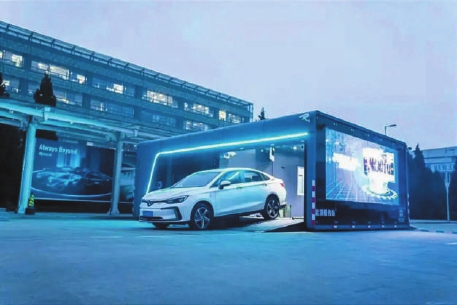
宁德时代(300750):换电篇:迈向应用创新,再造宁德时代
Changjiang Securities· 2026-01-31 12:43
Investment Rating - The investment rating for the company is "Buy" and is maintained [14] Core Insights - The report shifts focus from lithium battery manufacturing to application innovation, emphasizing battery swapping and separation of vehicle and battery, integrated energy storage for data centers, and zero-carbon grids [4][25] - By 2024, the company is expected to capture 72% of the high-end passenger vehicle market and 45% overall, indicating strong brand value in the high-end segment but requiring more strategies for the low-end market [9][21] - The demand for lithium batteries is expected to slow, but the trend of new energy replacing fossil fuels continues to create broader market opportunities and profit flexibility [9][25] Summary by Sections Passenger Vehicles - The company launched its first-generation chocolate battery swapping solution in January 2022, with a renewed plan set for December 2024, aiming to build 1,000 battery swapping stations by 2025 and 30,000 in the long term [10][27] - The penetration rate of new energy vehicles in the 5-15 million price range is challenging, with only 38% for 5-10 million and 52% for 10-15 million, indicating a need for better cost-performance and refueling efficiency [10][30] - If the battery swapping model is successfully promoted, the company's market share in passenger vehicles could exceed 50% [10][37] Commercial Vehicles - The report discusses the advantages of battery swapping for electric heavy trucks, including higher refueling efficiency and lower lifecycle costs compared to fast charging [12] - The company aims to establish a comprehensive network of battery swapping stations to support the growing demand for electric heavy trucks [12] Business Model Viability - The chocolate battery swapping model includes both battery swapping station operations and battery bank services, with a focus on achieving competitive pricing and operational efficiency [38] - The economic viability of battery swapping stations is sensitive to the number of daily swaps and service fees, with potential returns improving significantly with higher usage [41] Strategic Progress - The company has made significant progress in partnerships with multiple automakers, with new models set to launch in 2025, indicating a strong commitment to the battery swapping strategy [56]
宁德时代(300750):迈向应用创新 再造宁德时代-换电篇
Xin Lang Cai Jing· 2026-01-31 12:37
Group 1 - The core viewpoint of the articles emphasizes the strategic shift of CATL towards application innovation, particularly in battery swapping and separation of battery and vehicle, to enhance market competitiveness and profitability in the evolving electric vehicle landscape [1] - CATL's market share in high-end passenger vehicles is projected to reach 72% in 2024, while the overall market share is expected to be 45%, indicating strong brand value in the high-end segment but a need for further expansion in the low-end market [1] - The demand for lithium batteries is expected to slow down, with a downward adjustment in growth rate and valuation, yet the trend of new energy replacing fossil fuels continues to create broader market opportunities and profit elasticity [1] Group 2 - CATL's chocolate battery swapping solution, first introduced in January 2022, is set to be renewed in December 2024, aiming to enhance the penetration rate of electric vehicles in the economic segment, particularly in the 50,000 to 150,000 RMB price range [2] - The penetration rates for new energy vehicles in the 50,000 to 100,000 RMB and 100,000 to 150,000 RMB segments are 38% and 52% respectively, highlighting challenges in improving market share in the 50,000 to 150,000 RMB range due to cost-performance and charging efficiency issues [2] - If CATL successfully promotes the battery swapping model, its market share in passenger vehicles could exceed 50%, compared to an estimated 40% without this model [2] Group 3 - The separation of battery and vehicle ownership is viewed as an innovative business model that can lead to mutual benefits, such as maximizing battery lifecycle value and improving second-hand vehicle residual value [3] - Battery swapping can enhance insurance pricing competitiveness by addressing uncertainties related to battery lifespan and safety, benefiting both insurance companies and vehicle owners [3] Group 4 - The debate over whether electric heavy trucks should adopt battery swapping or fast charging continues, with battery swapping being favored for its higher refueling efficiency and lower lifecycle costs [4] - The initial purchase cost of vehicles using battery swapping is lower, and the approach is seen as more compatible with future trends towards autonomous driving and green transportation [4]
京东+宁德+广汽携手造车潜力可期,换电生态雏形初现
Haitong Securities International· 2025-10-15 11:17
Investment Rating - The report does not explicitly state an investment rating for the companies involved in the battery-swap ecosystem initiative [1]. Core Insights - JD Auto, CATL's subsidiary, and GAC Group are collaborating to launch a new energy vehicle priced between RMB 100,000 and 120,000, expected to debut during the "Double 11" shopping festival, with JD as the exclusive sales platform [1][8]. - The vehicle is likely based on GAC Aion's platform and will feature CATL's "Chocolate Swap" battery-swap technology, targeting the mainstream A-class NEV market and appealing to urban commuters and lower-tier city consumers [2][9]. - The battery-swap model aims to alleviate range anxiety, lower purchase barriers, and extend vehicle lifespan, making it attractive for cost-sensitive users, although the swap network is still in early expansion [2][9]. - The collaboration is strategically significant for all parties, with JD extending its e-commerce platform into mobility, CATL accelerating the commercialization of its battery-swap system, and GAC optimizing its product mix through JD's channel [3][10]. - The success of this initiative depends on the pace of network rollout, user experience, and collaboration depth among the three companies [3][10]. Summary by Sections Event Overview - JD Auto is partnering with CATL's CAES and GAC Group to launch a new NEV priced between RMB 100,000 and 120,000, set to be unveiled during the "Double 11" shopping festival [1][8]. Market Positioning - The new vehicle targets the mainstream A-class NEV segment, focusing on urban commuters and lower-tier city consumers, with a technological edge in energy replenishment efficiency if it utilizes CATL's battery-swap solution [2][9]. Strategic Collaboration - The partnership allows JD to create a closed-loop ecosystem integrating online sales, energy replenishment, and after-sales service, while CATL and GAC leverage JD's traffic and marketing capabilities [3][10]. Ecosystem Development - The report suggests monitoring ancillary segments in the battery-swap supply chain, including battery modules and energy-asset management services, as the project progresses [4][11].

宁德时代:兆瓦超充需要扩容或配备储能 不一定普遍适用
Di Yi Cai Jing· 2025-04-15 06:40
Core Viewpoint - The automotive industry is witnessing a shift towards "megawatt supercharging" and "intelligent driving equality," with companies like BYD, Huawei, and Zeekr entering the market. However, challenges remain in implementing megawatt-level charging stations due to high costs and long construction periods [2][3]. Company Developments - CATL reported a revenue of 84.705 billion yuan in Q1 2023, a year-on-year increase of 6.18%, with a net profit of 13.963 billion yuan, up 32.85%. The gross margin was 24.4%, showing growth both year-on-year and quarter-on-quarter [3]. - CATL launched the "Shenxing" ultra-fast charging battery in 2023, the first large-scale production battery using lithium iron phosphate material, capable of 4C charging. In 2024, the "Shenxing PLUS" battery will achieve an equivalent charging rate of 6C, with peak rates reaching 12C to 15C [2]. Market Trends - The demand for energy storage batteries is increasing, particularly in emerging markets like the Middle East and Australia, driven by renewable energy and AI data centers. CATL has secured significant energy storage projects in these regions [3]. - CATL plans to build 1,000 battery swap stations this year and has formed partnerships with Sinopec, NIO, and Didi to enhance battery swapping services, which are seen as a cost-effective solution for consumers [2]. Competitive Landscape - The U.S. market for energy storage primarily relies on lithium iron phosphate batteries, with Japanese and Korean battery manufacturers like LG and Panasonic expected to ramp up production only after 2026. The new tariffs are shared between energy storage companies and U.S. end-users [4].
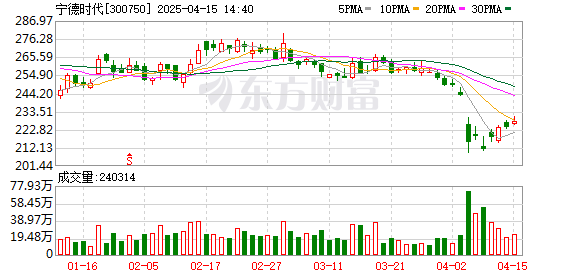
与蔚来合作换电后,传宁德时代欲控股武汉蔚能
Guan Cha Zhe Wang· 2025-04-08 04:25
Core Viewpoint - CATL is negotiating to acquire a controlling stake in Wuhan Weinan Battery Asset Co., Ltd, which is currently partially owned by NIO and CATL itself [1][4]. Group 1: Company Developments - Wuhan Weinan was established in 2020, with NIO holding less than 20% and CATL holding approximately 10.68% [1]. - The business focus of Wuhan Weinan is battery asset management, including battery leasing and lifecycle management under the BaaS model [1]. - NIO has a separate entity, Wuhan NIO Energy Co., Ltd, which is fully owned by NIO Energy Investment (Hubei) Co., Ltd, and CATL does not hold any shares in this company [1]. Group 2: Strategic Partnerships - On March 17, CATL and NIO signed a strategic cooperation agreement to deepen capital and business collaboration, aiming to build a comprehensive battery swap network [2][4]. - NIO has established around 3,200 battery swap stations and plans to build approximately 1,000 highway swap stations, connecting over 700 cities in China [5]. Group 3: Future Plans and Investments - CATL plans to invest up to 2.5 billion RMB in NIO Energy and is also increasing investments in battery swap facilities, with a goal of building 1,000 "chocolate" swap stations by 2025 [4][7]. - A framework agreement was signed between CATL and Sinopec to develop a nationwide battery swap ecosystem, with a target of constructing at least 500 swap stations this year [7].