
新能源车型

Search documents
观车 · 论势 || 从“出海”合作看中国车企全球化底气
Zhong Guo Qi Che Bao Wang· 2026-02-27 10:24
Core Viewpoint - Geely is expanding its global strategy through potential collaboration with Ford, focusing on capacity sharing and technology cooperation, which aligns with its previous partnership with Renault, indicating a shift in Chinese automakers' approach to globalization from "market for technology" to "technology-driven cooperation" [1] Group 1: Geely and Ford Collaboration - Geely is negotiating with Ford to utilize Ford's existing factories in Europe for producing vehicles aimed at the European market, while also exploring a framework for vehicle technology sharing, particularly in autonomous driving [1] - The collaboration aims to enhance Ford's factory utilization in Europe and provide Geely with local production capabilities to avoid high tariffs on electric vehicles imposed by the EU [3] Group 2: Geely and Renault Partnership - The partnership between Geely and Renault has established a "technology-capital-market" cooperation system, allowing both companies to leverage each other's strengths, particularly in the Brazilian market where they formed a joint venture to introduce new energy vehicles [2] - This model has proven effective in addressing the challenges faced by traditional automakers in Europe and facilitating Chinese automakers' entry into overseas markets [2] Group 3: Broader Industry Trends - The collaboration model of capacity sharing is becoming a key strategy for Chinese automakers to navigate trade barriers and establish a sustainable presence in foreign markets, as building independent factories is costly and time-consuming [1][2] - Other Chinese automakers, such as Chery, are also adopting similar strategies, partnering with local firms to enhance their production capabilities and market presence in Europe [3] Group 4: Technological Empowerment - Chinese automakers are increasingly taking on the role of technology providers in partnerships, showcasing their technological advancements in the electric and intelligent vehicle sectors, which marks a significant shift from their previous passive roles [4] - This transition reflects the growing technical strength of Chinese automakers and is a crucial indicator of the rise of the Chinese automotive industry on the global stage [4] Group 5: Challenges Ahead - Despite the progress, Chinese automakers face challenges such as cultural differences, varying automotive standards, and geopolitical risks that need to be addressed as they expand globally [4] - Intellectual property issues, including standard essential patent litigation, pose additional risks in the globalization process for Chinese companies [4] Group 6: Future Outlook - The arrival of the electric and intelligent era has positioned Chinese automakers like Geely, Chery, Xpeng, and Leap Motor to take the initiative in global competition through capacity sharing, technology output, and ecosystem collaboration [5] - These strategies are gradually reshaping the competitive landscape of the global automotive industry, pushing it towards a new phase of deep collaboration in electrification and intelligence [5]


溢价20%仍被抢,谁在高溢价入局A股定增,哪类行业高溢价?
Feng Huang Wang· 2026-02-25 06:24
Core Viewpoint - The A-share private placement market is witnessing a significant shift from traditional discount-based participation to high-premium issuance, with several projects achieving premium rates exceeding 20% [1][3]. Group 1: High Premium Issuance - A number of private placement projects have been successfully issued at high premiums, breaking the previous norm of "buying shares at a discount" [1][3]. - The issuance of shares by Guangdian Measurement has a premium rate of 29.09%, raising a total of 1.3 billion yuan at an issue price of 24.01 yuan per share [3]. - The automotive industry has seen particularly notable high-premium issuances, with companies like Jianghuai Automobile and Fengshen Co. achieving premium rates of 23.93% and 125% respectively [4]. Group 2: Participants in High Premium Placements - Public funds are the primary participants in high-premium private placements, with notable involvement from private equity, securities firms, insurance capital, and foreign institutions [1][6]. - The largest single subscription for the North Vehicle Blue Valley's new round of private placement was made by E Fund, amounting to 2.2 billion yuan [7]. - Notable individual investors, referred to as "bulls," have also played a significant role, with some becoming the largest subscribers in various projects [8][9]. Group 3: Investment Focus and Trends - The focus of investment has shifted towards sectors such as new energy vehicles, artificial intelligence, and high-end manufacturing, driven by macroeconomic policies and industry trends [2][10]. - The funds raised in these private placements are primarily allocated to the development of high-end intelligent electric platforms and new materials, aligning with the industry's push for innovation and sustainability [10][11]. - The demand for advanced materials and technologies in the automotive sector is increasing, with companies like Yao Pi Glass and Zhongbei Communication investing in energy-saving upgrades and 5G infrastructure [11][12].
韩国股市2026年展望:半导体景气与政策支持成焦点
Jing Ji Guan Cha Wang· 2026-02-11 14:52
Market Overview - The KOSPI index is projected to reach 7500 points by February 2026, indicating significant upside potential driven by the semiconductor industry's performance and corporate reforms [2] - Despite a single-day drop of over 5% on February 6, 2026, the KOSPI index has maintained a strong overall performance since breaking the 5000-point mark in January 2026 [2] Recent Events - The South Korean National Assembly passed the "Special Act on Strengthening and Supporting the Competitiveness of the Semiconductor Industry" on January 29, 2026, which is expected to take effect by the third quarter of 2026, providing institutional support for the semiconductor supply chain [3] - The South Korean government continues to promote the "Value Enhancement Plan" aimed at improving corporate governance and shareholder returns, with record levels of stock buybacks and dividends expected to continue into 2026 [3] Company Developments - Samsung Electronics plans to implement a stock price-linked employee compensation scheme from October 2025 to 2028, which may influence market sentiment; the company's Q4 2025 earnings guidance indicates a significant year-on-year increase in operating profit [4] - SK Hynix is expected to achieve record high performance in FY 2025 and has announced additional dividends; the company anticipates sustained demand for high bandwidth memory (HBM) and is focusing on capacity expansion plans for 2026 [4] - LG Energy's 2026 strategy focuses on expanding energy storage battery production, aiming to increase North American capacity to over 60 GWh and plans to launch new technology products such as lithium iron phosphate batteries within the year [4] - Hyundai Motor Group's Beijing Hyundai plans to launch four new energy vehicle models between 2026 and 2027, covering various technology routes including pure electric and hybrid [4] Industry Policy Landscape - The Bank of Korea maintained the benchmark interest rate at 2.5% for the fifth consecutive time in January 2026, with future meetings likely to cautiously balance economic recovery and inflation risks [5] - The National Pension Service (NPS) plans to reduce overseas stock investments by approximately $20 billion in 2026, shifting towards increased domestic allocations, which may impact market liquidity [5]
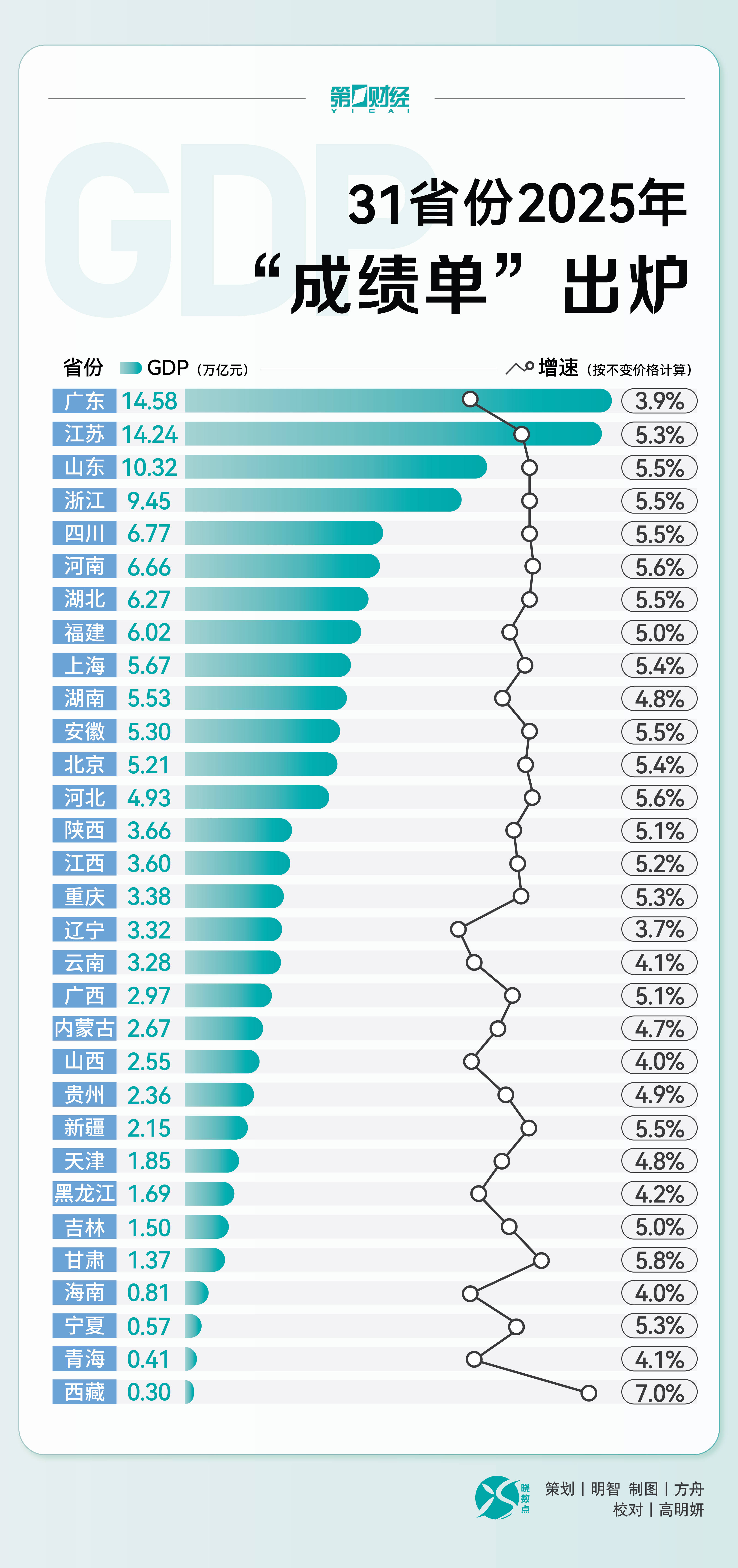
31省份去年GDP成绩单:西藏增速领跑,重庆总量进位
Di Yi Cai Jing· 2026-01-31 11:51
Economic Rankings - The overall GDP rankings of the 31 provinces in China remain stable, with only Chongqing surpassing Liaoning, marking a significant change [1][10] - In 2025, Chongqing's GDP is projected to be 33,757.93 billion, while Liaoning's is 33,182.9 billion, indicating a lead of 575 billion for Chongqing [10][14] Economic Growth Rates - Tibet continues to lead the nation in economic growth, achieving a GDP growth rate of 7.0% in 2025, with significant contributions from major infrastructure projects [2][6] - Other provinces with notable growth rates include Gansu (5.8%), Henan (5.6%), and Hebei (5.6%), driven by factors such as large-scale infrastructure, resource development, and the manufacturing of new energy vehicles [2] Industrial Performance - In 2025, Tibet's secondary industry is expected to see an increase in value added of 1,156.24 billion, growing by 9.6%, supported by resource processing and clean energy development [7] - Gansu's industrial output is projected to grow by 9.5%, with significant contributions from the non-ferrous metals, power, and petrochemical industries [8] - Chongqing's industrial value added is expected to grow by 5.9%, with the smart connected vehicle industry contributing significantly, particularly in new energy vehicle production [12] Regional Comparisons - The economic performance of Chongqing and Liaoning highlights a contrast, with Chongqing's industrial transformation leading to higher growth compared to Liaoning's stagnation in industrial output [11][12] - Yunnan is on track to potentially surpass Liaoning, with a GDP of 32,765.78 billion in 2025, indicating a narrowing gap due to lower growth rates in Liaoning [13] Historical Context - The surpassing of Liaoning by Chongqing is seen as a milestone, reflecting the shift in economic power from the Northeast to the Southwest region of China, marking a significant change in the historical economic landscape [15]

北汽蓝谷新能源科技股份有限公司关于签订募集资金专户存储三方监管协议的公告
Xin Lang Cai Jing· 2026-01-27 19:59
Group 1 - The core point of the announcement is that Beijing Automotive Blue Valley New Energy Technology Co., Ltd. has signed a tripartite supervision agreement for the storage of raised funds to ensure proper management and usage of the funds, thereby protecting investor rights [3][4][6]. Group 2 - The company has received approval from the China Securities Regulatory Commission to issue 793,650,793 shares at a price of RMB 7.56 per share, raising a total of approximately RMB 5.99 billion, with a net amount of approximately RMB 5.94 billion after deducting issuance costs [2]. - The funds raised will be specifically allocated for projects related to new energy vehicle development, AI intelligent platforms, and smart driving electric systems [4][5]. - A special account for the raised funds has been established, which will only be used for the designated projects and cannot be used for other purposes [4][5]. Group 3 - The tripartite agreement involves the company, Huaxia Bank, and CITIC Securities, ensuring compliance with relevant laws and regulations regarding the management of raised funds [3][6]. - The agreement stipulates that the company must notify CITIC Securities of any withdrawals exceeding 20% of the net raised funds within a 12-month period [7]. - CITIC Securities is responsible for supervising the usage of the raised funds and must conduct at least biannual inspections of the fund's storage and usage [6][7]. Group 4 - The agreement will remain effective until all funds are fully utilized and the account is legally closed, or until mutually agreed upon termination [8]. - The tripartite agreement is documented in six copies, with each party retaining one copy and submitting others to regulatory bodies [8].

北汽蓝谷:签订募集资金专户存储三方监管协议
Xin Lang Cai Jing· 2026-01-27 07:56
Core Viewpoint - The company, Beiqi Blue Valley, has announced the issuance of 793,650,793 shares at a price of 7.56 yuan per share, raising a total of 5.999 billion yuan, with a net amount of 5.943 billion yuan after deducting issuance costs [1] Fundraising Management - The company has signed a tripartite supervision agreement with Huaxia Bank and Beijing Rural Commercial Bank, along with CITIC Securities, to manage the raised funds [1] - A dedicated account has been opened for the funds, with the account number being 10279000001467563/2000000905113, and the balance as of January 19 is 0 million yuan [1] Fund Utilization - The funds raised will be specifically used for projects related to new energy vehicles and cannot be used for other purposes [1]
GDP增长5.4%,北京是怎样实现的?
Xin Jing Bao· 2026-01-25 05:48
Core Insights - Beijing's economy achieved significant growth in 2025, with a GDP increase of 5.4% [1] Economic Growth and Investment - The city established a central funding project reserve mechanism, issuing 123.3 billion yuan in local government special bonds and initiating a pilot program for special bond investment in government investment funds [2] - Fixed asset investment in Beijing reached 82 billion yuan, with a 5.5% increase in overall fixed asset investment and a 40.1% rise in high-tech industry investment [4] Support for SMEs and Innovation - A total of 6,742 billion yuan in loans were provided to small and micro enterprises and individual businesses, supported by various policies aimed at enhancing long-term capital market participation and promoting venture capital [2] - The city issued 6,643.3 billion yuan in technology innovation bonds, facilitating nearly 700 billion yuan in loans for over 1,400 enterprises [2] Consumption and Market Development - Beijing accelerated the construction of an international consumption center, implementing actions to boost consumption and receiving approval for new consumption models and environments [3] - The city organized 2,295 large-scale events and launched a citywide scenic area ticketing service platform, contributing to a 5% increase in consumer spending [4] Emerging Industries and Digital Economy - The city promoted the upgrade of advantageous industries and maintained a leading position in the digital economy, with over 31 trillion data entries shared cumulatively [5][6] - The establishment of a national data circulation infrastructure and a significant increase in data trading volume were reported, with a 172% year-on-year growth in trading volume at the Beijing big data exchange [6] Green Technology and Sustainability - Beijing led in green technology with 69,000 effective green technology invention patents and initiated a voluntary greenhouse gas emission trading market [7] - The city built 490,000 charging piles and 1,044 supercharging stations, promoting renewable energy and green development initiatives [7]
至信股份:未来公司将逐步提升新能源车型产品占比
Zheng Quan Ri Bao Wang· 2026-01-22 13:41
Core Viewpoint - The company aims to enhance its long-term development by expanding its customer base and increasing the proportion of new energy vehicle products while optimizing its product structure and developing lightweight automotive products [1] Group 1: Customer and Product Strategy - The company plans to actively expand its high-quality new customer base while continuing to serve existing clients [1] - There is a focus on gradually increasing the share of new energy vehicle products in the overall product lineup [1] Group 2: Production and Efficiency - The company intends to optimize its product structure and significantly develop lightweight automotive products to expand market coverage of its advantageous products [1] - The use of high-efficiency automated equipment is planned to achieve capacity expansion at core production bases [1] - The company is also looking to develop intelligent production scenarios based on its current automated production capabilities to further enhance operational efficiency [1]
一汽解放:公司各类产品保持稳健发展态势
Zheng Quan Ri Bao Zhi Sheng· 2026-01-14 13:39
Core Viewpoint - The company, FAW Jiefang, is maintaining a steady development trend across various product lines, with a focus on both traditional and new energy vehicles [1] Group 1: Product Development - The company has completed market layout for its small truck products, adapting various models for diverse usage scenarios [1] - The proportion of new energy vehicles is steadily increasing, while traditional energy vehicles continue to solidify their market foundation [1] Group 2: Market Strategy - The company emphasizes a comprehensive collaborative layout across its product offerings, ensuring synergy between different energy types [1] - Specific sales and operational data will be disclosed in accordance with the company's information disclosure policies [1]

每周股票复盘:长安汽车(000625)拟定向增发募资不超60亿
Sou Hu Cai Jing· 2026-01-02 17:40
Core Viewpoint - Changan Automobile plans to issue A-shares to a specific entity, China Changan Automobile Group, to raise up to 6 billion yuan for projects related to new energy vehicles and smart platform development, as well as global R&D center construction [2][12][13] Company Announcements - Changan Automobile's stock closed at 11.86 yuan, down 1.08% from the previous week, with a total market capitalization of 117.58 billion yuan, ranking 5th in the passenger car sector [1] - The company announced that 8,461,728 restricted shares will be released from restrictions, representing 0.0854% of the total share capital, effective January 5, 2026 [1] - The company held its 50th meeting of the 9th Board of Directors, approving the issuance of A-shares to a specific entity at a price of 9.52 yuan per share, with a total of 630,252,100 shares to be issued [2][5][12] Shareholder Meetings - Changan Automobile convened its second extraordinary general meeting on December 29, 2025, where it approved proposals for capital increases to its subsidiaries, with 4,408 shareholders present, representing 39.334% of the voting shares [3] - The company will hold its first extraordinary general meeting of 2026 on January 16, 2026, to discuss 13 agenda items, including the issuance of A-shares to a specific entity [4] Financial Details - The planned issuance of A-shares aims to raise funds for new energy vehicle projects and smart platform development, with the total amount not exceeding 6 billion yuan [5][12] - After the issuance, the shareholding of China Changan Automobile will increase from 35.07% to 38.95%, with a commitment not to transfer the new shares for 36 months [5][12][13] Legal and Compliance - A legal opinion confirmed that the procedures for the extraordinary general meeting were compliant with relevant laws and regulations [3] - The independent directors have expressed that the issuance plan does not harm the interests of minority shareholders and complies with regulatory requirements [11]
