开放式理财产品

Search documents
银行理财市场研究(2025年四季度)
Sou Hu Cai Jing· 2026-01-29 14:28
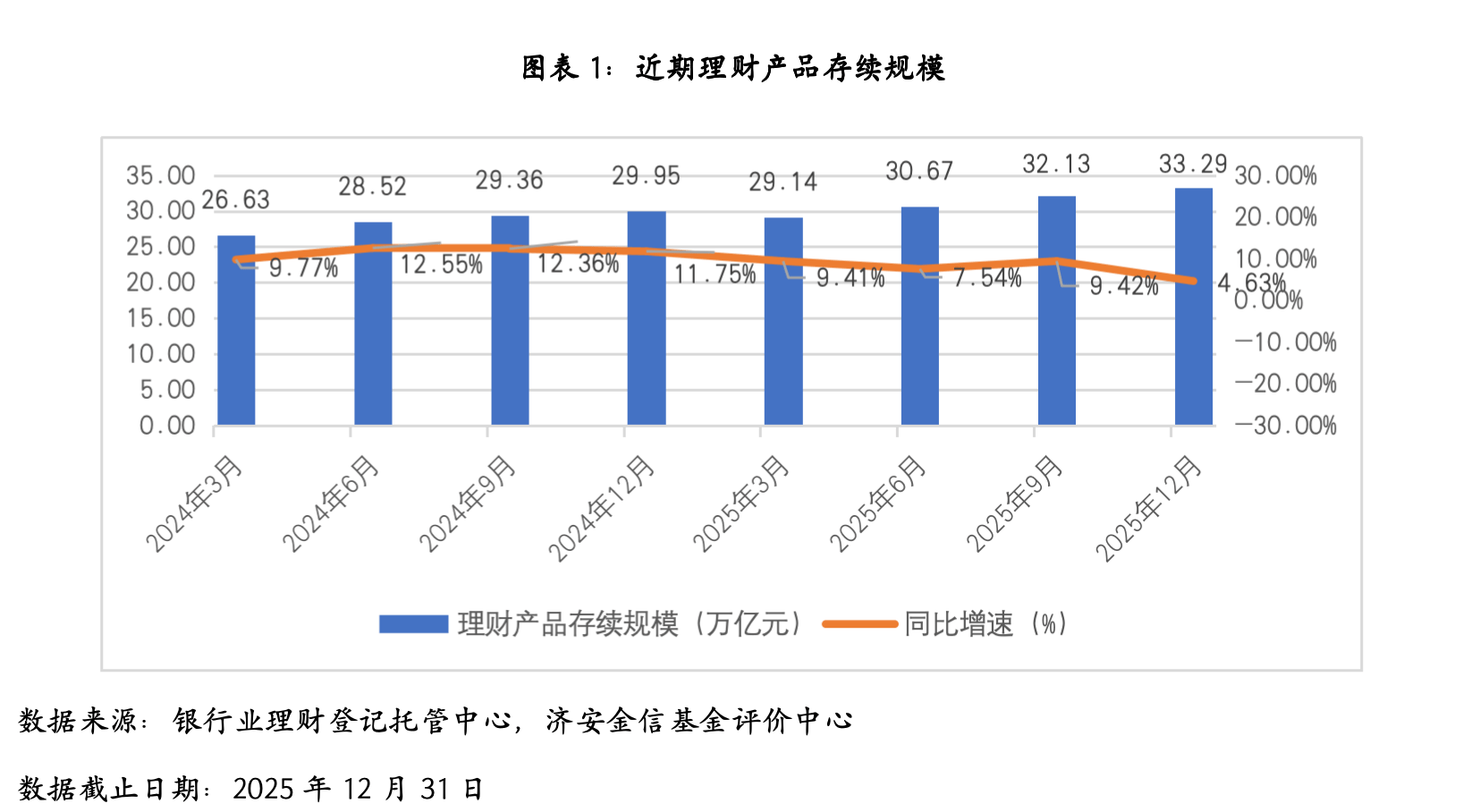
Group 1: Overall Market Performance - As of the end of 2025, the total outstanding scale of wealth management products reached 33.29 trillion yuan, an increase of 11.15% year-on-year, with wealth management companies accounting for 92.25% of the market share [17] - The number of outstanding wealth management products increased to 46,300, a year-on-year growth of 14.89% [1] Group 2: Institutional Breakdown - By the end of 2025, banks had 12,600 outstanding products with a scale of 2.58 trillion yuan, a decrease of 29.12% year-on-year, while wealth management companies had 33,700 products with a scale of 30.71 trillion yuan, an increase of 16.72% [4] Group 3: Product Characteristics - Fixed income products accounted for 97.09% of the total outstanding scale, amounting to 32.32 trillion yuan, a slight decrease of 0.24 percentage points year-on-year [6] - Open-ended wealth management products made up 79.87% of the total scale, with a size of 26.59 trillion yuan, a decrease of 0.93 percentage points year-on-year [8] - Products rated at level two (medium-low risk) and below constituted 95.73% of the total scale, amounting to 31.87 trillion yuan [11] Group 4: Asset Allocation - The asset allocation of wealth management products was primarily in fixed income, with bonds, cash and bank deposits, interbank certificates of deposit, and other assets making up 39.7%, 28.2%, 12.2%, and smaller percentages respectively [13] - The structure of bank wealth management assets has been optimized, focusing on low-volatility, high-liquidity standardized assets, with cash and bank deposits increasing by 4.9 percentage points [15] Group 5: Economic Impact - Wealth management funds injected approximately 2.1 trillion yuan into the real economy through various investments, including over 380 billion yuan in green bonds, supporting green and low-carbon development [15] - The funds also provided nearly 5.4 trillion yuan directly to small and micro enterprises, effectively alleviating financing challenges [15] Group 6: Future Outlook - The bank wealth management market is expected to continue on a path of high-quality development, with wealth management companies strengthening their professional advantages and expanding product systems around national strategies such as technology finance and green finance [17]

城商行开放式理财产品平均业绩比较基准达2.27%,环比上涨0.06个百分点
Jin Rong Jie· 2026-01-28 08:54
Group 1 - The core point of the report indicates that the total number of newly issued open-ended wealth management products decreased to 115, a reduction of 27 products compared to the previous week, with a market share of 20.28% and an average performance benchmark of 1.91%, which increased by 0.21 percentage points [1] - Wealth management companies issued the most products, totaling 103, accounting for 89.57% of the new offerings, while city commercial banks also held a significant share. The average performance benchmark for city commercial bank products was 2.27%, up by 0.06 percentage points, while that for wealth management companies was lower at 1.85%, increasing by 0.18 percentage points [1] - Fixed income products were the most prevalent, with 112 products issued, a decrease of 26 from the previous week. Mixed products followed with 3 offerings, down by 1, while commodity and financial derivatives, as well as equity products, were negligible, totaling 0. The average performance benchmark for fixed income products was 1.91%, which increased by 0.23 percentage points [1] Group 2 - In terms of risk levels, R2 products were the most numerous with 95 offerings, down by 24, followed by R3 products with 14, which increased by 7. R1 products were limited to 6, while R4 and R5 products were absent. The average performance benchmark for R3 products was 2.40%, down by 0.3 percentage points, while R1 products had a lower average benchmark of 1.39%, which increased by 0.04 percentage points [2]

“存款搬家”持续 银行理财三季度存续规模增1.46万亿元
Guo Ji Jin Rong Bao· 2025-10-24 19:59
Core Insights - The banking wealth management market has seen a significant increase in the scale of existing products, driven by a "deposit migration" phenomenon amid declining interest rates [1][2]. Group 1: Market Overview - As of the end of Q3 2025, the total scale of bank wealth management products reached 32.13 trillion yuan, a year-on-year increase of 9.42% [2]. - The number of existing wealth management products rose to 4.39 million, an increase of 10.01% year-on-year [2]. - The growth in scale is attributed to the "price effect" leading to deposit disintermediation, despite pressure on net asset values [2][3]. Group 2: Product Dynamics - The dominance of wealth management companies has increased, with their products accounting for 91.13% of the total market scale [3]. - The number of banks offering wealth management products has decreased from 194 to 181, with a year-on-year decline of 28.01% in the scale of bank-managed products [3]. - The appeal of closed-end products has risen, with their scale reaching 6.24 trillion yuan, while open-end products saw a slight decline [4]. Group 3: Product Structure and Investor Behavior - The market saw a total of 6,048 new closed-end products launched in Q3 2025, representing 76.90% of all new products [4]. - Investors are increasingly favoring closed-end products for their higher yields, especially in a volatile market environment [4]. - Wealth management companies are adjusting their product structures to increase the issuance of closed-end products to optimize asset allocation and enhance overall yield [4].
【理财锦囊】 “双节”期间,如何让闲置资金“活”起来?
Zheng Quan Shi Bao· 2025-09-29 22:27
Core Viewpoint - The upcoming Mid-Autumn and National Day holidays have prompted banks and wealth management companies to intensify marketing activities focused on "holiday returns," offering various investment products to attract idle funds [1][2]. Group 1: Holiday Investment Products - Multiple banks and wealth management firms have launched holiday-specific investment plans, emphasizing "early layout and pre-holiday confirmation" strategies [1]. - For instance, ICBC Wealth Management's "pre-holiday investment guide" allows investors to confirm shares on September 30 for returns during the holiday period from September 30 to October 8 [1]. - Other institutions like China Merchants Bank Wealth Management suggest combinations of cash management and short-term debt products to maximize holiday returns [1][2]. Group 2: Flexible Investment Options - Institutions such as Ping An Wealth Management and Minsheng Wealth Management have introduced similar products that require subscription by September 29 to enjoy holiday interest [2]. - Some companies have extended the subscription and redemption times for certain products, allowing purchases even after regular trading hours, thus enhancing investment flexibility [2]. - A recommended strategy involves a combination of government bond reverse repos and on-market liquidity management products to achieve dual returns during the holiday [2]. Group 3: Alternative Investment Choices - In addition to wealth management products, options like notice deposits and government bond reverse repos are available for conservative investors, with notice deposits offering a higher interest rate compared to regular savings [3]. - Investors with securities accounts can easily participate in government bond reverse repos, which also cover the holiday return period [3]. Group 4: Key Considerations for Holiday Investments - The core principle of holiday investments is "early planning and precise matching," requiring investors to consider factors such as idle fund duration, risk tolerance, and liquidity needs [4]. - Investors are advised to select appropriate product types and configurations to ensure that idle funds continue to generate value during the holiday [4].
“双节”期间,如何让闲置资金“活”起来?
Sou Hu Cai Jing· 2025-09-29 22:16
Core Insights - As the Mid-Autumn Festival and National Day approach, banks and wealth management subsidiaries are intensifying marketing activities around "holiday returns" [1][2] - Various banks have launched exclusive holiday financial products, emphasizing "early planning and pre-holiday confirmation" to attract idle funds [1][2] Group 1: Product Offerings - Multiple banks, including ICBC and CMB, have introduced holiday-specific financial plans that allow investors to confirm their shares and enjoy returns during the holiday period [1][2] - Institutions like Ping An Wealth and Minsheng Wealth have followed suit, offering similar products across cash management and short-term pure debt categories, expanding investor options [2] Group 2: Investment Strategies - Investors are advised to pay attention to fixed time windows for these products, with most requiring subscription by September 29 and confirmation by September 30 to enjoy holiday returns [2] - For those missing the regular subscription period, "delayed subscription and redemption" products are available, extending purchase and redemption times to enhance investment flexibility [2] Group 3: Alternative Investment Options - In addition to wealth management products, notice deposits and government bond reverse repos are viable options for conservative investors, with a current interest rate of approximately 0.65% for 7-day notice deposits [3] - Investors with securities accounts can participate in government bond reverse repos, which are convenient and low-risk, also covering the holiday return period [3] Group 4: Risk Considerations - The core of holiday financial planning lies in "early planning and precise matching," requiring investors to consider idle fund duration, risk tolerance, and liquidity needs to effectively utilize idle funds during the holiday [4]

【理财锦囊】“双节”期间 如何让闲置资金“活”起来?
Zheng Quan Shi Bao· 2025-09-29 18:23
Core Viewpoint - The upcoming Mid-Autumn and National Day holidays are prompting banks and wealth management companies to intensify marketing activities focused on "holiday returns," offering various investment products to attract idle funds [1][2]. Group 1: Holiday Investment Products - Multiple banks and wealth management firms have launched holiday-specific investment plans, emphasizing "early layout and pre-holiday confirmation" to maximize returns during the holiday period [1][2]. - For instance, ICBC Wealth Management's "pre-holiday investment guide" allows investors to confirm shares by September 30, enabling them to enjoy returns from September 30 to October 8 [1]. - Other institutions, such as China Merchants Bank Wealth Management, suggest combinations of cash management and short-term debt products to optimize returns during the holiday [1][2]. Group 2: Flexible Investment Options - Institutions like Ping An Wealth Management and Minsheng Wealth Management have introduced similar products that require subscription by September 29 to secure holiday interest [2]. - Some companies are extending the subscription and redemption times for certain products to enhance investment flexibility, allowing purchases even after traditional trading hours [2]. - A recommended strategy involves a combination of government bond reverse repos and on-market liquidity management products to achieve dual returns during the holiday [2]. Group 3: Alternative Investment Choices - In addition to wealth management products, options like notice deposits and government bond reverse repos are available for conservative investors, with notice deposits offering a higher interest rate compared to regular savings [3]. - Investors with securities accounts can easily participate in government bond reverse repos, which also cover the holiday return period [3]. Group 4: Strategic Planning for Holiday Investments - The essence of holiday investment lies in "early planning and precise matching," where investors should consider factors like idle fund duration, risk tolerance, and liquidity needs to select appropriate products [4].
“双节”将至银行及理财子公司花式营销“抢闲钱”
Zheng Quan Ri Bao· 2025-09-28 07:11
Core Viewpoint - As the Mid-Autumn Festival and National Day "Golden Week" approach, banks and their wealth management subsidiaries are intensifying marketing activities focused on "holiday returns," aiming to attract idle funds from investors through various promotional strategies [1][2]. Group 1: Marketing Strategies - Multiple banks and wealth management companies are releasing holiday investment strategies via public platforms, encouraging investors to make early investments to secure returns during the holiday period [2][3]. - Products recommended are primarily low-risk and stable, including open-ended, closed-end, cash management, and products with holding period requirements, catering to different investor needs for liquidity and investment duration [2][3]. Group 2: Specific Product Offerings - ICBC Wealth Management has launched cash management and open-ended products, requiring purchases to be completed by September 29 to enjoy holiday returns from September 30 to October 8 [2]. - Other institutions like China Merchants Bank Wealth Management are promoting cash and short-term debt products, with specific deadlines for purchases to maximize holiday returns [2][3]. Group 3: Performance of Wealth Management Products - Some wealth management products from various banks have shown impressive historical performance, with annualized returns reaching up to 12% [4]. - For instance, ICBC Wealth Management offers a product with a risk level of R2, achieving a near one-month annualized return of 12.01% and a historical annualized return of 8.42% since inception [4]. Group 4: Investor Behavior and Market Trends - The pre-holiday period sees an influx of idle funds from bonuses and repayments, creating opportunities for banks to promote their products [3]. - Research indicates that investors should be aware of liquidity risks and market volatility when selecting products, as some may have restrictions on redemption and could be affected by market fluctuations [5][6].
双节”将至 银行及理财子公司花式营销“抢闲钱
Zheng Quan Ri Bao· 2025-09-26 22:43
Core Viewpoint - As the Mid-Autumn Festival and National Day "Golden Week" approach, banks and their wealth management subsidiaries are intensifying marketing activities focused on "holiday returns," aiming to attract idle funds from investors through various promotional strategies [1][2]. Group 1: Holiday Investment Strategies - Multiple banks and wealth management companies are releasing holiday investment plans via public platforms, encouraging investors to make early investments to secure returns during the holiday period [2][3]. - Recommended products primarily feature low-risk and stable styles, including open-ended, closed-end, cash management, and products with holding period requirements, catering to different investor needs for liquidity and investment duration [2][3]. Group 2: Specific Product Offerings - ICBC Wealth Management has launched cash management and open-ended products, requiring purchases to be completed by September 29 to enjoy returns from September 30 to October 8 [2]. - Other institutions, such as China Merchants Bank Wealth Management, are promoting cash and short-term debt products, allowing investors to enjoy extended holiday returns if purchased before specified deadlines [2][3]. Group 3: Performance of Wealth Management Products - Some wealth management products from various banks have shown impressive historical performance, with certain products achieving annualized returns of around 12% [4]. - For instance, ICBC Wealth Management offers a product with a risk level of R2 (medium-low risk) that has a recent annualized return of 12.01% over the past month and 8.42% since inception [4]. Group 4: Investor Considerations - Investors are advised to be aware of potential liquidity risks associated with certain products that may have redemption restrictions or lock-up periods, necessitating careful planning of cash flow needs during the holiday [5]. - Different investment strategies are suggested based on risk tolerance, with conservative investors encouraged to prioritize money market funds and fixed-income products for stable returns, while more aggressive investors may consider increasing equity exposure for higher potential returns [6].

“双节”将至 银行及理财子公司花式营销“抢闲钱”
Zheng Quan Ri Bao· 2025-09-26 15:52
Group 1 - As the Mid-Autumn Festival and National Day "Golden Week" approach, banks and their wealth management subsidiaries are intensifying marketing activities around "holiday returns" to attract idle funds from investors [1][2] - Various banks and wealth management companies are releasing holiday investment strategies through public platforms, emphasizing the need for investors to plan ahead and complete investments before the holiday [2][3] - Many institutions are offering low-risk, stable investment products, including cash management and short-term debt products, to cater to different investor needs regarding liquidity and investment duration [2][3] Group 2 - Some wealth management subsidiaries are launching high-yield products, with historical performance benchmarks reaching up to 12% for certain offerings [4] - For instance, ICBC Wealth Management has introduced a product with a risk level of R2 (medium-low risk) that has a recent annualized return of 12.01% over the past month [4] - Other banks, such as Ping An Wealth Management, are also showcasing competitive returns on their products, with annualized returns ranging from 5.09% to 5.98% [4]
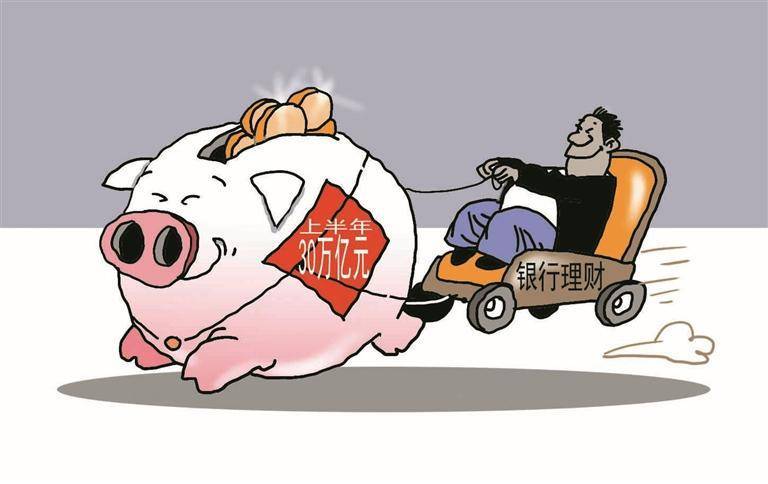
上半年银行理财规模站上30万亿元
Sou Hu Cai Jing· 2025-08-03 23:14
Core Insights - The banking wealth management market in China reported a total scale of 30.67 trillion yuan as of June 2025, reflecting a 2.38% increase from the beginning of the year and a 7.53% year-on-year growth [2][4] - The average annualized yield of wealth management products in the first half of the year was 2.12%, generating a total return of 389.6 billion yuan for investors, which is a 14.18% increase compared to the same period last year [2][5] - There has been significant growth in personal pension wealth management, with the number of accounts exceeding 1.439 million, marking a 46.2% increase since the beginning of the year [2] Investment Product Composition - Fixed income products dominate the market, with a total scale of 29.81 trillion yuan, accounting for 97.2% of the total wealth management products, showing a slight decrease of 0.13 percentage points from the beginning of the year but an increase of 0.32 percentage points year-on-year [3] - Mixed products have a scale of 0.77 trillion yuan, representing 2.51% of the total, with a slight increase of 0.07 percentage points from the beginning of the year but a decrease of 0.22 percentage points year-on-year [3] - Equity products and commodity/financial derivatives are relatively small, with scales of 0.07 trillion yuan and 0.02 trillion yuan, respectively [3] Operational Trends - Open-ended wealth management products are increasingly favored, with a total scale of 24.82 trillion yuan, making up 80.93% of all wealth management products, which is an increase of 0.13 percentage points from the beginning of the year and 1.06 percentage points year-on-year [3] - Cash management products account for 6.4 trillion yuan, representing 25.79% of open-ended products, but have seen a decrease of 4.38 percentage points from the beginning of the year and 7.09 percentage points year-on-year [3] Market Drivers - The growth of the wealth management market is attributed to the continuous decline in deposit rates, leading investors to seek safer and more stable returns through bank wealth management products [4] - The number of investors holding wealth management products reached 136 million, an increase of 8.37% since the beginning of the year [4] - Increased awareness of asset allocation among individual investors has led to a greater demand for diversified investment channels, with bank wealth management products standing out due to their transparency and strict regulation [5]