彩虹六号

Search documents
海通国际:腾讯去年第四季料续稳健 今年维持高质量增长
Zhi Tong Cai Jing· 2026-01-26 06:30
Group 1 - The core viewpoint of the report is that Haitong International maintains a "buy" rating on Tencent Holdings (00700) with a target price of HKD 700, expecting stable performance in Q4 2025 and high-quality growth to continue into FY 2026 [1][2] - The forecast for Tencent's Q4 performance includes total revenue of RMB 195 billion, representing a year-on-year growth of 13%, and an operating profit (non-IFRS) of RMB 68 billion, with a year-on-year increase of 15% [1] - For FY 2026, Tencent's gaming product line is expected to be robust, with key overseas titles and a variety of mid-sized games, predicting Q4 2025, full-year 2025, and full-year 2026 gaming revenues of RMB 58 billion, RMB 241 billion, and RMB 264 billion respectively, with year-on-year growth rates of 18%, 22%, and 10% [1] Group 2 - The advertising business is driven by three main growth engines: video accounts, search, and mini-programs, with AI technology continuing to empower growth; mini-programs are enhancing advertising revenue through e-commerce and content distribution [1] - The forecast for advertising revenue in Q4 2025, full-year 2025, and full-year 2026 is expected to reach RMB 42 billion, RMB 145 billion, and RMB 172 billion respectively, with year-on-year growth of 19%, 20%, and 18% [1] - Despite potential pressure on profit margins from increased capital expenditures in 2026, the company anticipates slight profit margin expansion driven by high-margin new business lines, with adjusted operating profits projected at RMB 68 billion, RMB 280 billion, and RMB 312 billion for Q4 2025, full-year 2025, and full-year 2026 respectively, reflecting year-on-year growth of 15%, 18%, and 12% [2]

大行评级|海通国际:维持腾讯“跑赢大市”评级,预期今年将维持高质量增长
Ge Long Hui· 2026-01-26 06:11
Core Viewpoint - Haitong International maintains a "Outperform" rating on Tencent Holdings with a target price of HKD 700, projecting a stable performance for the company in the upcoming quarter [1] Financial Performance - For Q4, total revenue is expected to reach CNY 195 billion, representing a year-on-year growth of 13% [1] - Non-IFRS operating profit is projected at CNY 68 billion, showing a year-on-year increase of 15% [1] Future Outlook - For the fiscal year 2026, Tencent's game product line is expected to be diverse, featuring key overseas titles such as "Honor of Kings World" and "Valorant Mobile," along with several mid-sized games like "Under the Red Sky," "RUST," "Monster Hunter: Traveler," and "Rainbow Six" [1] - In the advertising sector, the growth engines will continue to be Video Accounts, Search, and Mini Programs, with AI technology playing a significant role [1] - High-quality growth is anticipated to persist into the fiscal year 2026, despite potential pressure on profit margins from increased capital expenditures [1] - Driven by high-margin new business lines, a slight expansion in profit margins is still expected [1]
海通国际:维持腾讯“跑赢大市”评级,预期今年将维持高质量增长
Jin Rong Jie· 2026-01-26 06:11
Core Viewpoint - Haitong International maintains a "Outperform" rating for Tencent Holdings with a target price of HKD 700 [1] Financial Performance - The estimated total revenue for Tencent in Q4 is expected to reach HKD 195 billion, representing a year-on-year growth of 13% [1] - Non-IFRS operating profit is projected to be HKD 68 billion, reflecting a year-on-year increase of 15% [1] Future Outlook - For the fiscal year 2026, Tencent's game product line is expected to be diverse, including key overseas titles such as "Honor of Kings World" and "Valorant" mobile, along with several mid-sized games like "Under the Red Sky," "RUST," "Monster Hunter: Traveler," and "Rainbow Six" [1] - The advertising business is anticipated to continue growing, driven by video accounts, search, and mini-programs, with AI technology playing a significant role [1] - High-quality growth is expected to persist into the fiscal year 2026, despite potential acceleration in capital expenditures that may pressure profit margins [1] - New high-margin business lines are expected to drive a slight expansion in profit margins [1]
育碧重大重组,但股价再创新低
3 6 Ke· 2026-01-23 02:30
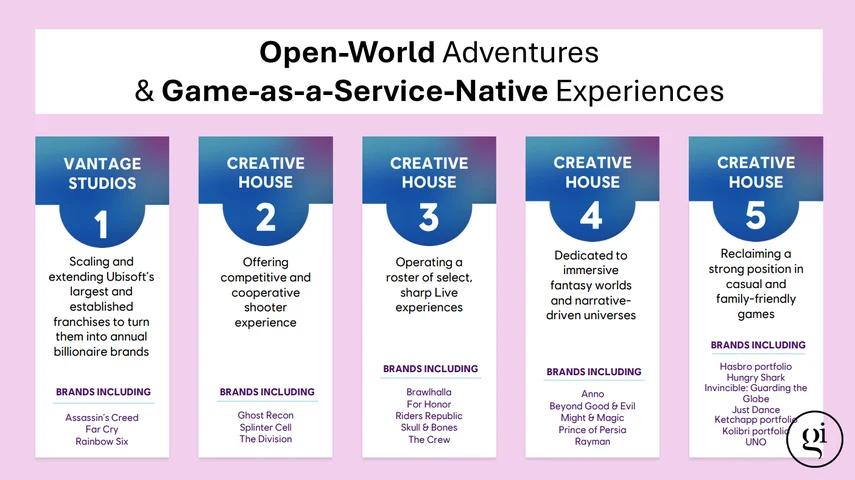
Core Insights - Ubisoft announced a significant organizational restructuring aimed at achieving sustainable growth through the establishment of five Creative Houses, which will be responsible for various IPs and projects [1][3]. Group 1: Organizational Changes - The new operational model will focus on five Creative Studios, with Vantage Studios already established, while the other four are identified by numbers [1][3]. - Each Creative Studio will manage specific segments, IP brands, and sub-studios, operating on a self-sustaining basis [1][3]. Group 2: Focus Areas of Creative Studios - Creative Studio 1 (Vantage Studios) will focus on major IPs like Assassin's Creed, Far Cry, and Rainbow Six [3]. - Creative Studio 2 will target competitive and cooperative shooting projects, including The Division and Ghost Recon [3]. - Creative Studio 3 will handle online service-oriented projects such as For Honor and The Crew [3]. - Creative Studio 4 will create immersive fantasy worlds and narrative-driven projects, including titles like Prince of Persia and Beyond Good and Evil [3]. - Creative Studio 5 will focus on casual and family-friendly projects, including Just Dance and Hungry Shark [3]. Group 3: Project Adjustments - The restructuring includes the announcement of four new IPs, while seven games have been delayed and six projects canceled, including the troubled Prince of Persia: Sands of Time remake [3][5]. - The new structure is set to begin operations in early April 2024 [3]. Group 4: Market Reaction and Challenges - Following the announcement, Ubisoft's stock price fell over 30%, dropping to €4.36, significantly below its historical peak of €100 in 2018 [5]. - The company has faced challenges due to aggressive layoffs and studio closures, with recent legal actions from former employees alleging wrongful termination and union-targeted layoffs [5].

欧洲游戏巨头大跌34%
21世纪经济报道· 2026-01-22 12:56
Core Viewpoint - Ubisoft has announced a major restructuring plan, which includes the cancellation of six games, the postponement of seven games, and a significant downward revision of its performance guidance for the fiscal year 2025-2026, leading to a sharp decline in its stock price by over 34% [1][3]. Group 1: Restructuring Plan - The restructuring plan will involve dividing the company's operations into five Creative Houses, each responsible for unique creative categories, with shared core services and oversight from Ubisoft's headquarters [3][5]. - Each Creative House will have independent financial decision-making authority and will be accountable for its financial performance [5]. Group 2: Creative Houses Breakdown - Creative House 1 (Vantage Studio Group): Focuses on expanding flagship series like Assassin's Creed, Far Cry, and Rainbow Six [5]. - Creative House 2: Responsible for competitive cooperative shooting games, including The Division and Ghost Recon [5]. - Creative House 3: Focuses on distinctive online gaming experiences, including For Honor and The Crew [5]. - Creative House 4: Dedicated to immersive fantasy and narrative-driven games, including Heroes of Might and Magic and Prince of Persia [5]. - Creative House 5: Refocuses on family-friendly casual games, including Just Dance and Hungry Shark [5]. Group 3: Cost-Cutting Measures - Ubisoft plans to cut fixed costs by at least €100 million (approximately ¥814 million) compared to the fiscal year 2024-2025, aiming to achieve this a year earlier than initially planned [6][7]. - The total fixed cost reduction since the fiscal year 2022-2023 is expected to reach approximately €500 million, with a target of reducing annualized fixed costs to about €1.25 billion (approximately ¥1.0173 billion) by March 2028 [7]. Group 4: Product Strategy Changes - Ubisoft will stop six game projects that do not meet the new quality standards or align with the prioritized product mix, including a remake of Prince of Persia: The Sands of Time and four unannounced projects [7][8]. - Seven games will receive additional development time to ensure they meet higher quality benchmarks, with one project postponed from fiscal year 2026 to fiscal year 2027 [7]. Group 5: Financial Performance and Future Outlook - Despite the success of new releases like Assassin's Creed: Mirage, Ubisoft's overall performance remains weak, with a 20.5% year-on-year revenue decline to €1.85 billion (approximately ¥15.055 billion) for the fiscal year 2024-2025 [8][9]. - The company projects net revenue of approximately €1.5 billion (approximately ¥12.215 billion) for the fiscal year 2025-2026, with a forecasted operating loss of about €1 billion [8][9]. Group 6: Employee and Union Response - Unions have expressed opposition to the restructuring plan, calling for a strike and demanding the cessation of cost-cutting measures and the preservation of remote work benefits [8].

腾讯战投Vantage Studios落地,育碧获11.6亿欧“关键输血”
Guo Ji Jin Rong Bao· 2025-11-24 12:22
Core Viewpoint - Ubisoft's recent financial performance shows a significant recovery in net bookings, driven by strong performance from key IPs, while the completion of Tencent's investment is expected to alleviate the company's financial pressures [1][5][8]. Financial Performance - For the first half of the 2025-2026 fiscal year, Ubisoft reported a net booking increase of 20.3% to €772.4 million, with the second quarter seeing a 39% rise to €491 million, surpassing previous guidance [5][6]. - Despite revenue growth, the company still faced operational losses, with an IFRS operating loss of €120.2 million and a net loss of €161.3 million for the same period [7]. Strategic Partnership - Tencent's investment of €11.6 billion in the newly established Vantage Studios gives it a 26.32% stake, while Ubisoft retains exclusive control over the studio [4][5]. - The partnership is expected to provide crucial funding for Ubisoft, aiding in debt reduction and improving the overall financial structure [5][8]. Cost Management - Ubisoft aims to reduce fixed costs by at least €100 million by the end of the 2026-2027 fiscal year, with fixed costs for the first half of 2025-2026 reported at €701 million, down 9% year-over-year [8]. - The company plans to continue cost control measures to enhance financial stability amid ongoing challenges in the gaming market [8].
艺电550亿美元私有化 游戏寡头时代将至?
Zhong Guo Jing Ying Bao· 2025-10-17 20:13
Core Viewpoint - The gaming industry is witnessing a trend towards consolidation, with major acquisitions like the $55 billion buyout of Electronic Arts (EA) by a Saudi-led consortium, marking it as the largest all-cash privatization deal in history and the biggest acquisition in the gaming sector since Microsoft's purchase of Activision Blizzard [3][4][8]. Group 1: Acquisition Details - EA is set to be acquired for a valuation of $55 billion, with shareholders receiving $210 per share in cash [3][4]. - The acquisition has been approved by EA's board and is expected to close in the first quarter of the 2027 fiscal year, pending regulatory approvals and shareholder consent [3][4]. - The buyers include the Saudi Public Investment Fund, Silver Lake Partners, and Affinity Partners, with the Saudi fund playing a leading role [4][6]. Group 2: Financial Implications - The deal will add $20 billion in debt to EA, with funding sourced from the buyers' cash contributions, the extension of existing shares held by the Saudi fund, and $20 billion in debt financing from JPMorgan [6][7]. - Following the acquisition, S&P Global Ratings anticipates downgrading EA's credit rating to "junk" status due to the increased debt burden [7]. Group 3: Industry Trends - The acquisition of EA is part of a broader trend of established gaming companies being bought, as seen with Ubisoft's recent partnership with Tencent to form Vantage Studios, focusing on the development of major IPs like Assassin's Creed [9][10]. - The gaming industry is shifting towards high-return real-time service models, with classic IPs potentially incorporating in-game purchases and subscription models post-acquisition [11][12]. - The consolidation trend aims to address gaps in service-oriented content and cross-platform operations, enhancing the ecosystem of hardware, content, and services [11][12].
属于CN彩六的“元年”,终于到来了
Hu Xiu· 2025-09-28 00:46
Core Points - The article discusses the significant development in the esports scene for "Rainbow Six Siege" (R6) in China, particularly the opportunity for Chinese teams to compete in the upcoming Six Invitational 2026 (SI 2026) [1][3][20] - Ubisoft announced that the last four spots for SI 2026 will be determined through a series of open qualifiers starting in December, with two spots allocated specifically for teams from mainland China [1][2] Group 1: Historical Context - The esports ecosystem for CNR6 has faced numerous challenges over the past decade, particularly after the game was banned from streaming in 2018, leading to a decline in domestic competitions and team disbandments [5][6][10] - Prior to this year, no Chinese teams had officially participated in international R6 events, with only one team invited to a demonstration match in 2018 [7][8] - The lack of a supportive environment for R6 esports in China has hindered its growth compared to other FPS games, despite the presence of skilled players [9][10] Group 2: Recent Developments - The revival of CNR6 esports is marked by the successful "薪火杯" tournament held in mid-2023, which showcased a high level of professionalism and attracted significant community engagement [15][17] - Following the announcement of Chinese teams' participation in SI 2026, several well-known clubs have begun recruiting former professional players and promising newcomers to form R6 divisions [17][20] - The GVC Pioneer Series, a domestic competition with a total prize pool of 1.35 million RMB, will serve as a preliminary qualifier for the LCQ, further stimulating interest and investment in the CNR6 scene [17][19] Group 3: Future Outlook - The article suggests that the current developments indicate a turning point for CNR6, with the potential for a new era in Chinese esports, referred to as the "CNR6 Year" [4][20] - Ubisoft's focus on the CNR6 ecosystem reflects a strategic interest in diversifying competition in the international league, especially against the backdrop of Brazil's dominance in the esports scene [21][22] - The article concludes with optimism about the future of CNR6, highlighting the importance of a robust competitive structure and the potential for Chinese teams to achieve success on the global stage [23][24]
腾讯又出手!斥资11.6亿欧元入股育碧子公司
2 1 Shi Ji Jing Ji Bao Dao· 2025-03-28 10:26
Core Viewpoint - Ubisoft has announced the establishment of a dedicated subsidiary based on its major franchises Assassin's Creed, Far Cry, and Rainbow Six, with Tencent investing €1.16 billion for approximately 25% equity [1] Group 1: Company Strategy - The new subsidiary aims to build a gaming ecosystem and develop these franchises into long-lasting brands, aligning with Tencent's strategy of creating "evergreen games" [1] - Ubisoft's pre-financing valuation for the new subsidiary is €4 billion, which is about four times its average annual sales revenue for the fiscal years 2023-2025 [1] - The establishment of the subsidiary is seen as a significant step in Ubisoft's transformation and operational model change, enhancing asset value and supporting long-term brand development [1] Group 2: Investment Details - Tencent will have customary minority shareholder rights and specific consent rights regarding the disposal of important assets of the new subsidiary [2] - Tencent has committed to a five-year lock-up period for its shares in the new subsidiary, unless Ubisoft loses majority voting rights and equity [2] - Prior to this transaction, Tencent had already acquired approximately 10% of Ubisoft's shares, increasing its stake through previous investments [3] Group 3: Market Expansion - Tencent's strategy includes a clear focus on expanding its presence in overseas markets, with investments being a key method for this expansion [4] - Over the past few years, Tencent has made significant investments and acquisitions in various gaming companies globally, including major firms like Activision Blizzard and Epic Games [4] - Tencent's approach to gaming investments has shifted towards longer-term plans, accepting timelines of 5-10 years to develop high-quality games, which aligns with its evergreen strategy [4]
腾讯11.6亿欧元收购育碧新公司25%股权 投资刺客信条等三大IP
Sou Hu Cai Jing· 2025-03-28 09:21
Core Viewpoint - Ubisoft announced the establishment of a new company that will encompass its popular game IPs such as Assassin's Creed, Far Cry, and Rainbow Six, with an estimated valuation of €4 billion (approximately $4.3 billion), and Tencent will invest €1.16 billion for a 25% stake [1][5][6] Group 1: Company Structure and Investment - The new subsidiary will manage the teams behind the aforementioned IPs and oversee other IPs or any games currently in development by Ubisoft [1] - Tencent's investment will strengthen Ubisoft's balance sheet and support the long-term development of key game brands [8][9] - The new company will operate independently with its own management team, focusing on enhancing creative vision and streamlining operations [9] Group 2: Strategic Goals and Future Plans - Ubisoft aims to accelerate its transformation and change its business model by creating a dedicated subsidiary for its major brands [5][6] - The subsidiary will work on building a gaming ecosystem, enhancing single-player narrative quality, and enriching multiplayer experiences through more frequent content releases and social features [5][7] - The company plans to continue investing in classic brands like Ghost Recon and The Division, leveraging innovative technologies to drive their development [6][7] Group 3: Financial and Operational Details - The pre-financing enterprise value is estimated at €4 billion, which is about four times the average annual sales revenue for the fiscal years 2023-2025 [5] - The transaction is expected to be completed by the end of 2025, with Tencent holding customary minority shareholder rights and specific consent rights regarding the disposal of significant assets [9][10] - The agreement includes a five-year lock-up period for Tencent's shares, ensuring that Ubisoft retains majority voting rights and equity in the new subsidiary for at least two years [9][10]