
智能仿生机器人

Search documents
中国为智能仿生机器人等产品增列税号
Zhong Guo Xin Wen Wang· 2026-01-17 03:50
Group 1 - The core viewpoint of the articles highlights the recent classification of new tax codes for advanced technology products, including humanoid robots, which reflects China's efforts to adapt to technological advancements and enhance its global competitiveness in the robotics industry [1][2] - The introduction of a specific tax code for "intelligent bionic robots" and "cleaning robots" is a significant step towards supporting the high-quality development of China's robotics industry and facilitating its integration into the global market [1] - The new tax codes for photovoltaic and semiconductor silicon wafers aim to improve the accuracy of import and export statistics, thereby enhancing the competitiveness of these sectors in the global market [2] Group 2 - The establishment of separate tax codes for photovoltaic and semiconductor silicon wafers allows companies to better engage in international competition and collaboration, addressing previous challenges related to shared tax classifications [2] - The introduction of a dedicated tax code for wild ginseng (林下山参) is expected to promote the internationalization and scaling of this unique Chinese agricultural product, which has seen steady growth in export volume [2] - The previous lack of a separate tax code for wild ginseng hindered its overseas promotion, but the new classification is anticipated to resolve this issue and enhance market opportunities [2]

我国持续扩大高水平对外开放
Xin Lang Cai Jing· 2026-01-03 22:20
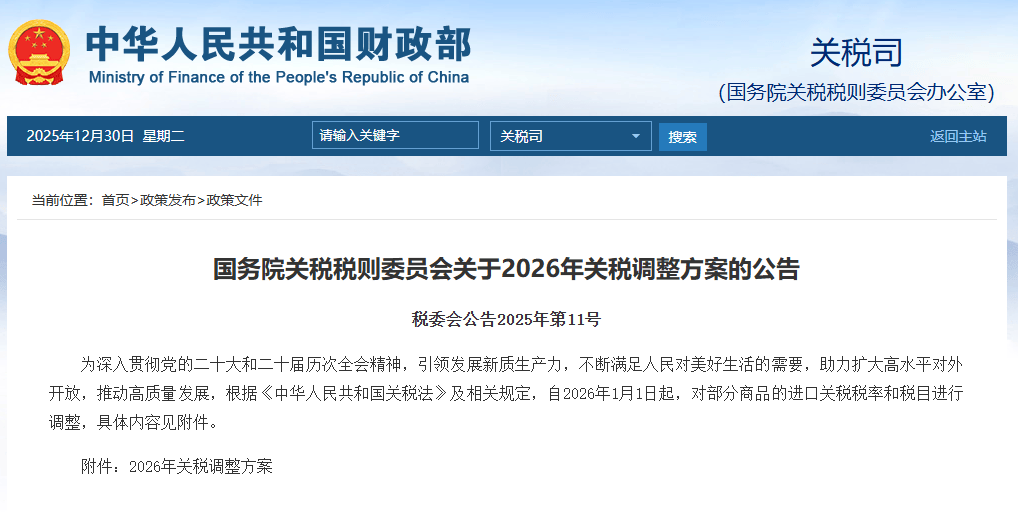
Group 1 - The 2026 Tariff Adjustment Plan aims to scientifically adjust import provisional tax rates, optimize tariff categories, and continue implementing agreement and preferential tax rates, which will help lead the development of new productive forces and meet the growing needs of the people [1] - The plan includes three main aspects: adjusting import provisional tax rates, optimizing tariff categories, and continuing to implement agreement and preferential tax rates [1] - In the adjustment of import provisional tax rates, 935 items will have provisional tax rates lower than the most-favored-nation rate, enhancing the linkage between domestic and international markets [1] Group 2 - The adjustment in the petrochemical sector includes items such as bio-aviation kerosene and lithium-ion battery recycled black powder, reflecting the national policy to support the green and low-carbon transition of fossil energy [2] - The reduction of import tariffs on medical products like artificial blood vessels and diagnostic kits for infectious diseases aims to improve public health and enhance the well-being of the population [2] - The adjustment of tariffs on certain medical devices is expected to increase the supply of quality products and reduce the medical burden on consumers [2] Group 3 - The optimization of tariff categories will include new entries such as intelligent bionic robots and bio-aviation kerosene, with the total number of tariff categories reaching 8,972 [3] - The plan continues to implement agreement tax rates for certain imported goods from 34 trade partners, promoting regional integration and economic cooperation [3] - China aims to provide 100% zero-tariff treatment for products from 43 least developed countries, showcasing its commitment to global development amidst rising trade protectionism [3]
保障民生 助推升级——看2026年关税调整新亮点
Xin Hua She· 2025-12-31 22:52
Group 1 - The core viewpoint of the news is the announcement of the 2026 tariff adjustment plan by the State Council Tariff Commission, which will implement provisional import tariffs lower than the most-favored-nation rate on 935 items starting January 1, 2026 [1][6]. - The adjustment plan aims to lower tariffs on key components, advanced materials, and energy resources, which is expected to reduce costs for enterprises and promote technological self-reliance and modernization of the industrial system [6][10]. - The plan includes a focus on improving people's livelihoods by reducing tariffs on medical products such as artificial blood vessels and diagnostic kits, contributing to the health of the population and the construction of a healthy China [8][10]. Group 2 - The adjustment will also optimize tariff categories and annotations, increasing the total number of tariff items to 8,972, which is expected to promote the development of strategic emerging industries and enhance import-export management [10]. - China will continue to implement preferential tariff rates for certain imported goods from 34 trade partners under 24 free trade agreements, as well as maintain zero-tariff treatment for 100% of products from 43 least developed countries [10]. - The proactive approach in expanding high-standard free trade networks demonstrates China's commitment to global development amidst rising trade protectionism [10].


权威解读丨保障民生 助推升级——看2026年关税调整新亮点
Xin Hua Wang· 2025-12-31 14:19
Core Viewpoint - The State Council's Tariff Commission announced a tariff adjustment plan for 2026, implementing provisional import tariffs lower than the most-favored-nation rate on 935 items starting January 1, 2026 [1] Group 1: Tariff Adjustments - The adjustment plan includes lowering tariffs on key components, advanced materials, and energy resources, which is a significant aspect of the provisional tariff changes [4] - Specific reductions will be made on import tariffs for resource products such as regenerated black powder for lithium-ion batteries and unroasted pyrite [4] - The total number of tariff items will be optimized to 8,972, including new entries like smart bionic robots and bio-aviation kerosene [7] Group 2: Economic and Social Impact - The large-scale tariff reduction reflects China's commitment to expanding openness and is expected to promote win-win cooperation across multiple sectors [2] - Lowering tariffs on medical products, such as artificial blood vessels and diagnostic kits for infectious diseases, aims to reduce the burden on residents and improve public health [6] - The tariff adjustments are designed to support green development and innovation, facilitating the achievement of carbon neutrality goals [4][6] Group 3: Trade Agreements and International Relations - China will continue to implement preferential tariffs for goods from 34 trade partners under 24 free trade agreements, as well as maintain zero-tariff treatment for 100% of products from 43 least developed countries [7] - The adjustments demonstrate China's proactive approach to expanding its high-standard free trade network amid rising trade protectionism globally [7]
2026年1月1日起 我国调整部分商品关税税率税目
Ren Min Ri Bao Hai Wai Ban· 2025-12-31 00:12
Group 1 - The State Council Tariff Commission announced the 2026 Tariff Adjustment Plan, which will implement provisional import tariff rates lower than the most-favored-nation rate for 935 items starting January 1, 2026, to enhance the linkage between domestic and international markets [1] - The plan aims to promote high-level technological self-reliance by reducing import tariffs on key components and advanced materials, such as hydraulic pressure machine parts and composite joints [1] - It also focuses on supporting the green transformation of the economy by lowering tariffs on resource-based products like regenerated black powder for lithium-ion batteries [1] - The adjustment includes measures to improve public welfare by reducing tariffs on medical products, such as artificial blood vessels and diagnostic kits for certain infectious diseases [1] - The plan will cancel provisional tariff rates on items like micro motors and sulfuric acid, restoring the most-favored-nation rate based on domestic industry development and supply-demand changes [1] Group 2 - The tariff schedule will include new entries for smart bionic robots, bio-aviation fuel, and forest ginseng to support technological development and the circular economy [2] - The total number of tariff items will be adjusted to 8,972 [2] - The plan continues to implement preferential tariff rates for certain imported goods from 34 trade partners based on 24 free trade agreements and preferential trade arrangements signed by China [2]
中国优化税率激活产业新动能 将对935项商品实施进口暂定税率
Chang Jiang Shang Bao· 2025-12-30 23:21
Core Viewpoint - The 2026 Tariff Adjustment Plan aims to enhance economic development through targeted tariff reductions on 935 items, focusing on "nurturing new growth," "green transition," and "benefiting the public" [1][2][4] Group 1: Tariff Adjustments - The adjustment includes a temporary import tariff lower than the most-favored-nation (MFN) rate for 935 items, expanding the total number of tariff items to 8,972 [1][2] - Key components such as numerical control hydraulic pads for pressure machines will see a reduction in import tariffs to 6%, which is 6 percentage points lower than the MFN rate, thereby reducing costs for domestic manufacturing [2] Group 2: Green Transition - Tariff reductions on resources like regenerated black powder for lithium-ion batteries support the circular economy, with estimates indicating that importing 10,000 tons of regenerated black powder could reduce primary mineral extraction by approximately 500,000 tons and carbon emissions by 25,000 tons [3] - The addition of new tariff items such as intelligent bionic robots and bio-aviation kerosene aligns with technological advancements and industry upgrades, contributing to a total of 8,972 tariff items [3] Group 3: Economic and Trade Cooperation - The tariff adjustments serve as a "barometer" for industrial development and a "warm-hearted" measure for improving public welfare, while also acting as a "declaration" for further opening up to international trade [4] - The plan includes zero tariffs on most finished medicines and certain cancer drugs, aiming to alleviate the medical burden on patients [4] - Continued commitment to multilateral cooperation is evident, with zero tariff treatment for 100% of products from 43 least developed countries and preferential rates for certain goods from ASEAN members like Bangladesh and Laos [4]
我国关税重要调整!2026年1月1日起实施
Sou Hu Cai Jing· 2025-12-30 12:04
Group 1 - The core point of the news is the implementation of a temporary import tariff lower than the most-favored-nation rate on 935 items starting from January 1, 2026, as part of the tariff adjustment plan released by the State Council Tariff Commission [1][4]. Group 2 - The adjustment aims to promote high-level technological self-reliance and the construction of a modern industrial system by reducing import tariffs on key components and advanced materials such as CNC hydraulic pads and composite joints [4]. - It also supports the green transformation of the economy by lowering tariffs on resource-based products like regenerated black powder for lithium-ion batteries and unroasted pyrite [4]. - The plan emphasizes improving people's livelihoods by reducing tariffs on medical products, including artificial blood vessels and diagnostic kits for certain infectious diseases [4]. - To enhance domestic circulation, the plan will cancel temporary tariffs on items like micro motors and restore the most-favored-nation rate, aligning with changes in domestic industry development and supply-demand conditions [4]. - The total number of tariff items will be adjusted to 8,972, including new entries for smart bionic robots, bio-aviation kerosene, and forest ginseng to support technological development and circular economy [4]. - The plan continues to promote trade cooperation with the least developed countries by providing zero-tariff treatment on 100% of products for 43 such countries [5]. - Additionally, it maintains preferential tariff rates for certain imports from Bangladesh, Laos, Cambodia, and Myanmar under the Asia-Pacific Trade Agreement and relevant agreements with ASEAN member states [5].
中国关税新增两类机器人税目
第一财经· 2025-12-30 07:55
Core Viewpoint - The article discusses the recent changes in China's tariff schedule for 2026, particularly the introduction of new tariff categories for robots, including intelligent bionic robots and cleaning robots, aimed at supporting technological development and the circular economy [3][5]. Group 1: Tariff Adjustments - The 2026 tariff schedule includes new categories for intelligent bionic robots with a most-favored-nation (MFN) rate of 0% and a general rate of 30% [3][5]. - Two new categories for cleaning robots have been added, with MFN rates of 8% and 0%, and general rates of 130% and 30% respectively [3][5]. Group 2: Definition and Features of Intelligent Bionic Robots - Intelligent bionic robots are defined as autonomous or semi-autonomous robots that closely mimic the appearance, structure, or functions of humans or animals [4]. - These robots are equipped with various sensors and technologies, enabling them to perform tasks such as environmental perception, autonomous path planning, and human interaction through natural language processing [4]. Group 3: Industry Impact and Future Outlook - The addition of these tariff categories is expected to help industries and companies better understand trade data and assess overseas market trends [5]. - The tariff adjustments also include a temporary import tax rate below the MFN rate for 935 items, aimed at promoting high-level technological self-reliance and modern industrial system construction [5].

中国关税新增两类机器人税目
Di Yi Cai Jing· 2025-12-30 06:40
Core Insights - The Chinese government has introduced new tariff categories for intelligent bionic robots and cleaning robots as part of the 2026 tariff adjustment plan, with the most favored nation (MFN) rates set at 0% for intelligent bionic robots and varying rates for cleaning robots [1][3] Group 1: New Tariff Categories - The 2026 tariff adjustment plan includes the addition of intelligent bionic robot tariff categories with an MFN rate of 0% and a general rate of 30%, along with two cleaning robot categories with MFN rates of 8% and 0%, and general rates of 130% and 30% respectively [1][3] - Intelligent bionic robots are defined as autonomous or semi-autonomous robots that closely mimic the appearance, structure, or functions of humans or animals, equipped with advanced technologies for environmental perception and interaction [2] Group 2: Rationale for Changes - The adjustments aim to support technological advancement, circular economy, and the development of the forest economy, with the total number of tariff categories now reaching 8,972 [3] - The introduction of these new tariff categories is expected to help industries and companies accurately grasp trade data and assess overseas market trends [3]
上游价格持续分化
Hua Tai Qi Huo· 2025-12-30 05:47
Report Summary 1. Industry Investment Rating No investment rating information is provided in the report. 2. Core View The report focuses on the continuous price differentiation in the upstream industry and provides an overview of mid - level events, industry status in the upstream, mid - stream, and downstream sectors. Upstream prices show a trend of divergence, with some rising and some falling, while the mid - stream and downstream industries have their own development characteristics such as low - level operation in some mid - stream industries and recovery in some downstream industries. 3. Summary by Related Catalogs Mid - level Event Overview - **Production Industry**: The State Administration for Market Regulation has deployed key tasks for 2026, including deepening fair competition governance, breaking administrative monopolies, strengthening anti - monopoly and anti - unfair competition law enforcement, promoting the development quality of business entities, and strengthening the regular supervision of the platform economy [1] - **Service Industry**: The 2026 Tariff Adjustment Plan will be implemented from January 1, 2026, with 935 items of goods subject to import provisional tax rates lower than the most - favored - nation tax rates, and new national sub - items added. Also, regulations on the deduction of advertising and business promotion expenses for certain industries have been announced [2] Industry Overview - **Upstream**: In the chemical industry, PTA prices are rising; in the non - ferrous metals sector, copper prices are rising; in the energy industry, LNG prices are falling [3] - **Mid - stream**: Chemical product start - up rates are at a low level, power plant coal consumption is increasing, and asphalt start - up is in the off - season [4] - **Downstream**: The sales of commercial housing in first, second, and third - tier cities are continuously warming up, and the number of domestic flights is increasing [4] Key Industry Price Index Tracking - **Agriculture**: On December 29, the spot prices of corn, palm oil, cotton, and the average wholesale price of pork increased year - on - year, while the spot price of eggs decreased [37] - **Non - ferrous Metals**: On December 29, the spot prices of copper, zinc, aluminum, and nickel increased year - on - year [37] - **Ferrous Metals**: On December 29, the spot price of线材 increased year - on - year, while the spot prices of rebar and iron ore decreased slightly [37] - **Non - metals**: On December 29, the spot price of natural rubber increased year - on - year, while the spot price of glass and the China Plastic City price index decreased [37] - **Energy**: On December 29, the spot prices of WTI crude oil and Brent crude oil increased slightly year - on - year, while the spot price of liquefied natural gas and coal price decreased [37] - **Chemical Industry**: On December 29, the spot price of PTA increased year - on - year, while the spot price of polyethylene decreased [37] - **Real Estate**: On December 29, the cement price index and the building materials composite index decreased slightly year - on - year, and the concrete price index remained unchanged [37]