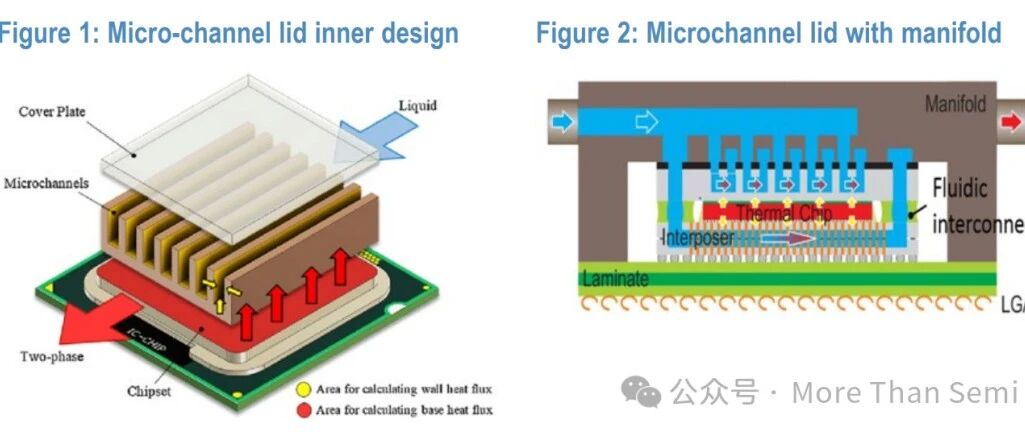
微通道盖板

Search documents
液冷行业深度报告:千亿液冷元年已至,看好国产供应链加速入局
2025-12-12 02:19
Summary of Liquid Cooling Industry Conference Call Industry Overview - The liquid cooling industry is experiencing significant growth driven by the surge in data center cooling demands and stricter PUE (Power Usage Effectiveness) regulations. The global AIDC (Artificial Intelligence Data Center) liquid cooling market is projected to reach approximately 110-115 billion RMB by 2026 [1][9]. Key Points and Arguments - **Market Dynamics**: The cost of cooling systems is expected to double to around 10% of total costs due to rapid server iterations. For instance, the value of server modules increased from $75,000 to $95,000, a 20% rise, as the GB300 phase introduced independent cold plates for each GPU [9][10]. - **Liquid Cooling Technology**: The technology is categorized into indirect contact, direct contact, and spray cooling. The single-sided cold plate is dominant in the North American market, while the Inrow model is suitable for new data centers, and the Inrack model is for retrofitting existing centers [2][6][7]. - **Key Components**: Liquid cooling plates are critical components, with significant technical barriers in the design and manufacturing of microchannel plates. These plates enhance heat transfer but require high stability and leak-proof performance [3][8][12]. Emerging Opportunities - **Domestic Supply Chain**: The opening of supplier permissions by NVIDIA in the GB300 phase allows domestic suppliers to enter the market, increasing the demand for cost-effective solutions as NVIDIA shifts towards cloud services [10][11]. - **Company Performance**: Leading companies like Yingwei and Hongsheng are expected to achieve significant performance milestones by 2026. Yingwei's market value is projected to reach 150 billion RMB, while Hongsheng's profits are expected to exceed 300 million RMB [3][5][14]. Additional Insights - **Technological Challenges**: The manufacturing of microchannel plates faces challenges such as low yield rates and high costs due to complex processes. Companies are actively experimenting to find efficient and cost-effective solutions [12][13]. - **Competitive Landscape**: Yingwei is recognized as a leading player with substantial orders from major clients like Google, while Hongsheng is positioned well within the supply chain, indicating a competitive edge in the liquid cooling market [14]. Conclusion - The liquid cooling industry is poised for rapid growth, driven by technological advancements and market dynamics. The shift towards domestic supply chains and the performance of key players will be crucial in shaping the future landscape of this industry [4][10].


液冷迎来千亿拐点:AI算力驱动热管理升级,国产链迎历史性入局机遇
材料汇· 2025-12-07 15:30
Core Viewpoint - The article emphasizes the rapid growth of global computing power demand driven by advancements in artificial intelligence, cloud computing, and high-performance computing, leading to unprecedented cooling challenges for data centers. Liquid cooling technology is evolving from an optional solution to a necessary one due to its energy efficiency, low power consumption, and noise reduction advantages, especially in light of tightening national PUE (Power Usage Effectiveness) requirements. The article outlines the evolution of liquid cooling technology, market landscape, and future trends, predicting that the global liquid cooling market will exceed 100 billion yuan by 2026, marking the beginning of a liquid cooling revolution driven by technology, policy, and industry collaboration [2]. Group 1: Liquid Cooling Technology - Liquid cooling technology is essential for addressing the cooling pressures of data centers. It utilizes liquid to dissipate heat from components, leveraging the high thermal conductivity and heat capacity of liquids compared to air, resulting in lower energy consumption, higher cooling efficiency, and reduced noise [6][13]. - The core advantages of liquid cooling include low energy consumption, high cooling capacity (4-9 times that of air cooling), low noise levels, and lower total cost of ownership (TCO), with PUE values potentially dropping below 1.2 [13][26]. - The rapid increase in chip power density necessitates the adoption of liquid cooling solutions, as traditional air cooling struggles to meet the demands of next-generation architectures like NVIDIA's Rubin, which anticipates power densities reaching up to 600 kW [14][18]. Group 2: Market Trends and Future Outlook - The liquid cooling market is expected to surpass 100 billion yuan by 2026, driven by technological advancements, policy support, and collaboration across the supply chain [2]. - The evolution of liquid cooling technology is characterized by the emergence of microchannel cold plates and phase change cooling plates, which enhance efficiency and customization [2][14]. - The article highlights the increasing importance of liquid cooling in meeting national PUE requirements, with policies pushing for lower PUE values, thereby promoting the adoption of energy-efficient technologies [22][25]. Group 3: Industry Applications and Solutions - Liquid cooling solutions are categorized into direct contact and indirect contact types, with single-phase immersion cooling being the primary development direction due to its high efficiency and energy savings [30][47]. - Single-phase cold plate cooling is expected to remain the mainstream solution for a considerable time due to its compatibility with existing infrastructure and lower retrofit costs [37]. - Immersion cooling offers high energy efficiency (PUE < 1.13) and supports high-density deployments, although it presents challenges in product design and maintenance [48][49].



千亿液冷元年已至,看好国产供应链加速入局 | 投研报告
Zhong Guo Neng Yuan Wang· 2025-12-05 10:13
Group 1 - Liquid cooling technology is essential for addressing the heat dissipation pressure in data centers, offering advantages such as low energy consumption, high heat dissipation, low noise, and low total cost of ownership (TCO) [1][2] - The value of liquid cooling systems is expected to grow significantly alongside chip upgrades, with a projected increase of over 20% for rack liquid cooling modules in GB300-GB200 servers [1][2] - The market for ASIC liquid cooling systems is estimated to reach 35.3 billion yuan by 2026, while the market for NVIDIA liquid cooling systems is projected to reach 69.7 billion yuan [1][2] Group 2 - The domestic supply chain is accelerating its entry into the liquid cooling market, with NVIDIA opening its supplier list to allow more flexibility in supply chain composition [2] - The Rubin architecture requires new liquid cooling solutions due to its high thermal design power (TDP) of 2300W, necessitating alternatives to single-phase cooling plates [2] - Two viable solutions for the Rubin architecture include phase change cooling plates and microchannel plates, with the latter likely becoming the preferred option as power requirements increase [2] Group 3 - The demand for AI server computing power is rapidly increasing, driving the penetration rate of liquid cooling solutions, and leading to an explosive demand for efficient and energy-saving heat exchange solutions in data centers [3] - Companies to watch in this sector include Yingweike, Shenling Environment, Gaolan Co., Hongsheng Co., Zhongke Shuguang, and Jieban Technology [3]
东吴证券:算力需求增长带动液冷渗透率提升 看好国产供应链加速入局
智通财经网· 2025-12-05 06:31
Core Viewpoint - The current mainstream solution for liquid cooling is the cold plate system, while immersion cooling is expected to become a future development direction. The maturity of domestic liquid cooling systems is increasing, and domestic supply chains are likely to enter the NVIDIA ecosystem directly as demand for AI server computing power surges, driving the penetration rate of liquid cooling solutions [1][2]. Group 1: Liquid Cooling Technology - Liquid cooling technology is essential for addressing the heat dissipation pressure in data centers, offering advantages such as low energy consumption, high heat dissipation, low noise, and low total cost of ownership (TCO). It can also reduce the Power Usage Effectiveness (PUE) of data centers, meeting national requirements [1]. - As chip iterations increase power density, the heat dissipation requirements for corresponding chips are growing, making traditional air cooling insufficient and necessitating the introduction of liquid cooling solutions. Currently, cold plate systems dominate the market, while immersion cooling is anticipated to be a future trend [1]. - The liquid cooling system consists of an outdoor side (primary side) and a data center side (secondary side), with the primary side accounting for approximately 30% of the value, including chillers and circulation pipelines, while the secondary side accounts for about 70%, with core components such as CDU, manifold, quick connectors, and water pumps [1]. Group 2: Liquid Cooling Industry - The value of liquid cooling is expected to increase alongside chip upgrades. For example, the value of rack liquid cooling modules is projected to grow by over 20% with the transition to GB300-GB200 servers. By 2026, the market for ASIC liquid cooling systems is estimated to reach 35.3 billion yuan, while the market for NVIDIA liquid cooling systems is expected to reach 69.7 billion yuan [2]. - Domestic supply chains are accelerating their entry into the liquid cooling market. NVIDIA has opened its supplier list, allowing manufacturers to choose their supply chain components independently. This shift from a single certified CDU supplier to multiple suppliers enables domestic chains to indirectly enter the market. As domestic liquid cooling systems mature and end-user CSPs focus more on cost-performance ratios, domestic suppliers are likely to enter NVIDIA's ecosystem directly [2]. Group 3: Rubin Architecture Outlook - Single-phase cold plates are unsuitable for the Rubin architecture due to its thermal design power (TDP) of 2300W and a total cabinet power of approximately 200KW, exceeding the design limit of single-phase cold plates at 150KW per cabinet. Therefore, new liquid cooling solutions must be introduced [3]. - One feasible solution is the phase change cold plate, which utilizes the phase change of a liquid working fluid to absorb heat efficiently, suitable for scenarios exceeding 300KW per cabinet. Another option is the microchannel cold plate (MLCP), which features densely packed micro-scale cooling liquid channels, potentially becoming the preferred choice for the Rubin architecture as future iterations may require even higher power capacities [3].

中信建投:展望2026年 算力领域有多方面投资机会
Zheng Quan Shi Bao Wang· 2025-11-26 00:13
Core Insights - The report from CITIC Securities highlights investment opportunities in the computing power industry by 2026, emphasizing the growth certainty of leading companies and the importance of technological upgrades and local industrial clusters [1] Group 1: Growth of Leading Companies - Leading companies like NVIDIA require rapid iteration and response capabilities across the entire industry chain, making it difficult for companies with insufficient capabilities to enter or maintain their market share in NVIDIA's ecosystem [1] - The value of PCB (Printed Circuit Board) is expected to benefit from the adoption of orthogonal backplanes and advancements in CoWOP (Chip on Wafer on Package) technology [1] Group 2: Technological Upgrades - From 2025, power supply and cooling issues are anticipated to become bottlenecks in system solutions, with a growing need for stable and efficient power delivery systems, highlighting investment opportunities in HVDC (High Voltage Direct Current) and more efficient SST (Solid State Transformer) technologies [1] - As chip performance improves, cooling solutions will face increasing challenges, creating investment opportunities in liquid cooling plates, CDU (Cooling Distribution Unit), and UQD (Ultra-Quantum Dot) technologies [1] - The evolution of next-generation chip packaging solutions, such as microchannel lids, diamond substrates, and thermal interface materials, is identified as a crucial investment direction for enhancing AI chip performance [1] Group 3: Localization of the Industry Chain - The advantages of local industrial clusters are becoming evident as domestic companies accelerate the validation of upstream materials like copper-clad laminates, resins, fiberglass, and copper foil in the PCB industry, following the high market share of domestic downstream players [1] - Similar trends are observed in the optical module sector, indicating a broader shift towards local supply chains [1] Group 4: Order Spillover - The report notes that as leading companies experience order spillover, the entire industry chain is expected to exhibit high prosperity, with some companies gaining market share as a result [1]

AI训练引爆散热革命?高盛:液冷明年全面超风冷,年复合增长超100%!
Hua Er Jie Jian Wen· 2025-11-05 11:43
Core Insights - The global server cooling market is experiencing structural growth opportunities driven by increased AI server shipments and rapid penetration of liquid cooling technology, with projections indicating a market size of $17.6 billion by 2027 [1][3]. Market Growth Projections - The global server cooling market is expected to grow by 111% in 2025, 77% in 2026, and 26% in 2027, reaching $17.6 billion by 2027 [1][3]. - The AI training server cooling market is projected to expand from $1.5 billion in 2024 to $12.4 billion in 2027, with a compound annual growth rate (CAGR) of 101% [1][3]. Liquid Cooling Penetration - Liquid cooling penetration for AI training servers is forecasted to rise from 15% in 2024 to 80% by 2027, with significant differentiation in penetration rates across market segments [2][4]. - Full rack AI training servers have achieved 100% liquid cooling penetration, becoming a key market driver [2]. Market Dynamics - The liquid cooling segment is expected to grow from $1.2 billion in 2024 to $15.2 billion by 2027, while the air cooling market remains relatively stable [3][4]. - The market is anticipated to peak in growth rate in 2025 before gradually declining, yet still maintaining strong growth [3]. Segment Analysis - The AI training server cooling market is expected to dominate, with growth from $4.5 billion in 2025 to $12.4 billion in 2027, while the general/HPC and AI inference server cooling markets will see more moderate growth [4]. - Liquid cooling penetration in the AI training server market is projected to reach 80% by 2027, indicating a clear technological direction [4]. Innovation and Supplier Requirements - Innovative cooling designs are being developed to meet the increasing thermal demands of AI servers, with a focus on enhancing both the quantity and value of cooling components [5]. - Suppliers are required to enhance their customization capabilities, design responsiveness, and production capacity to support new product introductions [5]. Component Innovations - New cooling technologies include 3D printed cold plates and microchannel solutions, which improve heat exchange efficiency [6].
英伟达Rubin的液冷新方案?
傅里叶的猫· 2025-09-16 15:57
Core Viewpoint - The article discusses the recent high interest in NVIDIA's new liquid cooling solution, specifically the microchannel lid, and its implications for the semiconductor industry [2][4]. Group 1: Investment Bank Perspectives - JP Morgan and Morgan Stanley provided detailed analyses of the microchannel lid, highlighting its efficiency in heat dissipation compared to traditional cooling methods [5]. - The microchannel lid integrates a heat spreader and cold plate, allowing for efficient heat transfer and cooling, which is crucial as chip power requirements increase [8][11]. - The adoption of the microchannel lid could increase the number of quick disconnects (QD) in VR series compute trays to at least 12, compared to 8 in the existing GB300 compute trays [12]. - In the short term, the impact on liquid cooling suppliers is limited, as a significant portion of NVIDIA's GPU shipments will still use traditional cold plates [13]. - Currently, ODMs are in the testing phase for the microchannel lid, with a decision expected in one to two months [14]. Group 2: Industry Perspectives - The microchannel lid concept was discussed in the industry as early as late August, with market speculation about its potential use in NVIDIA's Rubin GPU [15]. - Jentech, a key supplier for NVIDIA's lid products, is closely tied to NVIDIA's technology iterations and order fluctuations, which can influence its stock performance [16]. - The maturity of different cooling technologies ranks single-phase cold plates as significantly ahead, followed by dual-phase cold plates and immersion cooling, with microchannel lids lagging behind [18]. - Cold plate suppliers like AVC indicated that the microchannel lid may not be adopted until the release of the Rubin Ultra model, as current production timelines do not support its implementation [18]. - Companies are currently sending samples for the microchannel lid, but sample approval does not guarantee immediate procurement [19]. - Key players in the lid and cold plate sectors, such as Jentech and AVC, are conducting advanced research on microchannel lids, but it remains uncertain which company will dominate the market [21]. - Besides microchannel lids, 3D printing is also emerging as a cutting-edge research direction in the cooling field, offering high precision and customization capabilities [21].