户外装备

Search documents
李宁(02331.HK)公布年度业绩:营收稳增3.2%至295.98亿元 经营现金净流入48.52亿元
Ge Long Hui· 2026-03-19 13:57
Core Viewpoint - Li Ning (02331.HK) reported a revenue increase of 3.2% to RMB 29.598 billion for the fiscal year 2025, with a net profit margin of 9.9% and a proposed final dividend of RMB 0.2336 per share [1] Group 1: Financial Performance - Revenue for the fiscal year 2025 rose by 3.2% to RMB 29.598 billion, with a gross margin of 49% [1] - Operating cash inflow was RMB 4.852 billion, and net profit attributable to equity holders was RMB 2.936 billion [1] - The average operating capital as a percentage of revenue was 7.7%, with a cash conversion cycle of 37 days, an increase of 2 days from the previous year [1] Group 2: Revenue Breakdown - The licensed distributor channel continued to be a core pillar, with revenue growth of 6.3%, accounting for 46.6% of total revenue [1] - E-commerce revenue increased by 5.3% as the company deepened its online marketing efforts and explored emerging e-commerce opportunities [1] - Retail channel performance was under pressure due to adjustments in store layout and shifts in consumer scenarios [1] Group 3: Retail Performance - Overall retail sales (including online and offline) remained flat year-on-year, with offline new product sales accounting for 83% of total offline sales [2] - The inventory turnover ratio over four months indicated healthy inventory levels and age structure [2]

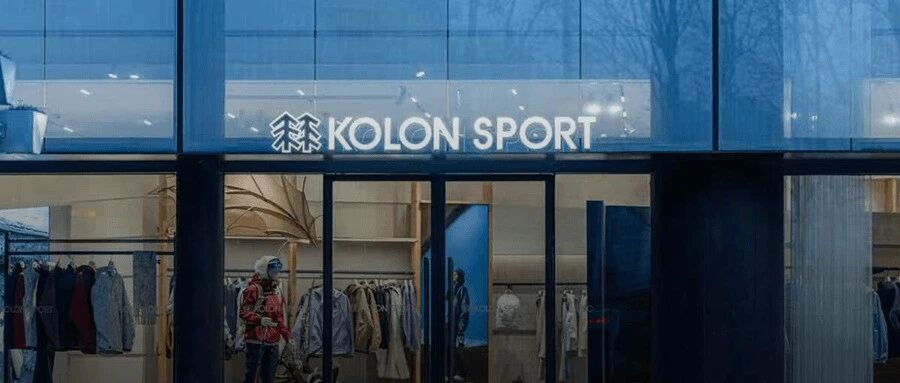
户外品牌竞逐高端商圈C位,可隆何以「安静突围」?
36氪· 2026-02-06 10:11
Core Viewpoint - The article discusses the evolving logic of flagship stores in urban environments, emphasizing the shift from efficiency-driven models to those that prioritize long-term relationships with consumers [5][30]. Group 1: Flagship Store Evolution - In recent years, flagship stores have proliferated in cities, indicating their continued relevance despite the rise of e-commerce and instant retail [3][4]. - The role of flagship stores is changing; they are no longer just places to purchase goods but are expected to embody brand identity, lifestyle, and values [5][8]. - As many brands adopt similar design elements, the uniqueness of physical retail spaces is diminishing, leading to a new differentiation based on whether a space encourages lingering and connection rather than immediate purchases [6][7]. Group 2: Efficiency vs. Relationship - The operational logic of flagship stores is increasingly focused on efficiency, aiming to shorten consumer understanding paths and maximize sales data [10][12]. - Key performance indicators for flagship stores now include sales per square meter and conversion rates, which dictate store layout and design [13][38]. - The outdoor industry reflects this trend, where flagship stores are designed to quickly convert consumer interest into sales, often at the expense of building long-term relationships [14][30]. Group 3: KOLON SPORT's Approach - KOLON SPORT's flagship store, "KOLON ATLAS," diverges from the efficiency norm by investing in long-term consumer relationships rather than immediate sales [16][29]. - The store's design encourages exploration and understanding rather than direct purchasing, aligning with the brand's values of nature and sustainability [18][21]. - KOLON ATLAS incorporates sustainable practices into its operations, making them a core part of the consumer experience rather than a mere marketing tactic [22][24]. Group 4: Long-term Relationship Focus - KOLON SPORT emphasizes the importance of relationship longevity over immediate transaction efficiency, aiming for higher relationship reuse rates [30][39]. - The brand's strategy reflects a shift in the outdoor industry, where maintaining consumer relationships is becoming more critical than merely attracting initial interest [33][34]. - KOLON SPORT's approach is consistent across its flagship stores, indicating a strategic commitment to fostering long-term connections with consumers [36][40].

“以租代买”让消费者选择更多 专家:具有更高性价比
Zhong Guo Qing Nian Bao· 2026-02-05 00:41
Core Insights - The article highlights the growing trend of "renting instead of buying" among young consumers in China, with nearly 80% of surveyed youths having experience in this consumption model [1][4]. Group 1: Renting Preferences - Digital devices (42.5%) and outdoor equipment (38.9%) are the most commonly rented items among young consumers [2][4]. - Other popular categories include cultural items (29.9%), tools (29.1%), fashion items (26.9%), and household goods (20.2%) [2]. Group 2: Reasons for Renting - 54.1% of respondents indicated low-frequency use as a reason for renting rather than buying [4]. - Additional motivations include supporting a circular economy (36.9%), the desire for temporary ownership (33.9%), and the wish to use the latest products without accumulating outdated items (30.4%) [4]. Group 3: Consumer Behavior Changes - The shift in consumer behavior reflects a more mature and pragmatic attitude among young people, moving from a binary mindset of ownership to a more rational decision-making process [2][4]. - The rental economy allows for greater flexibility and cost-effectiveness, particularly for high-cost items like wedding dresses and sports equipment [3][4].
探路者涨2.07%,成交额2.31亿元,主力资金净流出1721.20万元
Xin Lang Cai Jing· 2026-01-29 03:29
Group 1 - The core viewpoint of the news is that Tanshan's stock has shown significant growth in 2023, with a year-to-date increase of 31.76% and a notable rise of 48.18% over the past 60 days [1] - As of January 29, Tanshan's stock price reached 14.27 yuan per share, with a total market capitalization of 12.61 billion yuan [1] - The company's main business segments include outdoor apparel (63.31% of revenue), chip business (17.13%), outdoor footwear (13.29%), outdoor equipment (3.71%), and other services (2.56%) [1] Group 2 - As of September 30, Tanshan had 41,100 shareholders, a decrease of 29.16% from the previous period, while the average number of circulating shares per person increased by 41.16% to 21,485 shares [2] - For the period from January to September 2025, Tanshan reported operating revenue of 953 million yuan, a year-on-year decrease of 13.98%, and a net profit attributable to shareholders of 33.04 million yuan, down 67.53% year-on-year [2] - Tanshan has distributed a total of 509 million yuan in dividends since its A-share listing, with cumulative distributions of 30.42 million yuan over the past three years [3]

一年2415家海外企业开出首店,中国仍是全球品牌“试金石”
Huan Qiu Wang· 2026-01-28 11:56
Core Insights - The article highlights the structural changes in the entry of overseas brands into the Chinese consumer market, reflecting the evolving landscape of import consumption in China [2] Group 1: Brand Entry Strategies - The concept of "first store economy" is shifting from physical locations in key urban areas to online platforms, with e-commerce becoming the primary entry point for many overseas brands, especially smaller ones [2] - By establishing "online first stores," brands can conduct market testing and channel development at a lower cost, facilitated by platforms like Tmall International that provide essential infrastructure [2] - In 2025, brands from 52 countries are expected to enter China through this method, with the highest numbers from the US (555 brands) and South Korea, while countries like Cuba and Chile are also making their debut [2] Group 2: Competitive Strategies - New brands are increasingly focusing on niche markets rather than mass-market products, with health, beauty, and maternal and infant categories being the most attractive [3] - In the health sector, "precision nutrition" and "oral anti-aging" are emerging as key areas for new brand entries, while the maternal and infant sector sees a 128% increase in new baby food brands, indicating a growing demand for specialized dietary needs [3] - The beauty sector is witnessing a shift as overseas brands pivot towards personal care products, with a 37% increase in new personal care brands, many focusing on hair care [3] Group 3: Consumer Behavior Trends - The fastest-growing imported categories in 2025 include toys, outdoor gear, baby food, fashion cosmetics, and pet health, all showing growth rates exceeding 100% [4] - The growth in toy-related products is driven by fan economy and emotional consumption, while outdoor gear growth correlates with the rise of leisure lifestyles in China [5] - The high growth rates in baby food and pet health reflect families' increasing demand for quality in these areas, where imported brands hold a recognition advantage [5] Group 4: Platform Evolution - E-commerce platforms are evolving from mere entry points to providing operational support for overseas brands, as seen with Korean brands on Tmall International [7] - In 2023, eight of the top ten Korean brands by sales on Tmall International were beauty brands, but the platform is guiding these brands to diversify into apparel and other categories [7] - The structural shift in Korean brands from a beauty-centric focus to a broader distribution across various categories is supported by market insights and resources provided by the platform [7] Group 5: Market Attractiveness - The continuous entry of overseas brands is based on the stable demand from Chinese consumers for certain imported categories, particularly in health, maternal, and pet sectors [8] - Improved e-commerce infrastructure has lowered the cost for brands to test the market, allowing smaller brands to enter with manageable risks [9] - The segmentation and differentiation of the Chinese consumer market provide opportunities for brands with varying positioning, as evidenced by the growth of online first stores on Tmall International [10]
太力科技1月27日获融资买入1579.91万元,融资余额9525.29万元
Xin Lang Cai Jing· 2026-01-28 01:48
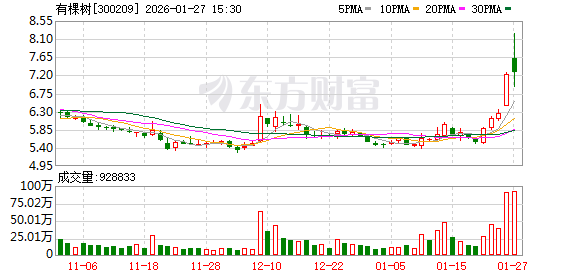
Group 1 - The core viewpoint of the news is that Tai Li Technology experienced a decline in stock price and trading volume on January 27, with a net financing outflow [1] - On January 27, Tai Li Technology's financing buy amounted to 15.79 million yuan, while financing repayment was 17.78 million yuan, resulting in a net financing buy of -1.98 million yuan [1] - As of January 27, the total balance of margin trading for Tai Li Technology was 95.25 million yuan, accounting for 6.87% of its circulating market value [1] Group 2 - As of September 30, the number of shareholders of Tai Li Technology was 13,600, a decrease of 16.71% compared to the previous period [2] - For the period from January to September 2025, Tai Li Technology achieved an operating income of 822 million yuan, representing a year-on-year growth of 6.98% [2] - The net profit attributable to the parent company for the same period was 53.15 million yuan, a year-on-year decrease of 20.68% [2] Group 3 - Since its A-share listing, Tai Li Technology has distributed a total of 27.07 million yuan in dividends [3] - As of September 30, 2025, the seventh largest circulating shareholder of Tai Li Technology was the交银瑞思混合(LOF) fund, which holds 300,000 shares as a new shareholder [3]
有棵树更名背后:新主掌舵,前路未卜
Guo Ji Jin Rong Bao· 2026-01-27 14:49
Core Viewpoint - The company Youkeshu Technology Co., Ltd. is undergoing a significant transformation, including a name change to Xingyun Technology Co., Ltd., reflecting a shift in strategic direction and control by a new management team [1][4]. Group 1: Company Name Change - The company will officially change its name from "Youkeshu Technology Co., Ltd." to "Xingyun Technology Co., Ltd." starting February 11, with the stock abbreviation changing accordingly [1][4]. - This name change coincides with the new management team taking over operations, marking a complete shift in control to Shenzhen Tianxingyun Supply Chain Co., Ltd. led by Wang Wei [4]. Group 2: Financial Performance - For the first three quarters of 2025, the company reported a significant decline in revenue, achieving 58.96 million yuan, a year-on-year decrease of 82.02%, and a net loss of 13.85 million yuan compared to a loss of 30.57 million yuan in the same period last year [5]. - The third quarter alone saw revenue drop to 16.38 million yuan, a staggering decline of 83.59%, with a net loss of 15.73 million yuan, representing a 5169.86% year-on-year drop [5]. Group 3: Subsidiary Integration Progress - The new management team has made progress in integrating 26 subsidiaries, completing the transfer of core qualifications and signing a four-party regulatory agreement, with 100 million yuan allocated to support business expansion [5]. - However, some subsidiaries have not yet completed the business handover, involving total assets of 64.71 million yuan and net assets of -10.96 million yuan, which may affect the completeness of financial statements [5]. Group 4: Historical Context and Challenges - Founded in 2010, the company initially thrived in the cross-border e-commerce sector but has faced significant financial challenges, accumulating losses exceeding 4 billion yuan from 2020 to 2023 [6]. - The company received a delisting risk warning from the Shenzhen Stock Exchange in April 2024 and subsequently filed for restructuring due to severe financial distress [6][7]. Group 5: Management Changes and Internal Conflicts - The restructuring process has led to a change in the company's major shareholders, with Wang Wei and his associates holding 18% of the shares, while the founder, Xiao Siqing, saw his stake diluted to 3.28% [7]. - Internal conflicts escalated, affecting operational efficiency, leading to delays in the third-quarter financial report, which was released three months late due to management transition issues [8].

有棵树更名背后:新主掌舵 前路未卜
Guo Ji Jin Rong Bao· 2026-01-27 14:48
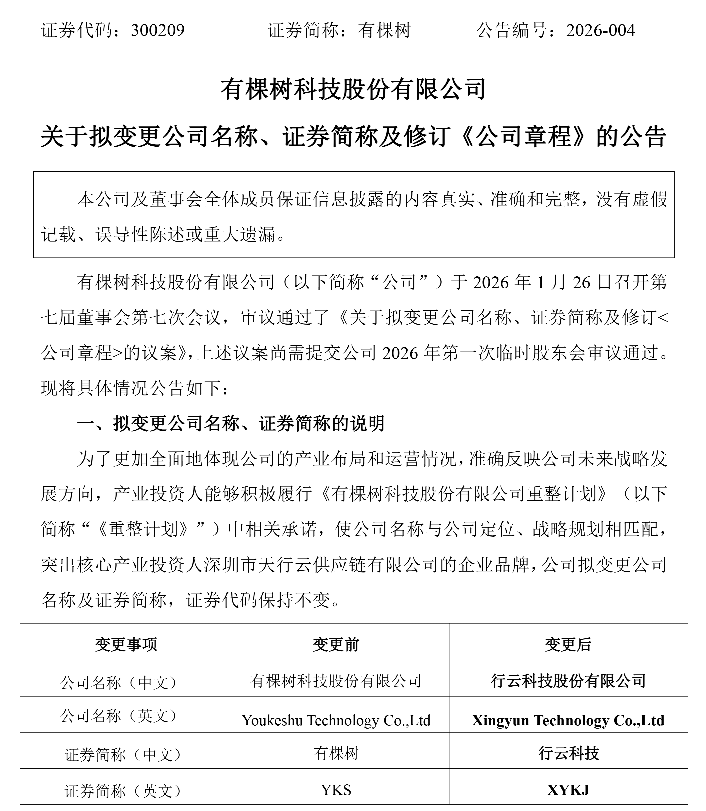
Core Viewpoint - The company Youkeshu Technology Co., Ltd. is undergoing a significant transformation, changing its name to Xingyun Technology Co., Ltd. and adjusting its brand positioning to align with its strategic shift, effective February 11 [1][5]. Company Name Change - The company name change includes the following adjustments: - Chinese Name: From 有棵树科技股份有限公司 to 行云科技股份有限公司 - English Name: From Youkeshu Technology Co., Ltd to Xingyun Technology Co., Ltd - Chinese Stock Abbreviation: From 有棵树 to 行云科技 - English Stock Abbreviation: From YKS to XYKJ - The stock code remains unchanged at 300209 [5]. Management Transition - The name change coincides with the new management team taking over operations for 100 days, indicating a complete takeover by Shenzhen Tianxingyun Supply Chain Co., Ltd., controlled by Wang Wei [5][6]. Financial Performance - The company reported a significant decline in performance for the first three quarters of 2025: - Revenue: 58.96 million yuan, a decrease of 82.02% year-on-year - Net Profit: Loss of 13.85 million yuan, compared to a loss of 30.57 million yuan in the same period last year - Q3 Performance: Revenue of 16.38 million yuan, down 83.59% year-on-year; net profit loss of 15.73 million yuan, a staggering drop of 5169.86% [6][8]. Subsidiary Integration Progress - As of December 31, 2025, the company has completed control over 26 subsidiaries' core qualifications and has made a capital injection of 100 million yuan to support business expansion [6][7]. - Some subsidiaries have not yet completed business handovers, involving total assets of 64.71 million yuan and net assets of -10.60 million yuan, which may affect the completeness of financial statements [7]. Historical Context - Founded in 2010, the company was once a leading player in cross-border e-commerce, leveraging a robust supply chain in Shenzhen for rapid growth [8]. - The company underwent a reverse merger in 2017 and was renamed in 2022, but has faced significant financial challenges, accumulating losses exceeding 4 billion yuan from 2020 to 2023 [8][9]. Shareholder Dynamics - Following a restructuring plan, Wang Wei became a major shareholder, while the founder, Xiao Siqing, saw his stake diluted to 3.28% [9]. - Internal conflicts between Wang Wei and Xiao Siqing have escalated, impacting operational stability and leading to delays in financial reporting [9][10]. Regulatory Issues - The company is under investigation by the China Securities Regulatory Commission for failing to disclose significant information, which poses a potential risk to its operations [10].
太力科技(301595) - 投资者关系活动记录表2026003
2026-01-21 00:48
Group 1: Company Overview and Business Strategy - The company focuses on both traditional and new businesses, with a strong emphasis on optimizing resource allocation and enhancing operational control to reduce overall marketing expenses [2] - The B-end new business is exploring functional materials in various industrial applications, such as nano-fluid materials in robotics and public safety systems [2][3] Group 2: Growth Drivers and Market Expansion - Future growth is expected to be driven by online cross-border channels, which leverage a mature product matrix to quickly reach global markets [3] - The company is enhancing its B-end market development through deeper collaboration with industrial clients and optimizing customer structure [3] Group 3: Performance in E-commerce Channels - Significant growth in the Amazon channel over the past two years is attributed to refined brand management and operational strategies, which enhance product visibility and brand influence [3] - The company plans to further integrate resources in mature cross-border markets to strengthen its competitive edge [3] Group 4: Incentives and New Business Contributions - The growth targets set for the company's equity incentive plan are realistic and achievable, with new business contributions expected to drive overall revenue and profit growth [4] - New business revenue includes flexible connections, outdoor equipment, bio-preservation, and safety protection materials [4] Group 5: B-end Client Development Progress - The company is leveraging its technical advantages in materials to expand diverse application scenarios, gaining trust from various industrial clients [5] - Ongoing research and development efforts are focused on applying coating materials in anti-icing and anti-scratch applications, particularly in automotive and consumer electronics [5]
运河关注|运河潮涌润商脉 2026扬州十大富豪揭晓!
Sou Hu Cai Jing· 2026-01-15 10:39
Core Insights - The economic vitality of Yangzhou has surged since the reform and opening-up, with a significant rise in private entrepreneurs who have created notable business legends [1] - The total wealth of the top ten billionaires in Yangzhou has reached 56.1 billion RMB, with two individuals surpassing 10 billion RMB and two newcomers making their debut on the list [1] Group 1: Top Billionaires - The richest individual is Liang Qin, chairman of Yangjie Electronics Technology, with a net worth of 16 billion RMB, ranking 411th nationally [4] - Zhu Daqing, chairman of Tianfu Long Group, ranks second with a net worth of 13 billion RMB, marking his first appearance on the list [7] - Zhu Yinghui, holding 36.17% of Rongtai Co., ranks third with a net worth of 5.5 billion RMB, also making her debut on the list [8] Group 2: Notable Achievements - Zhou Guangrong, chairman of Haichang New Materials, has a combined net worth with his wife of approximately 5.3 billion RMB, leading a prominent powder metallurgy company [10] - Fu Helian, chairman of Aidi Pharmaceutical Group, is the highest-educated billionaire on the list, focusing on innovative drug development [11] - Zou Weimin, chairman of Chuan Yi Technology, has a net worth of about 3.1 billion RMB, having established a successful company in the notebook industry [12] Group 3: Emerging Entrepreneurs - Li Hongqing, former actual controller of Aoliwei Sensor, has a net worth of at least 3.8 billion RMB, having taken control of the company through capital operations [14] - Zhang Wensheng, chairman of Beijiajie Group, has a net worth of around 2.4 billion RMB, having built a leading company in oral care products [15] - Lin Mingwen, chairman of Yangzhou Jinqiu Tourism Products, has a net worth of approximately 1.5 billion RMB, becoming a major player in outdoor equipment manufacturing [17] Group 4: Young Entrepreneurs - Zhu Xingrong, general manager of Tianfu Long Group and the youngest billionaire at 42, holds a 13.14% stake in the company with a net worth of about 2.3 billion RMB [19] - Over half of the top ten billionaires started from grassroots sales or technical positions, demonstrating their ability to seize opportunities in industry transformation [19]