
算力竞争

Search documents
长飞光纤(601869):长飞光纤深度研究:光纤光缆龙头,AI算力与空芯光纤双重驱动
GUOTAI HAITONG SECURITIES· 2026-03-05 03:03
Investment Rating - The report assigns a rating of "Buy" to the company with a target price of 293.87 CNY [5]. Core Insights - The company is a global leader in the production of optical fiber preforms, optical fibers, and cables, benefiting from breakthroughs in hollow-core fiber research and a surge in demand driven by AI computing power competition [2]. - The company is expected to see revenue growth from 12.91 billion CNY in 2025 to 19.85 billion CNY in 2027, with net profit projected to increase from 764 million CNY to 3.72 billion CNY during the same period [4][12]. - The demand for optical fibers is anticipated to grow significantly, particularly in data center interconnect (DCI) scenarios, with the share of optical fiber demand driven by AI expected to rise from less than 5% in 2024 to 35% by 2027 [11]. Financial Summary - Total revenue is projected to decline by 3.5% in 2023, followed by a further decline of 8.7% in 2024, before rebounding with a growth of 5.9% in 2025 and a substantial increase of 42.8% in 2026 [4]. - Net profit is expected to decrease by 47.9% in 2024 but is forecasted to recover significantly, with a projected increase of 315.9% in 2026 [4]. - The company’s earnings per share (EPS) is expected to rise from 0.82 CNY in 2024 to 4.49 CNY in 2027 [4]. Market Data - The company's market capitalization is approximately 188.99 billion CNY, with a 52-week stock price range of 29.94 CNY to 242.42 CNY [6]. - The company has a total share capital of 828 million shares, with 406 million shares in circulation [6]. Business Overview - The company has established a comprehensive range of optical fiber products and solutions, serving over 100 countries and regions [15]. - The management team has extensive industry experience, contributing to the company's operational efficiency and strategic development [24][25]. - The company has a clear and stable shareholding structure, with major shareholders being state-owned enterprises [20][21].

2026年人工智能+的共识与分歧
腾讯研究院· 2026-02-09 08:03
Core Viewpoint - Generative AI is transitioning from "technically feasible" to "value feasible," entering a critical validation period for its practical application, with significant industry consensus on its implementation but deep divisions on key pathways that will determine its potential as a new productive force [2]. Three Consensus Points - The bottleneck for AI implementation has shifted from the supply side to the demand side, with 88% of surveyed medium to large enterprises using AI in at least one business function, but only one-third achieving large-scale deployment. Key obstacles include unclear goals and insufficient integration readiness [4]. - Approximately 70% of current AI solutions require customization, with only 30% being standardizable. High customization leads to challenges in monetization and the inability to create reusable product capabilities, resulting in a reliance on "API calls + customization services" for enterprise AI delivery [5]. - The commercial model for AI remains unproven, with significant price competition pressures. While C-end AI applications have high user engagement, revenue conversion rates are low. B-end AI faces even greater challenges, with API prices dropping by 95%-99% since 2024, leading to a highly competitive low-price environment [6][7]. Three Divergence Points - The capabilities of intelligent agents are evolving from "answering questions" to "completing tasks," with significant advancements in long-term task execution and tool utilization. However, accuracy in complex tasks remains inconsistent, particularly in high-risk sectors like finance and healthcare [9][10]. - The focus of computing power competition is shifting from training to inference, with demand for AI applications driving exponential growth in inference calls. Companies are optimizing algorithms to enhance inference efficiency, indicating a shift in market dynamics [11][12]. - The evolution of the AI ecosystem is complex, with debates on data flow rules and user privacy. The transition from mobile internet to AI necessitates new structural solutions to address data sharing and privacy concerns, with no clear answers yet established [13][14]. Next Steps - Companies should prioritize real value and carefully select application scenarios, focusing on areas with strong data foundations and manageable risks, such as quality inspection in manufacturing and AI-assisted diagnosis in healthcare [16]. - Standardization efforts should be promoted to reduce customization costs and foster reusable product capabilities, particularly in key industries like finance and manufacturing [17]. - Quality supervision and safety audits should be strengthened in high-risk AI applications, establishing a governance framework to mitigate systemic uncertainties [18]. - Diverse commercial models should be encouraged to avoid detrimental price competition, supporting differentiated pricing strategies based on technical capabilities and industry expertise [19].


国泰海通|通信:光纤光缆供不应求,看好涨价趋势
国泰海通证券研究· 2026-02-05 14:00
Core Viewpoint - The optical fiber industry is experiencing a significant price increase driven by a surge in demand due to the competition in computing power, particularly from AI data centers, leading to a robust growth in both domestic and international markets [1][2]. Group 1: Optical Fiber Demand and Pricing Trends - The optical fiber market is witnessing a price increase after a period of pressure in the first half of last year, with the demand for G657A2 fibers significantly boosting production capacity adjustments, resulting in reduced supply of G652D fibers and longer delivery times [1] - The upcoming procurement by telecom and mobile operators, along with pre-Spring Festival inventory demands, is expected to further drive prices higher, indicating that major domestic clients are likely to accept these price increases [1] - The export performance of optical fiber and cable has been outstanding, with overseas demand driven by AI-related data center needs contributing to a continuous rise in global optical fiber demand [1] Group 2: Impact of AI and Data Centers - The demand for optical fibers is being significantly reshaped by intelligent computing centers, which require ultra-high bandwidth and low-latency transmission, making them the core engine for growth in the optical fiber sector [2] - A single intelligent computing center can require several times more optical fiber than traditional data centers, with a typical GPU cluster needing tens of thousands of fiber kilometers for internal connections [2] - The share of optical fiber demand from AI-driven data center interconnect (DCI) scenarios is projected to increase from less than 5% in 2024 to 35% by 2027, highlighting the rapid growth in this segment [2] Group 3: Growth in Specialty and Multimode Fibers - There is a continuous growth in the demand for specialty and multimode fibers, with rapid advancements being made by companies both domestically and internationally [3] - The domestic leading optical fiber and cable manufacturers are expected to benefit significantly from the price increase trend driven by the surge in demand [3]

国泰海通 · 晨报260206|通信:光纤光缆供不应求,看好涨价趋势
国泰海通证券研究· 2026-02-05 14:00
Core Viewpoint - The fiber optic cable industry is experiencing a supply-demand imbalance, leading to a confirmed upward price trend due to increased demand from telecom operators and data centers [2][3]. Group 1: Industry Trends - The fiber optic market is witnessing a price increase, particularly for G657A2 fibers, driven by heightened overseas demand and reduced supply of G652D fibers, resulting in longer delivery times [2]. - The upcoming procurement by telecom operators and pre-Spring Festival inventory demands are expected to further drive price increases in the domestic market [2]. - Export performance of fiber optic cables is strong, with international markets becoming a significant growth point for companies in the sector [2]. Group 2: Demand Drivers - The demand for fiber optics is surging due to the rise of intelligent computing centers, which require ultra-high bandwidth and low-latency transmission, fundamentally changing the demand dynamics in the fiber optic industry [3]. - A typical intelligent computing center can require several times more fiber than traditional data centers, with a single GPU cluster needing tens of thousands of fiber kilometers for internal connections [3]. - The share of fiber demand from AI-driven data center interconnect (DCI) applications is projected to increase from less than 5% in 2024 to 35% by 2027 [3]. Group 3: Investment Recommendations - The domestic leading fiber optic manufacturers are expected to benefit significantly from the price increase trend driven by the surge in fiber optic demand, with profit elasticity likely to be continuously revised upwards [4].

通信设备及服务:光纤光缆供不应求,看好涨价趋势
GUOTAI HAITONG SECURITIES· 2026-02-05 06:29
Investment Rating - The report assigns an "Overweight" rating to the fiber optic cable industry [1]. Core Insights - The fiber optic industry is experiencing a significant price increase trend, driven by a surge in demand due to computational power competition and the growth of special and multimode fibers. The export performance of fiber optic cables is strong, confirming the industry's upward pricing trend [3][4]. Summary by Sections 1. Fiber Optic Industry Cycle and Price Trends - After being under pressure in the first half of last year, the price of fiber optic cables has been gradually recovering, particularly with increased demand for G657A2 overseas, leading to a reduction in G652D supply and longer delivery times. The price of G652D fiber has seen significant increases, with expectations for continued price hikes as major telecom operators prepare for procurement [8][9]. 2. Factors Driving Price Increases - The demand for fiber optic cables is continuously growing, with G652D fiber experiencing a structural shortage. Prices have risen significantly, with the latest market quotes reaching 30-40 yuan per core kilometer, reflecting a more than 50% increase over the previous year [16][22]. - The competition for computational power is a core driver of fiber demand, with data centers requiring significantly more fiber than traditional setups. The global demand for fiber optic cables is expected to increase by 75.9% in 2025, particularly for high-end products like G.654.E and OM5 multimode fibers [20][22]. - The supply side is constrained, with a slow growth in global fiber preform capacity and a shift towards high-demand AI and specialty fibers, leading to a more orderly supply of traditional products [30]. 3. Export Performance and Growth Opportunities - The export of fiber optic cables has become a crucial growth point for companies in the industry, with significant increases in overseas demand. In 2025, the total export volume of fiber optic products reached 454,000 tons, a year-on-year increase of 11.1%, with export value rising by 44.1% [12][10]. 4. Investment Recommendations - The report recommends investing in leading domestic fiber optic manufacturers such as Yangtze Optical Fibre and Cable Joint Stock Limited Company, Hengtong Optic-Electric Co., Ltd., and Zhongtian Technology Co., Ltd., which are expected to benefit from the price increase trend and growing demand [51].


2025,AI行业发生了什么?
Jing Ji Guan Cha Bao· 2026-01-10 09:01
Core Insights - The AI industry experienced significant milestones in 2025, marked by technological innovations, business model transformations, and global regulatory dynamics [2] Group 1: Multi-Modal Integration - AI models have advanced rapidly in text and reasoning but lagged in multi-modal capabilities, limiting their effectiveness [4] - Developers are shifting from "assembled" models to "native multi-modal" models that can process text, images, audio, and video simultaneously [5] - The development of multi-modal models is becoming a primary focus for leading AI companies, enhancing their ability to perform real-world tasks [5][6] Group 2: Embodied Intelligence - The focus of embodied AI has shifted from experimental demonstrations to market-ready solutions, with companies announcing mass production of robots [8] - The cost of humanoid robots has significantly decreased, making them more accessible for commercial use [9] - The rise of embodied intelligence is driven by advancements in multi-modal AI and increasing labor costs, leading to greater demand for robotic solutions [9] Group 3: Computing Power Competition - The competition for computing power has evolved from a focus on acquiring GPUs to a more complex, efficiency-driven battle [10] - Companies are now prioritizing how to effectively utilize limited computing resources rather than just increasing their total computing power [10] - Some developers are moving towards self-developed chips to reduce reliance on dominant suppliers like NVIDIA [10] Group 4: Paradigm Controversy - There is a growing debate in the theoretical community regarding the "scale law" that has traditionally guided AI development [12] - Some experts argue that simply increasing model size does not lead to general intelligence, suggesting a need for new training paradigms and reasoning mechanisms [13] - Despite differing opinions, both sides recognize the need for a reevaluation of existing paradigms to find better development paths [13] Group 5: Rise of Agents - The emergence of AI agents, capable of executing complex tasks autonomously, signifies a shift in human-computer interaction from function-driven to task-driven systems [14][15] - This transition is expected to reshape organizational structures and business models, focusing on task completion rather than capability provision [15] Group 6: Open Source Renaissance - Open-source models have become a foundational infrastructure for global innovation, increasingly rivaling closed-source systems in performance and adoption [16] - The rise of open-source is attributed to changing AI innovation logic, where community collaboration and rapid customization are prioritized [17] Group 7: Business Innovation - The AI industry is moving towards clearer business paths, with different players finding monetization strategies that align with their capabilities [18] - The concept of "Outcome-as-a-Service" is gaining traction, shifting the focus from selling functionalities to delivering task completion [19] Group 8: Regulatory Dynamics - AI governance has become a critical area of focus, balancing innovation with regulatory frameworks to avoid stifling technological development [20] - Different regions are adopting varied approaches to governance, reflecting their priorities and institutional frameworks [21][22] Group 9: International Competition - The competition in AI has escalated from corporate to national levels, with countries vying for leadership in defining technological paths and standards [23] - The U.S. maintains a strong position in core technologies, while China focuses on optimizing existing frameworks for scalable applications [23][24] Group 10: Youth Leadership - A trend of young scientists gaining significant influence in AI companies is emerging, reflecting a shift in the industry's leadership dynamics [25][26] - This generational change is seen as essential for navigating the evolving landscape of AI, where innovative problem definition and evaluation are crucial [26]

广东智造进化论:“AIR”驱动千行百业变革
2 1 Shi Ji Jing Ji Bao Dao· 2025-11-04 23:16
Core Insights - The article highlights the rapid growth and investment in the AI and robotics sector in Guangdong, particularly focusing on tactile sensors for robots and the commercialization of embodied intelligent robots [1][2] - Guangdong is positioned as a "super testing ground" for AI+ applications due to its robust industrial system, innovative ecosystem, and diverse market demands [1][2] Investment and Financing - The startup, PAXINI, has raised nearly 1 billion RMB in funding over the past six months, indicating strong investor interest in tactile sensors as essential components for robots [1] - The AI core industry in Guangdong has grown from 130 billion RMB to 220 billion RMB during the 14th Five-Year Plan, with an annual growth rate exceeding 15% [2] Policy and Development - The Guangdong government is actively promoting AI integration into manufacturing, as outlined in the "Guangdong Province AI Empowering High-Quality Development Action Plan (2025-2027)" [2] - A focus on large-scale applications of industrial AI has been established, with a recent release of the first batch of "AI+" application scenarios covering key sectors like manufacturing, healthcare, and education [2] Industry Transformation - Companies like LIGONG Industrial have transitioned from traditional manufacturing to smart factories, integrating AI training into daily operations [4][5] - The shift towards humanoid collaborative robots is driven by the need for machines that can perform tasks requiring dexterity, such as packaging and assembly [5][6] Technological Advancements - The development of intelligent mobile robots by companies like Blue Ocean Robotics has enabled automated operations in complex environments, significantly reducing the need for human labor [7][8] - The focus on creating robots that can operate autonomously without human control is seen as a hallmark of the AI era [8][9] Market Opportunities - The vast industrial landscape in Guangdong presents numerous opportunities for AI and robotics companies to innovate and expand into new sectors, including agriculture and logistics [9][10] - The establishment of companies like Turing New Intelligent Computing, which focuses on providing AI training solutions, reflects the growing demand for computational power in industrial applications [11][12]
CoreWeave:算力时代,手握“金铲铲”
3 6 Ke· 2025-10-09 11:21
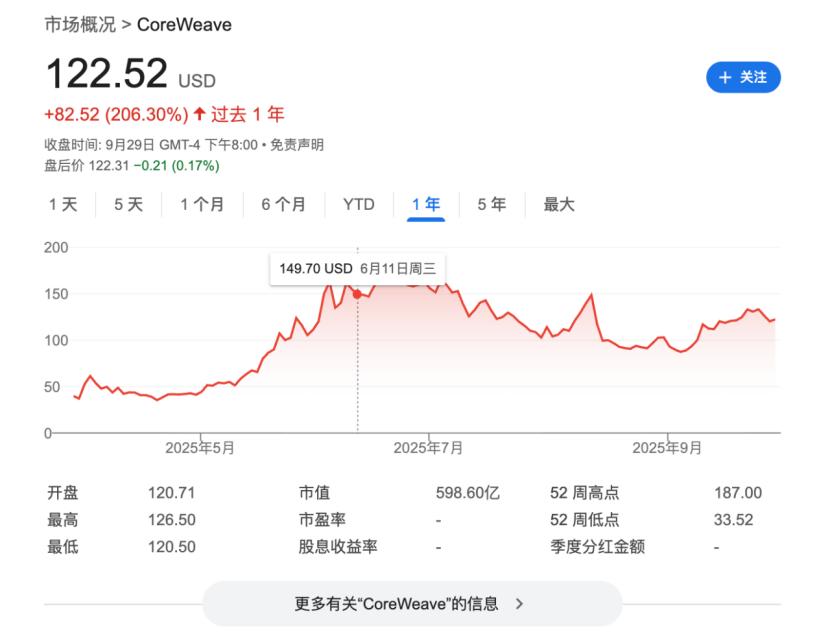
Group 1: CoreWeave Overview - CoreWeave, an AI cloud computing company, transitioned from cryptocurrency mining to cloud computing and GPU infrastructure services, leveraging its extensive GPU inventory to meet enterprise demand [3][17] - The company reported a revenue of $2.194 billion for the first half of 2025, a 275.68% increase from $584 million in the same period last year [3][5] - As of June 30, 2025, CoreWeave's total assets were $39.46 billion, with cash and cash equivalents amounting to $11.53 billion [3] Group 2: Financial Performance - CoreWeave's operating expenses for the first half of 2025 totaled $2.203 billion, leading to a net loss of $625.15 million [5] - The company has a significant net loss per share of $1.79 for diluted shares, compared to $2.23 in the previous year [5] - Despite the losses, the company is experiencing rapid growth, with a substantial increase in revenue driven by high demand for AI computing power [8] Group 3: Strategic Partnerships and Contracts - CoreWeave has secured a $6.5 billion partnership with OpenAI, adding to previous agreements totaling $22.4 billion, which is close to the company's total asset value [7][9] - The company has established strong partnerships with major clients like Microsoft and Google, enhancing its market position [9] Group 4: Market Demand and Competitive Landscape - The demand for AI computing power is surging, with cloud computing giants investing heavily to enhance their capabilities, creating opportunities for companies like CoreWeave [8] - CoreWeave's pricing strategy is favorable, with expectations to increase GPU rental prices to $2.50 per hour, supported by advantageous contracts with NVIDIA [9] - Competitors such as Nebius, Nscale, and Crusoe are also emerging in the AI computing space, indicating a growing market for GPU rental services [10][12][15] Group 5: Industry Trends - The transition from cryptocurrency mining to AI computing services is a common trend among leading companies in the sector, capitalizing on their existing infrastructure and operational capabilities [17] - The AI industry is witnessing exponential growth in computing power demand, with companies needing to adapt quickly to meet this need [18]
下一只“寒王”呼之欲出!算力+机器人共振,英伟达核心伙伴潜力股
Xin Lang Cai Jing· 2025-10-08 04:16
Group 1 - The report "Global Digital Intelligence Index 2025" predicts that by 2035, the total computing power of society will increase by 100,000 times, causing significant impact in the tech and finance sectors [1] - Computing power is considered the core productivity of the AI era, with China's intelligent computing power expected to reach 1,037.3 EFLOPS by 2025, a 43% increase from 2024, and to double to 1,460.3 EFLOPS by 2026 [2] - Major economies view computing power as a strategic resource, with the US investing $52 billion in the semiconductor industry through the CHIPS and Science Act, and the EU launching the European Chips Act to capture 20% of the global market share by 2030 [2] Group 2 - The demand for computing power is experiencing exponential growth across multiple fields, including AI model training, autonomous driving, smart cities, industrial robotics, and military applications [4] - In the context of Industry 4.0, the requirements for real-time computing power in smart manufacturing are continuously increasing [5] Group 3 - Unisoc is a leading company in the computing power sector, with its subsidiary Unisoc Xiaotong being the general agent for NVIDIA's enterprise products, providing a full-stack solution including computing, networking, storage, security, backup, and AI software [6] - Invid is another key player, supplying liquid cooling systems for data centers to IDC, with clients including Huawei and NVIDIA [6] - Industrial Fulian, a core supplier for NVIDIA, has seen rapid growth in its AI server product line, with the NVIDIA GB200 series achieving mass production [7] - Fenghuo Communication, through its subsidiary Changjiang Computing, collaborates with Ascend to provide computing infrastructure solutions, supplying products to Huawei [8] - A notable emerging company in robotics has developed inspection and cleaning robots, achieving automation in hazardous operations, and is the exclusive supplier of liquid cooling systems for Huawei's Ascend 910D chip [9]



全球AI竞赛正迈入新阶段 从“模型竞争”转向“算力竞争”
Zheng Quan Shi Bao Wang· 2025-09-28 23:40
Core Insights - The article highlights the growing concerns about the potential bubble in AI stocks, driven by overvaluation, technological bottlenecks, and funding competition [1] - NVIDIA and OpenAI have announced a significant investment plan, committing $100 billion to build a 10 gigawatt-level super AI data center and deploy millions of GPUs to support the training of next-generation large language models [1] - The global AI race is entering a new phase characterized by "super large scale, super high energy consumption, and super high investment," marking the beginning of a competition for AI infrastructure [1] Industry Trends - The AI computing industry chain is being fully activated, encompassing everything from chips to liquid cooling technology, and from computing clusters to energy support [1] - The focus of competition among nations is shifting from "model competition" to a more fundamental and core "computing power competition" [1]