标普中国A股大盘红利低波50指数

Search documents
红利资产逆市活跃,红利低波50ETF(515450)红盘上涨1.15%,高股息红利板块高性价比防御价值凸显
Sou Hu Cai Jing· 2026-01-20 03:35
Group 1 - The core viewpoint is that the market has experienced a cooling period despite previous strong performance, with significant net outflows from major ETFs and a need for attention on fund movements in the short term, while the long-term outlook for dividend stocks remains favorable due to their relative value and stability [1] - The recent market conditions have led to a rise in margin financing ratios and a notable net outflow exceeding 120 billion from the market, impacting large-cap stocks such as major telecom operators and oil companies [1] - The macroeconomic indicators, including inflation and social financing, are currently favorable for dividend stocks, and the divergence in market styles indicates a potential for recovery in the dividend sector [1] Group 2 - Zhejiang Securities analysis indicates that the valuation of dividend stocks remains at historically low levels, reflecting the asset revaluation potential due to the appreciation of the RMB and their defensive value during economic structural transitions [2] - The Dividend Low Volatility 50 ETF (515450) closely tracks the performance of the S&P China A-Share Large Cap Dividend Low Volatility 50 Index, which measures the performance of the 50 least volatile high dividend yield large-cap stocks in the Chinese A-share market [2]
市场创新高,红利慢半拍?2026年还能投吗?
Sou Hu Cai Jing· 2026-01-07 06:29
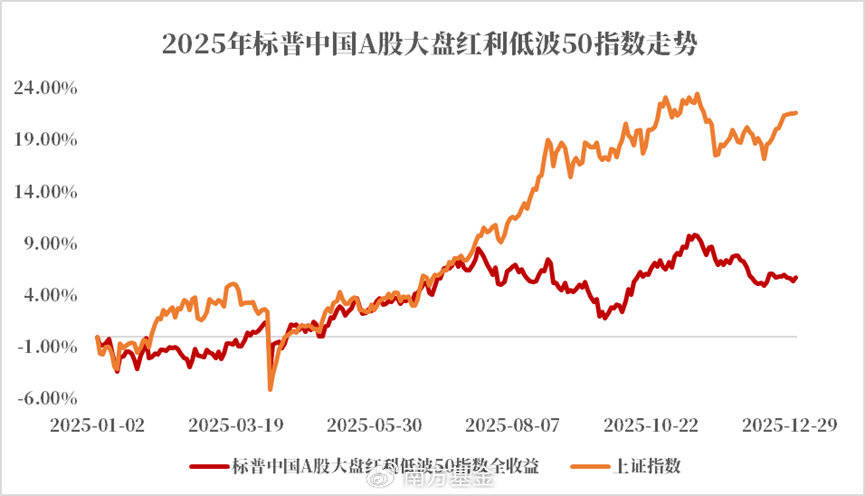
Core Viewpoint - The performance of dividend strategies in the A-share market has been relatively muted in 2025, despite the overall market reaching new highs, raising questions about the effectiveness of these strategies as a stable investment option [1][3]. Group 1: Performance Analysis - Over the past decade, major dividend indices have shown annualized returns between 10% and 15%, indicating solid long-term performance [3]. - In 2025, the Shanghai Dividend Index recorded a return of only 0.41%, while the CSI Dividend Index performed slightly better at 3.76% [4][5]. - The muted performance in 2025 can be attributed to two main factors: a digestion phase following a significant rise in 2024 and a market dominated by growth stocks, particularly in AI and technology sectors [5][6]. Group 2: Influencing Factors - Three key factors have influenced the dividend strategy's performance in 2025: 1. Style rotation suppression, as the A-share market has been dominated by a growth style since 2024, leading to a decline in interest for value-oriented dividend strategies [6]. 2. Increased uncertainty in geopolitical and policy environments, which can enhance the appeal of dividend strategies as a defensive measure during market volatility [6]. 3. Changes in government bond yields, where rising yields have reduced the attractiveness of dividends relative to bonds, impacting the dividend strategy's appeal [6]. Group 3: Future Outlook for 2026 - The future performance of dividend strategies in 2026 will depend on several factors: 1. The duration of the growth style's dominance in the market, with a potential need for a shift in market conditions for dividend strategies to recover [8]. 2. The ongoing performance of the "low volatility" factor, which may underperform in the early stages of a bull market but could regain traction as market conditions evolve [9]. 3. Internal differentiation within dividend strategies based on macroeconomic conditions, where sectors like manufacturing may benefit in a recovering economy, while stable high-dividend sectors may perform better in a low-rate environment [10]. Group 4: Investment Considerations - The underlying logic of dividend strategies remains focused on stable cash flow and long-term returns, while adaptability to macroeconomic and market style fluctuations is essential [11]. - The dividend yield of the S&P China A-share Large Cap Dividend Low Volatility 50 Index has returned to over 5%, indicating a potential favorable investment opportunity following recent market corrections [11].

A股低波红利指数及产品的投资价值与发展趋势
Shang Hai Zheng Quan Bao· 2025-12-15 19:19
Core Insights - The low-volatility dividend index demonstrates strong risk resistance, leading to increased market demand for related index products, particularly from long-term investors and financial institutions [2][8][9] Group 1: Characteristics of Low-Volatility Dividend Index - The low-volatility dividend index is based on high dividend and low volatility factors, with its first iteration launched in China in December 2013 [3] - The number of indices and related products has increased significantly, with 11 pure stock low-volatility dividend indices launched by the China Securities Index Company by Q1 2025 [4] - Investment scale in related products has surged, with passive index fund investments in major low-volatility dividend indices reaching 47.09 billion yuan in 2024, a 20-fold increase from 2022 [5] Group 2: Performance and Stability - The low-volatility dividend index has outperformed broad market indices and government bonds over the past three years, with a total return index nearly doubling in five years [5][6] - The index's volatility is lower than that of major market indices, with a significantly higher Sharpe ratio, indicating better risk-adjusted returns [6] - In extreme market conditions, the low-volatility dividend index has consistently outperformed the CSI 300 index, demonstrating its defensive characteristics [6] Group 3: Institutional Investor Engagement - Institutional investors hold a significant portion of low-volatility dividend products, with 85.53% of holdings attributed to them by the end of 2024 [7] - The introduction of new financial accounting standards has made it easier for insurance and brokerage firms to invest in low-volatility dividend equities [7] Group 4: Market Demand and Future Outlook - There is an anticipated increase in market demand for low-volatility dividend indices as long-term capital seeks stable investment options amid a low-interest-rate environment [9][10] - Financial institutions are increasingly viewing low-volatility dividend indices as a means to optimize asset allocation and enhance risk-adjusted returns [10] - Ordinary investors are also shifting towards more stable and long-term value investments, aligning with the characteristics of low-volatility dividend indices [10] Group 5: Limitations and Challenges - The sustainability of dividend yields and future performance is under scrutiny, particularly due to reliance on traditional cyclical industries [11] - There is a notable disparity in fund product performance, with smaller funds facing operational challenges and potential liquidation risks [12] - The index's reliance on short historical data may hinder its ability to adapt to market changes, affecting its long-term performance [12] Group 6: Recommendations for Development - It is recommended to encourage the creation and investment in low-volatility dividend indices and products, enhancing their market presence [13] - Increasing investor education and transparency regarding the benefits of low-volatility dividend indices is essential for broader adoption [14] - Optimizing the index compilation methodology to better reflect market trends and enhance its attractiveness is advised [15] - Improving the quality and governance of listed companies to ensure sustainable dividend practices is crucial for the long-term success of low-volatility dividend strategies [16]
红利板块走强,港股通央企红利ETF南方(520660)涨近2%,红利低波50ETF(515450)规模续创新高,现金流ETF南方(159232)涨超1%
Xin Lang Cai Jing· 2025-07-30 03:54
Group 1 - A-shares opened lower on July 30, 2025, with the Shanghai Composite Index rebounding, while Hong Kong stocks experienced fluctuations, particularly in high-dividend sectors such as steel, petrochemicals, and coal [1] - The Hong Kong Stock Connect Central State-Owned Enterprises Dividend ETF (520660) reached a new high of 1.142 billion yuan as of July 29, with continuous net inflows over the past three days [1] - The Low Volatility Dividend ETF (515450) achieved a record high of 13.259 billion yuan, with a total net inflow of 3.019 billion yuan over the past 16 days [1] Group 2 - China Galaxy Securities noted that adjustments to the long-term assessment of insurance funds by the Ministry of Finance will encourage insurance capital to increase equity asset allocation, benefiting bank stocks due to their stable dividends and low valuations [2] - Guosen Securities (Hong Kong) indicated that despite recent pullbacks in the banking sector, long-term funds like insurance still face asset scarcity, making high-quality retail banks attractive defensive assets [2] - The Low Volatility Dividend ETF (515450) closely tracks the S&P China A-Share Large Cap Low Volatility Dividend Index, which measures the performance of the 50 least volatile high-dividend large-cap stocks in the A-share market [2] Group 3 - The Hong Kong Stock Connect Central State-Owned Enterprises Dividend ETF (520660) tracks the CSI National New Hong Kong Stock Connect Central State-Owned Enterprises Dividend Index, reflecting the performance of high-dividend state-owned enterprises [3] - The Cash Flow ETF (159232) tracks the CSI All Index Free Cash Flow Index, which selects 100 companies with high free cash flow rates to represent the overall performance of companies with strong cash flow generation capabilities [3]
南方基金旗下红利低波50ETF(515450)突破100亿元
Xin Lang Ji Jin· 2025-07-01 02:13
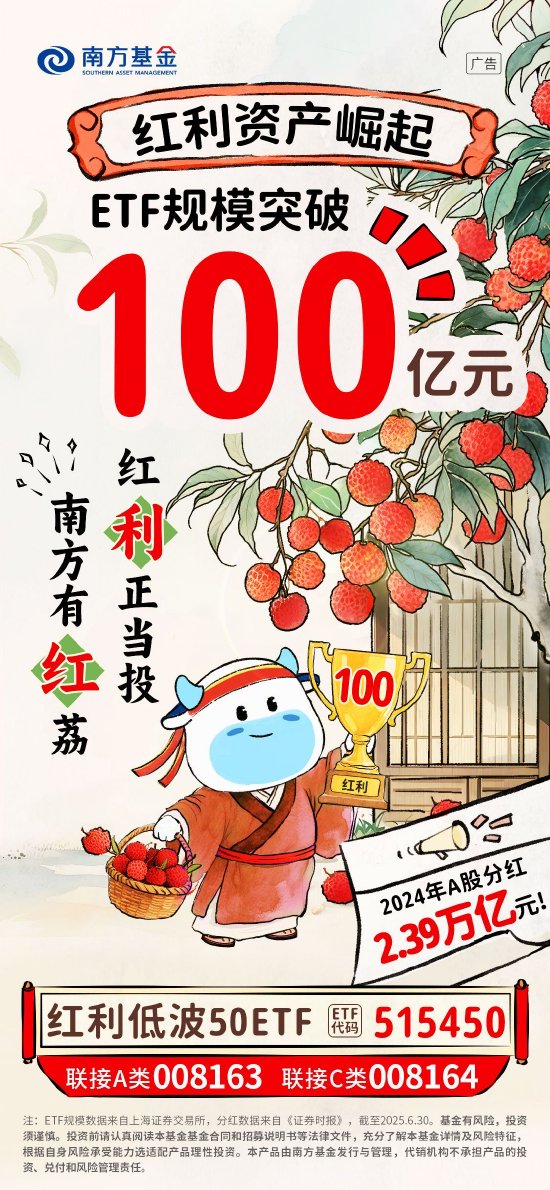
Group 1 - The A-share market has been experiencing continuous fluctuations this year, with the Southern Dividend Low Volatility 50 ETF (515450) gaining popularity due to its steady performance in a volatile environment, surpassing a scale of 10 billion yuan as of June 30 [1][3] - The Southern Dividend Low Volatility 50 ETF closely tracks the S&P China A-Share Large Cap Dividend Low Volatility 50 Index, which selects 50 high dividend yield and low volatility large-cap stocks from the A-share market, constructed using a dividend yield weighting method [3] - As of June 27, 2025, the index's dividend yield reached 5.45%, significantly outperforming the yield of 10-year government bonds, highlighting its high allocation value in a low-interest-rate environment [3] Group 2 - The index is designed to prioritize low-volatility stocks among high-dividend stocks, providing strong downside protection during market fluctuations and effectively reducing market risk for investors [3] - The index is diversified across multiple sectors, including banking, utilities, and transportation, which mitigates single-industry risk and enhances overall stability [3] - Recent policies, such as the new "National Nine Articles," have strengthened dividend regulation for listed companies, increasing the attractiveness of dividend assets [3] Group 3 - The Southern Fund Index team has a diverse background in mathematics, computer science, and financial engineering, possessing extensive experience in index product development, quantitative research, and fund management, leading the industry in tracking error control [4] - As of March 31, 2025, the Southern Fund's stock ETFs have ranked first in tracking accuracy among peers over the past decade [4]
资产荒下的配置革命:高股息与自由现金流“双轮驱动”破局
Xi Niu Cai Jing· 2025-06-11 01:08
Core Viewpoint - The central theme of the articles is the increasing popularity of dividend assets in the current low-interest-rate environment, driven by the recent monetary policy adjustments and regulatory changes that enhance cash dividend practices among listed companies [2][3][12]. Group 1: Market Conditions and Trends - In May 2025, the central bank unexpectedly implemented a "double reduction" policy, lowering the reserve requirement ratio by 0.5 percentage points and the policy interest rate by 0.1 percentage points, releasing over one trillion yuan in liquidity [2]. - The ten-year government bond yield fell to a historical low of 1.64%, contributing to a capital market "asset shortage" [2]. - The dividend yield of the S&P China A-share Large Cap Dividend Low Volatility 50 Index surpassed 6%, nearing a ten-year high, making dividend ETFs attractive to institutional and individual investors [2][3]. Group 2: Performance of Dividend Assets - As of June 9, 2025, the net asset value of the Southern S&P China A-share Large Cap Dividend Low Volatility 50 ETF (code: 515450) exceeded 9.2 billion yuan, representing a growth of over 300% compared to the same period in 2024 [2]. - The S&P China A-share Large Cap Dividend Low Volatility 50 Index had a dividend yield of 5.47% as of June 9, 2025, with a risk premium of 3.82% over the ten-year government bond yield [5]. - The index demonstrated strong performance from 2021 to 2024, with annual returns consistently outperforming the CSI 300 Index by over 10 percentage points [8]. Group 3: Investment Tools and Strategies - The Southern S&P China A-share Large Cap Dividend Low Volatility 50 ETF aims to minimize tracking deviation and error while focusing on high-dividend, low-volatility large-cap stocks [4]. - The introduction of the Free Cash Flow Index addresses the limitations of dividend-focused indices by considering both dividends and share buybacks as measures of shareholder returns [9]. - The Free Cash Flow Index has shown a cumulative increase of 595.68% since its inception on December 31, 2013, with an annualized return of 19.06% as of June 9, 2025 [9]. Group 4: Fund Management and Future Outlook - The Southern Fund's passive index funds are managed with precision, achieving an industry-leading tracking error of only 0.38% in 2024 [11]. - The recent approval of the Southern Free Cash Flow ETF (code: 159232) on April 23, 2025, reflects growing interest in cash flow-based investment strategies [10]. - The combination of the Dividend Low Volatility ETF and the Cash Flow ETF is positioned as a strategic choice for investors navigating through economic cycles, serving as a "safe haven" in volatile markets [12].