火烤汉堡

Search documents
汉堡王中国,摸着麦当劳的“石头”过河
东京烘焙职业人· 2026-01-13 08:33
Core Viewpoint - Burger King's performance in the Chinese market has been underwhelming compared to competitors like McDonald's and KFC, leading to a strategic partnership with local private equity firm CPE Yuanfeng to improve operations and market presence [5][8][10]. Group 1: Market Position and Challenges - Burger King has only about 1,300 stores in China, a significant drop from over 1,500 in 2023, while KFC and McDonald's have over 12,000 and are rapidly expanding [10][15]. - The company's system sales in China have been declining, with figures of 8.04 billion in 2023, 6.68 billion in the first half of 2024, and 3.09 billion in the second quarter of 2024, indicating a downward trend [10][12]. - The average annual sales per store in China are only $40,000, the lowest globally, compared to $380,000 in France [10][12]. Group 2: Strategic Moves and Future Plans - CPE Yuanfeng acquired 83% of Burger King China for $350 million, aiming to enhance marketing, store expansion, and overall management [8][9]. - The new management team plans to focus on product upgrades, brand marketing, store expansion, and digital transformation, with a goal of increasing the number of stores to over 4,000 by 2035 [25][26]. - Recent initiatives, such as introducing new chicken burger products, have led to a 10.5% increase in same-store sales in the third quarter of 2024, marking a positive shift after six quarters of decline [26][27]. Group 3: Competitive Landscape - The fast-food market in China is highly competitive, with local brands like Tastin rapidly gaining market share, having over 10,000 stores and expanding faster than McDonald's and KFC [25]. - Burger King's late entry into the Chinese market in 2005 and cautious expansion strategy have allowed competitors to dominate consumer preferences [15][16]. - The company faces challenges not only from established players but also from emerging local brands, necessitating a strong focus on localization and adaptation to consumer tastes [25][26].

汉堡王、Costa、哈根达斯:国际消费品牌批量迎来“中国资本”买家
Xin Lang Cai Jing· 2025-11-17 01:46
Core Insights - International brands are increasingly seeking local partners in China, as evidenced by CPE Yuanfeng's acquisition of 83% of Burger King's China operations for 2.5 billion RMB, signaling a shift towards local capital and management [1][4][16] - The acquisition aims to transform Burger King's operations in China, with a target of expanding to 4,000 stores over the next decade, up from approximately 1,250 [1][4][20] - The trend of Chinese capital integrating international consumer brands is accelerating, with Luckin Coffee's potential acquisition of Costa Coffee highlighting this movement [2][16] Group 1: Investment and Acquisition - CPE Yuanfeng's investment in Burger King China is part of a broader strategy to engage deeply with local markets, moving away from purely foreign ownership models [1][16] - The deal is seen as a "bottom-fishing opportunity" given Costa Coffee's reduced valuation compared to its previous acquisition price by Coca-Cola [2] - The investment reflects a commitment to long-term operational involvement rather than just financial backing, aiming for a "quasi-controlling investment" approach [18][20] Group 2: Management and Operational Changes - The new management team for Burger King China includes experienced executives from major brands like Yum China and McDonald's, indicating a strong focus on local expertise [4][11][12] - Significant operational changes have already been implemented, including the closure of nearly 200 underperforming stores, resulting in a 10.5% increase in same-store sales for Q3 [10][11] - The restructuring aims to address past management issues, including high turnover and ineffective franchise operations, which have hindered growth [9][25][27] Group 3: Market Position and Strategy - Burger King China has struggled with low average store sales, significantly below competitors like McDonald's, indicating a need for strategic repositioning [22][23] - The brand's marketing efforts have been criticized for lacking differentiation compared to competitors, which has affected its market presence [27][29] - The focus on localizing operations and marketing strategies is expected to enhance brand recognition and consumer engagement in the competitive fast-food landscape [16][27] Group 4: Future Outlook - The ambitious goal of reaching 4,000 stores within ten years reflects confidence in the Chinese fast-food market's growth potential, driven by urbanization and changing consumer habits [1][20] - The partnership with local capital is seen as essential for navigating the rapidly evolving market dynamics and consumer preferences in China [16][18] - The success of this transformation will depend on the new management's ability to implement effective operational strategies and marketing initiatives [15][27]
汉堡王、Costa、哈根达斯:国际消费品牌批量迎来「中国资本」买家
3 6 Ke· 2025-11-17 00:59
Core Insights - International brands are increasingly seeking local partners in China, as evidenced by CPE Yuanfeng's acquisition of 83% of Burger King's China operations for 2.5 billion RMB, marking a significant shift in strategy towards local capital and management [1][4][25] - The acquisition aims to transform Burger King's operations in China, with a target of expanding from approximately 1,250 stores to 4,000 over the next decade [1][4][8] - Luckin Coffee's major shareholder is evaluating a bid for Costa Coffee, indicating a trend of Chinese capital consolidating international consumer brands [2][25] Investment and Strategic Moves - CPE Yuanfeng's investment strategy emphasizes deep operational involvement, aiming for a "quasi-holding" approach even with minority stakes [27][30] - The management team for Burger King China has been revamped with experienced local executives, including former leaders from Yum China and McDonald's, to drive the brand's growth [19][20][22] - The restructuring includes closing around 196 underperforming stores, resulting in a 10.5% same-store sales increase, demonstrating potential for operational efficiency [16][20] Market Context and Challenges - Burger King China has faced significant challenges, including a decline in store numbers and low average sales per store compared to competitors like McDonald's and KFC [34][36] - The brand's positioning has been criticized for lacking differentiation in a competitive market, struggling to establish a clear identity against both premium and budget competitors [38][39] - The investment from CPE Yuanfeng is seen as a "bottom-fishing opportunity," given the current low valuation of Burger King China compared to its revenue potential [2][31] Future Outlook - The new management team is expected to implement strategies similar to those that successfully revitalized McDonald's in China, focusing on localization and digital transformation [17][20] - CPE Yuanfeng's long-term goal includes a significant expansion of Burger King's footprint in China, with a focus on leveraging local insights to enhance brand appeal [25][50] - The success of this venture could reshape the competitive landscape of the fast-food market in China, as local capital and management take a more prominent role [50][51]
汉堡王错失黄金期年内净关店224家 CPE源峰3.5亿美元豪赌本土化临考
Chang Jiang Shang Bao· 2025-11-16 23:35
Core Viewpoint - Burger King's exit from the Chinese market is characterized as a failure after 20 years of operation, leading to a strategic partnership with CPE Yuanfeng, which will take an 83% stake in the newly formed joint venture, Burger King China, with an investment of $350 million [1][12]. Group 1: Market Performance - Burger King has struggled to establish a strong presence in China, failing to meet its goal of opening 2,000 stores, with a net reduction of 224 stores since early 2025 [1][11]. - As of March 2024, Burger King had only 1,593 stores, significantly lagging behind competitors like KFC and McDonald's, which had 10,296 and 5,903 stores respectively [9][8]. - The average annual revenue per store in China is approximately $400,000, which is less than one-ninth of the top-performing market [11]. Group 2: Competitive Landscape - The competitive landscape in China has been dominated by established brands like KFC and McDonald's, as well as the rapid rise of local brands such as Tastin and Wallace, which have opened thousands of new stores [10][4]. - Burger King's late entry into the market and slow expansion have been detrimental, with only 68 stores opened in the first seven years [6][7]. Group 3: Strategic Shift - The partnership with CPE Yuanfeng is seen as a gamble, as the latter aims to leverage its understanding of local consumer preferences to revitalize the brand [14]. - CPE Yuanfeng plans to inject $350 million into Burger King China for store expansion, marketing, menu innovation, and operational improvements [14]. - The previous management's dissatisfaction with Burger King's performance in China led to the termination of a partnership with TFI and the search for a new strategy [13].
卖身中资,汉堡王搭上本土化末班车
Hua Er Jie Jian Wen· 2025-11-14 11:57
Core Insights - CPE Yuanfeng and Burger King have formed a strategic partnership to establish a joint venture named "Burger King China," with an initial investment of $350 million aimed at expanding store presence and enhancing operations [1][9] - The partnership is seen as a "second entry" for Burger King into the Chinese market, addressing previous missteps and aiming to capitalize on local market opportunities [2][8] Company Development History - Burger King entered the Chinese market in 2005, significantly later than competitors like KFC and McDonald's, which affected its market positioning [3] - The company initially adopted a fully franchised model, which only began to show improvement after 2012 when it shifted to a franchise model under TFI [3][4] - Despite reaching a peak of 1,587 stores in 2023, Burger King failed to meet its expansion targets, indicating a struggle to keep pace with competitors [6][7] Market Position and Challenges - The competitive landscape in China is dominated by KFC and McDonald's, which have established a significant number of stores and captured market share through early strategic positioning [4][5] - Burger King faced challenges in 2024 due to a price war in the fast-food industry, which negatively impacted its profitability and market share [7][8] - The average annual sales per store in China are approximately $400,000, significantly lower than in markets like South Korea, indicating underperformance [8] Strategic Changes and Future Outlook - Following a full acquisition by RBI, Burger King China has implemented several restructuring measures, including the closure of underperforming stores and the introduction of experienced executives from leading fast-food brands [9][10] - The company plans to increase its store count from 1,250 to over 4,000 in the next decade, aiming for sustainable same-store sales growth [10][12] - There is potential for expansion in both first-tier cities and lower-tier markets, leveraging the expertise of CPE Yuanfeng in rapid store openings [10][11] Market Opportunities - The Chinese Western fast-food market is projected to grow to 297.5 billion yuan in 2024, with an annual growth rate of 11%, indicating a favorable environment for expansion [12] - The new partnership allows for a more agile decision-making process, enhancing Burger King's ability to respond to market changes [12]
CPE源峰控股汉堡王中国,3.5亿美元押注4000家门店目标
Sou Hu Cai Jing· 2025-11-12 23:45
Core Insights - The strategic partnership between CPE Yuanfeng and RBI marks a significant shift in the operational control of Burger King in China, with CPE Yuanfeng acquiring an 83% stake for $350 million, indicating a new phase of local capital-driven development for the brand [2][4][8] - The partnership aims for aggressive growth, targeting an expansion of Burger King's store count from approximately 1,250 to over 4,000 by 2035, representing nearly a threefold increase [2][9] Group 1: Investment and Strategic Goals - CPE Yuanfeng's investment will focus on store expansion, menu localization, digital infrastructure development, and brand marketing upgrades [2][8] - The new joint venture will have exclusive operational rights in China for 20 years, emphasizing a long-term commitment to the market [2][8] Group 2: Market Position and Challenges - Burger King has struggled in the Chinese market, with a significant decline in store numbers from 1,587 at the end of 2023 to about 1,250 by Q3 2025, reflecting a closure rate of over 20% [5][6] - The brand's average annual sales per store in China are approximately $40,000, significantly lower than in France and South Korea, ranking last among RBI's top ten markets [5][6] Group 3: Localization Strategy - The new strategy emphasizes a "Same China" approach, focusing on capital, product, and channel localization to better meet local consumer demands [8][10] - A dedicated localization R&D center has been established to innovate the menu, with new products like "Spicy Lobster Burger" and "Sichuan Beef Burger" set to launch, addressing local taste preferences [9][10] Group 4: Operational Improvements - The expansion strategy includes a focus on smaller "mini-store" formats in lower-tier cities, with plans for 70% of new stores to be 80-120 square meters, enhancing market penetration [9] - Digital upgrades will be implemented, including AI ordering systems and smart kitchen equipment, to align with the growing trend of online ordering and delivery in China [9]
CPE源峰与RBI达成战略合作 为汉堡王中国业务增长添新动力
Zhong Jin Zai Xian· 2025-11-12 09:32
Core Insights - CPE Yuanfeng has announced a strategic partnership with Burger King, owned by Restaurant Brands International (RBI), to establish a joint venture named "Burger King China" aimed at expanding the brand's presence in the Chinese market [1][2] - CPE Yuanfeng will inject an initial capital of $350 million into Burger King China to support restaurant expansion, marketing, menu innovation, and operational enhancements [1] - The joint venture will operate under a 20-year master development agreement granting exclusive rights to develop the Burger King brand in China, with CPE Yuanfeng holding approximately 83% of the equity and RBI retaining about 17% [1] Investment and Growth Strategy - The partnership aims to leverage CPE Yuanfeng's local market expertise and insights to enhance Burger King's product offerings and brand marketing, while also expanding physical store locations and digital capabilities [1][2] - The plan includes increasing the number of Burger King outlets in China from approximately 1,250 to over 4,000 by 2035, alongside achieving sustainable same-store sales growth [1]


星巴克刚 “嫁人”,汉堡王就 “倒插门”,洋餐饮都在找中国资本续命?
3 6 Ke· 2025-11-12 08:36
Core Viewpoint - The recent sale of a majority stake in Burger King China to local investors reflects a significant shift in the strategy of foreign fast-food brands in China, moving towards partnerships with local capital and expertise to navigate the complex market dynamics [1][19][22]. Group 1: Company Developments - RBI Group, the parent company of Burger King, has formed a joint venture with CPE Yuanfeng, where CPE will hold approximately 83% of the stake, leaving RBI with a symbolic 17% [1][10]. - The restructuring aims to revitalize Burger King China, which has struggled with brand perception and market penetration since its entry in 2005 [2][3]. - After a series of missteps, including a failed franchise model that led to a decline in store numbers, RBI has decided to take direct control of operations with a new management team composed of local executives [9][10]. Group 2: Market Context - The fast-food market in China has become increasingly competitive, with local consumers favoring brands that offer localized products and marketing strategies [19][20]. - The shift from foreign-led operations to partnerships with local capital is indicative of a broader trend where foreign brands are recognizing the need for local expertise to succeed in the Chinese market [19][22]. - Successful examples of this model include Yum China and McDonald's, which have seen significant growth after partnering with local investors [20][22]. Group 3: Investment Insights - CPE Yuanfeng, with over 150 billion RMB in managed assets, is positioned as a strategic partner capable of providing not just capital but also operational expertise and market insights [13][15]. - The investment by CPE includes a commitment of 2.5 billion RMB (approximately 350 million USD) to support the expansion of Burger King in China, with plans to increase the number of stores from around 1,250 to over 4,000 by 2035 [10][18]. - CPE's approach emphasizes deep involvement in operational management, indicating a shift towards a more hands-on investment strategy that could enhance Burger King's performance in the local market [15][16].
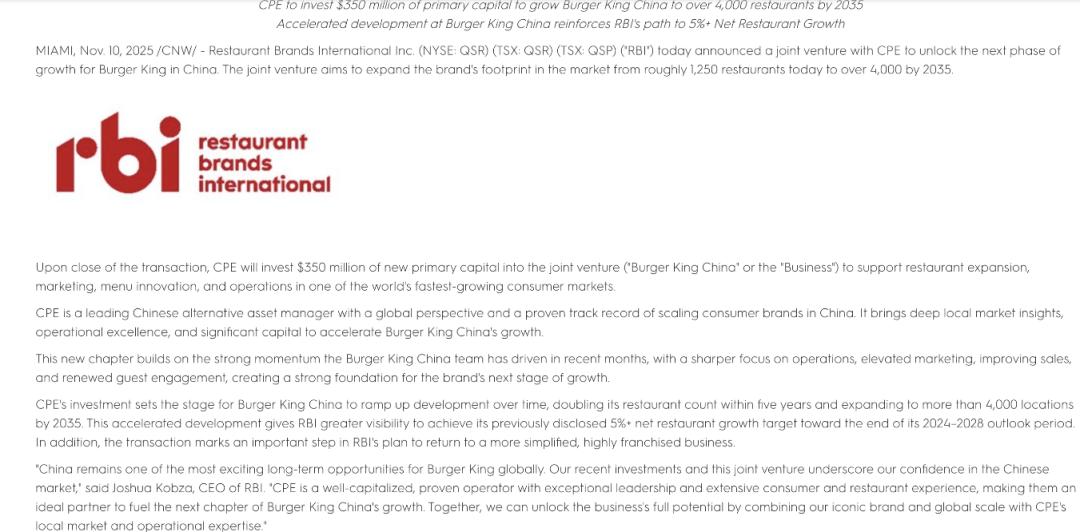
汉堡王中国3.5亿美元易主将扩店超4000家 外资品牌本土化难破双重困境
Chang Jiang Shang Bao· 2025-11-11 23:22
Core Insights - Burger King China has been sold to local private equity firm CPE Yuanfeng, which will hold 83% of the shares, while the original parent company, Restaurant Brands International (RBI), retains 17% [2][4] - CPE Yuanfeng will inject $350 million into Burger King China for store expansion and other initiatives, aiming to increase the number of outlets from approximately 1,250 to over 4,000 by 2035 [2][4][5] - The ownership change is part of a broader trend where foreign brands like Starbucks and Burger King are localizing operations to navigate intense market competition in China [2][6] Company Overview - CPE Yuanfeng, established in 2008, manages over 180 billion RMB in assets and has invested in over 300 companies, focusing on the chain consumer service sector [5] - The new partnership will enable Burger King China to enhance product offerings, marketing strategies, and operational capabilities [5][6] Market Context - Burger King has faced stagnation in store expansion and slowing performance, with a significant drop in market share and competition from local brands like Luckin Coffee [6][12] - The company has struggled to meet its expansion goals, with a net decrease of 224 stores since early 2025 [12][13] - The competitive landscape includes established players like KFC and McDonald's, as well as emerging brands targeting lower-tier cities [13]
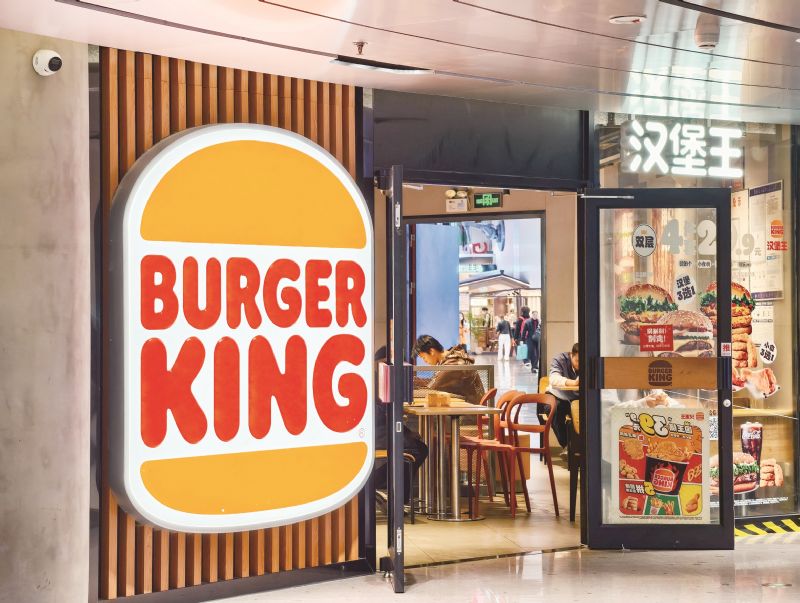
汉堡王中国业务83%股权花落CPE源峰,敲定20年主开发协议,拟注入25亿初始资金
36氪· 2025-11-11 10:23
Core Viewpoint - The article discusses the strategic partnership between CPE Yuanfeng and RBI Group to establish a joint venture for Burger King China, highlighting the investment and growth potential in the Chinese market [4][5][9]. Summary by Sections Transaction Details - CPE Yuanfeng will hold approximately 83% of Burger King China after the transaction, while RBI will retain about 17% [4][5]. - The deal is expected to be completed by the first quarter of 2026, subject to regulatory approval [5]. - CPE Yuanfeng will inject $350 million (approximately 2.5 billion RMB) into Burger King China to support expansion, marketing, menu innovation, and operational improvements [9]. Growth Plans - The plan aims to expand the number of Burger King locations in China from around 1,250 to over 4,000 by 2035, with a focus on sustainable same-store sales growth [10]. - CPE Yuanfeng's investment reflects confidence in Burger King's long-term growth potential in China, a market seen as one of the most attractive for global expansion [11]. Background and Context - Burger King China has faced declining market share and same-store sales, prompting RBI to seek a new local partner after years of management by TFI [18][19]. - The transition to a new operator comes after RBI acquired full ownership of Burger King China from TFI for approximately $158 million [19]. Management and Strategy - The management team of Burger King China has been localized, with new appointments from major players in the industry, enhancing operational capabilities [22]. - CPE Yuanfeng plans to empower Burger King China through product upgrades, brand marketing, store expansion, online channel restructuring, digital system development, and financial optimization [23]. Market Insights - CPE Yuanfeng, with a strong background in consumer investments, aims to leverage local insights and resources to drive growth for Burger King in China [13][14]. - The article emphasizes the importance of local partnerships in the success of international brands in the Chinese market, citing examples of successful expansions by Yum China and McDonald's [16].