
电动垂直起降飞行器(eVTOL)

Search documents
上海发布先进制造业转型升级三年行动方案
Shang Hai Zheng Quan Bao· 2026-02-09 00:14
Core Insights - Shanghai has launched a three-year action plan to support the transformation and upgrading of advanced manufacturing, aiming to add 100 manufacturing enterprises with an annual output value exceeding 1 billion yuan by 2028, totaling over 600 such enterprises [1][5] - The plan includes four major actions and 17 measures to enhance the modern industrial system, focusing on structural optimization, innovation breakthroughs, quality and efficiency improvements, and resource support [1][3] Group 1: Structural Optimization and Upgrading - The action plan outlines three paths for structural optimization: enhancing traditional industries, accelerating strategic leadership in emerging sectors, and promoting the growth of key and emerging industries [2][3] - Specific initiatives include supporting traditional industries like petrochemicals and steel to innovate and expand into new materials, while also fostering advancements in integrated circuits and artificial intelligence [2][3] Group 2: Innovation and Technology - The plan emphasizes the role of enterprises in driving innovation, encouraging increased investment in basic research, and providing financial incentives for high-growth R&D companies [3][4] - It aims to deepen digital transformation through initiatives like "AI + manufacturing," promoting the application of AI technologies in production processes and enhancing the digitalization of manufacturing equipment [3][4] Group 3: Resource and Financial Support - Shanghai will strengthen support for key resources such as talent, space, and funding, optimizing financial services for the manufacturing sector, including lower interest rates and longer loan terms [4][5] - The action plan aims to create a robust ecosystem for manufacturing, addressing individual needs related to talent acquisition, land use, logistics, and energy supply [5][6] Group 4: Long-term Development Goals - By 2025, Shanghai's industrial output value is projected to grow by 5.1%, reaching a historical high of 4.07 trillion yuan, with significant investments in high-end manufacturing [4][5] - The plan sets ambitious targets for the establishment of advanced intelligent factories and green manufacturing enterprises, aiming for substantial growth in emerging industries such as electronic information and smart vehicles [6]
低空经济应用场景广阔 勾勒城市生活新画卷
Zheng Quan Ri Bao· 2026-02-03 16:29
Group 1 - The low-altitude economy is recognized as a key strategic emerging industry globally, with significant attention from local governments and a clear roadmap for development [1][3] - The year 2026 is seen as a critical turning point for the low-altitude economy, transitioning from concept validation to large-scale application [1] - Recent policy changes, including the revised Civil Aviation Law and mandatory standards for drone registration, are set to enhance the safety and order of the drone industry [2] Group 2 - Local governments are actively promoting low-altitude economic initiatives, with cities like Chongqing and Shanghai outlining ambitious development plans [3] - The low-altitude economy is becoming a focal point for commercial validation, with enterprises exploring various sectors from equipment production to infrastructure development [3] - The industry is not only expanding domestically but also making significant strides in international markets, with Chinese eVTOL manufacturers securing large overseas orders [4] Group 3 - The low-altitude economy is contributing to economic growth, with Guangdong's foreign trade showing a 4.4% increase and drone exports growing by 40.9% [4] - The integration of the low-altitude economy with advanced manufacturing, modern services, and agriculture is creating new economic growth points and job opportunities [4] - The establishment of rules and standards for the domestic low-altitude economy is expected to support its healthy development and provide a reference for global industry standardization [4]
低空经济创新发展大会倒计时,产业链面临价值重估
Xuan Gu Bao· 2026-01-13 14:40
Industry Insights - The second China eVTOL Innovation Development Conference will be held in Shanghai from January 15 to 16, 2026, focusing on breakthroughs in eVTOL technology and commercialization [1] - The revised Civil Aviation Law promotes the construction of a general aviation infrastructure network and low-altitude flight regulatory service platform, which is expected to alleviate the current bottlenecks in physical and digital infrastructure in China [1] - Encouragement of application expansion and cultivation of emerging markets is anticipated to stimulate the vitality of diverse market entities in the low-altitude economy, laying the foundation for sustainable business models [1] - Continuous refinement of supportive policies and the extension of application scenarios are expected to lead to a revaluation of the low-altitude economy industry chain [1] Company Developments - Shangong Shenbei holds equity in Shanghai Feiren Technology, which focuses on the research and development of carbon fiber lightweight aircraft [2] - Zongheng Co., Ltd. is creating low-altitude digital economy application scenarios in multiple locations [3]


多地部署支持发展先进制造业 地方版方案陆续出炉
Zheng Quan Ri Bao· 2026-01-12 00:11
Core Viewpoint - The Shanghai Municipal Government has released the "Three-Year Action Plan for Supporting the Transformation and Upgrading of Advanced Manufacturing (2026-2028)", aiming to accelerate the establishment of a modern industrial system centered on advanced manufacturing [1] Group 1: Policy Initiatives - Various regions, including Shanghai and Guangzhou, are actively implementing policies to support the development of advanced manufacturing and emerging industries [1][2] - The "Action Plan" aims to add over 100 manufacturing enterprises with an annual output value exceeding 1 billion yuan by 2028, totaling over 600, and to drive the addition of 500 industrial enterprises above designated size [2] - Guangzhou's "Planning" targets significant progress in building a strong advanced manufacturing city by 2030, with a new economic structure supported by trillion-yuan industries [2] - Hangzhou's "Action Plan" sets a goal for industrial added value to reach 530 billion yuan by 2027, with an average annual growth rate of over 6% [2] Group 2: Focus on Emerging Industries - The "Action Plan" emphasizes investment in emerging fields such as low-altitude economy, commercial aerospace, humanoid robots, and biomanufacturing [3] - Guangzhou's "Planning" identifies five strategic leading industries, including artificial intelligence and new energy storage [3] - Experts suggest that local investments in emerging industries will foster industrial cluster development and enhance the overall industrial chain [3] Group 3: Financial and Support Mechanisms - To support advanced manufacturing, regions are enhancing financial support and accelerating the cultivation of relevant scenarios [4] - The "Action Plan" proposes lower interest rates and longer loan terms for manufacturing loans, with interest subsidies ranging from 0.8% to 1.3% for key components and raw materials [4] - Shenzhen's new measures encourage foreign investment in advanced manufacturing sectors, aiming to strengthen key industry chains [4] Group 4: Recommendations for Future Development - Experts recommend strengthening scenario-driven approaches and optimizing financial supply to support advanced manufacturing [5] - There is a call for a comprehensive support system that includes innovation leadership, policy coordination, and scene empowerment [5] - Encouraging continuous R&D investment and breaking through key technology bottlenecks are essential for high-quality development in advanced manufacturing [5]
A股晚间热点 | 国常会部署!实施财政金融协同促内需一揽子政策
智通财经网· 2026-01-09 15:29
Group 1: Government Policies and Economic Measures - The State Council, led by Premier Li Qiang, has announced a package of fiscal and financial policies aimed at boosting domestic demand, emphasizing the importance of coordinating fiscal and monetary policies to enhance their effectiveness and encourage social capital participation in consumption and investment [1] - The Ministry of Finance and the State Taxation Administration will cancel the VAT export tax rebate for photovoltaic products starting April 1, 2026, and will reduce the VAT export tax rebate rate for battery products from 9% to 6% during 2026, before completely eliminating it in 2027 [2] Group 2: Employment and Economic Indicators - In December, the U.S. non-farm payrolls increased by 50,000, falling short of the expected 70,000, while the unemployment rate decreased to 4.4%, better than the anticipated 4.5% [3] - Traders are betting that the Federal Reserve will pause interest rate cuts, with expectations of a cumulative reduction of about 50 basis points by 2026 [3] Group 3: Industry Investigations and Developments - The State Council's Anti-Monopoly and Anti-Unfair Competition Committee is conducting an investigation into the competitive landscape of the food delivery platform industry, addressing issues such as excessive subsidies and price competition that are impacting the real economy [4] - Shanghai has launched a three-year action plan to support the transformation and upgrading of advanced manufacturing, focusing on emerging sectors like low-altitude economy and humanoid robots [5] Group 4: Market Trends and Investment Opportunities - The price of rare earth concentrates has been raised for the sixth consecutive quarter, with Baotou Steel and Northern Rare Earth announcing price adjustments for the first quarter of 2026 [6] - Elon Musk's xAI plans to invest over $20 billion in building a data center in Mississippi to meet the rising demand for computing power driven by generative AI [10] - The AI sector is seeing significant investment opportunities, particularly in chip design and manufacturing, with companies like Cambrian, Haiguang Information, and SMIC being highlighted for their potential [10] Group 5: Corporate Announcements and Financial Performance - China Merchants Bank announced a cash dividend distribution of approximately 25.55 billion yuan for the first half of 2025 [12] - Luzhou Laojiao plans to distribute around 2 billion yuan in dividends for the mid-2025 period [12] - Several companies, including Jian Kai Technology and Huati Technology, are facing shareholder reductions, while others like Zhongchuan Defense and Greenland Holdings are projecting significant losses for 2025 [17]


通用航空ETF南方(159283.SZ)涨4.55%,航天电子涨9.09%
Jin Rong Jie· 2026-01-09 03:28
Group 1 - The A-share market experienced narrow fluctuations on January 9, with the defense, media, and low-altitude economy sectors showing significant gains. The Southern General Aviation ETF rose by 4.55%, and Aerospace Electronics increased by 9.09% [1] - According to Guosen Securities, China's general aviation sector is currently benefiting from a triple driving effect of policy support, technological advancements, and growing market demand. The elevation of low-altitude economy to a national strategic level has led to reforms in airspace management and infrastructure development [1] - Domestic companies are actively participating in complete aircraft manufacturing through international mergers and acquisitions, achieving global leadership in areas such as drone and electric vertical takeoff and landing (eVTOL) aircraft certification [1] Group 2 - Global Market Insights predicts that the global general aviation market will reach USD 40.2 billion by 2029, with a compound annual growth rate (CAGR) of 4.72% during this period [2] - In China, general aviation shows significant potential in infrastructure development, fleet expansion, and application structure optimization, particularly in high-value segments like short-distance transport and business charter services [2] - As new aircraft technologies mature, costs related to purchasing, energy consumption, personnel, and operational maintenance are expected to decrease, improving the commercial economic benefits of low-altitude operations and leading to a development model that prioritizes cargo over passengers, independence before integration, and suburban areas before urban centers [2]

36氪研究院 | “十五五”时期重点产业前瞻与发展路径研究
3 6 Ke· 2025-12-29 23:32
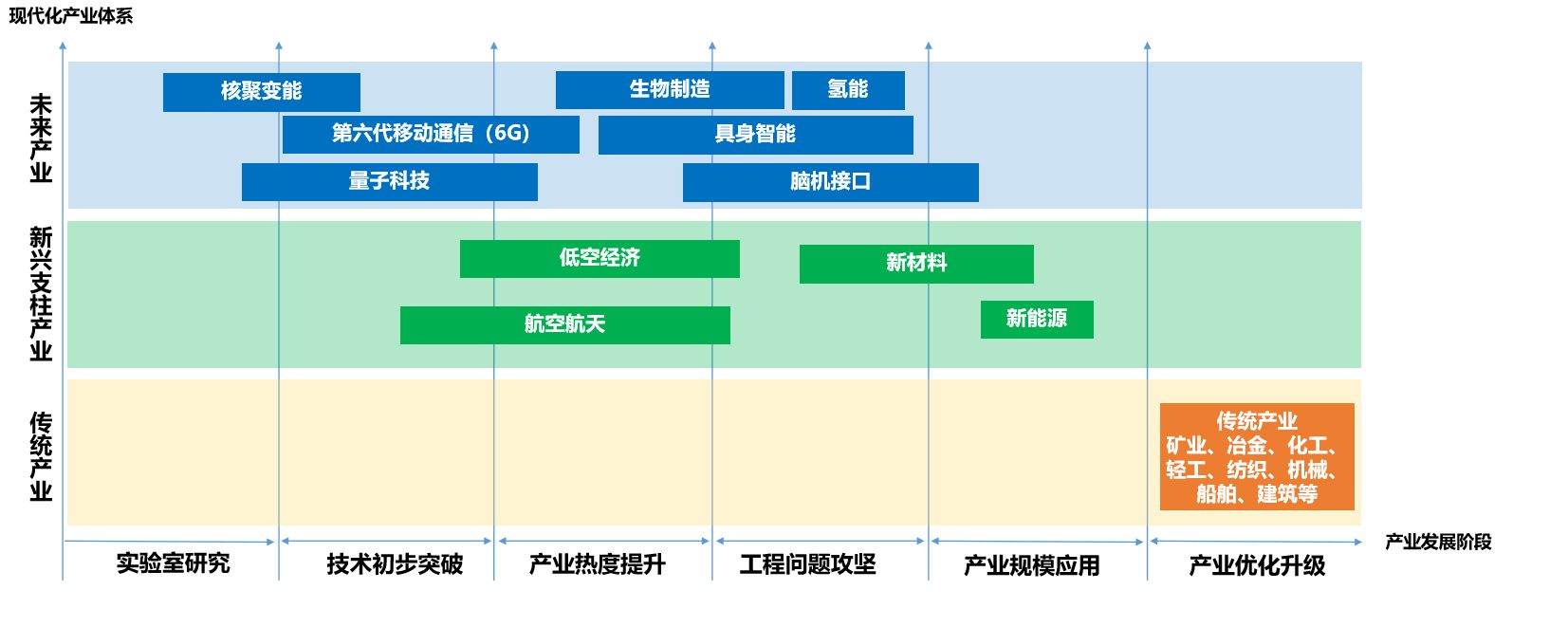
Core Insights - The "14th Five-Year Plan" emphasizes the construction of a modern industrial system as a primary strategic task, marking a shift from isolated technological breakthroughs to systematic industrial upgrades [4][10] - The new energy industry is transitioning from focusing on installed capacity to establishing a "source-network-load-storage" collaborative system, emphasizing dynamic balance between production and consumption [4][18] - The aerospace sector is developing a dual-driven model of national engineering and commercial spaceflight, with large aircraft industrialization and commercial spaceflight jointly promoting the scale and capability of the industrial chain [4][35] - Future industries such as 6G and quantum technology place China in the global leading tier of R&D, aiming to seize the high ground in technology standards and industrial ecosystems through forward-looking layouts [4][61] - The transformation of traditional industries emphasizes not only greening and intelligentization but also explicitly promotes "service-oriented manufacturing," guiding the manufacturing sector to extend services throughout the product lifecycle [4][93] Emerging Pillar Industries - The cultivation of emerging pillar industries is positioned as a core strategy for high-quality development, with a focus on sectors like aerospace and low-altitude economy that have industrialization foundations [14][35] - The new energy sector is expected to maintain a leading global position, with installed capacity projected to reach 1.41 billion kilowatts by the end of 2024, accounting for 83% of new installations [18][20] - The new materials industry is rapidly growing, with a total output value expected to exceed 8 trillion yuan by 2024, although about 30% of key high-end materials still rely on imports [29][30] Future Industries - Future industries represent cutting-edge directions, with a focus on quantum technology, biomanufacturing, hydrogen energy, brain-computer interfaces, and embodied intelligence [61][62] - The quantum technology sector is expected to grow significantly, with the global market projected to reach nearly 1 trillion USD by 2035, driven by advancements in quantum communication and measurement [64][66] - The biomanufacturing industry is anticipated to maintain rapid growth, with a total scale of approximately 1.1 trillion yuan, although it faces challenges in high-end industrial strains and precision technology [69][70] Traditional Industries - The modernization of traditional industries is crucial for maintaining competitiveness in global industrial division, with a focus on enhancing the self-controllability of industrial chains [93][94] - The transformation of traditional industries includes promoting digitalization and green initiatives, as well as extending manufacturing into service-oriented solutions [93][94] - The integration of emerging technologies into traditional industries is expected to create a resilient modern industrial system, laying a decisive foundation for achieving the goal of becoming a manufacturing powerhouse by 2035 [96]
事关无人机!强制性国家标准发布,产业链投资机会获关注(附概念股)
Zhi Tong Cai Jing· 2025-12-23 00:45
Group 1 - The core viewpoint of the news is the introduction of mandatory national standards for civil unmanned aerial vehicles (UAVs) in China, which will enhance the safety and orderly development of the industry, effective from May 1, 2026 [1] - The standards include requirements for real-name registration and activation of UAVs, detailing the relationship, processes, and technical requirements among various systems involved in registration and activation [1] - The operational identification standard mandates UAV systems to actively report their identity, location, speed, and status throughout their operation, providing unified technical standards for design, production, and testing [1] Group 2 - The drone industry is reshaping the engineering operation and maintenance service ecosystem in China's infrastructure market, addressing challenges in high-risk inspections and supporting intelligent monitoring of energy pipelines [2] - The low-altitude economy, which includes UAVs and eVTOLs, is projected to grow at a compound annual growth rate of over 25%, potentially reaching a market size of 1.5 trillion yuan by 2025 and 3.5 trillion yuan by 2035 [2] - As of now, 969 companies have registered in the civil UAV product information system, with 3,191 products and over 478,000 UAVs, indicating a robust growth trajectory in the sector [2] Group 3 - Recent policies have been introduced to accelerate the development of the low-altitude economy, with the Shenzhen Low Altitude Economy Industry Association releasing standards for low-altitude communication networks and UAV traffic management [3] - The national strategy emphasizes the low-altitude economy as a key area for development, with various local governments issuing policies to support its growth [3] - The market for low-altitude logistics and tourism applications is emerging, with leading eVTOL manufacturers receiving orders and expanding internationally [3] Group 4 - The low-altitude economy market in China has been growing steadily, with a goal to achieve a trillion-yuan market size by 2030, focusing on enhancing general aviation equipment supply capabilities and industry innovation [4] - The development of the low-altitude economy is expected to drive growth in related infrastructure, including satellite and air traffic management systems [4] Group 5 - Companies involved in the low-altitude economy include AVIC (中航科工), which is a leading player in aviation technology and services [6] - ZTE Corporation (中兴通讯) is advancing its 5G-A sensing system for low-altitude applications, indicating a push towards integrating technology in this sector [6] - XPeng Motors (小鹏汽车) has launched a low-altitude flight camp and plans to establish a flying car store, marking a significant step in the practical application of low-altitude economy technologies [6] - GAC Group (广汽集团) successfully completed the first flight of its composite wing flying car, showcasing advancements in urban air mobility technology [7]
事关无人机!强制性国家标准发布 产业链投资机会获关注(附概念股)
Zhi Tong Cai Jing· 2025-12-22 23:31
Group 1: Regulatory Developments - The Civil Aviation Administration of China has released two mandatory national standards for civil unmanned aerial vehicles (UAVs), effective from May 1, 2026, aimed at promoting a safer and more orderly industry development [1] - The standards include requirements for real-name registration and activation of UAVs, detailing the relationship, processes, and technical requirements for various systems involved in registration and activation [1] - The operational identification standard mandates UAV systems to actively report their identity, location, speed, and status throughout their operation, providing unified technical standards for design, production, and testing [1] Group 2: Market Opportunities - The drone industry is reshaping engineering operation and maintenance services in China's infrastructure sector, addressing challenges in high-risk inspections and supporting intelligent monitoring of energy pipelines and telecom base stations [2] - The low-altitude economy, encompassing UAVs and eVTOLs, is a significant area of growth, with 969 companies registered and over 478,000 UAVs documented in China [2] - The low-altitude economy is projected to grow at a compound annual growth rate of over 25%, potentially reaching a market size of 1.5 trillion yuan by 2025 and 3.5 trillion yuan by 2035 [3] Group 3: Policy Support and Industry Growth - Recent policies have intensified focus on the low-altitude economy, with local governments releasing standards for low-altitude communication networks and UAV traffic management [3] - The national "14th Five-Year Plan" emphasizes the development of the aerospace and low-altitude economy sectors, with state-owned enterprises establishing low-altitude economic companies [4] - The market for low-altitude economy is expected to reach a trillion yuan by 2030, with significant investments in infrastructure and technology to support this growth [4] Group 4: Key Players and Innovations - AVIC (Aviation Industry Corporation of China) is a leading player in the aerospace sector, involved in various UAV and aviation-related businesses [6] - ZTE Corporation is advancing its low-altitude sensing technology and has completed pilot projects for 5G-A sensing systems [6] - XPeng Motors has launched a low-altitude flight camp and plans to establish a flying car store, marking a significant step in the practical application of low-altitude economy technologies [6] - GAC Group's GOVY AirJet, a composite wing flying car, has successfully completed its first flight, showcasing advanced technology and performance [7]



跨界融合激活创新动能“飞”出发展新空间 低空经济从概念蓝图迈向体系落地
Yang Shi Wang· 2025-11-04 09:24
Core Viewpoint - The 20th Central Committee's Fourth Plenary Session emphasizes the acceleration of building a modern industrial system, focusing on nurturing strategic emerging industries and developing new production capabilities, with low-altitude economy being a key area of development [1] Group 1: Low-altitude Economy Development - The low-altitude economy is rapidly integrating into various production and life scenarios, expanding its application from urban governance to logistics, emergency rescue, and maritime inspection [14][18] - Guangdong has opened over 700 drone logistics routes, covering multiple sectors such as agricultural protection, marine inspection, security monitoring, and medical emergency [18] - The low-altitude economy in Guangdong has reached a scale of over 100 billion, with more than 2,000 drone manufacturing companies and over 15,000 related enterprises, accounting for over 30% of the national low-altitude economic industry chain [31] Group 2: Technological Innovations and Applications - Innovations in low-altitude applications are accelerating, with drone logistics routes being utilized for efficient delivery, such as packages flying directly from factory rooftops to customs supervision areas [16] - The integration of electric vertical takeoff and landing (eVTOL) aircraft into the market is progressing, with companies like EHang and Huitian Aerospace establishing production bases for eVTOLs [20] - The development of low-altitude applications is benefiting from the complete industrial chain in Guangdong, with technologies from the electric vehicle sector being transferred to low-altitude aircraft [29] Group 3: Safety and Governance - The "14th Five-Year Plan" highlights the importance of safety and governance capabilities for sustainable industry development, prompting Guangdong to build a comprehensive low-altitude flight protection system [32] - The province is enhancing its airspace management mechanisms to ensure safe and orderly low-altitude operations, with ongoing tests for new drone routes [36] - A low-altitude flight comprehensive management service platform is being developed to monitor the status of flying vehicles and streamline airspace approval processes [41]
