番茄音乐

Search documents
中金 | 在线音乐跟踪观察:持续关注竞争与AI影响,静待估值修复
中金点睛· 2026-03-26 23:40
Core Viewpoint - The music sector has undergone a significant valuation adjustment since the second half of 2025, with market concerns focusing on the long-term growth potential of subscription services, competition from AI-generated music, and the impact of AIGC on the value of original content and platforms [1][5]. Group 1: Competition Landscape - The recent growth in MAU (Monthly Active Users) for platforms like Soda Music and Tomato Music indicates a shift in user engagement, driven by AI-generated music and the ecosystem of Douyin [6]. - The focus of competition has shifted from merely subscription numbers to the overall value users derive from the music ecosystem, emphasizing long-term user value [6]. - User segmentation is becoming more pronounced, with Soda Music attracting price-sensitive, light users, which minimally impacts the core paid user base of Tencent Music and NetEase Cloud Music [6]. Group 2: Impact of AI - Concerns about AI disrupting the music industry are becoming more rational, with a focus on copyright standardization and the reassessment of the value of original content [7][8]. - The music industry is expected to transition from scale expansion to value extraction, with leading platforms adopting differentiated strategies based on their business stages [7][8]. Group 3: Industry Valuation Recovery - Key catalysts for industry valuation recovery include stabilization of MAU growth for free music platforms, deepening copyright governance, standardization of AI technology, and a calming of pessimistic expectations both domestically and internationally [2][8].



腾讯音乐2025年Q3业绩超预期,AI与竞争格局引关注
Jing Ji Guan Cha Wang· 2026-02-11 22:41
Core Insights - Tencent Music Entertainment Group (TME) demonstrates robust financial performance and deepens strategic layout while facing new market competition and technological challenges [1] Financial Performance - In Q3 2025, Tencent Music reported total revenue of 8.46 billion yuan, a year-on-year increase of 20.6%, with adjusted net profit rising 27.7% to 2.48 billion yuan [2] - Online music service revenue grew by 27.2%, with the number of paying users increasing by 1.3 million quarter-on-quarter to 126 million [2] - Non-subscription revenue surged by 50.3%, becoming a highlight of growth [2] - Institutions expect continued growth in Non-IFRS net profit for 2025 and 2026, with an optimistic outlook on gross margin trends [2] Industry and Risk Analysis - ByteDance's "Tomato Music" is rapidly increasing its monthly active users, complementing "Soda Music," which may intensify competition in the music streaming market [3] - Companies like Kunlun Wanwei (300418) are adopting free strategies in the AI music sector to expand their market presence, circumventing domestic copyright barriers, posing long-term challenges to the industry landscape [3] - Tencent Music is also investing in AI to enhance its services [3] Strategic Advancement - The company adheres to a "one body, two wings" strategy, deepening collaborations with global record companies and expanding its own IP matrix while making long-term investments in offline performances [4] - Tencent Music has partnered with Billboard data provider Luminate to incorporate Chinese music consumption data into international ranking systems, aiming to enhance its global content influence [4] Industry Status - The rapid growth of paid users in music live streaming indicates a shift towards professionalization and interactivity in the industry, which may indirectly affect Tencent Music's competitive strategy in social entertainment [5]
狂揽1.4亿月活,汽水音乐凭免费逆袭腾讯网易?
3 6 Ke· 2026-01-27 00:28
Core Insights - ByteDance's AI product Doubao has surpassed 100 million daily active users, becoming the first AI application in China to achieve this milestone [1] - The music app Soda Music has reached nearly 140 million monthly active users, ranking fourth in the industry, driven by ByteDance's traffic ecosystem [1][3] - Soda Music's user growth is significant, with a year-on-year increase of 90.7% in September 2025, while other platforms are experiencing user declines or minimal growth [2][3] Group 1: User Growth and Market Position - Soda Music's monthly active users increased from over 70 million to 130 million in one year, and then to nearly 140 million in just one month [2] - The app has become the third in daily active users, surpassing NetEase Cloud Music [3] - 82.1% of Soda Music's users in June 2025 came from Douyin, highlighting the importance of Douyin as a traffic source [3] Group 2: Business Model and User Demographics - Soda Music employs a free model that attracts a broad user base, allowing users to listen for free by watching ads, similar to the model used by the successful product Hongguo [3][4] - The app targets younger users aged 18-30, while another app, Tomato Music, focuses on older demographics, indicating a strategy to cover a wide age range [6][7] - Soda Music's user base is primarily composed of users from lower-tier cities, with over 50% of users being from third-tier cities and below [7] Group 3: Competitive Landscape and Industry Challenges - Despite rapid growth, Soda Music's library of 50 million songs is significantly smaller than Tencent Music's 260 million songs, which includes exclusive rights to many top artists [8] - Industry experts believe that while Soda Music could reach 200 million monthly active users, it is unlikely to surpass Tencent Music or NetEase Cloud Music in market dominance [8][9] - The music industry is facing challenges with declining revenues for artists and increasing promotional costs, which may impact the long-term sustainability of platforms like Soda Music [10]

腾讯音乐“守城”,汽水音乐“改道”
3 6 Ke· 2026-01-21 12:18
Core Viewpoint - Tencent Music has successfully established itself in the fan economy within a sentiment-driven market, leading to a positive outlook from analysts and a significant increase in stock value following its recent financial report [1][2]. Financial Performance - Tencent Music's revenue grew from 254.3 billion to 312.4 billion from 2019 to 2021, but fell to 283.4 billion in 2022 due to structural adjustments, maintaining around 280 billion since then [2]. - As of Q3 2025, Tencent Music's cumulative revenue reached 265.7 billion with a net profit of 96.97 billion, marking a peak in net profit [2]. - The stock price surged over 17% to a historical high of 102.10 HKD per share, with a total market capitalization of 316.3 billion HKD following the Q2 2025 financial report [1]. Market Position - Tencent Music holds approximately 69% market share in China's online music sector, significantly ahead of its closest competitor, NetEase Cloud Music, which has about 19% [9]. - The company has integrated various platforms like QQ Music, Kugou, and Kuwo to create a complementary business ecosystem, solidifying its leadership in the online music market [5]. Revenue Streams and Growth Potential - Tencent Music's online music service revenue reached 69.7 billion, a 27.2% increase year-on-year, with subscription revenue at 45 billion, up 17.2% [5][6]. - The company is exploring new revenue sources through online and offline events, merchandise, and collaborations with major entertainment companies [1][6]. Fan Economy and User Engagement - Tencent Music has developed a robust fan economy, enhancing user engagement through features like digital albums and exclusive content for higher-tier subscriptions [6][7]. - The introduction of SVIP services has increased user willingness to pay, reflected in a rise in average revenue per paying user (ARPPU) to 11.9 yuan [7]. Competitive Landscape - The online music market is transitioning from growth to competition for existing users, with Tencent Music and NetEase Cloud Music being the primary competitors [9][10]. - New entrants like ByteDance's Soda Music are disrupting the market, leveraging algorithmic recommendations and the vast user base of Douyin (TikTok) to attract users [11][13]. Strategic Initiatives - Tencent Music is focusing on expanding its content library and enhancing user experience through collaborations with major music labels and artists [5][6]. - The company is also diversifying its offerings by integrating music with gaming and film, creating a comprehensive ecosystem that extends beyond traditional music consumption [6][8]. Future Outlook - Analysts remain optimistic about Tencent Music's long-term value, with expectations for continued growth in both subscription and non-subscription revenue streams [1][8]. - The competitive landscape is evolving, with a need for Tencent Music to innovate and adapt to maintain its market leadership amid rising competition from new platforms [17][18].

用抖音“喂”出1.2亿用户 字节跳动的音乐阳谋
Bei Jing Shang Bao· 2025-12-30 08:32
Core Insights - The article discusses the rapid growth of "Soda Music," a music app developed by ByteDance, which has reached 120 million monthly active users, closely approaching NetEase Cloud Music's 147 million users [1][6] - Soda Music serves as a music library for various content platforms like Douyin and aims to redefine how users discover songs, rather than competing directly with established music platforms [1][3] - The app's growth is heavily reliant on Douyin's traffic and algorithm support, but it faces challenges in monetization and sustaining user engagement in the long term [1][10] User Engagement and Growth - Soda Music's user acquisition is primarily driven by its integration with Douyin, where users can easily access the app while browsing [1][6] - The app has a high user retention rate, with 82.1% of its monthly active users coming from Douyin [6] - Users appreciate the app's free membership model, which allows them to access music by watching ads, making it a cost-effective alternative to other music services [7][9] Market Position and Strategy - The app was launched in June 2022, initially functioning as a music collection tool for Douyin users, but has since evolved to include a diverse music library [3][9] - Soda Music's catalog includes popular Douyin songs, various covers, classic tracks, and original works, including AI-generated music [9] - The app's strategy includes leveraging AI to enhance user experience and engagement, with plans to establish an "AI Music Creation Lab" to support creators [9][10] Monetization Challenges - Despite its rapid user growth, Soda Music's "free + low-cost" model raises concerns about its ability to cover rising copyright and operational costs [10][17] - The app aims to replicate Douyin's successful user acquisition strategy but faces difficulties in establishing a stable revenue model through advertising and subscription services [10][15] - Industry experts suggest that Soda Music may struggle to attract core music users due to its limited copyright content, positioning it more as a supplementary service within ByteDance's broader entertainment ecosystem [17][18] Competitive Landscape - The competitive dynamics of the online music platform market remain largely unchanged, with no significant evidence that ByteDance is prioritizing Soda Music over other ventures [17] - The introduction of "Tomato Music," another free music app by ByteDance, indicates that the company is exploring multiple avenues in the music space [18]
这音乐App月活直逼网易云,1.2亿用户是用抖音“喂”出来的?能赚到钱吗
Bei Jing Shang Bao· 2025-12-30 06:52
Core Insights - Soda Music has rapidly grown to 120 million monthly active users, closely approaching NetEase Cloud Music's 147 million, largely due to its integration with Douyin's traffic and resources [2][8] - The platform serves as a copyright music library for content platforms like Douyin, Jianying, and Xigua Video, positioning itself as a disruptor in the music market [2][5] - Despite its growth, Soda Music faces challenges in monetization, as its user acquisition strategy relies heavily on a free model, raising questions about long-term profitability [12][16] User Engagement and Growth - Soda Music's user base is significantly driven by Douyin, with 82.1% of its users coming from the platform [8] - The app's initial appeal was as a "music collection" tool for Douyin users, with a high percentage of trending songs being popular Douyin tracks [6][11] - Users appreciate the platform's free membership model, which allows them to access music without traditional subscription fees [9][11] Market Position and Strategy - The platform's music library includes a mix of Douyin hits, popular covers, classic tracks, and original works, including AI-generated music [11] - Soda Music's strategy involves leveraging AI to attract users, with a focus on creating a comprehensive ecosystem for music creation and monetization [11][12] - The platform's growth has raised concerns about its ability to sustain profitability given the high costs associated with copyright and operations [12][15] Competitive Landscape - The music industry is characterized by a strong head effect, making it difficult for new entrants like Soda Music to establish a stable commercial model [12][15] - Analysts suggest that Soda Music may struggle to attract core music users due to its reliance on a free model, which could undermine its competitive advantage [15][16] - The introduction of new music apps by ByteDance, such as Tomato Music, indicates a broader strategy to capture the music market, but also highlights the competitive pressures Soda Music faces [16]
抖音跑出一个新王炸
投资界· 2025-12-01 11:26
Core Viewpoint - The article discusses the rapid rise of Soda Music, a new player in the mobile music app industry, which has quickly gained a significant user base despite lacking exclusive rights to popular artists and a distinct artistic style [3][4]. Group 1: Market Position and User Growth - Soda Music has reached 120 million monthly active users by September 2025, marking a 90.7% year-on-year growth, surpassing KuGou Music and approaching NetEase Cloud Music's 147 million users [4]. - The app has positioned itself as a top competitor in the market, ranking among the top four music apps in terms of monthly active users [3]. Group 2: Unique Features and User Engagement - Soda Music employs a "brushing music" interface, allowing users to switch songs easily, similar to the experience on Douyin (TikTok), which enhances user engagement [6]. - The app integrates Douyin's long video content, allowing users to access a variety of media, including talk shows and educational videos, directly within the music app [6][8]. - Users have reported that Soda Music's recommendations are highly accurate, often feeling that the app understands their preferences better than they do [8][9]. Group 3: Monetization Strategy - Unlike competitors, Soda Music offers a completely free listening experience by allowing users to watch ads for access to the full music library, appealing to price-sensitive consumers [11][13]. - The app's subscription prices are lower than those of QQ Music, KuGou Music, and NetEase Cloud Music, making it an attractive option for users [11]. Group 4: Copyright Challenges and Strategies - Soda Music faces challenges regarding music copyright, as it lacks the exclusive rights that competitors like Tencent Music have secured [14]. - The app has focused on expanding its mainstream music rights and leveraging Douyin's ecosystem to create its own content sources [15][17]. Group 5: User Demographics and Market Impact - Soda Music attracts a different user demographic compared to its competitors, with a significant portion of its users coming from lower-tier cities and a higher male-to-female ratio [18][19]. - The app's growth has had a notable impact on KuGou Music, which has seen a decline in active users, indicating Soda Music's disruptive presence in the market [22]. Group 6: Douyin's Strategic Intent - Douyin's motivation for developing Soda Music is to capture the value generated by popular songs that originate on its platform, ensuring that it benefits directly from the music consumption that follows [25][26]. - The establishment of a complete music ecosystem, from creation to distribution, is part of Douyin's strategy to enhance user engagement and retention [26][28].

腾讯音乐今年三季度收入同比增两成,高管回应国内市场竞争
Bei Ke Cai Jing· 2025-11-13 00:41
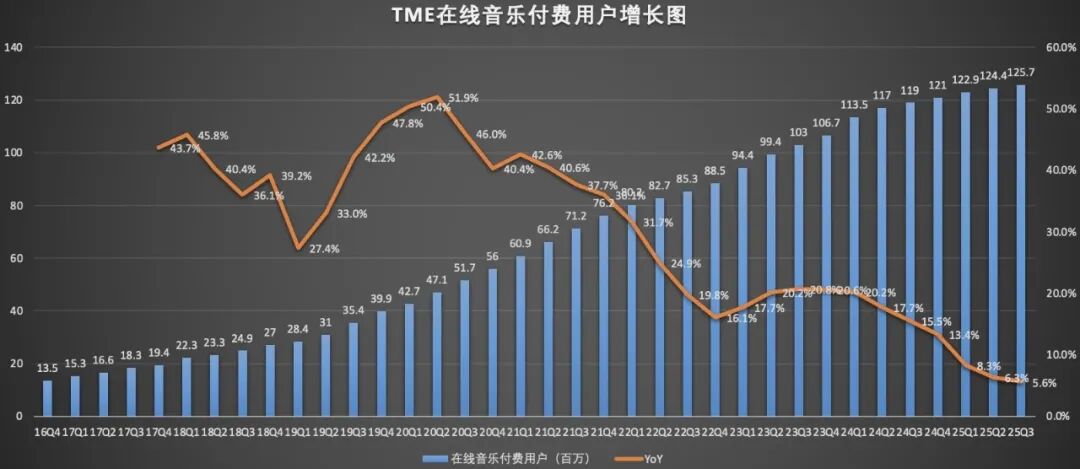
Core Insights - Tencent Music Entertainment Group reported Q3 2025 financial results, showing total revenue of 8.46 billion yuan, a year-on-year increase of 20.6%, and a net profit of 2.21 billion yuan, with profit attributable to equity holders at 2.15 billion yuan [1] Revenue Breakdown - Online music service revenue grew by 27.2% to 6.97 billion yuan, while social entertainment and other services revenue decreased by 2.7% to 1.49 billion yuan [2] User Metrics - The number of paying users for online music services reached 125.7 million, a year-on-year increase of 5.6%, and the ARPPU (Average Revenue Per Paying User) was 11.9 yuan, up 10.2% [3] Competitive Landscape - The report marks the first full financial quarter for Tencent Music following the acquisition of Ximalaya. However, the impact of Ximalaya on user subscriptions and long audio services has yet to be reflected in the data. Monthly active users for online music services decreased to 551 million year-on-year [4] Market Competition - ByteDance's music products are intensifying competition in the domestic online music market. Despite Tencent's music apps leading in monthly active users, ByteDance's products are showing significant growth rates, with some reaching over 90% year-on-year [5] Strategic Responses - Tencent Music's executives acknowledged the competitive pressure, emphasizing that music is a traditional business where library advantages and user asset accumulation remain core strengths. The company is expanding its offerings with services like Starlight Card and Bubble, which are not available from competitors [5] Growth Drivers - Beyond traditional music content subscriptions, Tencent Music is focusing on content derivatives and user rights operations as growth drivers. The company plans to increase investments in live performances and proprietary events to differentiate itself in the market [6] Cost Trends - Tencent Music's operating costs have returned to positive growth, with costs reported at 4.11 billion yuan, 4.69 billion yuan, and 4.78 billion yuan for the first three quarters, reflecting year-on-year increases of 2.9%, 13.1%, and 18.8% respectively [6]
净赚超90亿,“情绪经济”造富腾讯音乐
3 6 Ke· 2025-11-12 23:51
Core Insights - The essence of consumption in China is shifting from functional satisfaction to the pursuit of meaning, leading to the rise of the "emotional economy" [1] - Tencent Music Entertainment Group (TME) is a successful case benefiting from this emotional consumption trend, leveraging fan economy to establish a clear commercialization path [1] Financial Performance - In Q3 2025, Tencent Music reported revenue of 8.46 billion yuan, a year-on-year increase of 20.6% [2] - The net profit for Q3 reached 2.48 billion yuan, up 27.7% year-on-year [2] - For the first three quarters of 2025, total revenue was 24.26 billion yuan, a 15.8% increase, with net profit soaring to 9.07 billion yuan, an 80% rise from 5.03 billion yuan in the same period last year [2] - Online music service revenue for Q3 was 6.97 billion yuan, growing 27.2% and accounting for 82.3% of total revenue [2] User Growth and Monetization - The number of paid users increased to 12.57 million, a growth of 5.6% year-on-year [2] - Average revenue per paying user (ARPPU) rose from 10.8 yuan to 11.9 yuan, reflecting a 10.2% increase [4] Competitive Positioning - TME's gross margin stood at 43.5%, outperforming Spotify by 12 percentage points, while its operating margin was 32%, compared to Spotify's 13.6% [6] - TME's strategic transformation has successfully linked music consumption with fan economy, enhancing user engagement and monetization [6] Strategic Initiatives - TME's acquisition of nearly 10% stake in SM Entertainment and its purchase of Ximalaya are aimed at expanding audio content and refining fan economy operations [7] - The company is enhancing user retention and payment rates through a free ad-supported model for users with low willingness to pay [7] Competitive Landscape - Despite TME's leading position, competitors like NetEase Cloud Music and ByteDance's Soda Music are emerging threats [8] - NetEase Cloud Music has a unique UGC community and independent musician ecosystem, while Soda Music has rapidly increased its user base, reaching 18 million daily active users by mid-2024 [10][11] - The competition is evolving from user growth to value extraction, with a focus on ecosystem integration and content expansion [11] Future Outlook - The online music industry is established but requires continuous evolution beyond being a simple music player [12] - Future winners will be those who can effectively manage technology, content, and user engagement [12]
字节发力,腾讯音乐还能“小而美”吗?
3 6 Ke· 2025-11-12 23:17
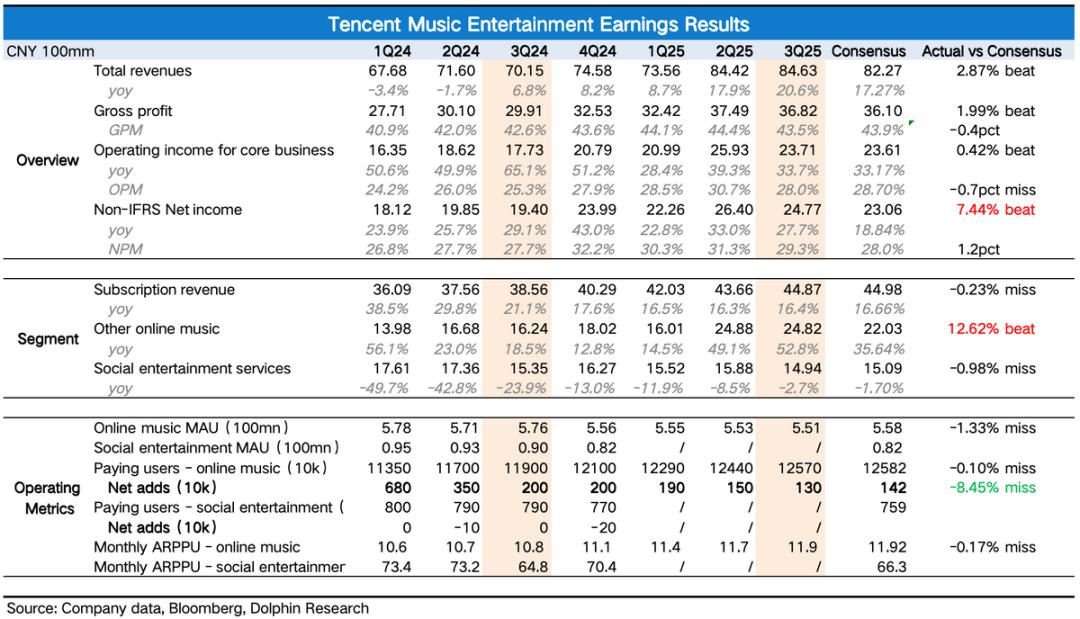
Core Viewpoint - Tencent Music's Q3 2025 earnings report exceeded expectations, showcasing the initial development of its second growth curve, despite ongoing challenges in subscription growth due to intensified competition [1][2]. Financial Performance - Subscription revenue grew by 16% in Q3, with a net increase of 1.3 million subscribers, and an average revenue per paying user (ARPPU) of 11.9 CNY/month, indicating a shift from volume-driven growth to price-driven growth [2][22]. - Other music revenue surged by 53% in Q3, primarily from live concert ticket sales and related merchandise, highlighting Tencent Music's strategy to expand its value chain [2][27]. - Total revenues reached 84.63 billion CNY, beating consensus estimates by 2.87% [5]. User Metrics - Monthly active users (MAU) decreased by 2 million to 551 million, while paying users for online music reached 12.6 million, with a payment rate of 22.8% [16][22]. - The competitive landscape is shifting, with rival platforms like "Soda Music" gaining traction, which may impact Tencent Music's user retention and growth [11][12]. Profitability - Operating income for the core business was 23.71 billion CNY, reflecting a year-on-year growth of 33.7%, although the operating profit margin decreased by 0.7 percentage points [5][31]. - The company maintained a strong cash position with net cash of 22.3 billion CNY (approximately 3.2 billion USD) as of the end of Q3 [4]. Strategic Initiatives - Tencent Music is focusing on enhancing its SVIP offerings and expanding its fan economy, which are seen as key drivers for future revenue growth [12][22]. - The company is also exploring synergies from potential mergers, such as the anticipated integration with Ximalaya, which could enhance user acquisition and retention [13][22].