石油LOF

Search documents
这些石油基金集体公告!停牌一小时
证券时报· 2026-03-24 04:33
Core Viewpoint - The oil funds have shown remarkable performance amidst a broader market decline, with several funds hitting the daily limit up on March 23, 2026, indicating strong investor interest and potential risks associated with price premiums in the secondary market [1][2]. Group 1: Fund Performance - Multiple oil funds, including Southern Oil LOF (501018), Jiashi Oil LOF (160723), and E Fund Oil LOF (161129), experienced significant gains, with Southern Oil LOF leading at a year-to-date increase of 62.92% as of March 23, 2026 [2][3]. - The top seven performing oil funds have all outperformed the market, with Jiashi Oil LOF and E Fund Oil LOF both nearing a 60% increase year-to-date [2][3]. - The recent surge in oil fund prices has led to warnings about potential price premiums, with Jiashi Oil LOF reaching a historical high of 2.904 yuan [3][4]. Group 2: Market Dynamics - The geopolitical situation, particularly conflicts in the Middle East, has significantly influenced oil prices, with supply disruptions leading to an increase in oil prices and a projected supply shortfall of 2 million barrels per day [7][8]. - The ongoing conflict has prompted a wave of new oil and gas-themed funds, with 12 fund companies reporting new oil and gas funds this year, indicating strong market demand [7]. - The average forecast for Brent crude oil prices in 2026 has been raised to $90 per barrel, up from a previous estimate of $78 per barrel, reflecting expectations of sustained high prices due to supply constraints [8].


这些石油基金集体公告!今日停牌一小时
券商中国· 2026-03-23 23:28
Core Viewpoint - On March 23, amidst a significant market decline, several oil funds experienced a collective surge, showcasing their resilience in a challenging environment [1][2]. Group 1: Market Performance - Multiple oil funds, including Southern Oil LOF (501018), Jiashi Oil LOF (160723), and others, announced a trading suspension due to significant price premiums over net asset values, indicating heightened market activity and investor interest [2][4]. - As of March 23, Southern Oil LOF (501018) led with a year-to-date increase of 62.92%, followed closely by Jiashi Oil LOF (160723) and Oil LOF Yifangda (161129) with nearly 60% gains, outperforming the broader market [2][3]. - The recent surge in oil prices is attributed to geopolitical tensions, particularly in the Middle East, which have led to supply disruptions and increased demand for oil-related investments [2][8]. Group 2: Fund Details - Jiashi Oil LOF (160723) reached a historical high of 2.904 yuan, with a monthly increase of 48.56%, prompting a trading suspension to protect investors from excessive premiums [3][4]. - Yifangda Oil LOF (161129) also saw a significant rise, reaching a historical high of 2.387 yuan, with similar trading suspension measures in place due to price premiums [4][6]. - The oil fund sector has attracted substantial capital inflows, with 12 fund companies reporting new oil and gas-themed funds this year, reflecting strong investor sentiment [7][8]. Group 3: Future Outlook - Analysts predict that ongoing geopolitical tensions will lead to a sustained increase in oil prices, with Brent crude forecasted to average $90 per barrel in 2026, up from a previous estimate of $78 [8]. - The potential for a global supply shortfall of 2 million barrels per day due to Middle Eastern conflicts and other factors may further elevate oil prices, benefiting domestic energy companies [8].
LOF/ETF潜伏套利,耐心等待高溢价率兑现
Sou Hu Cai Jing· 2026-02-23 08:09
Core Viewpoint - The article discusses the potential for arbitrage opportunities in oil-related LOF (Listed Open-Ended Fund) investments, emphasizing the importance of market trends and pricing strategies for maximizing returns [6][18]. Group 1: LOF Arbitrage Strategy - The current oil LOF funds are experiencing significant price increases, with some showing gains of up to 10.02% [3]. - The article suggests that if the market remains stable post-purchase, arbitrage returns could approach 30%, but warns of risks associated with price drops [6]. - It highlights that the risk of LOF arbitrage is lower than direct fund purchases, as investors can redeem at net asset value if prices fall [6][18]. Group 2: Market Trends and Analysis - The article notes that oil has seen a continuous decline over five years, but the current low prices provide a sufficient safety margin for long-term investments [6]. - It emphasizes the importance of analyzing the medium to long-term trends of the underlying assets before engaging in arbitrage [6][18]. - The article provides a case study of an ETF that experienced a price increase of 19.07% due to rising premium rates, demonstrating the effectiveness of the arbitrage strategy [9]. Group 3: Investment Strategies - The article outlines a three-step approach for successful arbitrage: analyzing long-term trends, buying at low premium rates, and holding for higher premium rates [6][18]. - It discusses the potential for using a systematic investment plan to accumulate shares over time, which can help mitigate risks associated with market volatility [16]. - The article also mentions the option of purchasing LOF shares in anticipation of future premium increases, allowing for strategic selling when market conditions are favorable [18].

公募基金密集示警、限购,原油LOF高溢价“退烧”
Hua Xia Shi Bao· 2026-02-07 04:32
Core Viewpoint - International oil prices are experiencing fluctuations due to geopolitical factors and macroeconomic sentiment, leading to significant premium trading risks in domestic oil and gas funds, prompting warnings from major public fund institutions [2][4]. Group 1: Fund Company Announcements - Multiple fund companies, including Southern Fund, have issued risk warnings regarding their oil LOF products, highlighting that secondary market prices are significantly higher than net asset values, indicating a large premium [3][4]. - Southern Fund has issued multiple announcements regarding the premium risk of its Southern Oil Securities Investment Fund A class shares, noting a closing price of 1.397 yuan on February 2, 2026, compared to a net asset value of 1.2304 yuan on January 29, 2026 [3]. - Other fund companies, such as GF Fund and E Fund, have also issued similar warnings about their oil LOF products, indicating significant price deviations from net asset values [4]. Group 2: Premium Rate Trends - The premium rates of certain oil LOF funds have shown signs of cooling, with the Huaan S&P Global Oil Index Securities Investment Fund experiencing a drop in premium rates from over 40% to just 2.01% as of February 6 [5][6]. - The measures taken by public fund institutions to manage high premiums have begun to show initial effectiveness, as evidenced by the significant reduction in premium rates [5]. Group 3: Regulatory Measures - Starting from late January, several fund companies implemented a combination of "suspension" and "strict purchase limits" on their oil LOF products to manage the high premium situation [7][8]. - Specific measures included suspending trading for certain funds and drastically reducing purchase limits, with some funds lowering limits from 100 yuan to as low as 2 yuan [8]. Group 4: Market Outlook - Analysts predict that the oil market will continue to face a supply surplus in the medium to long term, despite potential short-term geopolitical disruptions [9]. - Supply from OPEC+ is expected to increase by 1.5 million barrels per day in 2026, while global demand is projected to rise by only 0.8 to 1 million barrels per day, indicating a continued oversupply situation [9].

基金早班车丨石油LOF溢价飙升,公募密集限购
Sou Hu Cai Jing· 2026-02-04 00:43
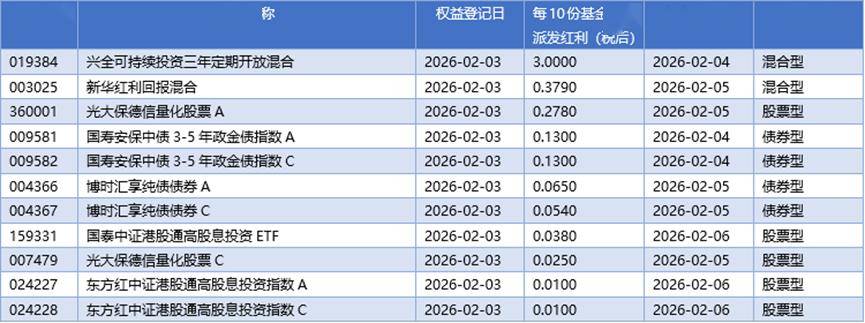
Group 1 - International crude oil experienced significant fluctuations in early February, leading to a surge in oil and gas-themed LOF, with premium rates exceeding 20% at one point [1] - Major public funds such as E Fund, GF Fund, Huaan Fund, and Harvest Fund announced suspensions or restrictions on purchases, with the maximum subscription amount reduced to 100 yuan, highlighting the high premium risk [1] - The price of LOF is driven by sentiment, which can lead to distortions; investors are advised to avoid chasing premiums and focus on net value and actual oil price performance [1] Group 2 - On February 3, A-shares saw the three major indices initially rise and then pull back, ultimately closing with the Shanghai Composite Index up 1.29% at 4067.74 points, the Shenzhen Component Index up 2.19% at 14127.11 points, and the ChiNext Index up 1.86% at 3324.89 points [1] - The total trading volume in the Shanghai and Shenzhen markets reached 2.54 trillion yuan, with over 4800 stocks rising across the market [1] Group 3 - On February 3, three new funds were launched, primarily focusing on fund of funds (FOF) and mixed funds, with the Baodao Xinghang Mixed Fund targeting a fundraising amount of 3 billion yuan [2] - A total of 11 funds announced dividends, with the highest dividend payout being 3.00 yuan per 10 fund shares from the Xingquan Sustainable Investment Three-Year Regular Open Mixed Securities Investment Fund [2] - In January, 48 funds were closed early, with 16 being "daylight" funds, focusing on growth sectors such as non-ferrous metals, chips, and new energy batteries, indicating a proactive approach to lock in investment opportunities [2]
多只石油LOF现高溢价 公募基金密集限购预警
Zheng Quan Ri Bao· 2026-02-03 16:42
Core Viewpoint - The recent volatility in the international oil market has led to a surge in trading activity for domestic oil and gas-themed funds, resulting in significant premium risks as market prices deviate from net asset values [1] Group 1: Premium Risks and Fund Responses - Multiple public fund institutions, including E Fund, GF Fund, Huaan Fund, and Harvest Fund, have issued warnings about high premium trading risks for their oil and petroleum LOF products, implementing measures such as suspensions and strict purchase limits to cool market enthusiasm [1][2] - On February 3, GF Fund and Huaan Fund reiterated warnings about premium risks in their oil LOF products, with GF Fund noting significant price deviations from net asset values, cautioning investors against blind investments in high premium funds [2] - Several public fund institutions have already warned investors about premium risks this year, with E Fund's oil LOF showing a net asset value of 1.1315 yuan on January 27, while the market closing price reached 1.437 yuan on January 29, prompting a suspension of trading [2] Group 2: Subscription Limit Adjustments - Many public fund institutions have reduced subscription limits for oil LOFs to prevent excessive capital inflow that exacerbates premium risks, with Huaan Fund adjusting its limit from 100 yuan to 2 yuan within a month [3] - E Fund's oil LOF reduced its subscription limit from 20 yuan to 10 yuan, while GF Fund lowered its limit from 500 yuan to 10 yuan, and Harvest Fund set its limit to 5 yuan, creating a "limit control matrix" across multiple products [3] Group 3: Market Dynamics and Risks - The high premiums for oil LOFs are attributed to a combination of limited QDII quotas, supply-demand imbalances, and the failure of arbitrage mechanisms, leading to a situation where investors turn to the secondary market, driving up prices [4] - The current high premiums are seen as driven by market sentiment rather than a reassessment of the underlying asset values, with warnings that investors may face dual risks of premium contraction and net asset value volatility [4] - Investors are advised to differentiate between the "net value (actual value)" of LOFs and "market price (supply-demand price)" and to monitor real-time net values and premium rates disclosed on fund websites to avoid potential risks [4]
提示溢价风险后,4只原油LOF全部跌停!
Xin Lang Cai Jing· 2026-02-02 12:21
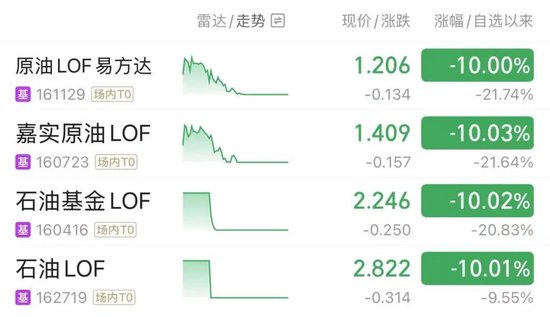
Core Viewpoint - The four oil LOFs managed by E Fund, Jiashi Fund, Huashan Fund, and Guangfa Fund all experienced a trading halt on February 2, with significant price drops following their resumption of trading, indicating volatility in the oil market driven by geopolitical factors and supply-demand dynamics [1][5]. Group 1: Fund Performance - All four oil LOFs, including Huashan's and Guangfa's, hit the trading limit down on their resumption day, with significant declines observed [1][5]. - The specific price changes for the funds included a drop of 10.00% for E Fund's oil LOF, 10.03% for Jiashi's oil LOF, 10.02% for Huashan's oil LOF, and 10.01% for Guangfa's oil LOF [2][3]. - The funds had previously issued warnings about significant premiums in their secondary market trading prices, advising investors to be cautious of potential losses from high premium purchases [2][7]. Group 2: Market Dynamics - Brent crude oil futures fell below $67 per barrel, while WTI crude oil futures dropped below $63, with both experiencing daily declines exceeding 3% [3][8]. - The volatility in oil prices is attributed to sudden shifts in geopolitical expectations, particularly concerning U.S.-Iran relations, which had previously driven prices to six-month highs [3][8]. - The International Energy Agency (IEA) forecasts a supply surplus in the global oil market this year, with supply exceeding demand by 3.85 million barrels per day [4][8]. Group 3: Future Outlook - Analysts suggest that the oil market may continue to experience volatility in the short term, with the potential for further price increases if geopolitical tensions escalate [4][9]. - The balance of supply and demand remains loose, indicating that much of the geopolitical risk premium has already been priced in, but any escalation in conflict could lead to upward pressure on oil prices [4][9].
最牛石油股1个月飙涨133%
2 1 Shi Ji Jing Ji Bao Dao· 2026-02-01 15:06
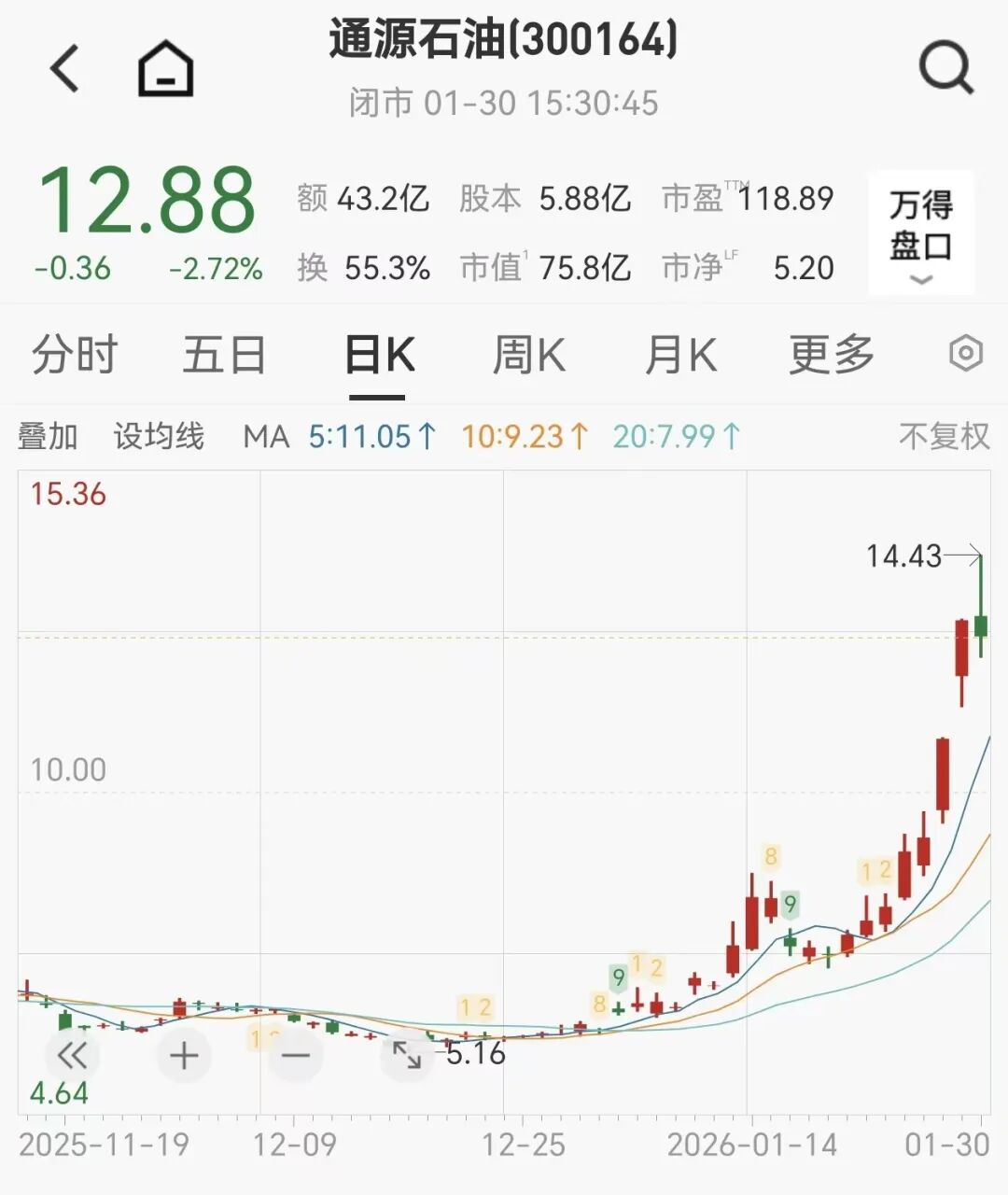
Group 1 - Geopolitical factors have driven up oil prices, leading to a strong increase in oil funds and related stocks [1] - The stock of Tongyuan Petroleum (300164.SZ) has surged over 63% in a week, making it the top-performing stock, with a year-to-date increase of over 133% [2] - The oil and gas industry has seen significant price movements, with the oil service sector rising nearly 15% in a week, driven by geopolitical tensions and cold weather [5] Group 2 - E Fund Management announced that its crude oil LOF fund's market price significantly exceeded its net asset value, prompting a warning about premium risks [3] - Several oil funds, including those managed by GF Fund Management and Huaxia Fund Management, have also reported substantial premiums in their market prices, leading to temporary trading suspensions [3] - Tongyuan Petroleum reported abnormal stock price fluctuations, with a cumulative increase of over 30% in three trading days, and emphasized that there was no violation of information disclosure [5]

最牛石油股1个月飙涨133%
21世纪经济报道· 2026-02-01 15:04
Core Viewpoint - Geopolitical factors have driven up oil prices, leading to a strong rise in oil funds and related stocks [1] Group 1: Oil Funds and Market Reactions - Four oil funds have collectively warned about premium risks, indicating that investors may face significant losses if they buy at high premiums [1] - The E Fund's crude oil LOF fund (code: 161129) showed a significant premium, with a net asset value of 1.1514 yuan on January 28, 2026, while the market closing price was 1.340 yuan [4] - Other funds, including those managed by GF Fund, Huaan Fund, and Harvest Fund, also reported substantial premiums and announced temporary suspensions of trading to alert investors [4] Group 2: Stock Performance - Tongyuan Petroleum (300164.SZ) emerged as the top-performing stock, achieving a weekly increase of over 63% and doubling its price since the beginning of the year, with a cumulative rise of over 133% [3] - The stock experienced abnormal trading fluctuations, with a cumulative price deviation exceeding 30% over three consecutive trading days [6] - The oil and gas extraction industry is closely linked to international crude oil prices and capital expenditures, with geopolitical tensions in regions like Venezuela and Iran contributing to supply risk concerns [6] Group 3: Industry Trends - The oil and petrochemical sector saw a nearly 8% increase in a week, with oil service engineering rising nearly 15% [6] - Recent reports indicate a significant increase in market sentiment towards oil, driven by geopolitical and macroeconomic factors, although no substantial fundamental improvements have been observed [6]

突发公告!明起集体停牌!罕见一幕上演,多只基金涨停
券商中国· 2026-01-29 12:08
Core Viewpoint - On January 29, a rare market event occurred where resource-related LOFs, including oil LOFs, experienced a collective surge, with many products hitting the daily limit up [1][4]. Group 1: Market Performance - Multiple LOF products, including Yuanda Oil LOF and Jiashi Oil LOF, achieved significant gains, with several products closing at the daily limit up of 10% [3][5]. - The WTI crude oil futures reached $65.002 per barrel, marking a 2.83% increase and the highest level since September 2025 [7]. - The strong performance of resource LOFs was attributed to high premium rates and a surge in investor interest due to tight QDII quotas and low subscription limits [6][7]. Group 2: Fund Announcements - Several fund companies announced that their resource-related LOFs would be suspended from trading starting January 30, 2026, to alert investors about the risks associated with high premium rates [2][9]. - The announcement included specific funds such as the Yuanda Oil LOF and Jiashi Oil LOF, which will also be suspended until 10:30 AM on January 30 [9][10]. - The suspension is a response to significant deviations between market prices and net asset values, indicating potential risks for investors [9][10]. Group 3: Investor Behavior - Investors have been utilizing the "offshore subscription + onshore selling" arbitrage mechanism, leading to concentrated inflows into LOF funds [6]. - The tightening of subscription limits for oil LOFs, with the daily single account limit reduced to as low as 2 yuan, has led investors to purchase at higher prices in the secondary market [7][9]. - Analysts warn that if international oil prices decline or if arbitrage funds withdraw, the prices of these funds may quickly revert to net asset values, posing risks for investors who buy at high prices [9][10].