
神舟二十二号载人飞船

Search documents
创新中国 攀高向新——二〇二五年我国重大科技成果盘点(科技视点)
Ren Min Ri Bao· 2025-12-30 22:37
Core Insights - In 2025, China made significant technological breakthroughs across various fields, contributing to high-quality development and global progress in civilization [1][2] Group 1: Technological Innovations - The "artificial sun" achieved a world record of 1 million degrees Celsius for 1066 seconds, marking a significant step in nuclear fusion research [9] - The successful launch of the Tianwen-2 probe initiated China's first asteroid exploration mission, enhancing capabilities in deep space exploration [10] - The DeepSeek AI model broke traditional paths by optimizing algorithms to achieve top performance with limited computing power, promoting an open ecosystem for global developers [7] Group 2: Scientific Research Achievements - The first large-area production of two-dimensional metal materials was achieved, marking a new frontier in material science [3] - Research on lunar samples from the far side of the moon revealed new insights into its geological history, challenging previous understandings [4] - The Jiangmen Neutrino Experiment (JUNO) achieved a measurement precision 1.5 to 1.8 times better than the previous international standard, advancing the study of neutrinos [4] Group 3: Economic Impact and Industry Development - The integration of AI technologies across various sectors, including healthcare and transportation, is driving high-quality development and enhancing productivity [12][14] - The approval of 69 innovative drugs in 2025 set a new record, reflecting the rapid advancement in the pharmaceutical industry [13] - The promotion of carbon capture technology in the cement industry and digital transformation in the steel industry are part of a broader shift towards sustainable practices [14] Group 4: Strategic Initiatives - The establishment of a comprehensive innovation system is underway, with a focus on self-reliance in technology and the cultivation of new productive forces [15] - The development of advanced technologies such as brain-computer interfaces and quantum computing is positioning China as a leader in these fields [8]
精准“把脉”气象保障神舟二十二号飞天
Ke Ji Ri Bao· 2025-11-28 09:01
Core Points - The successful launch of the Shenzhou-22 manned spacecraft took place on November 25 at 12:11 PM, facilitated by the Long March 2F Yao-22 rocket from the Jiuquan Satellite Launch Center [1][2] - The meteorological support team effectively analyzed complex weather conditions, including frequent cold air activities and high-altitude wind speeds, to determine the optimal launch window [1] - The Gansu Provincial Meteorological Bureau quickly mobilized experts to form a meteorological support team, which began on-site support tasks on November 18, focusing on critical weather elements [1] Meteorological Support - The meteorological team conducted multiple consultations with the launch base's meteorological office to assess key weather factors such as temperature, wind speed, and weather phenomena [1] - Since November 14, the weather conditions posed significant uncertainties for the wind field forecasts at the Jiuquan Satellite Launch Center [1] - Advanced technologies and platforms from the China Meteorological Administration and Gansu Provincial Meteorological Bureau were integrated to enhance forecasting accuracy [1] Launch Timing - After precise calculations, the team identified November 20 for vertical transport and analyzed various alternative launch windows [2] - The optimal launch time was determined to be 12:11 PM on November 25, coinciding with a break in cold air activity [2]
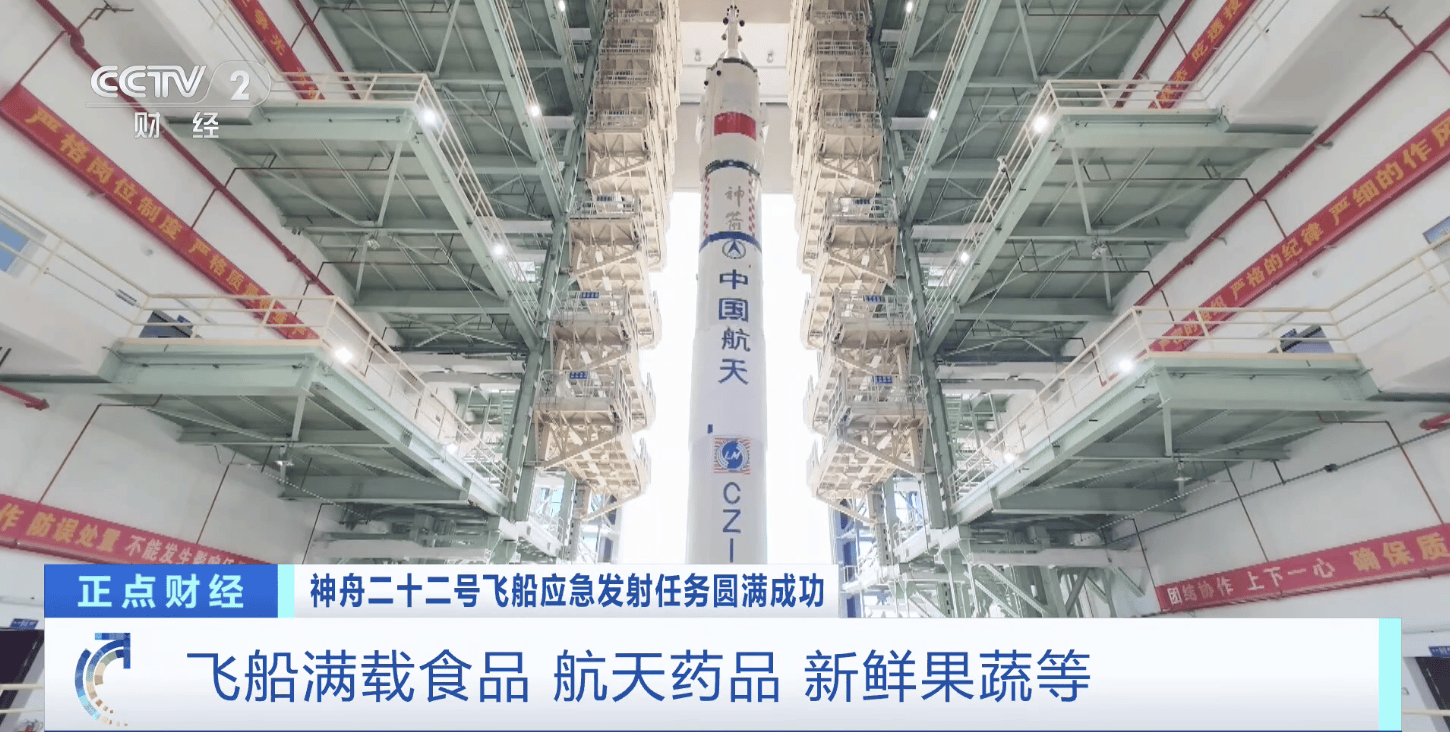
神舟二十二号“无人”满载启程:物资坐航天椅,为空间站精准补货
Sou Hu Cai Jing· 2025-11-25 11:26
Core Viewpoint - The Shenzhou-22 manned spacecraft is launched in an unmanned state to support the Shenzhou-21 crew, carrying essential supplies for the space mission [1] Group 1: Mission Details - The Shenzhou-22 spacecraft is loaded with supplies including space food, medicine, fresh fruits and vegetables, and spare parts necessary for the space station [2] - The supplies are primarily life-supporting materials, with a focus on food and fresh produce, to replenish what was consumed by the Shenzhou-21 crew during their extended stay [3] Group 2: Technical Improvements - The Shenzhou-22 spacecraft features multiple technical upgrades that enhance its functionality and performance, including improved human-machine interaction design for astronaut comfort and ease of control [5] - The optimization of the instrument panel and return cabin layout significantly increases the payload return capacity, supporting better space station operations [5] Group 3: Load Management - The mission involves a unique approach where the unmanned spacecraft carries a larger load than previous missions, necessitating careful distribution of weight to maintain balance and meet launch requirements [7] - The payload is secured in a practical manner using soft bags placed in the seats, ensuring that the center of mass remains within acceptable limits during the flight [9][11]

中国航天员首次“换乘”天外平安归来
Ren Min Ri Bao Hai Wai Ban· 2025-11-14 22:22
Core Points - The Shenzhou 20 astronaut crew successfully returned to Earth aboard the Shenzhou 21 spacecraft, setting a new record for the duration of stay in orbit for Chinese astronauts [1][2] - This marks the first time Chinese astronauts have returned safely from space using a "transfer" method between spacecraft [2] - The Shenzhou 20 crew spent a total of 204 days in space, completing four extravehicular activities and numerous scientific experiments across various fields [3] Summary by Sections - **Return Mission**: The Shenzhou 20 crew was initially scheduled to return on November 5 but faced a delay due to a minor crack in the spacecraft's window. The mission was resumed with the crew transferring to the Shenzhou 21 for their return [2] - **Safety Measures**: The Chinese manned space program prioritized safety, activating emergency protocols and ensuring a coordinated response to the situation [2] - **Crew Achievements**: Commander Chen Dong became the first Chinese astronaut to exceed 400 days in total spaceflight duration and holds the record for the most extravehicular activities [2][3] - **Scientific Contributions**: During their 204 days in orbit, the crew conducted extensive scientific experiments in microgravity, materials science, life sciences, and aerospace medicine, in collaboration with ground researchers [3]
最新任务公布!代号MZ-1
Ren Min Ri Bao· 2025-11-01 11:14
Core Viewpoint - The China Manned Space Engineering Office has announced the basic situation of manned spaceflight missions for the year 2026, detailing various upcoming missions and their objectives [1]. Group 1: Tianzhou-10 Mission - Launch Location: Wenchang Space Launch Site [2] - Docking Method: Tianzhou-10 cargo spacecraft (code TZ-10) will dock at the rear port of the core module after launch [2]. - Main Tasks: The mission aims to transport supplies for astronauts, maintenance parts, propellants, various payloads, and samples for application tasks, as well as to dispose of space debris [2]. Group 2: Shenzhou-22 and Shenzhou-23 Manned Missions - Launch Location: Jiuquan Space Launch Site [3]. - Crew Composition: Each mission will consist of a crew of three astronauts [3]. - Docking Method: Shenzhou-22 (code SZ-22) will dock at the radial port of the core module, while Shenzhou-23 (code SZ-23) will dock at the forward port [3]. - Main Tasks: Shenzhou-22 will conduct a long-term stay experiment for over one year, perform extravehicular activities, continue space science experiments, and manage space station operations and astronaut support [3]. Group 3: Mengzhou-1 Mission - Launch Location: Wenchang Space Launch Site [4]. - Docking Method: Mengzhou-1 (code MZ-1, unmanned) will dock at the radial port of the core module after launch [4]. - Main Tasks: This mission will utilize the Long March 10A rocket (code CZ-10A) for the first flight of the Mengzhou manned spacecraft, which is a next-generation spacecraft based on the Shenzhou design. The mission will validate the overall system status and test various equipment and modules [4].

我国明年将发射梦舟一号等4艘飞船
Xin Hua She· 2025-11-01 09:45
Core Points - China will implement four spaceflight missions in 2024, including Tianzhou-10, Shenzhou-22, Shenzhou-23, and Mengzhou-1, with Mengzhou-1 being the first crewed spacecraft and the Long March 10A rocket also making its inaugural flight [1] Group 1 - The missions will be launched from the Jiuquan Satellite Launch Center, with Shenzhou-22 and Shenzhou-23 carrying crews of three astronauts each [1] - Shenzhou-22 will dock with the radial port of the space station core module, while Shenzhou-23 will dock with the forward port [1]
我国明年将发射梦舟一号等4艘飞船 航天员开展1年以上长期驻留试验
Xin Hua She· 2025-11-01 07:45
Core Points - China plans to conduct four space missions in 2024, including the first flights of the Mengtian-1 crewed spacecraft and the Long March 10A rocket [1][2] - The Shenzhou-22 and Shenzhou-23 crewed spacecraft will be launched from the Jiuquan Satellite Launch Center, each carrying a crew of three astronauts [1] - The main objectives of the Shenzhou-22 mission include a long-term stay experiment, extravehicular activities, and various scientific experiments [1] - The Tianzhou-10 cargo spacecraft will be launched from the Wenchang Space Launch Site, aimed at delivering supplies and equipment to the space station [1][2] - The Mengtian-1 spacecraft is a new generation of crewed spacecraft designed for transportation to and from the space station, featuring a modular design [2] Mission Details - The Shenzhou-22 spacecraft will dock at the radial port of the space station's core module, while the Shenzhou-23 will dock at the forward port [1] - The Tianzhou-10 cargo spacecraft will deliver supplies, maintenance parts, and various payloads to ensure the safe operation of the space station [1] - The Mengtian-1 spacecraft will validate the full system operational status and deliver environmental evaluation equipment and research modules [2] Public Engagement - The Chinese Manned Space Engineering Office has initiated a public call for mission insignia for the upcoming crewed spaceflight missions [1][2] - Since the Shenzhou-5 mission in 2003, each crewed flight has featured a designated mission insignia, with public participation encouraged annually [2]
1名航天员驻留1年以上 梦舟一号首飞……2026年载人航天飞行任务公布
Yang Shi Xin Wen· 2025-11-01 04:31
Core Points - The Chinese manned space program will conduct four missions in 2026, including Tianzhou-10, Shenzhou-22, Shenzhou-23, and Mengzhou-1 [1][2] Group 1: Tianzhou-10 Mission - Launch Site: Wenchang Space Launch Site [1] - Docking Method: Tianzhou-10 cargo spacecraft will dock at the rear port of the core module [1] - Main Tasks: The mission will transport supplies for astronauts, maintenance parts, propellants, and various payloads, while also disposing of waste in orbit [1] Group 2: Shenzhou-22 and Shenzhou-23 Missions - Launch Site: Jiuquan Space Launch Site [1] - Crew Composition: Each mission will consist of a crew of three astronauts [1] - Docking Method: Shenzhou-22 will dock at the radial port, while Shenzhou-23 will dock at the forward port of the core module [1] - Main Tasks: Shenzhou-22 will conduct a long-term stay experiment for over one year, perform extravehicular activities, and continue space science experiments and technical trials [1] Group 3: Mengzhou-1 Mission - Launch Site: Wenchang Space Launch Site [2] - Docking Method: Mengzhou-1 will dock at the radial port of the core module in an unmanned state [2] - Main Tasks: This mission will utilize the Long March 10A rocket for the first flight of the Mengzhou spacecraft, validating the full system's operational status and conducting various technology verifications [2]
神舟二十一号载人飞船发射窗口确定
Jing Ji Ri Bao· 2025-10-30 22:13
Core Points - The Shenzhou-21 manned spacecraft is scheduled for launch on October 31 at 23:44 Beijing time, with a crew consisting of Zhang Lu, Wu Fei, and Zhang Hongzhang [1] - This mission marks the 6th manned flight during the space station application and development phase and the 37th flight of the manned space program [1] - The primary objectives include crew rotation with the Shenzhou-20 crew, a six-month stay at the space station, conducting space science and application work, extravehicular activities, cargo operations, and installation of space debris protection devices [1] Mission Details - The Shenzhou-21 spacecraft will utilize an autonomous rapid rendezvous and docking mode, expected to dock with the Tianhe core module approximately 3.5 hours after entering orbit [1] - During the stay, the Shenzhou-21 crew will receive visits from the Tianzhou-10 cargo spacecraft and the Shenzhou-22 manned spacecraft [1] - The current status of the spacecraft and crew is stable, with ground systems functioning normally, indicating readiness for the launch [2]
中国瞄准10月31日23时44分发射神舟二十一号载人飞船
Zhong Guo Xin Wen Wang· 2025-10-30 07:05
Core Points - China is set to launch the Shenzhou-21 manned spacecraft on October 31 at 23:44 Beijing time, with a crew consisting of Zhang Lu, Wu Fei, and Zhang Hongzhang [1] - The primary objective of the Shenzhou-21 mission is to conduct an in-orbit crew rotation with the Shenzhou-20 crew, stay in the space station for approximately six months, and perform various scientific and application tasks [1] - The Shenzhou-21 spacecraft will utilize an autonomous rapid rendezvous and docking mode, docking with the Tianhe core module approximately 3.5 hours after entering orbit [1] Mission Details - The Shenzhou-21 crew will engage in space science and application work, extravehicular activities, cargo operations, and installation of space debris protection devices [1] - The mission will also include public education activities and space-based experiments to maximize the comprehensive application benefits of the space station [1] - During the stay in orbit, the Shenzhou-21 crew will receive visits from the Tianzhou-10 cargo spacecraft and the Shenzhou-22 manned spacecraft [1] Shenzhou-20 Crew Status - The Shenzhou-20 crew has been in orbit for 188 days, potentially setting a new record for the longest duration of a Chinese astronaut crew in space [2] - Commander Chen Dong has become the first Chinese astronaut to exceed 400 days in space and has completed six extravehicular activities, making him the most experienced in this regard among Chinese astronauts [2] - The other two crew members, Chen Zhongrui and Wang Jie, are successfully completing their first flight missions [2]