第三代人形机器人Optimus

Search documents
汽车行业周报(2026/1/26-2026/1/30):特斯拉加速AI转型,将发布第三代人形机器人Optimus
GUOTAI HAITONG SECURITIES· 2026-02-01 02:45
股 票 研 究 股票研究 /[Table_Date] 2026.02.01 特斯拉加速 AI 转型,将发布第三代人形机器人 Optimus [Table_Industry] 汽车 汽车行业周报(2026/1/26-2026/1/30) | [姓名table_Authors] | 电话 | 邮箱 | 登记编号 | | --- | --- | --- | --- | | 刘一鸣(分析师) | 021-23154145 | liuyiming@gtht.com | S0880525040050 | | 潘若婵(分析师) | 021-23154145 | panruochan@gtht.com | S0880525110006 | 本报告导读: 近一周,申万汽车指数下跌 5%,新能源整车指数下跌 5%,汽车零部件指数下跌 投资要点: [Table_Report] 相关报告 汽车《12 月乘用车销量同环比下降,预计 26 年 销量同比微增》2026.01.25 汽车《国内人形机器人持续放量,Robotaxi 产业 化加速》2026.01.24 汽车《12 月重卡顺利收官,收获同比"九连 增"》2026.01.23 汽车 ...

汽车行业周报(2026/1/26-2026/1/30):特斯拉加速AI转型,将发布第三代人形机器人Optimus-20260201
国泰海通· 2026-02-01 02:28
Investment Rating - The report maintains an "Overweight" rating for the automotive industry [4][18]. Core Insights - The automotive industry is experiencing a significant shift with Tesla accelerating its AI transformation and planning to release the third-generation humanoid robot, Optimus. This move indicates a strategic pivot away from traditional automotive manufacturing towards smart manufacturing and emerging industries [15][16]. - The report highlights the importance of humanoid robots in creating demand, suggesting a focus on high-cost-performance technology routes and companies with inherent advantages, similar to the lithium iron phosphate battery technology in electric vehicles [18]. - The report notes that the domestic passenger vehicle market is facing increased competition as the effects of vehicle replacement programs diminish, recommending companies that differentiate their vehicle offerings [18]. Summary by Sections Industry Weekly Market Review - In the week from January 23 to January 30, 2026, the automotive index fell by 5%, the new energy vehicle index also dropped by 5%, and the automotive parts index decreased by 6% [7][8]. - Over the past month, the automotive index remained flat, while the new energy vehicle index declined by 3% [7]. Tesla's AI Transformation - Tesla plans to gradually stop production of Model S and Model X starting in Q2 2026, focusing on the production of the Optimus humanoid robot, with a target of producing one million units annually [15][16]. - The company has over 500 Robotaxi vehicles deployed, with plans to double this fleet monthly and expand services to major cities by the end of 2026 [16]. Investment Strategy and Recommendations - The report recommends investing in companies like Dechang Motor Holdings and Haoneng Co., which are positioned well in the automotive motor and reducer sectors [18]. - It suggests focusing on differentiated vehicle offerings from Great Wall Motors, SAIC Motor, and high-end models from JAC Motors, as well as long-term investments in BYD due to its high level of self-research [18]. - The report also highlights the potential for natural gas generators and SOFCs in data centers, recommending Weichai Power for its comprehensive power layout [18].
特斯拉Q3增收不增利,全球交付近50万辆
美股研究社· 2025-10-28 10:24
Core Viewpoint - Tesla reported record revenue and free cash flow for Q3, driven by increased vehicle deliveries, but faced a decline in net profit and gross margin [4][5]. Revenue and Deliveries - Tesla's Q3 revenue reached $28.1 billion, a 12% year-over-year increase [4]. - Vehicle deliveries hit a record high of 497,000 units in Q3, with Model 3 and Model Y accounting for 481,000 units, a 9% increase year-over-year [4]. - In China, Tesla delivered 169,000 vehicles in Q3, a 31% increase quarter-over-quarter, representing over 30% of global deliveries [4]. Profitability and Margins - Despite increased revenue, Tesla's net profit (non-GAAP) fell to $1.77 billion, a 29% decline year-over-year [5]. - The gross margin for Q3 was 18%, down from 19.8% in the same period last year [5]. Market Performance - Tesla's deliveries in South Korea, Japan, and Singapore reached record levels, with South Korea becoming the third-largest market after the U.S. and China [5]. - The stock price fell by 0.82% to $438.97 before the earnings report and dropped nearly 5% in after-hours trading [10]. Operational Costs and Future Outlook - Increased operational costs, including R&D and stock-based compensation, contributed to the profit decline [8]. - Tesla did not provide performance guidance for the upcoming quarters, citing uncertainties in global trade and fiscal policies [8]. Future Investments - Tesla is focusing on AI and robotics, with plans to release the third-generation humanoid robot, Optimus, in Q1 2026, and aims for an annual production of 1 million units [9]. - The company is expanding its Robotaxi service and enhancing its AI capabilities through partnerships, including one with Samsung for AI chip production [9].


【汽车】科技变革加速汽车产业格局重塑,关注消费政策延续+科技主题——二十届四中全会精神学习汽车篇(倪昱婧/邢萍)
光大证券研究· 2025-10-27 23:04
Core Viewpoint - The article emphasizes the accelerated transformation of the automotive industry driven by technological advancements, particularly in intelligent driving and humanoid robots, which are seen as key factors for economic growth and domestic demand stimulation in China [4]. Group 1: Industry Trends - The automotive industry is undergoing a significant reshaping due to technological changes, particularly in intelligent driving and humanoid robotics, aligning with the national policy focus on "industrial technology + boosting domestic demand" [4]. - The retail sales of domestic passenger vehicles increased by 9.2% year-on-year to 17.01 million units from January to September 2025, with new energy vehicle (NEV) sales rising by 24.4% to 8.87 million units, achieving a penetration rate of 52% [5]. - The application for the vehicle trade-in subsidy exceeded 10 million by October 22, 2025, with NEVs accounting for 57.2% of the total applications [5]. Group 2: Future Projections - The trade-in policy is expected to significantly boost NEV sales, with projections indicating that total NEV retail sales could reach 13 million units by the end of 2025, supported by year-end effects and tax incentives in 2026 [5]. - The intelligent driving sector is anticipated to enter a "strong standard" era by 2026, benefiting the domestic L2+ industry chain, particularly for models priced below 200,000 yuan [6]. - The mass production of humanoid robots is expected to create new growth opportunities within the automotive supply chain, as these technologies are highly synergistic with smart vehicles [6]. Group 3: Policy and Standards - The Ministry of Industry and Information Technology is working on the "14th Five-Year" plan for the intelligent connected new energy vehicle industry, aiming to accelerate the establishment of standards for driving assistance and autonomous driving [6].
汽车:节能与新能源汽车技术路线图3.0发布特斯拉Q3增收不增利
Huafu Securities· 2025-10-26 11:51
Investment Rating - The industry rating is "Outperform the Market" [8] Core Insights - The "Energy-saving and New Energy Vehicle Technology Roadmap 3.0" was officially released on October 22, outlining six major goals for China's automotive industry by 2040, including a 60% reduction in carbon emissions from peak levels by 2040 and achieving over 80% penetration of new energy vehicles [3][15] - Tesla's Q3 financial report showed revenue of $28.1 billion, a 12% year-on-year increase, but net profit decreased by 29% to $1.77 billion, primarily due to rising operational costs and a decline in full self-driving revenue [4][16] - The automotive sector's performance from October 20 to October 24 showed a 2.9% increase, underperforming the CSI 300 index by 0.3 percentage points, with the automotive sector ranking 10th among 31 sectors [20][23] Summary by Sections Industry Research - The "Energy-saving and New Energy Vehicle Technology Roadmap 3.0" emphasizes low-carbon, electric, and intelligent development directions for the automotive industry, structured around one overall industry goal, five technology groups, and 26 specialized areas [14] - The roadmap aims for a mature ecosystem for intelligent connected vehicles and significant advancements in original innovation capabilities in China [15] Market Performance - The automotive sector's performance from October 20 to October 24 was 2.9%, while the CSI 300 index was at 3.2%, indicating a slight underperformance [20] - Year-to-date, the automotive sector has increased by 22.7%, ranking 10th among 31 sectors [20] Key Data - From October 1 to 19, retail sales of passenger vehicles were 1.128 million units, a 6% year-on-year decrease, while new energy passenger vehicle retail sales were 632,000 units, a 5% year-on-year increase [6][38] - In September, total automotive sales reached 3.226 million units, with a year-on-year increase of 14.9% [43] Company Highlights - Tesla's Q3 delivery reached a record 497,000 vehicles, driven by consumer demand ahead of the expiration of federal EV tax credits [16] - Tesla plans to release its third-generation humanoid robot, Optimus, in Q1 2026, with an expected annual production of 1 million units [17]
机器人产业跟踪:特斯拉明确第三代机器人进展 提升产业发展预期确定性和新技术落地预期
Xin Lang Cai Jing· 2025-07-26 10:32
Group 1 - Tesla has clarified the progress of its third-generation robot, which is expected to enhance market certainty regarding industry development and the rollout of new technologies [1][2] - The prototype of the third-generation humanoid robot, Optimus, is set to be completed within three months, with production planned to start in early 2026, aiming for a monthly output of 100,000 units within five years [1][2] - The Q2 earnings call emphasized expectations for the evolution of AI in robotics, with the potential for Robotaxi services to expand to cover half of the U.S. population by the end of 2025 [1][2] Group 2 - Market expectations for the new generation of robots are likely to strengthen, particularly regarding advancements in motion coordination and the ability to perform complex tasks [2] - Concerns about delays in the robot's development are expected to dissipate, leading to increased certainty in industry development forecasts [2] - Companies within the Tesla robot supply chain, such as Top Group, Sanhua Intelligent Controls, and Zhenyu Technology, are recommended for attention due to their potential alignment with new technological changes [2]

二季度营收利润双降,马斯克:预计下半年量产低价新车
Bei Jing Shang Bao· 2025-07-24 09:43
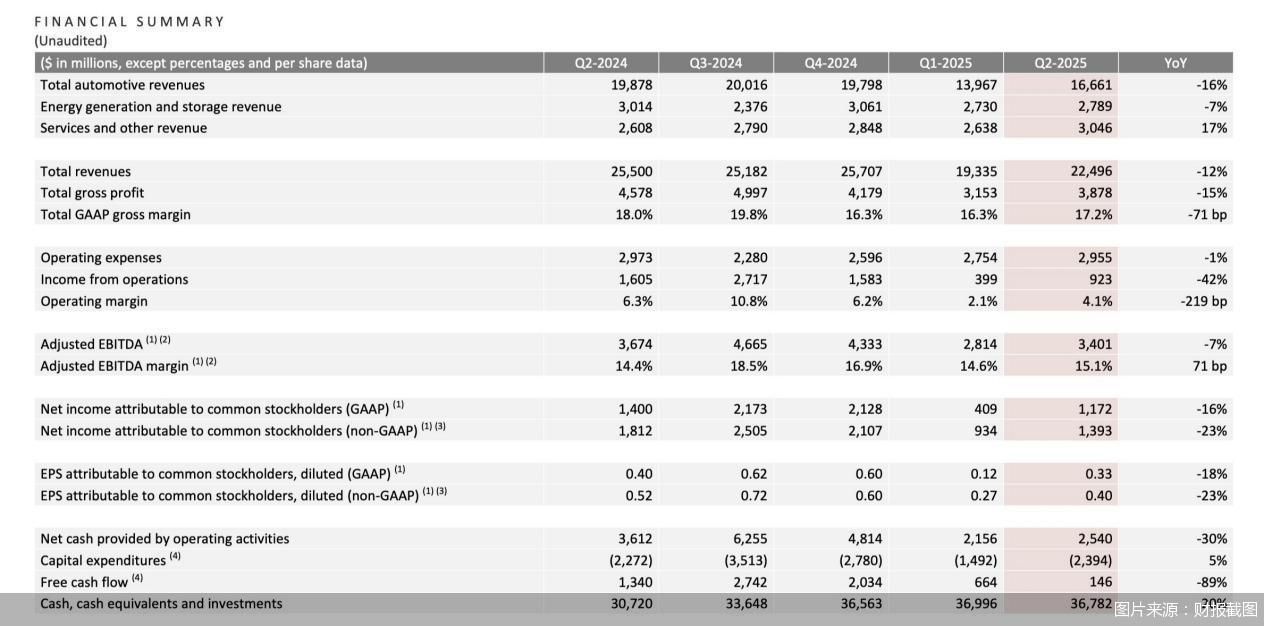
Core Viewpoint - Tesla's Q2 2024 financial results show a decline in revenue and net profit, attributed to decreased sales and reduced carbon credit income [1][2]. Financial Performance - Q2 2024 total revenue was $22.496 billion, a 12% year-over-year decrease [1]. - Net income for Q2 2024 was $1.172 billion, down 16% year-over-year [1]. - Global deliveries in Q2 2024 reached 384,000 units, reflecting a 13% decline compared to the previous year [2]. Market Challenges - CEO Elon Musk indicated that Tesla may face several difficult quarters due to sudden changes in EV tax credit policies and tariffs [2][3]. - The U.S. Congress has passed a tax and spending bill that will eliminate the $7,500 tax credit for new electric vehicle purchases starting September 30, increasing uncertainty for Tesla's sales in the second half of the year [2]. Product Development - Tesla has begun initial production of a new affordable model in June 2024, with plans for mass production in the second half of the year [3]. - The new model is expected to be a version of Model Y, with a target price below $30,000 [3]. Competitive Landscape - The introduction of the long-wheelbase Model Y in China is seen as a response to increasing competition from local automakers [4]. - Tesla is also focusing on expanding its autonomous driving and robotics business, with plans to launch a third-generation humanoid robot and expand Robotaxi services [4].