纯电SUV i6

Search documents
新能源汽车首月“成绩单”,来了
Shang Hai Zheng Quan Bao· 2026-02-01 15:20
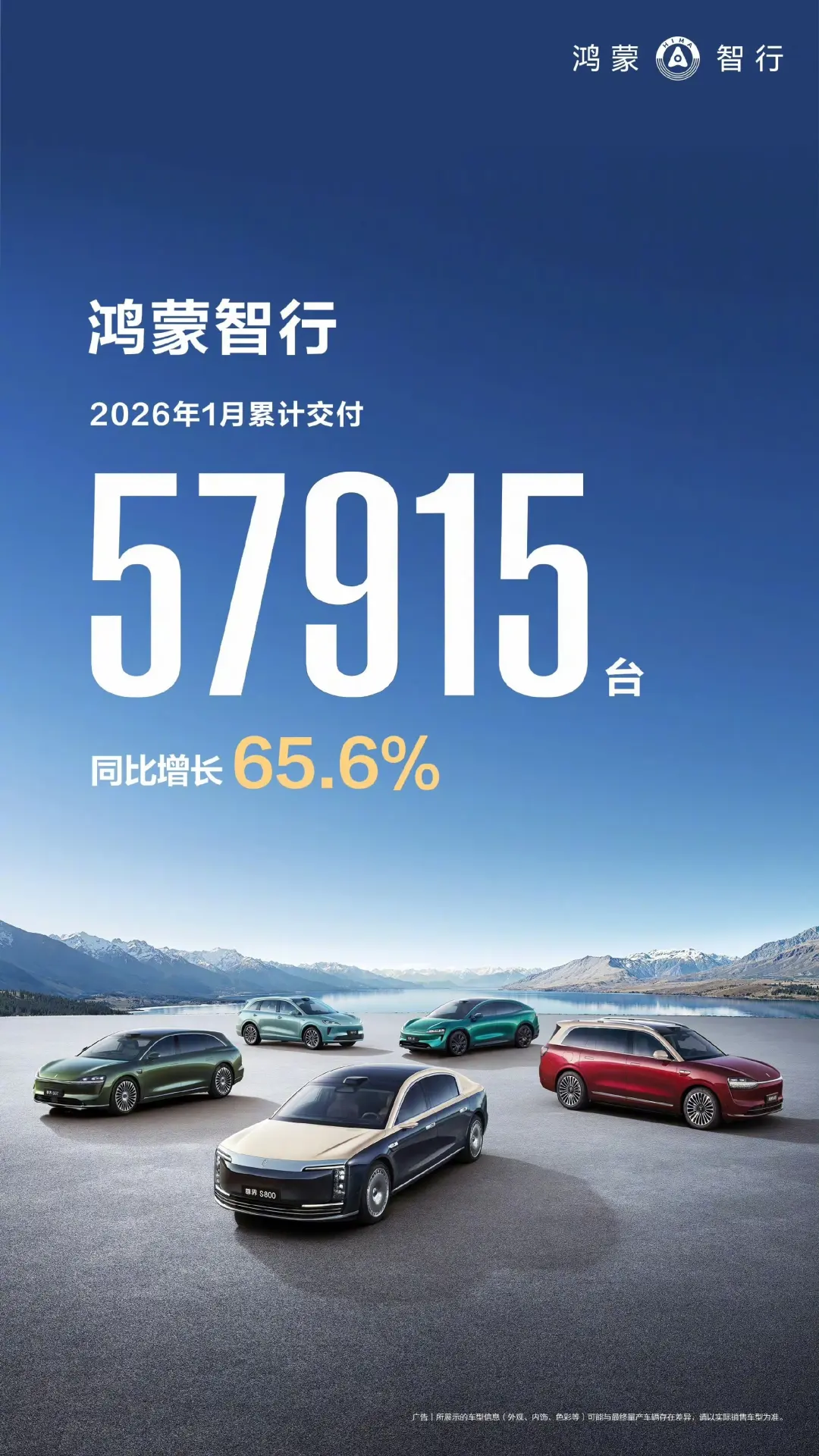
Group 1: Industry Overview - In January 2026, major Chinese electric vehicle manufacturers reported mixed results in new car sales, with some companies showing year-on-year growth but a noticeable decline compared to December 2025 deliveries [1] - BYD's January sales exceeded 210,000 units, representing a year-on-year decrease of 30.11% [4] - The China Passenger Car Association (CPCA) maintains an optimistic outlook for 2026, predicting a retail growth rate of approximately 10% for new energy vehicles [1] Group 2: New Energy Vehicle Manufacturers - Leap Motor delivered 32,059 vehicles in January 2026, a year-on-year increase of 27.37% but a month-on-month decline of 46.94% [2] - NIO reported January deliveries of 27,182 vehicles, marking a year-on-year increase of 96.08% but a month-on-month decrease of 43.53% [2] - Li Auto's January deliveries reached 27,668 units, reflecting a year-on-year growth of 7.55% but a month-on-month drop of 37.47% [3] - Xpeng Motors delivered 20,011 vehicles in January, showing a year-on-year decline of 34.07% and a month-on-month decrease of 46.65% [3] Group 3: Huawei and Xiaomi Developments - Huawei's HarmonyOS Smart Mobility achieved significant growth with January deliveries of 57,915 vehicles, a year-on-year increase of 65.6% [4] - Xiaomi announced January deliveries exceeding 39,000 vehicles, with a target of 550,000 units for the entire year of 2026 [8] Group 4: Market Statistics - As of the end of 2025, the total number of new energy vehicles in China reached 43.97 million, accounting for 12.01% of the total vehicle population [10] - The number of newly registered new energy vehicles in 2025 was 12.93 million, representing 49.38% of all new vehicle registrations, with a year-on-year increase of 14.93% [10]





掉出造车新势力销量前三后,理想1月新车交付同比环比均下滑
Shen Zhen Shang Bao· 2026-02-01 05:46
Core Viewpoint - Li Auto's vehicle deliveries have significantly declined in January 2026, indicating challenges in its transition to pure electric vehicles and raising concerns about its product strategy and operational efficiency [1][2][3] Group 1: Delivery and Sales Performance - In January 2026, Li Auto delivered 27,668 new vehicles, a year-on-year decrease of 7.55% and a month-on-month drop of 37.46% [1] - Cumulative deliveries reached 1.5678 million vehicles as of January 31, 2026 [1] - In 2025, Li Auto sold 406,300 vehicles, down 18.81% year-on-year, achieving only 58.05% of its initial target of 700,000 vehicles [2] Group 2: Retail and Service Network - As of January 31, 2026, Li Auto has 547 retail centers and 547 after-sales service centers across 159 and 221 cities, respectively [1] - The company has deployed 3,966 charging stations and 21,945 charging piles nationwide [1] Group 3: Challenges and Strategic Shifts - Li Auto's shift towards pure electric models has faced difficulties, with mixed market feedback on new products like MEGA HOME, i8, and i6 [2] - The company plans to close 100 underperforming stores in 2026, although it refuted claims of mass closures [3] - The chairman acknowledged that 2025 was challenging due to product cycles, public relations issues, supply chain constraints, and policy changes affecting deliveries and operations [3] Group 4: Market Performance - Li Auto's stock has underperformed, with a 36% decline in 2024 and a further 31% drop in 2025, although it has seen a slight increase of 1.7% in the current year [3]
造车新势力11月齐遇“寒流”:“蔚小理”集体环比下滑
Feng Huang Wang· 2025-12-01 15:00
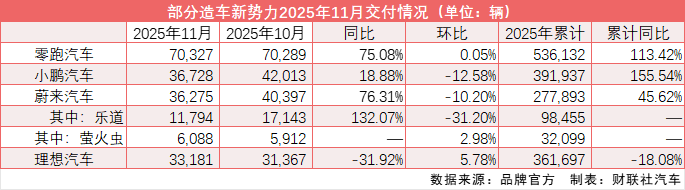
Core Viewpoint - The new energy vehicle market is experiencing varied delivery performances among different manufacturers in November, with some companies showing growth while others face declines. The overall market sentiment is cautious due to tightening policies and consumer hesitation. Group 1: Delivery Performance - Leap Motor led the delivery numbers with 70,327 units in November, marking a 75.08% year-on-year increase and a slight 0.05% month-on-month growth, achieving its annual sales target of 500,000 units 45 days ahead of schedule [2][3] - Xiaopeng Motors delivered 36,728 units, reflecting an 18.88% year-on-year increase but a 12.58% month-on-month decline, marking its first monthly drop in six months [3][4] - NIO delivered 36,275 units, a 76.31% year-on-year increase, with its sub-brands showing significant growth, particularly the LeDao brand with a 132.07% increase [2][3] - Li Auto's deliveries were at 33,181 units, showing a 31.92% year-on-year decline, continuing a six-month trend of year-on-year decreases [4][5] Group 2: Future Projections and Strategies - Leap Motor aims to reach a sales target of 1 million units by 2026, supported by the launch of new models like the A10 and Lafa5, which cater to different market segments [3][4] - Xiaopeng Motors is expanding its overseas market presence, with a 95% year-on-year increase in overseas deliveries, and is optimistic about new models contributing to future growth [3][4] - NIO has set a quarterly delivery guidance of 120,000 to 125,000 units, needing to deliver over 43,000 units in December to meet this target [4] - Li Auto is focusing on enhancing its long-term competitiveness through organizational, product, and technological improvements, with a cautious delivery guidance of 100,000 to 110,000 units for the fourth quarter [5]
理想汽车:卖车更猛了,赚钱更难了
雪豹财经社· 2025-03-18 16:22
Core Viewpoint - The article discusses the mixed financial performance of Li Auto, highlighting record sales and revenue growth but significant declines in net profit and gross margin, indicating challenges in maintaining profitability amidst a competitive market environment [1][3]. Financial Performance - In Q4 2024, Li Auto reported revenue of 44.3 billion yuan and delivered 158,696 vehicles, both setting historical records. The annual revenue reached 144.5 billion yuan, a 16.6% year-on-year increase, marking the second consecutive year of exceeding 100 billion yuan in revenue [1]. - However, net profit for Q4 decreased by 38.6% to 3.5 billion yuan, and the annual net profit fell by 31.9% to 8 billion yuan. The automotive gross margin for Q4 was 19.7%, down 1.2 percentage points from the previous quarter, falling short of market expectations [1][2]. Sales and Revenue Dynamics - Despite a 20.4% increase in Q4 sales, the revenue from vehicle sales only grew by 5.6%, leading to a year-on-year decline in per vehicle revenue of approximately 12.4%, from 269,000 yuan to 236,000 yuan, equating to a loss of about 33,000 yuan per vehicle sold [5]. - The decline in gross margin is attributed to changes in product mix, with lower-margin models like the L6 gaining a larger share of total sales, and a reduction in average vehicle price from 320,000 yuan in 2023 to 276,800 yuan in 2024 [4][5]. Strategic Initiatives - To boost sales, Li Auto plans to launch two new electric SUVs, the i8 and i6, and expand its charging network to 77,000 kilometers, aiming to replicate the success of previous models [3][6]. - The company is also focusing on enhancing its autonomous driving capabilities and has established a dedicated overseas market expansion department, targeting regions like Central Asia and the Middle East for future growth [8]. Market Outlook - For Q1 2025, Li Auto expects to deliver between 88,000 and 93,000 vehicles, representing a year-on-year growth of 9.5% to 15.7%. However, total revenue is projected to decline by 8.7% to 3.5% [6]. - The automotive industry is facing significant pricing pressures, with a reported average price reduction of 1.6 million yuan across new models, particularly in the electric vehicle segment, which is experiencing a 9.2% average price drop [5].