
绿色电力ETF

Search documents
晕了晕了!机构大手笔调仓 近百亿资金借道ETF涌入这个板块
Mei Ri Jing Ji Xin Wen· 2025-12-13 06:35
Core Viewpoint - The stock indices showed mixed performance this week, with a total net outflow of 2.897 billion yuan from stock ETFs and cross-border ETFs in the Shanghai and Shenzhen markets [1][3]. Fund Flows - A total of 9.67 trillion yuan was traded in the Shanghai and Shenzhen markets this week, with the Shanghai index closing at 3,889.35 points, down 0.34%, and the Shenzhen index at 13,258.33 points, up 0.84% [3]. - The net inflow for the CSI A500 ETF was 9.684 billion yuan, while the ChiNext index saw a net outflow of 3.152 billion yuan [6]. - Among the ten largest broad-based index ETFs, there was a total net outflow of 0.13 billion yuan, with the ChiNext ETF experiencing a net outflow of 1.822 billion yuan [8]. Industry Themes - ETFs related to non-ferrous metals and robotics attracted significant capital, while financial-related ETFs faced selling pressure [2][11]. - Specifically, the non-ferrous metals ETF saw a net inflow of 0.819 billion yuan, and the robotics ETF had a net inflow of 0.691 billion yuan [11]. - In contrast, the securities ETF, banking ETF, and artificial intelligence ETF experienced substantial net outflows of 2.305 billion yuan, 2.168 billion yuan, and 1.528 billion yuan, respectively [13]. Market Sentiment - Analysts suggest that the current macroeconomic environment in China is undergoing a mild recovery, although the foundation still needs strengthening. The potential for the A-share market to rise again is increasing due to supportive policies and improved capital conditions [3]. Upcoming ETFs - Five new ETFs are set to be issued next week, focusing on sectors such as food, industrial software, state-owned enterprise dividends, and healthcare in the Hong Kong stock market [21][22].


ETF量化配置策略更新(251031)
Yin He Zheng Quan· 2025-11-07 13:50
Group 1: Macro Timing Strategy - The macro timing strategy has an annualized return of 7.67% as of October 31, 2025, with a Sharpe ratio of 1.45 and a Calmar ratio of 1.67, indicating a maximum drawdown of -4.60% [2][4][5] - The latest portfolio allocation includes 7.01% in CSI 300 ETF, 7.99% in CSI 500 ETF, 55.94% in government bond ETF, 11.63% in soybean meal ETF, 5.02% in non-ferrous ETF, 7.40% in gold ETF, and 5.00% in currency ETF, with no allocation to S&P 500 ETF and corporate bond ETF [7][8] Group 2: Momentum Strategy - The momentum strategy has an annualized return of 18.25% since January 2020, with a Sharpe ratio of 0.88 and a Calmar ratio of 0.64, experiencing a maximum drawdown of -28.72% [9][10] - The latest portfolio allocation includes 27.01% in Huatai-PB CSI Telecom Theme ETF, 24.92% in Fuguo CSI Tourism Theme ETF, 21.52% in Xinhua CSI Cloud Computing 50 ETF, 16.38% in Huatai-PB CSI Smart Car ETF, and 8.17% in Huaxia CSI Artificial Intelligence ETF [13][14] Group 3: Sector Rotation Strategy - The sector rotation strategy has an annualized return of 10.00% since 2020, with an excess return of 7.27% relative to CSI 300, and a maximum drawdown of -42.98% [15] - The latest portfolio includes home appliance ETF, green power ETF, steel ETF, new energy vehicle ETF, financial ETF, and agricultural ETF, while excluding non-ferrous metals ETF and transportation ETF [18][19] Group 4: Copula-Based Second-Order Stochastic Dominance Strategy - The Copula-based second-order stochastic dominance strategy has an annualized return of 14.41% since January 2020, with a Sharpe ratio of 0.68 and a maximum drawdown of -42.62% [20][24] - The latest portfolio allocation includes 5.00% in Huaxia CSI Petrochemical Industry ETF, 85.00% in Fuguo CSI 800 Bank ETF, 5.00% in Fuguo CSI All-Index Securities Company ETF, and 5.00% in Bosera CSI Oil and Gas Resources ETF [23][25] Group 5: Quantile Random Forest Technology ETF Allocation Strategy - The quantile random forest technology ETF allocation strategy has an annualized return of 13.54% since 2020, with a Sharpe ratio of 0.76 and a maximum drawdown of -29.89% [26] - The latest portfolio allocation consists of 95.63% in technology ETFs, including 4.78% in Jiahua National Communication ETF, 4.78% in Tianhong CSI Photovoltaic Industry ETF, 4.78% in Huabao CSI Military Industry ETF, 76.51% in Ping An CSI Consumer Electronics Theme ETF, and 4.78% in Fuguo CSI Technology 50 Strategy ETF [29][30]
ETF午评 | 红利板块领涨,煤炭ETF涨2.88%
Sou Hu Cai Jing· 2025-10-23 04:21
Market Overview - The three major A-share indices experienced a collective decline in the morning session, with the Shanghai Composite Index down by 0.66%, the Shenzhen Component Index down by 0.87%, and the ChiNext Index down by 1.1% [1] - The North Stock 50 Index fell by 1.75% [1] - The total trading volume in the Shanghai and Shenzhen markets reached 10,580 billion yuan, a decrease of 290 billion yuan compared to the previous day [1] - Over 3,800 stocks in the market saw declines [1] Sector Performance - Sectors that performed well included Shenzhen state-owned enterprise reform, coal mining and processing, film and television, port shipping, energy metals, and tourism and hotels [1] - Sectors that faced significant declines included engineering machinery, cultivated diamonds, CPO, precious metals, and semiconductors [1] ETF Performance - The dividend sector led the gains, with the Guotai Fund Coal ETF and Guotai Fund Dividend State-Owned Enterprise ETF rising by 2.88% and 1.1%, respectively [1] - Soybean futures strengthened, leading to a 1.4% increase in the Huaxia Fund Soybean Meal ETF [1] - Oil prices rebounded, with the Huatai Fund Energy ETF and Huaxia Fund Petrochemical ETF both increasing by 1% [1] - The electricity sector saw gains, with the Huaxia Fund Green Electricity ETF and the E Fund Green Electricity ETF rising by 1.24% and 1.06%, respectively [1] Hong Kong Market - The innovative drug sector in the Hong Kong market experienced a widespread decline, with the Hang Seng Innovative Drug ETF and the Kexin Innovative Drug ETF falling by 3.65% and 3.54%, respectively [1] - The AI computing power sector also declined, with the communication equipment ETF and communication ETF both dropping by over 3% [1]
ETF午评 | A股三大指数集体下跌,AI硬件回调居前,通信设备ETF、创业板人工智能ETF跌逾6%,云计算ETF跌5.4%
Sou Hu Cai Jing· 2025-09-02 03:57
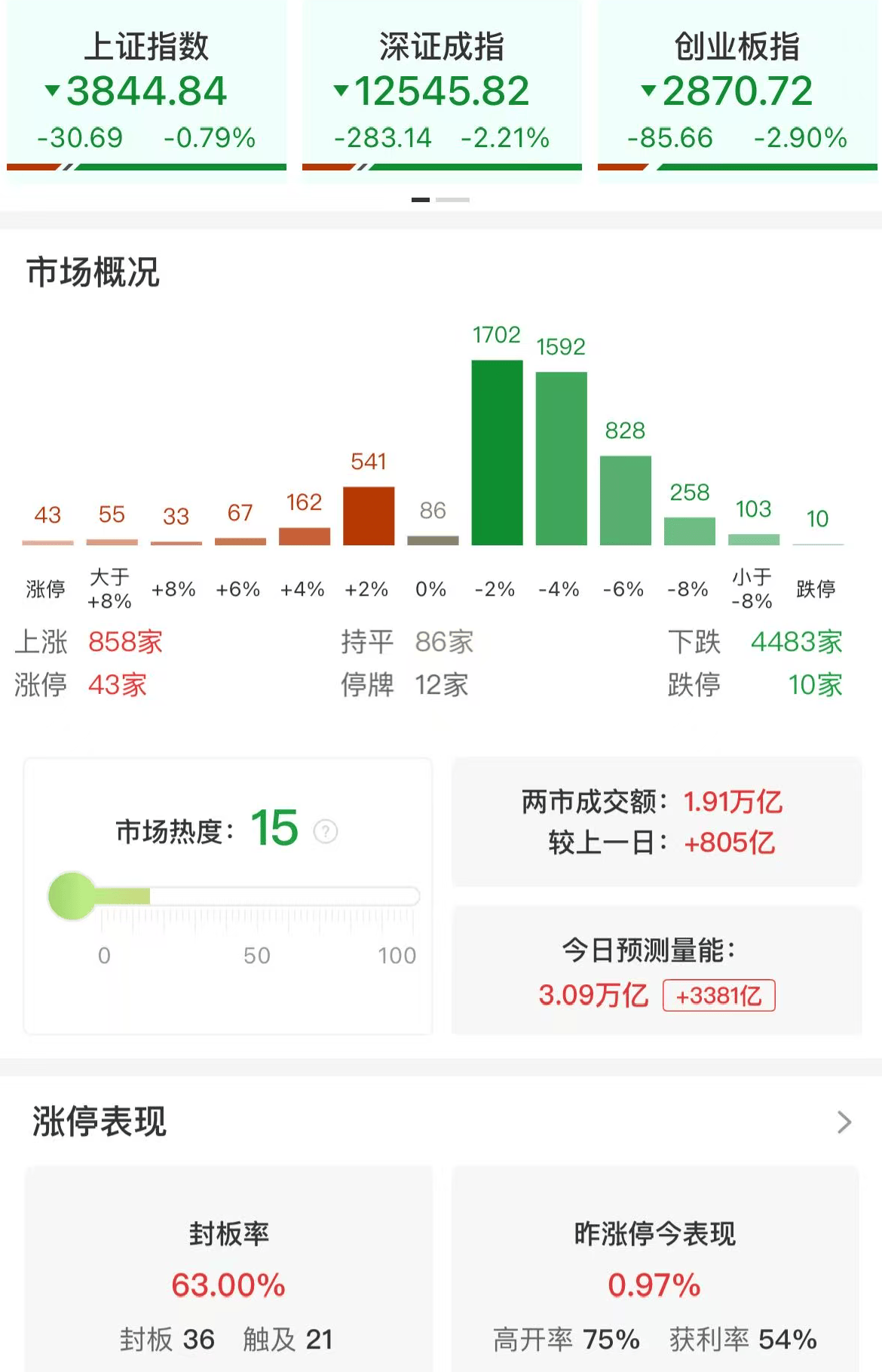
Group 1 - The A-share market experienced a collective decline in the three major indices, with the Shanghai Composite Index down by 0.79%, the Shenzhen Component Index down by 2.21%, and the ChiNext Index down by 2.9% [1] - The total trading volume in the Shanghai, Shenzhen, and Beijing markets reached 19,304 billion yuan, an increase of 840 billion yuan compared to the previous day [1] - Over 4,400 stocks in the market saw declines, with sectors such as computing hardware, military equipment, consumer electronics, and digital currency concepts experiencing the largest drops [1] Group 2 - In the ETF market, the S&P Consumer ETF rose by 2.86%, while the financial sector showed strong performance with various bank ETFs increasing by 1.42%, 1.29%, and 1.26% [5] - The public utility sector also saw gains, with green power ETFs rising by 1.1% and public utility ETFs increasing by 1.01% [5] - Conversely, the previously high-performing new energy vehicle battery ETF fell by 9.97%, and the AI hardware sector experienced a broad pullback, with communication equipment ETFs dropping by 6.49% [5]

三大压制因素释放绿电迎反转,绿色电力ETF(159625)冲击4连涨,成分股大唐发电领涨
Sou Hu Cai Jing· 2025-07-22 05:38
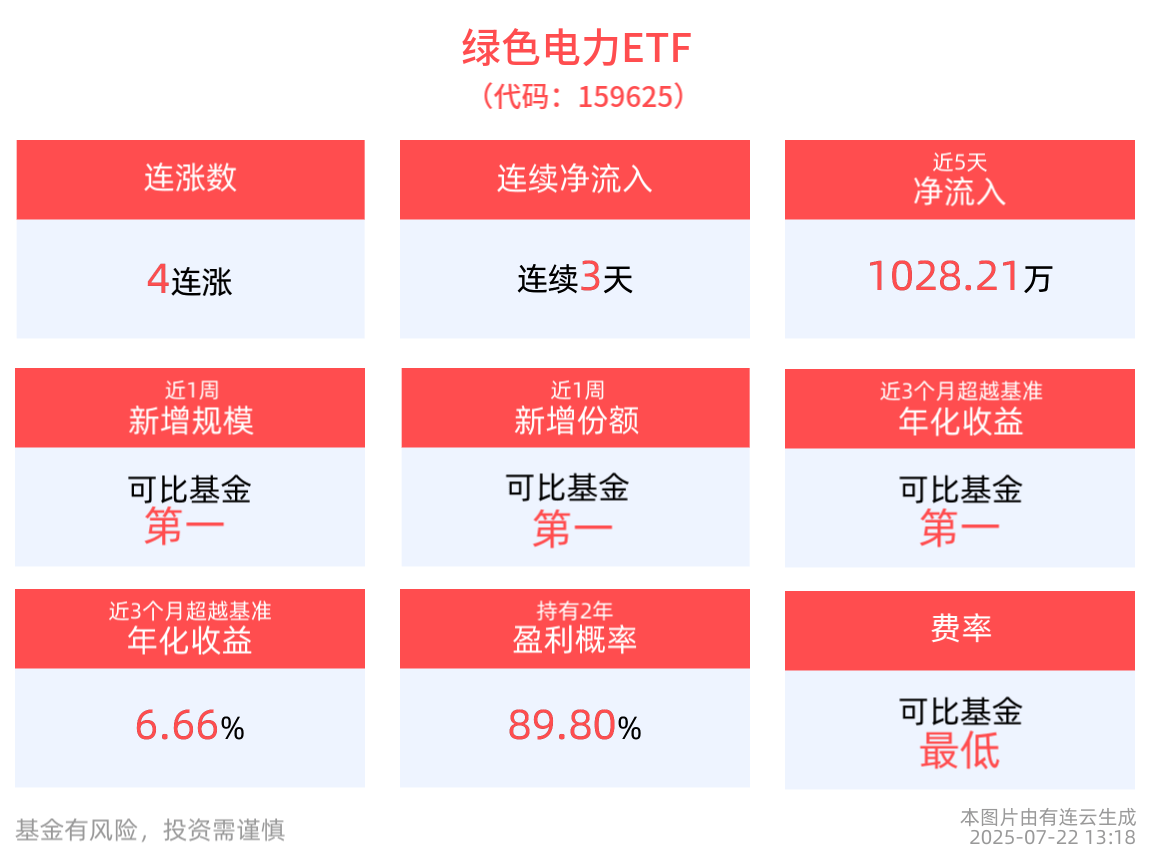
Group 1: Liquidity and Scale of Green Power ETF - The Green Power ETF had an intraday turnover of 3.03%, with a transaction volume of 9.51 million yuan. Over the past week, the average daily transaction volume reached 22.38 million yuan [2] - The Green Power ETF experienced a scale increase of 13.62 million yuan over the past week, ranking first among comparable funds. The number of shares increased by 8.40 million, also the highest among comparable funds [2] - In terms of net fund inflow, the Green Power ETF saw continuous inflows over three days, with a maximum single-day net inflow of 7.04 million yuan, totaling 9.82 million yuan [2] Group 2: Valuation and Index Composition - The latest price-to-earnings ratio (PE-TTM) of the index tracked by the Green Power ETF is 18.77 times, which is below the 81.36% historical level over the past three years, indicating a low valuation [2] - As of June 30, 2025, the top ten weighted stocks in the National Green Power Index include Changjiang Electric Power, Three Gorges Energy, China Nuclear Power, and others, collectively accounting for 56.91% of the index [2] Group 3: Market Dynamics and Policy Changes - The National Development and Reform Commission has released a plan for a normalized electricity trading mechanism across grid operation areas, aiming for optimized resource allocation during peak summer periods in 2025 [3] - The number of market participants in the national electricity market is projected to reach 816,000 in 2024, a year-on-year increase of 8.9%, with 35,000 power generation companies and 777,000 electricity users [3] - The release of three major factors—consumption, electricity prices, and subsidies—will likely lead to a reversal for green electricity operators, with market-driven pricing expected to guide renewable energy investments back to actual demand [3]





多只光伏ETF涨超5%;首批科创债ETF“日光”丨ETF晚报
2 1 Shi Ji Jing Ji Bao Dao· 2025-07-08 11:20
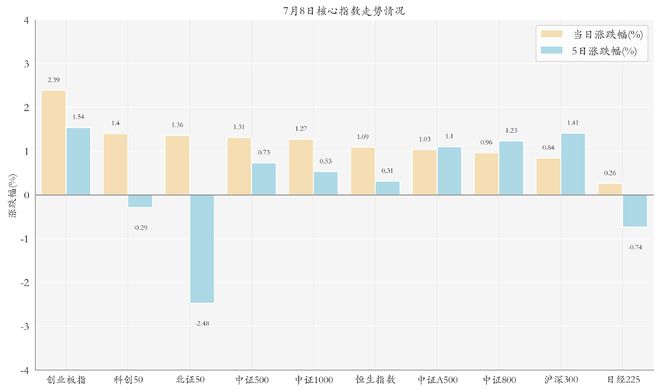
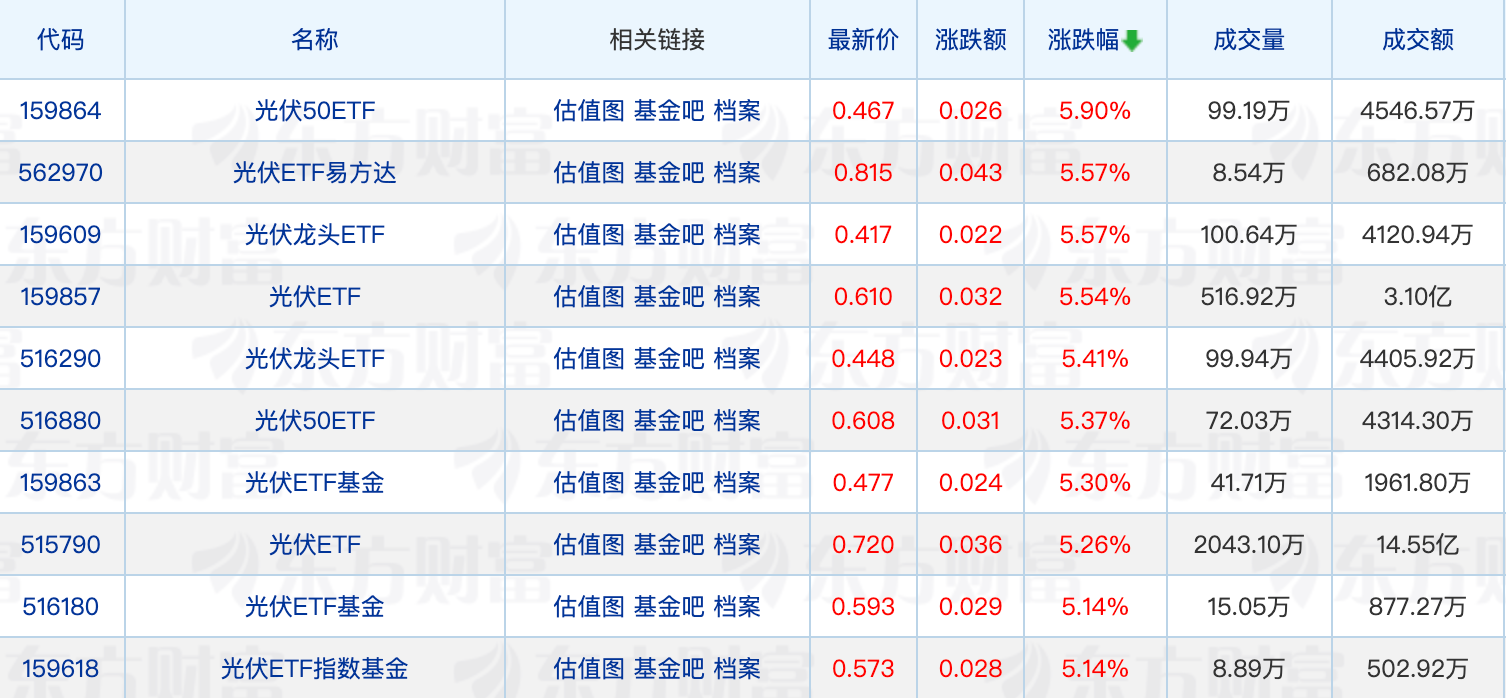
Market Overview - The three major indices in China experienced collective gains, with the Shanghai Composite Index rising by 0.7%, the Shenzhen Component Index increasing by 1.47%, and the ChiNext Index up by 2.39% [1][3]. - The photovoltaic sector saw significant ETF performance, with multiple ETFs such as the Photovoltaic 50 ETF rising by 5.90% and the E Fund Photovoltaic ETF increasing by 5.57% [1][10]. Sector Performance - In the A-share market, the telecommunications, power equipment, and electronics sectors led the day with gains of 2.89%, 2.3%, and 2.27% respectively, while utilities, banking, and household appliances lagged behind with declines [6]. - Over the past five trading days, the construction materials, steel, and comprehensive sectors showed strong performance with increases of 5.71%, 5.43%, and 3.67% respectively [6]. ETF Market Activity - The overall performance of ETFs indicated that thematic stock ETFs had the best average gain of 1.46%, while bond ETFs showed no change [8]. - The top-performing ETFs included the Photovoltaic 50 ETF, Photovoltaic Leader ETF, and E Fund Photovoltaic ETF, with returns of 5.90%, 5.57%, and 5.57% respectively [10]. - The top three ETFs by trading volume were the A500 ETF Fund, A500 ETF Huatai Baichuan, and A500 ETF Jiashi, with trading volumes of 3.73 billion, 3.37 billion, and 3.09 billion respectively [12][13]. Investment Trends - There is a notable influx of capital into the technology innovation sector, highlighted by the rapid issuance of the first batch of 10 technology innovation bond ETFs, which collectively raised 30 billion yuan [2]. - The introduction of technology innovation bond ETFs is seen as strategically significant, filling a gap in public funds within the "technology finance" bond fund sector and promoting targeted investment in hard technology [2].
首批10只科创债ETF全部“日光”;多只QDII基金“开门迎客”
Mei Ri Jing Ji Xin Wen· 2025-07-08 07:20
Group 1: Fund News - The first batch of 10 Sci-Tech Bond ETFs was fully subscribed on the first day, with a fundraising cap of 3 billion yuan for each fund [1] - Multiple QDII funds have adjusted their large subscription limits, allowing for increased investment opportunities [2] - Public funds have seen a significant increase in net subscriptions, reaching 5.318 billion yuan in the first half of the year, a 189.65% increase compared to the same period last year [3] Group 2: Fund Manager Updates - Huabao Fund announced the appointment of a new fund manager, Cao Xucheng, for the Huabao CSI Financial Technology Theme ETF, who has 5 years of experience in the industry [4] Group 3: ETF Market Performance - The market experienced a rally, with the Shanghai Composite Index rising by 0.7%, the Shenzhen Component Index by 1.46%, and the ChiNext Index by 2.39%, with a total trading volume of 1.45 trillion yuan [5] - Solar energy stocks rebounded strongly, with over 10 stocks hitting the daily limit, and related ETFs saw gains of up to 5.90% [6] Group 4: ETF Thematic Opportunities - The government has signaled a shift in the solar energy sector, which may accelerate the clearing of excess capacity and drive technological advancements, presenting potential investment opportunities in solar ETFs [9]
“冬炒煤、夏炒电”失灵:电价跌停潮,风电成独苗?
市值风云· 2025-06-24 10:17
Core Viewpoint - The traditional investment logic of "winter coal and summer electricity" is losing its effectiveness due to significant changes in the electricity market, including price declines and increased volatility in project revenues [3][15]. Group 1: Electricity Market Dynamics - The electricity market is undergoing a transformation with the implementation of the "New Energy Grid Price Marketization Reform Notice," which requires new energy to enter the market, ending the previous "guaranteed quantity and price" policy [3]. - In April 2025, the National Development and Reform Commission and the National Energy Administration announced plans to accelerate the construction of the electricity spot market, aiming for full coverage by the end of 2025 [4]. - The electricity trading prices in Jiangsu and Guangdong provinces have seen significant declines, with Jiangsu's price dropping by 22% from May 2025 [5][8]. Group 2: Price Trends and Supply-Demand Imbalance - The decline in electricity prices is attributed to a combination of oversupply in the electricity market and weak demand, particularly in industrial provinces like Guangdong [10][11]. - The falling coal prices have further reduced the marginal costs of thermal power generation, exacerbating the price drop in the electricity market [9][15]. - The average return of electricity indices in the second and third quarters has historically been around 8.2%, but recent performance has significantly lagged behind this average [16][17]. Group 3: ETF Performance and Valuation Concerns - The major electricity ETFs have underperformed, with the top five ETFs tracking the electricity sector showing average returns of -8.3% over the past year [18][19]. - The current low price-to-earnings (PE) ratios for the electricity indices (17.1 for the China Securities Index and 17.3 for the Green Electricity Index) indicate market pessimism regarding future profitability [22][25]. - Despite the low valuations suggesting a potential buying opportunity, they reflect a broader market concern about declining industry profits due to price pressures [25][26]. Group 4: Wind Power as an Investment Opportunity - The wind power sector has shown resilience, with the China Wind Power Industry Index increasing over 20% since late April 2025, outperforming other electricity indices [39]. - The competitive environment in the wind power industry has improved, leading to stabilized prices and increased installation capacity [44][45]. - Wind power companies, such as Goldwind Technology, have reported significant revenue and profit growth, indicating a positive outlook for the sector [46][47].

ETF午评:港股医疗ETF领涨2.26%,绿色电力ETF易方达领跌2.05%
news flash· 2025-04-29 03:33
Group 1 - The Hong Kong medical ETF (159366) led the gains with an increase of 2.26% [1] - The automotive parts ETF (562700) rose by 2.05% [1] - The 2000 ETF enhancement (159553) saw an increase of 2.01% [1] Group 2 - The green power ETF from E Fund (562960) was the biggest loser, declining by 2.05% [1] - Another green power ETF (561170) also fell by 2.05% [1] - The power ETF fund (561700) decreased by 2.03% [1] Group 3 - A-share accounts can now buy Hong Kong stocks with T+0 trading without the need for Hong Kong Stock Connect [1]
ETF开盘:红利低波100ETF基金领涨9.99%,港股通创新药ETF领跌3.15%
news flash· 2025-04-28 01:29
Group 1 - The ETF market opened with mixed results, with the Low Volatility Dividend ETF (560520) leading gains at 9.99% [1] - The Home Appliance ETF (561120) increased by 3.03%, while the Green Power ETF (561170) rose by 2.90% [1] - The Hong Kong Stock Connect Innovative Drug ETF (159570) experienced the largest decline at 3.15%, followed by the ICBC Hong Kong Stock Connect Innovative Drug ETF (159217) down 2.89%, and the Hong Kong Innovative Drug ETF (513120) falling by 2.86% [1] Group 2 - The article suggests that investors looking to capitalize on market rebounds should consider purchasing index ETFs [1]