
自动化分拣设备

Search documents
坚持内需主导,建设强大国内市场
Xin Hua Wang· 2026-01-04 23:29
Group 1 - The core focus of the article is on the importance of domestic demand in driving economic growth and the establishment of a strong domestic market as a priority for the 2026 economic agenda [5][15] - The Chinese government has identified eight key tasks for economic work in 2026, with "insisting on domestic demand as the main driver" being the foremost task [5] - The "Two New" policies and "Two Heavy" project optimizations are set to enhance domestic consumption and investment, with a special bond plan of 625 billion yuan allocated for consumer goods replacement [5][15] Group 2 - The ice and snow economy is highlighted as a significant driver of consumption, with outdoor ski resort searches increasing over threefold year-on-year [6][7] - The implementation of the old-for-new policy has led to a 20% increase in sales for Haier's home appliances, with total sales related to this policy exceeding 2.6 trillion yuan in 2025 [7][8] - Equipment investment has shown a robust growth of 12.2% year-on-year, contributing to an overall investment increase of 1.8 percentage points [8] Group 3 - Experts believe that while challenges exist, the potential for expanding domestic demand remains significant, driven by consumption upgrades and digital economy innovations [10][11] - The article emphasizes the need for effective investment strategies, with a focus on technological upgrades and infrastructure projects, predicting that fixed asset investment will exceed 3.6 trillion yuan in 2025 [16][17] - The government aims to enhance consumer spending by improving social security systems and increasing residents' income, thereby expanding consumption capacity [16][17]


坚持内需主导,建设强大国内市场(稳中求进、提质增效 实现“十五五”良好开局)
Ren Min Wang· 2026-01-04 22:37
Group 1 - The core focus of the article is on the importance of expanding domestic demand as a primary driver for economic growth in China, emphasizing the need for a strong domestic market and effective investment strategies [8][19]. - The Central Economic Work Conference has identified eight key tasks for 2026, with "maintaining domestic demand as the main driver" being the top priority [8]. - The "Two New" policies and "Two Heavy" projects are set to optimize implementation, with a first batch of 625 billion yuan in special long-term bonds allocated to support consumer goods replacement programs [8]. Group 2 - The ice and snow economy is highlighted as a significant contributor to consumption and domestic demand, with outdoor ski resort search volumes increasing over three times since December 2025 [9]. - The "old for new" consumer goods policy has led to a notable increase in sales, with over 2.6 trillion yuan in sales related to this initiative in 2025, benefiting more than 360 million people [10]. - Investment in equipment and tools has seen a 12.2% year-on-year increase from January to November 2025, contributing to overall investment growth [11]. Group 3 - The article discusses the potential for consumption upgrades, with digital technologies and new consumption models driving significant retail growth, as evidenced by a network retail sales figure of 543.98 million yuan in a specific region [13]. - Effective investment opportunities remain vast, with companies like Tianjin Feixuan Technology Co., Ltd. benefiting from quick access to credit for technology upgrades [14]. - The article emphasizes the need for a robust domestic market, advocating for policies that enhance consumer spending and investment in infrastructure and public services [17][18].

网点老板向每经记者讲述“史上最无感双11”:科技上位,人力退场,快递行业驶向国际市场
Mei Ri Jing Ji Xin Wen· 2025-11-17 13:25
Core Insights - This year's "Double 11" shopping festival has been described as the "most unremarkable" in history, with many express delivery companies reporting that their package volumes remained nearly flat compared to last year [1][4] - The average daily package collection volume for postal and express companies during this year's "Double 11" was 634 million, which is 117.8% of the normal business volume, with a peak daily volume of 777 million packages [1] - The logistics peak period has been extended, with significant promotional activities starting as early as September and continuing until mid-November [3] Group 1: Domestic Market Performance - Many express delivery outlets did not feel a significant increase in package volume during "Double 11," with some reporting only a few thousand more packages than usual on peak days [1] - The peak daily order volume for some outlets was approximately 55,000, showing minimal growth from last year's 54,700 [4] - Express companies have shifted focus from quantity to quality, indicating a healthy development in the logistics industry [4][6] Group 2: International Market Growth - In contrast to the domestic market, international markets are providing new growth opportunities for express companies, with J&T Express reporting a 55% increase in average daily package volume in the Philippines during "Double 11" [2] - Other Southeast Asian markets, such as Vietnam, saw a remarkable 211% year-on-year increase in package volume during the promotional period [2][5] Group 3: Technological Advancements - This year's "Double 11" highlighted the extensive use of technology in logistics, with many companies deploying automated sorting equipment and unmanned delivery vehicles [6][7] - J&T Express has upgraded over 1,000 delivery vehicles and established a large unmanned delivery fleet, while Zhongtong Express has formed the largest unmanned vehicle fleet in the industry [7][8] - The introduction of AI-driven systems has significantly improved routing efficiency, reducing analysis time from five days to one day, potentially saving over 100 million yuan in annual operational costs [8] Group 4: Future Outlook - Experts predict that the logistics industry will continue to experience a shift from quantity-focused strategies to quality-driven approaches, with stable price increases expected in the coming year [8]
网点老板讲述“史上最无感双11”:快递少了吗?技术上位、人力退场 ,行业驶向AI与全球化新战场
Mei Ri Jing Ji Xin Wen· 2025-11-15 06:49
Core Insights - This year's "Double 11" shopping festival saw a significant shift in consumer behavior and logistics operations, with many express delivery companies reporting stable package volumes compared to previous years, indicating a more normalized shopping pattern [1][3][6]. Group 1: Delivery Volume and Trends - Many delivery point owners reported that the volume of packages during this year's "Double 11" was nearly the same as last year, with peak daily volumes only slightly higher than usual [1][5]. - The average daily package collection volume for postal and express companies during "Double 11" reached 634 million, which is 117.8% of regular business volume, with a peak daily volume of 777 million packages [1][3]. - The logistics peak period has been extended, with significant promotional activities starting as early as September and lasting until mid-November, leading to three distinct peak periods [5][6]. Group 2: Automation and Technology Adoption - The express delivery industry has increasingly adopted automation technologies, with many companies investing in automated sorting equipment and unmanned delivery vehicles to enhance efficiency and reduce labor intensity [7][8][11]. - Jitu Express reported a significant increase in global package volume, with a 9% year-on-year growth on November 11, and a 15% increase in average daily package volume from November 1 to 12 [7][8]. - Major express companies like Zhongtong and Yunda have deployed thousands of unmanned vehicles and drones to address last-mile delivery challenges, indicating a shift towards technology-driven logistics solutions [8][9][11]. Group 3: Market Performance and Future Outlook - Experts noted that this year's "Double 11" was characterized by the best performance across enterprise, user, and delivery endpoints, reflecting a healthy development in the logistics industry [6][11]. - The logistics sector is transitioning from a focus on quantity to a focus on quality, with expectations for stable price increases in the coming year as automation becomes standard in delivery operations [11].

“双十一”新观察·分拣“加速跑” 快递小哥告别“爆单焦虑”
Yang Shi Wang· 2025-11-12 06:06
Core Viewpoint - The logistics industry is experiencing a peak in package volume during the "Double Eleven" shopping festival, with new technologies aiding delivery personnel in managing the increased workload [1]. Group 1: Automation and Efficiency - A new automated sorting system has been implemented at a major logistics hub, allowing a reduction in the number of staff needed for sorting from over ten to five or six, achieving an average sorting time of 40 seconds per package [3][5]. - The introduction of automation has alleviated the "explosion order anxiety" experienced by delivery personnel during peak seasons [5]. Group 2: Innovative Delivery Solutions - In Jiangsu, unmanned vehicles have been deployed to assist delivery personnel, enhancing collection efficiency by allowing drivers to input destinations and have the vehicle autonomously pick up packages [7]. - These unmanned vehicles are equipped with cooling and shock-absorbing systems, and logistics routes have been optimized to ensure the freshness of perishable goods, such as crabs [7]. - The delivery scope has expanded from just the Jiangsu region to nationwide distribution, with plans for further speed enhancements by 2025 [9].

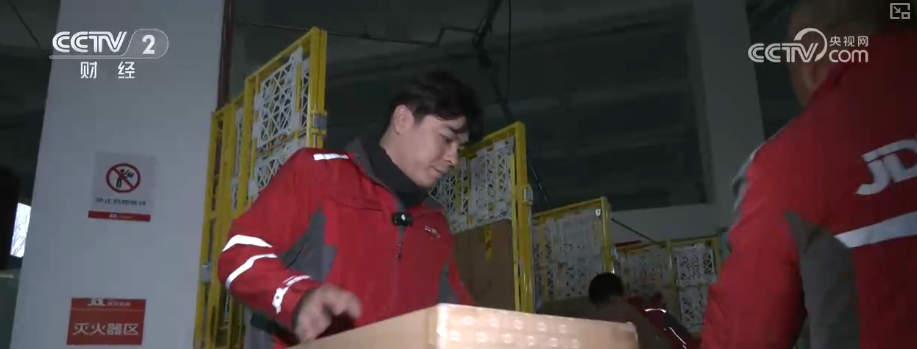
快递小哥的“双十一”:科技助力物流升级 告别“爆单焦虑”
Yang Shi Wang· 2025-11-11 23:32
Core Viewpoint - The logistics industry is experiencing a peak in package volume during the Double Eleven shopping festival, prompting the adoption of new technologies to enhance efficiency and manage the increased workload [1]. Group 1: Automation and Efficiency - A new automated sorting system has been implemented at a major logistics hub, allowing a reduction in the workforce needed for sorting from over ten to five or six employees, achieving an average sorting time of 40 seconds per package [3]. - The experience of delivery personnel, such as Wang Yang, has improved significantly, alleviating the stress associated with high package volumes during peak seasons [3]. Group 2: Innovative Delivery Solutions - In Jiangsu, the introduction of unmanned delivery vehicles is assisting couriers by automating the collection and delivery process, allowing for efficient handling of time-sensitive products like hairy crabs [5]. - These unmanned vehicles are equipped with cooling and shock-absorbing systems, enhancing the preservation of perishable goods during transit [7].

“大企帮小店”的协同之智(纵横)
Ren Min Ri Bao· 2025-11-03 22:20
Core Insights - The "Big Enterprises Helping Small Shops" initiative in Zhejiang has significantly improved the operational efficiency of small businesses by sharing resources, leading to a reduction in procurement costs by over 50% and a steady increase in customer traffic [1][2]. Group 1: Initiative Overview - The initiative aims to address the challenges faced by individual businesses, such as funding shortages and supply chain issues, by leveraging the resources of large enterprises [1][2]. - A structured support mechanism has been established, where small shops can express their difficulties, large enterprises provide resources, and the government facilitates the process [2]. Group 2: Benefits of Collaboration - The collaboration between large enterprises and small shops not only helps in overcoming operational challenges but also optimizes the supply chain, enhancing market resilience [3]. - The integration of technology from large enterprises with the flexibility of small shops fosters a mutually beneficial cycle of growth and transformation [3].
“双十一”首个快递高峰到来 自动化分拣、无人设备助力效率提升
Yang Guang Wang· 2025-10-22 01:40
Core Insights - E-commerce platforms are initiating sales activities, and express delivery companies are enhancing their logistics efficiency through automation to prepare for the upcoming peak business period [1][2] - The express delivery industry is increasingly focusing on automation, with one company reporting a 30% increase in efficiency due to upgraded automated equipment, raising processing capacity from 5,000 to 7,000-8,000 packages per hour [1][2] Industry Trends - The express delivery sector is experiencing a shift towards intelligent, data-driven, and automated operations to adapt to the evolving market demands [2] - The volume of express deliveries is projected to grow from approximately 170 billion packages last year to an estimated 200 billion packages by the end of this year, indicating a rapid growth rate [2]
无人车开进公交场站,深圳南京试水“公交车送快递”跨界融合
Nan Fang Du Shi Bao· 2025-07-25 11:41
Core Insights - The collaboration between Shenzhen Bus Group, SF Express, and New Stone Technology aims to create an innovative model that integrates public transport, logistics, and autonomous systems, marking a significant step in enhancing urban resource utilization and service efficiency [1][3] Group 1: Collaboration and Innovation - The partnership focuses on utilizing Shenzhen Bus Group's extensive bus station network as efficient supply and transfer hubs for autonomous delivery vehicles, integrating logistics into the public transport framework [2][3] - New Stone Technology provides L4-level autonomous driving technology, which is currently being tested in various districts of Shenzhen to improve last-mile delivery efficiency for SF Express [2][3] Group 2: Operational Efficiency - Shenzhen Bus Group plans to leverage big data and road network knowledge to optimize delivery routes for autonomous vehicles, ensuring safety through integrated monitoring and support systems [3] - As of now, over 300 functional autonomous vehicles are operational in Shenzhen, with ongoing efforts to expand the delivery network and explore collaborative innovation between public transport and logistics [3] Group 3: Broader Applications - Other cities, such as Nanjing and Zhengzhou, are also exploring similar "bus delivery" models to enhance delivery efficiency and reduce costs, with Nanjing successfully implementing a same-day delivery service through public transport [4][5] - In Zhengzhou, SF Express plans to utilize excess bus capacity for urgent deliveries and transform bus stations into multifunctional logistics hubs, enhancing urban logistics efficiency [5]


公交车“兼职”送快递 多地探索城市物流配送新模式
Zheng Quan Ri Bao· 2025-07-24 16:07
Core Viewpoint - The collaboration between express logistics companies and public transport groups is exploring new urban logistics delivery models, particularly the "bus + logistics" unmanned delivery integration model in cities like Shenzhen [1][2]. Group 1: Collaboration Initiatives - Shenzhen has initiated a "bus + logistics" unmanned delivery model, with local bus companies partnering with express firms to utilize bus stations and resources for urban automated delivery [1]. - Zhengzhou Public Transport Group and SF Express signed a strategic cooperation agreement to explore a "bus + logistics + ecology" integration model [2]. - JD Logistics and Chengdu Public Transport Group have also entered into a cooperation framework agreement to enhance logistics services [2]. Group 2: Operational Enhancements - The collaboration aims to transform bus stations into multifunctional logistics hubs, integrating bus transport with express delivery services [2]. - SF Express plans to utilize excess capacity of buses during off-peak hours for urgent local deliveries, while also investing in automated sorting and smart warehouse management systems [2]. Group 3: Technological Integration - Public transport companies are developing smart management systems and apps to track express deliveries in real-time, enhancing efficiency and service quality [3]. - The integration of data sharing between bus groups and express companies allows for real-time monitoring and intelligent scheduling of deliveries [3]. Group 4: Industry Outlook - The "bus + logistics" model is expected to play a significant role in promoting urban-rural logistics integration, reducing delivery costs, and improving service efficiency [3]. - The transportation sector is facing challenges due to declining public transport attractiveness, necessitating innovative solutions to improve operational conditions [3]. - Experts believe that the potential for large-scale promotion of the "bus + logistics" model is significant, although it requires balancing safety, costs, and profit distribution [4].