英克司兰

Search documents
沉默的基因,百亿的战争:小核酸技术破壁敲开药物新世界大门丨黄金眼
Quan Jing Wang· 2026-02-05 01:42
Group 1 - The "small nucleic acid" sector is gaining significant attention and investment, moving from laboratory research to the forefront of the industry [1] - Traditional drugs struggle with over 80% of disease-related targets being "undruggable," while small nucleic acid drugs offer a new approach by targeting the "blueprints" of disease-causing genes [2][3] - Small nucleic acid drugs, such as ASO and siRNA, can silence or regulate the expression of pathogenic genes, providing new treatment pathways for diseases like spinal muscular atrophy [4] Group 2 - The delivery system is a critical bottleneck for the development of small nucleic acid drugs, with recent advancements enabling targeting beyond the liver to other organs [5] - The FDA has approved 19 small nucleic acid drugs globally, with ASO and siRNA making up 38% and 32% of the development focus, respectively [5] - The pipeline for siRNA drugs is expanding into chronic diseases and CNS disorders, with significant applications in metabolic and cardiovascular diseases [6] Group 3 - The global market for small nucleic acid drugs is projected to grow from $2.7 billion in 2019 to $5.7 billion in 2024, with a compound annual growth rate (CAGR) of 16.2% [8] - The siRNA market share is expected to increase significantly, from $200 million in 2019 (7% share) to $2.4 billion in 2024 (44.5% share) [9] - Chinese companies are increasingly recognized for their innovation in small nucleic acids, with significant licensing deals and collaborations, marking a shift from following to competing in the global market [13] Group 4 - Notable acquisitions, such as Novartis's $12 billion purchase of Avidity, highlight the strategic importance of small nucleic acid platforms in drug delivery [8] - Companies like Be Better Med and Frontier Bio are developing diverse pipelines targeting various diseases, including hypertension and metabolic disorders [16][17] - The rise of small nucleic acids signifies a paradigm shift in drug discovery, moving from protein-based approaches to rational design based on genetic sequences [19]


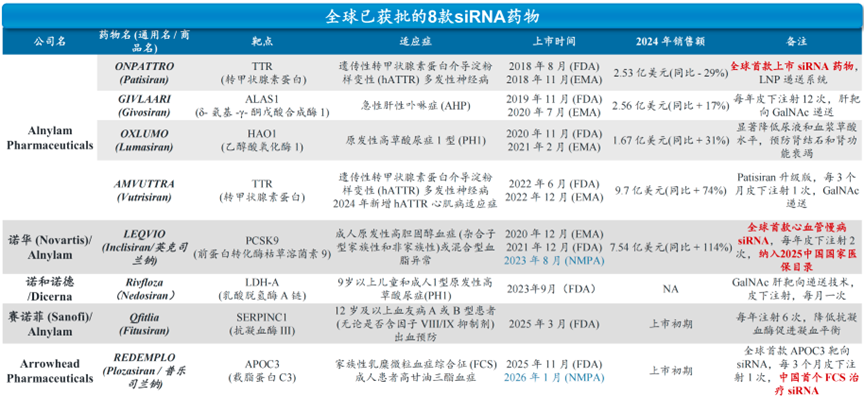
华西证券:小核酸药物凭借技术突破性与治疗差异化 成为精准医疗核心赛道
Zhi Tong Cai Jing· 2026-02-03 02:01
Group 1 - The small nucleic acid drug industry is recommended to focus on three categories: clinical progress type (key targets with Phase III data + beneficiaries of medical insurance), technology platform type (extracellular delivery + multi-target technology companies), and international cooperation type (local companies endorsed by MNCs) to capture dual dividends from new drug launches and data readout windows [1] - Small nucleic acid drugs have become a core track in precision medicine due to their technological breakthroughs and therapeutic differentiation, covering thousands of rare and chronic disease-related targets [1] - The global market for small nucleic acid drugs is expected to grow from $2.7 billion in 2019 to $5.7 billion in 2024, with a CAGR of 16.2%, and projected to reach $20.6 billion by 2029, driven by the increase in chronic diseases and significant drug commercialization [2] Group 2 - The industry is entering a high growth phase, with over 50% of the 19 drugs currently on the market targeting rare diseases, while the proportion of chronic diseases is expected to gradually increase [2] - Key players in the industry include Alnylam and Ionis, which dominate the market with their technological barriers, while local companies like Reebio and Bowang Pharmaceutical are focusing on niche areas [2] - 2025 is anticipated to be a pivotal year for small nucleic acid drugs, with several key drugs expected to achieve significant sales milestones and clinical endpoints [3]

小核酸药物行业深度研究报告:RNA精准医疗时代的崛起与挑战
HUAXI Securities· 2026-02-03 00:25
Investment Rating - The industry rating is recommended for investment [5] Core Insights - The small nucleic acid drug industry is positioned as a core track in precision medicine due to technological breakthroughs and differentiated treatments, focusing on ASO and siRNA types to regulate genes at the mRNA level, overcoming traditional "undruggable" targets and covering thousands of rare and chronic disease-related targets [2][11][12] - The global market for small nucleic acid drugs is rapidly expanding, with a projected growth from $2.7 billion in 2019 to $5.7 billion in 2024 (CAGR of 16.2%), and expected to reach $20.6 billion by 2029 (CAGR of 29.4%), driven by the increase in chronic diseases and significant breakthroughs in liver-targeted technologies [3][21] - The industry is characterized by a dual structure of "international leaders dominating + local companies breaking through," with companies like Alnylam and Ionis leading the market while local firms focus on niche areas [3][40] Summary by Sections Industry Overview - Small nucleic acid drugs leverage unique mechanisms to achieve precise gene regulation, offering advantages over traditional small molecules and antibody drugs [11][12] - The technology has evolved from being considered "undruggable" to providing viable treatment options for various diseases, including rare genetic disorders [12][13] Market Expansion - The market is transitioning from rare diseases to common diseases, with chronic disease treatments expected to dominate in the future [21][22] - The introduction of significant products like Novartis' Inclisiran is anticipated to drive sales growth, with a projected revenue of $750 million in 2024 [21][22] Competitive Landscape - International leaders like Alnylam have established a strong market presence with multiple commercialized products, while local companies are innovating in specific niches [40][41] - Alnylam's revenue reached $2.62 billion in the first three quarters of 2025, marking a significant milestone in profitability and cash flow [40][41]
东方证券:小核酸实现长效减脂保肌 有望再塑减重市场
智通财经网· 2026-01-15 04:05
Core Insights - Small nucleic acid drugs are emerging as potential leaders in the weight loss sector, shifting from merely "suppressing appetite" to "precisely regulating fat metabolism" [1][2] - The global weight loss market still has unmet needs despite the rapid uptake of GLP-1 drugs, which face issues such as rebound weight gain and gastrointestinal intolerance [2] - Domestic companies are quickly establishing small nucleic acid weight loss pipelines, focusing on targets, delivery platforms, and indications to unlock potential value in health weight loss and fatty liver disease [1][2] Group 1: INHBE Insights - INHBE, which encodes activin E, interacts with the ALK7 receptor in adipose tissue to inhibit fat breakdown, presenting a differentiated clinical value with strong drug development certainty [3] - Early clinical data for INHBE siRNA shows safety and efficacy in long-term fat loss while preserving muscle mass, with combined therapy yielding doubled weight loss and tripled visceral fat reduction compared to GLP-1 [3] - The GalNAc delivery system used for INHBE siRNA has proven clinical development certainty due to existing successful drugs like inclisiran [3] Group 2: ALK7 Insights - ALK7 siRNA requires a targeted delivery system to adipose tissue, with early clinical data indicating significant mRNA knockdown efficiency and sustained effects [4] - ARO-ALK7 demonstrated superior reduction in visceral fat compared to INHBE, with a 14.1% reduction observed at the 8-week mark after a single 200 mg dose [4] - The breakthrough in fat-targeted delivery systems is crucial for the competitive landscape of small nucleic acid drugs [4] Group 3: Investment Recommendations - Relevant investment targets include companies such as Heng Rui Medicine, Innovent Biologics, and others involved in small nucleic acid drugs [5] - The potential for small nucleic acid drugs in the weight loss market is significant, with various companies positioned to capitalize on this emerging trend [5]

2026年的“降脂计划”做好了吗?吃素吃药都不管用怎么办?看这篇就够了
Xin Lang Cai Jing· 2026-01-04 23:12
Core Viewpoint - Abnormal blood lipids are a major risk factor for cardiovascular diseases, and controlling blood lipids is particularly important during high-incidence seasons for these diseases [3] Group 1: Misconceptions about Blood Lipid Control - Many patients believe that dietary changes alone can significantly lower cholesterol levels, but cholesterol in the blood is primarily produced internally, with only 20% to 30% coming from dietary sources [6][7] - The body's cholesterol production is largely determined by genetics, and some individuals may have a high internal production rate regardless of dietary restrictions [6][7] Group 2: Underlying Causes of High Blood Lipids - High blood lipids can be a symptom of other underlying conditions, such as hypothyroidism, which can slow metabolism and reduce cholesterol clearance [9][10] - Other endocrine disorders, like diabetes and Cushing's syndrome, can also lead to abnormal lipid levels, indicating the need for comprehensive evaluation rather than solely relying on medication [10] Group 3: Treatment Options and Guidelines - Statins are the cornerstone of treatment for cardiovascular diseases, effectively lowering "bad cholesterol" and stabilizing atherosclerotic plaques [12] - For patients with specific genetic backgrounds or those who do not respond adequately to statins, advanced treatments like PCSK9 inhibitors and high-purity prescription-grade Omega-3 fatty acids are available [12][13] - Current medical guidelines recommend different LDL cholesterol targets based on individual risk factors, emphasizing the importance of a balanced approach to cholesterol management rather than aiming for excessively low levels [13]
云顶新耀(01952.HK)宣布与海森生物达成战略合作 发挥商业化平台的优势与布局
Ge Long Hui· 2025-12-11 09:56
Core Insights - Cloudtop New Horizon (HKEX 1952.HK) has signed two strategic cooperation agreements with Haisen Biopharmaceutical Co., Ltd., which will enhance operational efficiency and commercial capabilities in the cardiovascular disease sector [1][3] Group 1: Strategic Agreements - The commercial service agreement allows Cloudtop New Horizon to leverage its existing sales and marketing system to provide commercialization services for six mature products from Haisen Biopharmaceutical, focusing on critical care, cardiovascular, and metabolic fields [1] - The licensing agreement grants Cloudtop New Horizon exclusive rights for the clinical development, registration, and commercialization of Lerodalcibep in Greater China, enriching its late-stage pipeline [1] Group 2: Financial Terms - Under the licensing agreement, Cloudtop New Horizon will make an initial payment of approximately 205 million yuan, with potential milestone payments not exceeding 212 million yuan for development and regulatory milestones, and up to 1.977 billion yuan for sales milestones, along with potential royalties based on net sales [1] Group 3: Product Overview - Lerodalcibep, developed by LIB Therapeutics, is a third-generation PCSK9 inhibitor designed to lower LDL-C levels in patients with high cholesterol, including heterozygous familial hypercholesterolemia [2] - The product is designed for convenient monthly subcutaneous injection and has shown significant efficacy in clinical trials, with applications submitted to the FDA and EMA, and a BLA submission expected in mid-2026 in Greater China [2] Group 4: Industry Implications - This collaboration is seen as a critical step in strengthening Cloudtop New Horizon's full industry chain layout, aligning with its long-term development strategy and enhancing its core competitiveness [3]
东方证券:医保平稳商保可期 国产创新药龙头胜出
Zhi Tong Cai Jing· 2025-12-10 03:17
Group 1 - The core viewpoint of the report is that the National Medical Insurance Administration (NMI) is encouraging the high-quality development of innovative drugs, with a clear trend towards supportive payment policies for innovative drugs, indicating that leading domestic innovative drug companies are entering a commercial realization phase [1] - The 2025 National Medical Insurance Drug List includes 127 products participating in bidding, with 114 drugs successfully added, of which 50 are Class 1 innovative drugs, accounting for 44%, marking a historical high [1] - The overall negotiation success rate is 90%, the highest in nearly seven years, while the success rate for drug applications is 18%, up by 2.5 percentage points year-on-year [1] Group 2 - The Chinese innovative drug market is experiencing accelerated differentiation, with a few leading domestic innovative drug companies contributing significantly to the newly included innovative drugs, indicating a concentration effect [2] - Heng Rui is the biggest winner with 20 innovative drugs/indications included, including 10 new entries, while Innovent Biologics follows with 7 innovative drugs, 6 of which are newly included [2] - The first version of the commercial insurance directory has three key highlights: only 19 out of 121 new drugs passed the formal review, 5 domestic CAR-T therapies were included, and 14 out of 19 drugs are oncology-related, accounting for 74% [4]
2025年医保谈判结果点评:医保平稳商保可期,国产创新药龙头胜出
Orient Securities· 2025-12-10 00:45
Investment Rating - The report maintains a "Positive" investment rating for the pharmaceutical and biotechnology industry, indicating an expected return that is stronger than the market benchmark by over 5% [5]. Core Insights - The National Medical Insurance Administration is strongly encouraging the high-quality development of innovative drugs, with clear policies supporting the payment side for innovative drugs. Domestic leading innovative drug companies are entering a commercial realization phase [3][7]. - The 2025 National Medical Insurance Drug List includes 127 products, with 114 successfully added, of which 50 are innovative drugs, marking a historical high. The overall negotiation success rate reached 90%, the highest in nearly seven years [7]. - The report highlights that the domestic innovative drug market is becoming increasingly concentrated, with leading companies like Heng Rui and Xin Da Biotech significantly benefiting from the new insurance policies [7]. Summary by Sections Investment Recommendations and Targets - Recommended stocks include Heng Rui Pharmaceutical (600276, Buy), Ke Lun Pharmaceutical (002422, Buy), Xin Li Tai (002294, Hold), Ao Sai Kang (002755, Buy), Jing Xin Pharmaceutical (002020, Buy), and others [3]. Market Dynamics - The report notes that the introduction of the commercial insurance directory marks the beginning of a "new golden decade" for Chinese innovative drugs, with a focus on high clinical efficacy and value innovation [7]. - The report emphasizes that the competition in the GLP-1 market remains clear, with the entry of new drugs not significantly altering the competitive landscape for existing treatments [7].



招商证券国际:降血脂市场潜力巨大 PCSK9/Lp心血管新药将迎来黄金时代
Zhi Tong Cai Jing· 2025-11-18 09:20
Core Insights - The lipid-lowering market is projected to reach $35 billion, with some drugs entering the long-term prevention field for cardiovascular event risk reduction (CVRR) [1][2] - Two significant lipid-lowering drugs are expected to report critical Phase III results in 2026, targeting PCSK9 and Lp(a) [1][2] - The development of cardiovascular and cardiac drugs is entering a harvest phase, with a focus on Phase III progress [1] Group 1: Key Developments in Lipid-Lowering Drugs - Novartis' PCSK9 small nucleic acid Leqvio and ASO drug Pelacarsen are under close observation for their Phase III trials, which could expand the market for lipid-lowering therapies [1][2] - Merck's MK-0616, the first oral cyclic peptide PCSK9 to enter Phase III, is expected to influence the long-term trajectory of the PCSK9 market [2] Group 2: Emerging Targets and Innovations - Arrowhead Pharmaceuticals' Plozasiran (ARO-APOC3) is set for FDA approval for treating familial chylomicronemia syndrome (FCS), marking a significant advancement in the siRNA field [3] - Eli Lilly's Lp(a) small molecule inhibitor Muvalaplin has initiated Phase III trials, with plans to enroll 10,450 participants, expected to complete by 2031 [3] Group 3: Direct-to-Consumer (DTC) Transformation - Major pharmaceutical companies like Eli Lilly, AbbVie, and Pfizer are launching online Direct-to-Consumer platforms, breaking traditional barriers in drug sales [4] - This shift aims to attract more self-paying users, particularly in the chronic disease sector, which is anticipated to capture the largest market share in the future [4]



小核酸:技术突破,打开千亿市场
2025-11-18 01:15
Summary of Key Points from the Conference Call on Small Nucleic Acid Drugs Industry Overview - The global small nucleic acid drug market has reached $6.2 billion and is expected to exceed $40 billion by 2033, driven by new drug approvals, commercialization, and breakthroughs in non-liver-targeted therapies [1][9][14] - Major multinational pharmaceutical companies like Novartis and Roche are actively investing in this sector through business development (BD) and acquisitions, with over 20 small nucleic acid drugs already on the market and more than 300 in clinical stages [1][4][9] Core Insights and Arguments - Key technological breakthroughs include GalNAc delivery technology and chemical modification techniques, which significantly enhance drug stability and efficacy, facilitating successful clinical trials [1][5][8] - ASO (Antisense Oligonucleotides) and siRNA (small interfering RNA) are the two main types of small nucleic acids, with siRNA showing rapid development post-delivery technology breakthroughs [1][6][7] - The small nucleic acid drug development process faces challenges in delivering drugs to non-liver tissues, necessitating the development of new delivery systems like AOC (Antibody-Oligonucleotide Conjugates) [1][8] Market Dynamics - The small nucleic acid target landscape is concentrated on metabolic diseases, hyperlipidemia, and hepatitis B, with significant competition in targets like PCSK9 [3][16] - Since 2018, the total BD transaction value in the small nucleic acid field has reached $45.2 billion, indicating strong interest from multinational corporations [3][17] - Domestic companies in China are rapidly emerging, transitioning from follower strategies to gaining leading advantages in certain targets and technologies [3][20] Company-Specific Developments - **Novartis**: Acquired Avidity for $12 billion to obtain AOC delivery technology, indicating a strong commitment to the small nucleic acid sector [3][9][15] - **Domestic Companies**: Companies like Shiyao Group, BoWang Pharmaceutical, and Jingyin Biotechnology are actively pursuing relevant targets and have made significant progress in clinical stages [3][20][21] - **Yuekang Pharmaceutical**: Leading in the domestic A-share market with a revenue of approximately $383.8 billion in 2024 and a focus on small nucleic acid pipelines [22] - **Frontier Biotech**: Concentrating on IGA nephropathy with multiple candidates showing first-in-class potential [24] - **Fuyuan Pharmaceutical**: Focused on generics but also advancing in small nucleic acid innovation, with over 20 patented targets [25] - **Shiyao Group**: Notable for its rapid progress in the SRA field, with three drugs in clinical trials [26][27] - **Rebio**: Recently submitted a listing application and has established significant partnerships, indicating strong growth potential [31] Future Trends - The small nucleic acid field is expected to see a surge in new drug approvals and clinical data readouts in the coming years, with a focus on expanding indications beyond liver-targeted therapies [14] - The market is anticipated to grow significantly, with projections indicating a rise from $6.2 billion to over $40 billion by 2033, driven by new approvals and commercialization efforts [9][14] - Companies are increasingly focusing on innovative delivery systems and expanding their target indications to include CNS and other areas [8][14][30] Additional Important Insights - The sales of existing small nucleic acid products are growing rapidly, with drugs like Inclisiran expected to see sales increase from $754 million in 2024 to over $1.2 billion in 2025 [12][13] - The competitive landscape is intensifying, with domestic companies showing strong potential to emerge as leaders in the small nucleic acid market [10][30]