
萤火虫汽车

Search documents
蔚来发布2025年Q4盈利预告:经调整经营利润首度转正
Feng Huang Wang· 2026-02-05 10:25
Core Viewpoint - NIO Group has announced a significant financial milestone, projecting its first positive adjusted operating profit in Q4 2025, with estimates ranging from RMB 700 million to RMB 1.2 billion, compared to a loss of RMB 5.5436 billion in the same quarter of 2024 [1][2] Financial Performance - The company expects an operating profit between RMB 200 million and RMB 700 million under GAAP standards for the same quarter, exceeding market expectations [1] - This positive shift in profitability is attributed to increased delivery volumes in the terminal market and an optimized product mix under its multi-brand strategy [1] Cost Management and Efficiency - NIO has implemented comprehensive cost reduction and efficiency enhancement measures, which have yielded significant benefits in Q4 [1] - Strict control over operating costs and improved organizational efficiency have helped offset the high investment pressures from R&D and infrastructure [1] Market Positioning - NIO is building a comprehensive business landscape covering all market segments through its high-end brand NIO, family-oriented brand Ladao, and small car-focused brand Firefly [1]

新势力成绩单出炉:小米首盈、零跑续赚、理想转亏
Xin Lang Cai Jing· 2025-11-27 11:58
Core Insights - The domestic new energy vehicle market is experiencing intensified competition and rapid technological iteration, leading to significant performance differentiation among leading new forces in the automotive sector [2] Company Performance Summary NIO - NIO reported a total delivery of 87,100 vehicles in Q3, a year-on-year increase of 40.8%, with revenue reaching 21.79 billion yuan, up 16.7% year-on-year [4] - The company narrowed its net loss to 3.48 billion yuan, a reduction of 31.2% compared to the previous year, and aims for profitability in Q4 with a delivery guidance of 120,000 to 125,000 vehicles [4] Xpeng - Xpeng achieved a record delivery of 116,000 vehicles in Q3, a year-on-year increase of 149.3%, with revenue surpassing 20 billion yuan for the first time, reaching 20.38 billion yuan, up 101.8% year-on-year [5] - The net loss was reduced to 380 million yuan, down 78.9% from the previous year, and the company aims for overall breakeven in Q4 [5] Li Auto - Li Auto reported a total delivery of 93,211 vehicles in Q3, a year-on-year decline of 39%, with revenue of 27.4 billion yuan, down 36.2% year-on-year, marking its first loss in nearly three years with a net loss of 624.4 million yuan [6] - The company anticipates a Q4 delivery of 100,000 to 110,000 vehicles, with revenue expected to be between 26.5 billion and 29.2 billion yuan [6] Leap Motor - Leap Motor achieved revenue of 19.45 billion yuan in Q3, nearly doubling year-on-year, and reported a net profit of 150 million yuan, marking consecutive quarters of profitability [8] - The company delivered 173,852 vehicles, leading the new forces in sales, and plans to accelerate its global expansion [8] Xiaomi - Xiaomi's automotive division achieved its first quarterly profit with an operating income of 700 million yuan, contributing to a total revenue of 290 billion yuan, up 199% year-on-year [9] - The company delivered 108,796 vehicles in Q3 and aims to exceed 400,000 vehicle deliveries for the full year [9]




蔚来第三季度营收218亿元 经调净亏损27亿元
Xin Lang Ke Ji· 2025-11-25 12:03
Core Insights - NIO reported total revenue of 21.7939 billion yuan for Q3 2025, representing a year-over-year increase of 16.7% and a quarter-over-quarter increase of 14.7% [1][5] - The net loss for the quarter was 3.4805 billion yuan, a reduction in loss of 31.2% year-over-year and 30.3% quarter-over-quarter [1][14] - Adjusted net loss, not in accordance with GAAP, was 2.7351 billion yuan, reflecting a year-over-year reduction of 38.0% and a quarter-over-quarter reduction of 33.7% [1][14] Q3 Operational Performance - NIO delivered 87,071 vehicles in Q3 2025, marking a year-over-year increase of 40.8% and a quarter-over-quarter increase of 20.8% [2] - The delivery breakdown included 36,928 vehicles from the NIO brand and 37,656 from the ONVO brand, with the newly launched "Firefly" model contributing 12,487 vehicles [2] Revenue Highlights - Q3 automotive sales revenue was 19.2023 billion yuan (approximately 2.6973 billion USD), up 15.0% year-over-year and 19.0% quarter-over-quarter [3][9] - Other sales revenue reached 2.5916 billion yuan (approximately 364 million USD), showing a year-over-year increase of 31.2% but a quarter-over-quarter decline of 9.8% [9] Profitability Metrics - Q3 gross profit was 3.0246 billion yuan (approximately 424.9 million USD), a 50.7% increase year-over-year and a 59.4% increase quarter-over-quarter [5][11] - The automotive gross margin improved to 14.7%, compared to 13.1% in Q3 2024 and 10.3% in Q2 2025 [4][11] Operating Expenses - R&D expenses for Q3 were 2.3906 billion yuan (approximately 335.8 million USD), down 28.0% year-over-year and 20.5% quarter-over-quarter [12] - Selling, general, and administrative expenses were 4.1847 billion yuan (approximately 587.8 million USD), a slight increase of 1.8% year-over-year and 5.5% quarter-over-quarter [12] Loss Analysis - Q3 operating loss was 3.5215 billion yuan (approximately 494.7 million USD), a reduction in loss of 32.8% year-over-year and 28.3% quarter-over-quarter [13] - The adjusted operating loss, not in accordance with GAAP, was 2.7761 billion yuan (approximately 390 million USD), reflecting a year-over-year reduction of 39.5% [13] Cash Position - As of September 30, 2025, NIO held cash and cash equivalents totaling 36.7 billion yuan (approximately 5.1 billion USD) [5][16] Future Outlook - NIO expects Q4 2025 vehicle deliveries to be between 120,000 and 125,000, representing a year-over-year growth of approximately 65.1% to 72.0% [17] - Projected total revenue for Q4 is estimated to be between 32.758 billion yuan (approximately 4.602 billion USD) and 34.039 billion yuan (approximately 4.781 billion USD), indicating a year-over-year growth of approximately 66.3% to 72.8% [17]
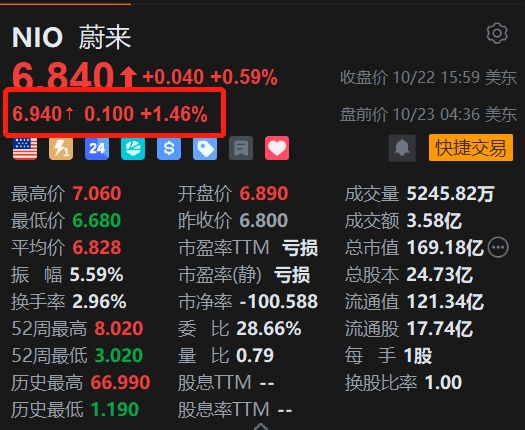
美股异动丨蔚来盘前涨1.5% 上周交付破万 L90单周交付创历史新高
Ge Long Hui· 2025-10-23 08:50
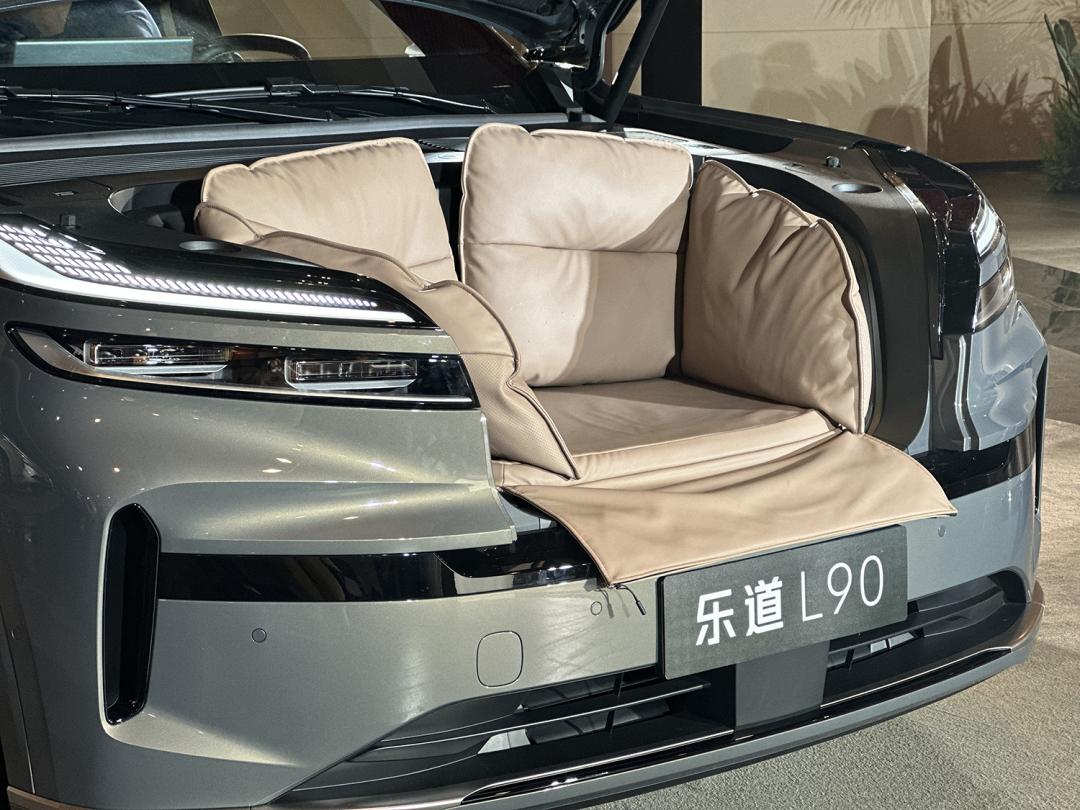
Core Insights - NIO's stock price increased by 1.46% to $6.94 in pre-market trading, reflecting positive market sentiment following recent delivery updates [1][2] - The company achieved over 10,000 vehicle deliveries in the week of October 13-19, with significant contributions from its sub-brands, marking a notable production capacity increase of 50% compared to the previous month [1] Delivery Performance - NIO delivered over 4,000 vehicles, while its sub-brands, Ladao and Firefly, contributed over 5,000 and 1,500 deliveries respectively [1] - The L90 model achieved a record weekly delivery of over 3,500 units, indicating strong demand and operational efficiency [1] Financial Metrics - As of October 22, NIO's closing price was $6.84, with a pre-market price of $6.94 [2] - The stock experienced a trading volume of approximately 52.45 million shares, with a market capitalization of $16.918 billion [2] - The stock's 52-week high and low were $8.02 and $3.02 respectively, indicating significant volatility in its trading history [2]
冲刺四季度盈利,李斌拼了
3 6 Ke· 2025-09-05 00:18
Core Viewpoint - NIO's CEO Li Bin emphasizes the importance of achieving profitability in Q4 2023, highlighting the company's focus on operational efficiency and cost control to meet this goal [1][3][5]. Financial Performance - In Q2 2023, NIO reported revenue of 19.01 billion yuan, a year-on-year increase of 9% and a quarter-on-quarter increase of 57.9% [1]. - The net loss for Q2 was 4.995 billion yuan, narrowing by 1% year-on-year and by 26% quarter-on-quarter [1]. - Li Bin stated that Q2 marked the bottom for NIO, with expectations for improvement in key metrics starting from Q3 [1][3]. Profitability Goals - NIO aims to achieve a gross margin of 20% within the year and positive operating cash flow by Q4 [1][3]. - The company has set a target to deliver 150,000 vehicles in Q4, with a gross margin of 16% to 17% [2][6]. - Li Bin acknowledges the challenges in reaching profitability but asserts that the company is at a critical juncture where profitability is essential [1][5]. Operational Efficiency - NIO has implemented the Cell Business Unit (CBU) mechanism to enhance operational efficiency, resulting in a 6.6% decrease in R&D expenses to 3.007 billion yuan in Q2 [2]. - The company plans to maintain quarterly R&D expenditures between 2 billion to 2.5 billion yuan while controlling sales and administrative expenses to within 10% of revenue [6][8]. Market Performance - NIO delivered over 31,000 vehicles in August 2023, setting a new record, with the L90 model achieving 10,575 deliveries in its first month [3][5]. - The company expects Q3 delivery guidance to be between 87,000 to 91,000 vehicles, with revenue guidance of 21.8 billion to 22.8 billion yuan [3]. Organizational Changes - Li Bin highlights significant organizational changes aimed at improving marketing and operational capabilities, with a focus on sustainable growth [9][11]. - The company has undergone two organizational transformations, enhancing its resilience and learning capacity [11][16]. Product Strategy - NIO continues to focus on a multi-brand strategy with NIO, Ladao, and Firefly, aiming to serve a broader customer base while sharing technology and infrastructure [15]. - The company is committed to a pure electric technology route and has seen a market shift towards pure electric vehicles, with a 24.5% year-on-year increase in July [15].
蔚来:财务资源足以支持未来12个月的持续经营
Sou Hu Cai Jing· 2025-09-02 14:08
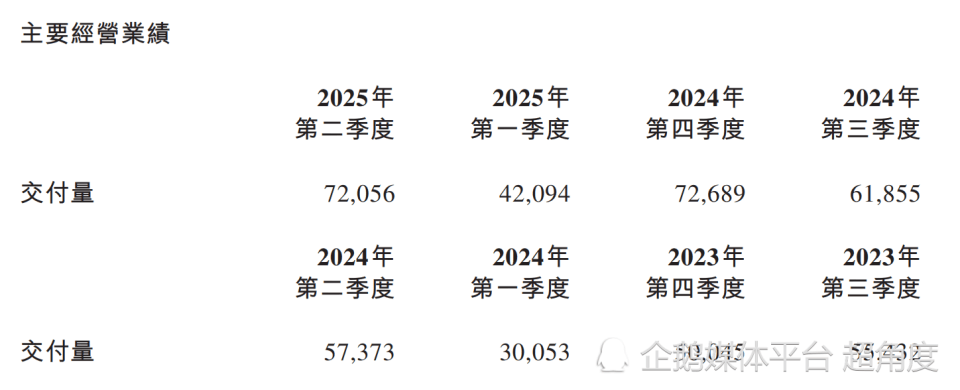
Core Insights - NIO reported a total revenue of RMB 19.0087 billion for Q2 2025, representing a year-on-year increase of 9.0% and a quarter-on-quarter increase of 57.9% [1] - The net loss for Q2 2025 was RMB 4.9948 billion, a decrease in loss of 1.0% year-on-year and 26.0% quarter-on-quarter [1] - The adjusted net loss, excluding certain expenses, was RMB 4.1267 billion, down 9.0% year-on-year and 34.3% quarter-on-quarter [1] Delivery and Sales Performance - NIO delivered 72,056 vehicles in Q2 2025, a year-on-year increase of 25.6% and a quarter-on-quarter increase of 71.2% [2] - The breakdown of deliveries includes 47,132 vehicles from the NIO brand, 17,081 from the ONVO brand, and 7,843 from the newly launched "Firefly" model [2] - Cumulative vehicle deliveries reached 166,472 by August 31, 2025, with total deliveries since inception at 838,036 [2] Financial Summary - Total revenue for Q2 2025 was RMB 19.0087 billion, with automotive sales contributing RMB 16.1361 billion, a 2.9% increase year-on-year and a 62.3% increase quarter-on-quarter [6] - Gross profit for Q2 2025 was RMB 1.8975 billion, up 12.4% year-on-year and 106.3% quarter-on-quarter, with a gross margin of 10.0% [6] - Operating loss for Q2 2025 was RMB 4.9089 billion, a decrease of 5.8% year-on-year and 23.5% quarter-on-quarter [6] Research and Development Expenses - R&D expenses for Q2 2025 were RMB 3.007 billion, down 6.6% year-on-year and 5.5% quarter-on-quarter [5] - Adjusted R&D expenses, excluding certain costs, were RMB 2.4889 billion, a decrease of 13.8% year-on-year and 14.6% quarter-on-quarter [5] Outlook - For Q3 2025, NIO expects vehicle deliveries between 87,000 and 91,000, representing a year-on-year growth of approximately 40.7% to 47.1% [8] - Total revenue is projected to be between RMB 21.812 billion and RMB 22.876 billion, reflecting a year-on-year growth of approximately 16.8% to 22.5% [8] - The CFO indicated that cost reduction and efficiency measures have begun to yield results, with a significant reduction in adjusted operating losses [8]
蔚来萤火虫发布BaaS模式,新车起售价将降至7.98万元
Ju Chao Zi Xun· 2025-06-25 03:22
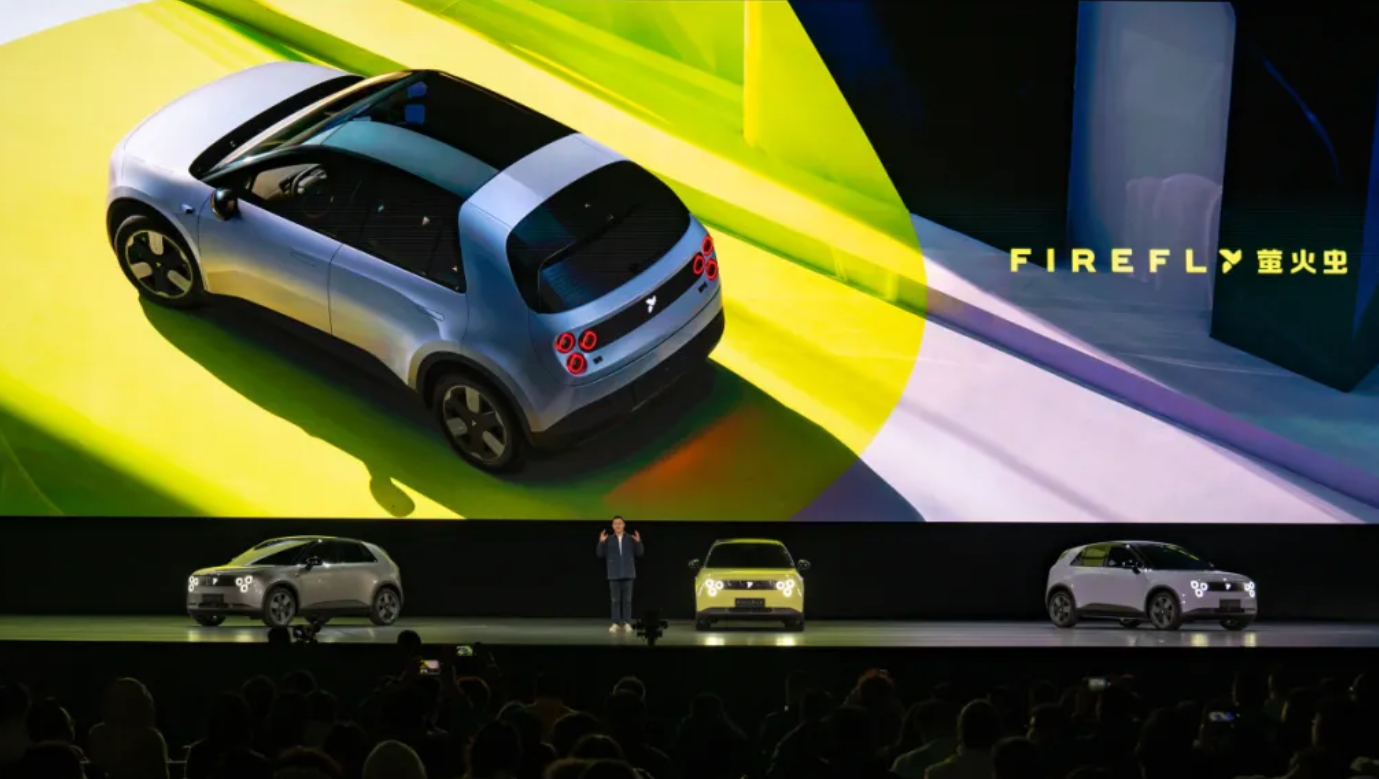
Group 1 - Firefly brand officially announced its BaaS (Battery as a Service) model on June 24, ahead of the previously communicated timeline by about two months, providing unexpected benefits to consumers [2] - The current models available for sale are the self-driving version starting at 119,800 yuan and the luminous version starting at 125,800 yuan. With the introduction of the BaaS model, the vehicle prices can be reduced by 40,000 yuan, lowering the starting prices to 79,800 yuan and 85,800 yuan respectively, significantly decreasing the purchase threshold for consumers [2] - Consumers opting for the BaaS model will need to pay a monthly battery rental service fee of 399 yuan, which adds a recurring cost to the ownership model [2] Group 2 - Firefly, as the third brand under NIO, is positioned in the high-end small car market, similar to how MINI is positioned under the BMW Group, aiming to create the best small cars for global users [3] - The first model, Firefly, is set to launch on April 19, 2025, featuring a 42.1 kWh long-life battery, a CLTC range of 420 km, and a drag coefficient of 0.287, which is the lowest in its class. It boasts a self-developed six-in-one electric drive with an overall efficiency of 90%, consuming only 10.9 kWh per 100 km, and includes 28 Tops of computing power with 24 high-performance perception hardware for intelligent navigation assistance covering 99% of highways and urban expressways [3]
蔚来李斌,又站在了ICU门口
3 6 Ke· 2025-06-10 02:46
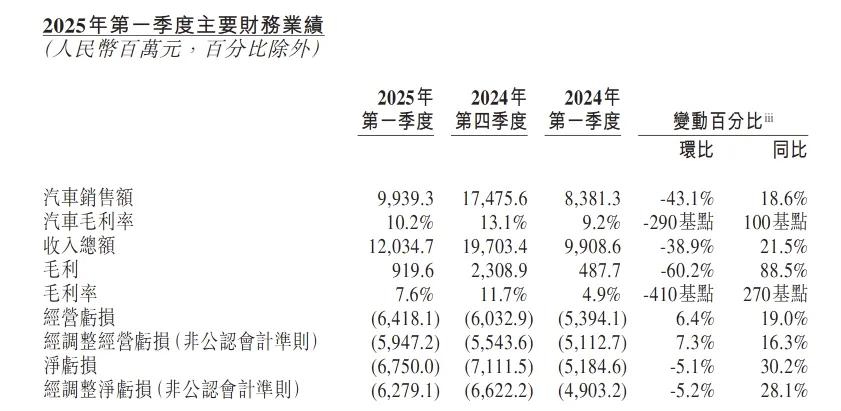
Core Viewpoint - The automotive industry is currently experiencing intense competition, with companies like BYD and Great Wall Motors publicly clashing, while NIO faces significant financial challenges despite a recent increase in vehicle deliveries and revenue [1][2][3]. Financial Performance - NIO reported a net loss of 6.75 billion yuan in Q1 2025, a 31% year-over-year increase, with cash reserves dropping to 26 billion yuan from 41.9 billion yuan at the end of 2024 [3][8][10]. - The company's asset-liability ratio has surged to nearly 93%, significantly above the healthy industry range of 40%-60% [8][9]. - Cumulative losses since 2016 have exceeded 130 billion yuan, indicating a severe financial strain [7]. Sales and Revenue - In Q1 2025, NIO delivered a total of 42,094 vehicles, achieving a revenue of 12.0347 billion yuan, a 21.5% year-over-year increase, but with a significant drop in vehicle sales compared to the previous quarter [5][6][13]. - The company aims to achieve a total monthly sales volume of over 50,000 vehicles across its three brands by Q4 2025 to return to profitability [11][15]. Strategic Initiatives - NIO is focusing on improving cash flow through increased vehicle sales and cost-cutting measures, including a reduction in R&D expenses, which amounted to 3.18 billion yuan in Q1 2025 [16][17]. - The company is implementing a new operational mechanism to enhance efficiency and reduce costs across its three brands [16][22]. - NIO plans to leverage its battery swap stations as key sales points, aiming to increase vehicle ownership through innovative sales strategies [24]. Competitive Landscape - The competition in the Chinese electric vehicle market remains fierce, with rivals like Li Auto and Xpeng gaining market share and profitability, putting pressure on NIO to adapt quickly [20][21]. - NIO's unique selling propositions include a strong patent portfolio and a focus on high-quality user experience, which the company hopes will help it regain market confidence [22][24].
百万粉UP主团队解散两月后光速复活,大家都错怪B站了?
Guan Cha Zhe Wang· 2025-05-21 06:10
Core Viewpoint - The dissolution of the "铁秀IRONSHOW" team and the emergence of new accounts on Bilibili highlight the challenges and opportunities within the automotive content creation space, particularly in the context of Bilibili's evolving commercial environment [1][4][10]. Group 1: Team Dynamics and Challenges - The "铁秀IRONSHOW" team, known for its high-quality automotive content, disbanded due to economic difficulties and creative differences, leading to the formation of new accounts by former members [4][10][18]. - The team faced significant production costs, particularly related to vehicle rentals for reviews, which contributed to their financial strain [14][15][16]. - Despite the dissolution, the former members chose to continue creating content on Bilibili, indicating the platform's importance for automotive content creators [19][21]. Group 2: Bilibili's Automotive Sector - Bilibili has become a key platform for automotive brands to engage with consumers, with a reported 50% year-on-year growth in user engagement and video views in the automotive sector [19][20]. - The platform's audience is characterized by a preference for in-depth content, making it an attractive space for automotive brands to invest in advertising [19][20]. - The automotive category has emerged as a significant revenue source for Bilibili, ranking fifth after gaming, e-commerce, and other sectors [19][20]. Group 3: Economic Viability of Automotive Content Creation - The economic model for automotive content creation is under scrutiny, with the perception that it is a lucrative business being challenged by the realities of production costs and revenue generation [10][18]. - Successful automotive content creators on Bilibili demonstrate that a blend of technical knowledge and engaging presentation can lead to profitable partnerships with automotive brands [20][21]. - The former "铁秀" members' new ventures reflect a potential for continued success in the automotive content space, despite previous challenges [18][21].

