乐道汽车

Search documents
蔚来发布2025年Q4盈利预告:经调整经营利润首度转正
Feng Huang Wang· 2026-02-05 10:25
Core Viewpoint - NIO Group has announced a significant financial milestone, projecting its first positive adjusted operating profit in Q4 2025, with estimates ranging from RMB 700 million to RMB 1.2 billion, compared to a loss of RMB 5.5436 billion in the same quarter of 2024 [1][2] Financial Performance - The company expects an operating profit between RMB 200 million and RMB 700 million under GAAP standards for the same quarter, exceeding market expectations [1] - This positive shift in profitability is attributed to increased delivery volumes in the terminal market and an optimized product mix under its multi-brand strategy [1] Cost Management and Efficiency - NIO has implemented comprehensive cost reduction and efficiency enhancement measures, which have yielded significant benefits in Q4 [1] - Strict control over operating costs and improved organizational efficiency have helped offset the high investment pressures from R&D and infrastructure [1] Market Positioning - NIO is building a comprehensive business landscape covering all market segments through its high-end brand NIO, family-oriented brand Ladao, and small car-focused brand Firefly [1]

美股异动丨蔚来盘前涨超2% 旗下乐道汽车全国换电站电池翻倍计划完成
Ge Long Hui· 2026-02-05 09:26
Core Viewpoint - NIO Inc. (NIO.US) shares rose by 2.48% to $4.55 in pre-market trading, driven by the successful completion of its battery doubling plan for the nationwide battery swap network [1] Group 1: Company Developments - NIO's subsidiary, NIO Power, has successfully completed a plan to double the number of battery packs in its nationwide battery swap stations [1] - The plan involved an investment of 8,295 new battery packs, bringing the total number of battery packs in the network to over 15,000 [1] - Each battery swap station now has an average reserve of 6 to 7 battery packs, aimed at meeting the high demand during the Spring Festival travel peak [1] Group 2: Market Performance - The closing price of NIO shares was $4.55, with a pre-market price of $4.55 reflecting a 2.48% increase [1] - The trading volume was approximately 38.38 million shares, with a total transaction value of $170 million [1] - NIO's market capitalization stands at $10.982 billion, with a total share count of 2.473 billion [1]


中公网校易捷加油等App被通报!违法违规收集使用个人信息
Nan Fang Du Shi Bao· 2026-01-07 00:05
Core Viewpoint - A total of 71 mobile applications have been reported for illegal collection and use of personal information, as detected by the National Computer Virus Emergency Response Center, highlighting significant compliance issues within the industry [1][2]. Group 1: Violations Identified - The report identifies 13 types of violations, including failure to prompt users to read privacy policies at the first app launch and collecting personal information without user consent [1]. - Specific applications, such as Yu Xiao Er and Le Zu Xing, did not provide clear access to privacy policies or adequately inform users about the handling of their personal information [2]. - 31 mobile apps, including Dan Zai Pai Dui and Zhong Gong Wang Xiao, failed to list the purposes, methods, and scope of personal information collection in their privacy policies [2]. Group 2: Security Measures Lacking - 27 mobile applications, including Le Dao Automobile and Shen Lan Automobile, were reported for not implementing necessary security measures such as encryption and de-identification [2]. - Five applications, including Ai Ju Zhao Fang and Chang Long Tourism, were noted for lacking any privacy policy altogether [2].
蔚来公司12月交付同比增长54.6%
Xin Lang Cai Jing· 2026-01-03 02:15
Core Insights - NIO reported record vehicle deliveries in December 2025, with a total of 48,135 units delivered, marking a year-on-year increase of 54.6% [1] - The NIO brand alone delivered 31,897 units, also a record high, with a year-on-year growth of 54.8% [1] - The company achieved a total of 326,028 vehicle deliveries for the entire year of 2025, representing a 46.9% increase compared to the previous year [1] Delivery Breakdown - In Q4 2025, NIO delivered 124,807 vehicles, a record high with a year-on-year increase of 71.7% [1] - The NIO brand delivered 67,433 units in Q4, reflecting a year-on-year growth of 27.8% [1] - The Ladao brand saw a significant increase in Q4 deliveries, reaching 38,290 units, which is a 92.1% year-on-year growth [1] - The Firefly brand delivered 19,084 units in Q4, showing a quarter-on-quarter increase of 52.8% [1] Cumulative Deliveries - As of now, NIO has cumulatively delivered 997,592 vehicles, with the NIO brand accounting for 829,609 units [2] - The Ladao brand has delivered 128,569 units, while the Firefly brand has delivered 39,414 units [2] Policy Impact - Starting January 1, 2026, the vehicle purchase tax policy will change from exemption to a 50% reduction, which is expected to benefit battery-swapping models [3] - Under the BaaS battery rental scheme, customers purchasing NIO, Ladao, or Firefly vehicles could save between 1,770 yuan and 9,558 yuan due to the new tax policy [3]
蔚来汽车:2025年12月交付车辆为48135辆,同比增长54.6%
Mei Ri Jing Ji Xin Wen· 2026-01-01 08:13
Core Viewpoint - NIO Inc. achieved a record high in vehicle deliveries in December 2025, with a total of 48,135 vehicles delivered, marking a year-on-year increase of 54.6% [1] Group 1: December Deliveries - NIO brand delivered 31,897 vehicles in December 2025, also a record high, with a year-on-year increase of 54.8% and continuous growth for five consecutive months [1] - The Ladao brand delivered 9,154 vehicles in December 2025 [1] - The Firefly brand delivered 7,084 vehicles in December 2025, a record high with a month-on-month increase of 16.4%, also showing continuous growth for five consecutive months [1] Group 2: Annual Deliveries - In 2025, NIO Inc. delivered a total of 326,028 vehicles, setting a new historical record with a year-on-year increase of 46.9% [1] - The NIO brand accounted for 178,806 vehicles delivered in 2025 [1] - The Ladao brand delivered 107,808 vehicles in 2025 [1] - The Firefly brand delivered 39,414 vehicles in 2025 [1]
新势力成绩单出炉:小米首盈、零跑续赚、理想转亏
Xin Lang Cai Jing· 2025-11-27 11:58
Core Insights - The domestic new energy vehicle market is experiencing intensified competition and rapid technological iteration, leading to significant performance differentiation among leading new forces in the automotive sector [2] Company Performance Summary NIO - NIO reported a total delivery of 87,100 vehicles in Q3, a year-on-year increase of 40.8%, with revenue reaching 21.79 billion yuan, up 16.7% year-on-year [4] - The company narrowed its net loss to 3.48 billion yuan, a reduction of 31.2% compared to the previous year, and aims for profitability in Q4 with a delivery guidance of 120,000 to 125,000 vehicles [4] Xpeng - Xpeng achieved a record delivery of 116,000 vehicles in Q3, a year-on-year increase of 149.3%, with revenue surpassing 20 billion yuan for the first time, reaching 20.38 billion yuan, up 101.8% year-on-year [5] - The net loss was reduced to 380 million yuan, down 78.9% from the previous year, and the company aims for overall breakeven in Q4 [5] Li Auto - Li Auto reported a total delivery of 93,211 vehicles in Q3, a year-on-year decline of 39%, with revenue of 27.4 billion yuan, down 36.2% year-on-year, marking its first loss in nearly three years with a net loss of 624.4 million yuan [6] - The company anticipates a Q4 delivery of 100,000 to 110,000 vehicles, with revenue expected to be between 26.5 billion and 29.2 billion yuan [6] Leap Motor - Leap Motor achieved revenue of 19.45 billion yuan in Q3, nearly doubling year-on-year, and reported a net profit of 150 million yuan, marking consecutive quarters of profitability [8] - The company delivered 173,852 vehicles, leading the new forces in sales, and plans to accelerate its global expansion [8] Xiaomi - Xiaomi's automotive division achieved its first quarterly profit with an operating income of 700 million yuan, contributing to a total revenue of 290 billion yuan, up 199% year-on-year [9] - The company delivered 108,796 vehicles in Q3 and aims to exceed 400,000 vehicle deliveries for the full year [9]




购置税补贴兜底 乐道沈斐重申“纯电+换电”路线
Zheng Quan Shi Bao Wang· 2025-11-24 22:12
Core Viewpoint - The ongoing shift in the Chinese electric vehicle market is characterized by a transition from pure electric vehicles to extended-range vehicles, with companies like NIO and Li Auto adapting their strategies accordingly [2][3]. Group 1: Company Strategies - NIO's Senior Vice President, Shen Fei, emphasized the company's commitment to a "pure electric + battery swap" strategy, rejecting the need for extended-range technology [2]. - Li Bin, CEO of NIO, noted that the user experience from pure electric technology has surpassed the inconveniences of charging, leading to a surge in sales of large three-row pure electric SUVs [3][4]. - Shen Fei highlighted that the battery swap system offers significant advantages in safety and user experience, with 90% of users relying on battery swaps and home charging [5]. Group 2: Market Trends - The Chinese electric vehicle market is witnessing a "technical route adjustment," with companies like Xpeng launching extended-range models while others, like Li Auto, are increasingly focusing on pure electric vehicles [2]. - The number of charging stations in China has reached between 6 million and 10 million, indicating a robust infrastructure supporting the pure electric vehicle market [4]. - NIO is targeting profitability this quarter, with a focus on expanding its market presence in lower-tier cities through its extensive battery swap network [7].
李斌谈被问蔚来何时倒闭:公司混得不好,车主也没面子!他曾强调,四季度盈利的目标必须实现......
Sou Hu Cai Jing· 2025-10-30 04:37
Core Insights - NIO's founder and CEO Li Bin emphasized the importance of balancing long-term goals with short-term operational objectives, stating that responsible management is crucial for user trust and company stability [1][6][7] Delivery Performance - In September, NIO delivered approximately 34,700 new vehicles, marking a 64% year-on-year increase. The breakdown includes around 13,700 vehicles from the NIO brand, 15,200 from the Ladao brand, and 5,775 from the Firefly brand, with Ladao consistently outperforming NIO [6] - Recent data indicates that NIO's weekly deliveries surpassed 10,600 units in the third week of October, suggesting a monthly delivery capacity exceeding 40,000 units [6] - NIO is progressively increasing production capacity, with monthly output for the L90 model rising from 10,000 units in August and September to 15,000 units starting in October. The new ES8 model's production will also gradually reach 15,000 units [6] Financial Goals - Li Bin reiterated the necessity of achieving profitability in the fourth quarter, viewing it as a critical measure of the team's operational efficiency and management capabilities [7]

美股异动丨蔚来盘前涨1.5% 上周交付破万 L90单周交付创历史新高
Ge Long Hui· 2025-10-23 08:50
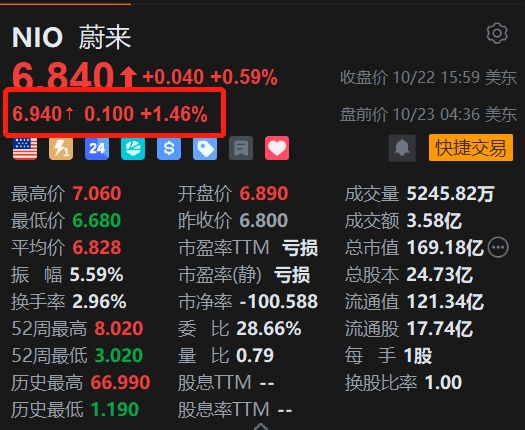
Core Insights - NIO's stock price increased by 1.46% to $6.94 in pre-market trading, reflecting positive market sentiment following recent delivery updates [1][2] - The company achieved over 10,000 vehicle deliveries in the week of October 13-19, with significant contributions from its sub-brands, marking a notable production capacity increase of 50% compared to the previous month [1] Delivery Performance - NIO delivered over 4,000 vehicles, while its sub-brands, Ladao and Firefly, contributed over 5,000 and 1,500 deliveries respectively [1] - The L90 model achieved a record weekly delivery of over 3,500 units, indicating strong demand and operational efficiency [1] Financial Metrics - As of October 22, NIO's closing price was $6.84, with a pre-market price of $6.94 [2] - The stock experienced a trading volume of approximately 52.45 million shares, with a market capitalization of $16.918 billion [2] - The stock's 52-week high and low were $8.02 and $3.02 respectively, indicating significant volatility in its trading history [2]
被控证券欺诈,“最惨CEO”李斌,难上加难 || 深度
Sou Hu Cai Jing· 2025-10-17 10:48
Core Viewpoint - The lawsuit initiated by Singapore's sovereign wealth fund GIC against NIO for alleged financial fraud could hinder the company's ongoing financing efforts worth billions and cast doubt on CEO Li Bin's promise of profitability in Q4 [4][5][15]. Group 1: Lawsuit and Financial Implications - GIC has accused NIO and its executives of securities fraud, leading to a significant drop in NIO's stock price, with a market value loss exceeding 100 billion [4][6]. - The lawsuit may obstruct NIO's ongoing financing efforts, which are crucial for the company's survival and growth [5][15]. - GIC's allegations focus on NIO's battery leasing business, claiming that revenue recognition practices were misleading and that the financial statements may have been inflated [8][11]. Group 2: Financial Performance and Market Reaction - NIO has reported cumulative net losses exceeding 100 billion from 2016 to mid-2025, raising concerns about its financial sustainability [6][22]. - Despite the lawsuit, NIO's stock saw a temporary increase, but the long-term outlook remains uncertain due to ongoing financial pressures [6][29]. - The company's cash reserves are only slightly above its annual net loss, indicating a precarious financial position [23][24]. Group 3: Business Model and Future Outlook - NIO's reliance on continuous financing has become a core aspect of its business model, with significant capital raised in recent years [17][19]. - The company has struggled to achieve profitability, with a significant decline in vehicle margins and sales prices, complicating its path to financial recovery [27][28]. - Li Bin's ambitious goal of achieving profitability in Q4 faces substantial challenges, with analysts expressing skepticism about the feasibility of this target [28][29].