
蒸烤箱

Search documents
【2026新春走基层】春节消费热,焕新正当时!顺德家电产销同频发力
Xin Lang Cai Jing· 2026-02-19 02:30
Group 1 - The core viewpoint of the article highlights the surge in home appliance consumption during the New Year, driven by government subsidies, corporate discounts, and consumer demand for innovative products [1][4][12] - The home appliance market is experiencing a significant increase in sales, with reports indicating that sales revenue has exceeded ten million yuan since the beginning of the year, with 85% of transactions occurring after in-store experiences [1][4] - The combination of national and local subsidies, along with additional discounts from retailers and brands, has resulted in overall price reductions of 30% to 40% on certain appliances, making them more attractive to consumers [4][12] Group 2 - The production side of the home appliance industry is also thriving, with companies in Shunde ramping up production to meet both domestic and international demand, indicating a robust supply chain [9][12] - Companies like Wanhe are reporting successful overseas orders, including a significant order in Egypt, and are maintaining production schedules to ensure continuous supply during the Chinese New Year [12][13] - The "Guangdong Goods Go Global" initiative is further supporting the home appliance industry by promoting high-quality products and enhancing brand visibility in international markets [12][13]


京东联合多方发布洗碗机容积新标准 为消费者提供选购依据
Zhong Jin Zai Xian· 2026-02-02 00:36
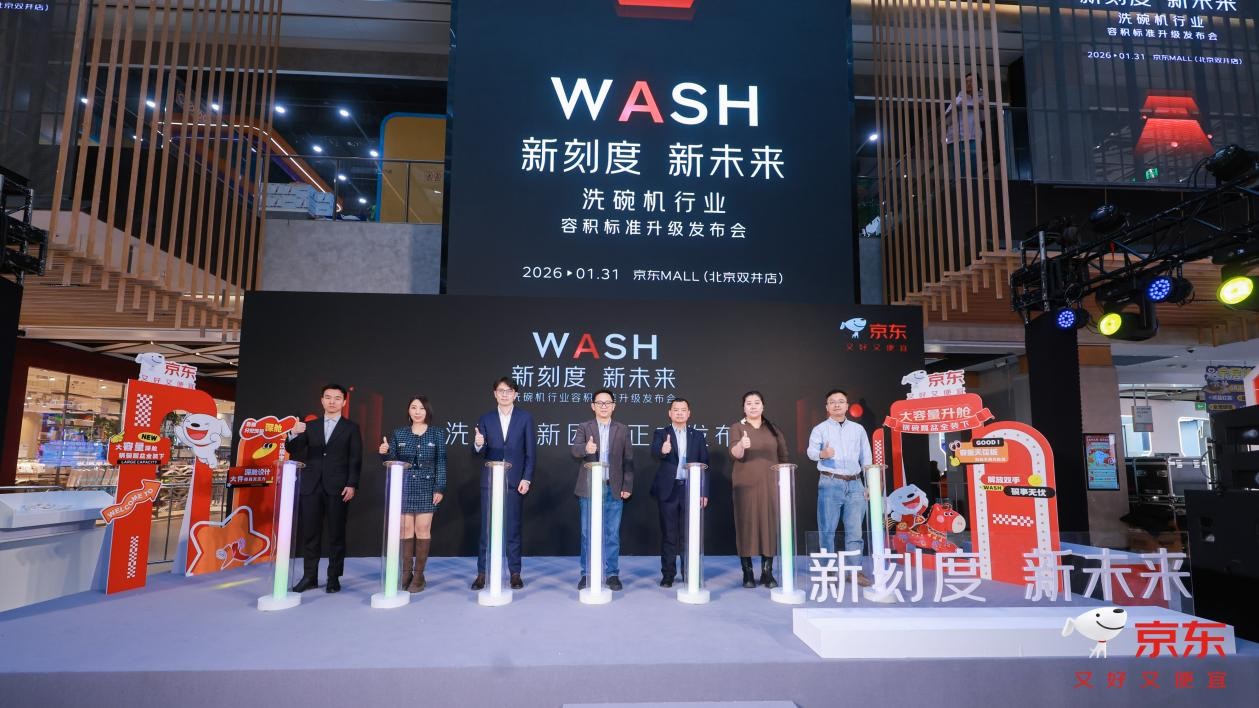
Core Viewpoint - The recent launch of the new dishwasher capacity standard by JD aims to enhance industry norms and provide clearer purchasing guidelines for consumers, addressing the confusion caused by vague capacity parameters in the growing Chinese dishwasher market [1][9]. Industry Overview - The Chinese dishwasher market has seen significant growth, with a 69% year-on-year increase in transaction volume as of January 2026, and the number of brands rising to 101, a growth of 12 brands [3]. - Despite the market's expansion, issues such as misleading marketing and poor user experience persist, particularly regarding the effectiveness of cleaning and the confusion surrounding capacity measurements [5][6]. New Standards Implementation - JD, in collaboration with various industry leaders and standardization bodies, has introduced a new capacity standard that replaces the ambiguous "set number" concept with a more quantifiable system based on internal volume (liters) and key installation dimensions [9][11]. - The new standard categorizes dishwashers based on effective volume rate (R), with three levels defined: Level 1 (R≥60%), Level 2 (58%≤R<60%), and Level 3 (R<58%). Higher levels indicate better space utilization and cleaning capacity [11]. Consumer Focus - The new standards aim to align dishwasher designs with the needs of Chinese households, moving away from Western-centric designs that do not accommodate common Chinese dishware [8][12]. - JD's initiative is expected to enhance consumer confidence by providing clear and reliable information, allowing for informed purchasing decisions [16][19]. Service Enhancements - JD has introduced a "5-year replacement at 50% off" service for certain kitchen appliances, ensuring that consumers have a safety net for performance issues or accidental damage [17]. - The service is part of a broader strategy to improve customer experience and satisfaction, making it easier for consumers to upgrade their kitchen appliances [18]. Conclusion - JD's efforts to standardize dishwasher capacity and enhance consumer services are set to transform the market, making dishwashers more accessible and suitable for Chinese households, ultimately promoting a more efficient and enjoyable kitchen experience [19].

技术破界,场景延伸:凯度多品类进化背后的用户价值升级
Sou Hu Wang· 2026-01-26 03:25
Core Insights - The kitchen appliance industry is shifting from "scale growth" to "high-quality development," with consumer demand evolving from merely owning products to enjoying a comprehensive and comfortable experience [1] - The new consumer philosophy emphasizes rational decision-making, focusing on "practicality of technology, adaptability to scenarios, and professionalism of service" as core decision-making criteria [1] Group 1: Market Trends - Online retail sales in the kitchen and bathroom market are projected to grow by 14.0% year-on-year by 2025, while offline sales are expected to increase by 21.9% [1] - The trend of "embedded and integrated" appliances is becoming a core focus in the kitchen appliance industry, driven by consumer demands for space efficiency and aesthetic appeal [5] Group 2: Company Strategy - Kaito Electric has expanded from a single product category (steam oven) to a full range of products including water purifiers, range hoods, dishwashers, and coffee machines, focusing on user value and technological extension [1][3] - The company has developed a "1㎡+N Kaito = ∞ beautiful kitchen life" concept, with designs that seamlessly integrate into modern home styles, addressing traditional kitchen appliance issues of space and aesthetics [6] Group 3: Technological Innovation - Kaito's multi-category expansion is driven by technological innovation, with significant advancements such as the dual hot air technology in steam ovens and the upcoming ZR Pro 2 multi-functional cooking machine [3] - The company has received recognition for its technological achievements, including awards based on extensive user data, validating its market acceptance [3][9] Group 4: User Experience and Service - Kaito addresses user pain points by creating a comprehensive service system that includes a 400 hotline and WeChat service, ensuring quick response times and additional value-added services [6] - The company focuses on young consumers' emotional needs and convenience, exemplified by its AI coffee machine that simplifies the coffee-making process while enhancing the user experience [7] Group 5: Competitive Positioning - Kaito's strategy of "segment breakthrough → technological extension → scenario coverage → service upgrade" has enabled it to achieve growth amidst increasing competition in the kitchen appliance sector [9] - The company has established itself as a market leader in embedded steam ovens and water purifiers, supported by technological achievements and brand recognition [9]

购买力全国第三!今年“双十一”,北京人都在买些啥?
Xin Lang Cai Jing· 2025-11-11 18:23
Core Insights - The "Double Eleven" shopping festival has evolved from a traffic-driven promotional event to a consumer demand-centric rational consumption node, emphasizing operational standards and consumer experience, reflecting the transition of China's consumer market from rapid growth to high-quality development [1] Group 1: Consumer Behavior and Trends - Consumers are increasingly focusing on product quality and experience rather than just price during the "Double Eleven" event, indicating a structural upgrade in the home appliance market [3] - Sales of home appliances with integrated AI features have reached 55% since the start of "Double Eleven," showcasing a growing interest in smart home technology among consumers [3] - Different age groups exhibit distinct purchasing preferences, with younger consumers favoring digital products, while older generations prioritize health and personal care items [3] Group 2: Market Performance and Statistics - Beijing ranks third in national purchasing power, with Chaoyang District leading in purchasing strength, while Daxing District shows the highest growth rate in the city [4] - The top five categories with the highest transaction growth rates include gold pendants (148%), digital cameras (143%), action cameras (123%), children's down jackets (82%), and sideboards (71%) [3] - The average spending per consumer in Beijing is highest for mobile phones, refrigerators, tablets, smartwatches, and washing machines [3] Group 3: Logistics and Operational Developments - The logistics demand generated by the "Double Eleven" shopping spree is being efficiently handled by high-speed rail express services, with over 1,700 high-speed passenger trains utilized daily for freight transport [6] - The overall express delivery capacity has increased by 10% compared to the previous year, indicating enhanced logistics capabilities during the shopping festival [6]
炒菜机器人号称救餐饮,没烟火气还不降价,消费者:省的钱去哪了
Sou Hu Cai Jing· 2025-09-22 16:05
Core Viewpoint - The restaurant industry is experiencing a significant shift with the introduction of pre-prepared meals and cooking robots, but these innovations are not a cure-all solution for the challenges faced by the industry [1][3]. Group 1: Automation and Efficiency - Cooking robots present a compelling economic case for restaurant owners, offering a one-time investment that eliminates labor costs such as salaries, social security, and overtime pay [3][5]. - Robots address a major issue in the restaurant industry: inconsistent food quality. They ensure that every dish is prepared with precision, maintaining the same taste across multiple servings, which is particularly beneficial for chain restaurants [5][7]. - The ongoing labor shortage in the restaurant sector makes automation an attractive option, as robots can operate continuously, significantly enhancing operational efficiency [7][11]. Group 2: Customer Experience and Human Touch - Despite the efficiency of robots, customers may feel a lack of warmth and personal connection in their dining experience, leading to a perception of "standard coldness" in service [7][9]. - The human element in dining—personalized service and emotional engagement—cannot be replicated by machines, which may lead to customer dissatisfaction [9][11]. - The initial excitement around fully automated restaurants may fade quickly if the experience does not meet customer expectations, as evidenced by a fully automated noodle shop that saw a decline in patronage shortly after opening [7][9]. Group 3: Future of the Restaurant Industry - The future of the restaurant industry may not be about choosing between efficiency and human interaction, but rather about creating a collaborative ecosystem where machines assist humans rather than replace them [11][13]. - The ideal approach is "intelligent assistance," where machines handle repetitive and labor-intensive tasks, allowing human staff to focus on customer interaction and culinary innovation [13][15]. - Restaurant owners need to carefully evaluate the cost-benefit of automation, considering not just the savings on labor but also how to reinvest those savings into enhancing service and menu development [17].


锚定行业发展方向,2025中国家电健康趋势高峰论坛在京举办
Xin Lang Cai Jing· 2025-07-11 01:49
Core Viewpoint - The "2025 China Home Appliance Health Trend Summit" emphasizes the integration of health and innovation in the home appliance industry, aiming to stimulate consumer demand and promote health-oriented consumption trends [1][3][19]. Group 1: Health as a Driving Force - Health is identified as a "renewal engine" for the home appliance market, with new policies encouraging consumers to replace old appliances, making health features a core decision factor [3][6]. - The home appliance industry is aligning with the "Healthy China 2030" initiative, indicating a shift towards health-oriented product development and innovation [3][12]. - The launch of the "Health Home Appliance Shopping Festival" aims to enhance consumer recognition of health-oriented products [10][19]. Group 2: Challenges in Health Technology Innovation - The industry faces challenges such as distinguishing genuine health needs from marketing gimmicks, requiring a focus on practical health benefits rather than mere statistics [6]. - There is a need for interdisciplinary collaboration to overcome barriers in health technology innovation, integrating fields like life sciences and environmental engineering [6]. - The market is shifting from price competition to value competition, emphasizing the importance of health in product offerings [6][31]. Group 3: Market Trends and Consumer Behavior - The demand for health-oriented appliances is growing, with products like air purifiers and water purifiers becoming essential for consumers [27][28]. - Sales of health-labeled appliances are increasing significantly, with a reported growth trend in categories such as air conditioning and refrigeration [8][19]. - The search volume for health appliances on platforms like JD.com is projected to be 4.9 times higher than the overall product search index from 2022 to 2025, indicating a strong consumer interest [8][19]. Group 4: Innovations and Product Development - Companies are developing innovative products that address health concerns, such as air quality and food safety, with examples including advanced refrigerators and cooking appliances [7][14][15]. - The introduction of new technologies, such as electrochemical hydrogen peroxide production, is enhancing the health functionalities of home appliances [17][20]. - The release of the "2025 China Home Appliance Health Trend White Paper" outlines nine health scenarios and product trends, guiding the industry towards a more health-focused future [19][22]. Group 5: Industry Collaboration and Standards - The industry is encouraged to adopt standards that promote health features in appliances, fostering collaboration across the supply chain [31]. - Companies are urged to focus on long-term strategies that prioritize health innovation as a core asset for brand development [31]. - The recognition of health-oriented products through awards highlights the industry's commitment to advancing health standards in home appliances [22][25].






浙江美大(002677) - 002677浙江美大投资者关系管理信息20250521
2025-05-21 10:08
Industry Overview - The integrated stove industry is currently undergoing a deep adjustment period due to multiple factors, including the real estate market and consumer spending downgrade, leading to a slowdown in industry growth [2][4]. - Despite the challenges, the industry is expected to recover in the long term, driven by national economic development, policy support, and the push for smart home appliances [2][4]. Company Strategy - The company has established a dedicated operation team to enhance online channel development and increase investment in e-commerce platforms [2][4]. - The company plans to continue participating in the national "old-for-new" subsidy policy to boost sales and market share [4][8]. Financial Performance - The company's gross profit margin for 2024 is reported at 40.69%, a decrease of 6.41% year-on-year, with future adjustments expected based on product structure and raw material price trends [6][8]. - Sales in 2024 are projected to be approximately 85% from new home renovations, indicating a significant reliance on the real estate market [8]. Competitive Landscape - The company maintains a leading position in the integrated stove market with nearly 2,000 dealers and over 4,500 retail outlets, significantly outpacing competitors [4][6]. - The company emphasizes its product advantages through advanced technology and innovative designs, which effectively address kitchen pollution and health concerns [4][6]. Product Development - The company has launched several high-end smart integrated stove products in 2024, incorporating AI technology for enhanced cooking experiences [10][10]. - Future plans include expanding the product line to include more smart appliances and enhancing the overall kitchen experience through integrated solutions [10][10]. Market Challenges - The company acknowledges the impact of the economic downturn and the real estate market on its performance, with strategies in place to strengthen market development and product innovation [5][8]. - There is a recognition of the competitive pressure from rivals, prompting the company to focus on technological innovation and brand promotion to maintain its market position [10][10].
