
语音识别

Search documents
禾赛科技三位创始人再创业,成立机器人公司;OpenAI或于2026年推出首款硬件设备;疯狂动物城2成全球影史好莱坞动画电影票房冠军丨邦早报
创业邦· 2026-01-20 00:10
Group 1 - Hesai Technology's co-founders have established a new robotics company, Sharpa, aimed at developing general-purpose robots and core components, with over 100 employees [1] - Porsche's global sales for 2025 are projected to be 279,400 units, a 10% decrease year-on-year, with a significant decline of 26.28% in the Chinese market [4] - UTree Technology is expected to ship over 5,500 humanoid robots in 2025, with mass production exceeding 6,000 units [9] - OpenAI's annual revenue for 2025 is projected to exceed $20 billion, a significant increase from $6 billion in 2024, driven by an expansion in computing power [13] - The UK government has announced a substantial subsidy plan for electric trucks, with a total budget of £318 million, aiming to boost the adoption of electric vehicles [19] Group 2 - The HuRun Research Institute's report on China's AI companies ranks Cambricon first with a valuation of 630 billion yuan, reflecting a 165% increase from the previous year [10] - Anker Innovations and Feishu have launched the AI hardware product "Anker AI Recording Bean," which features advanced recording capabilities and is priced at 899 yuan [21] - Alibaba Health has introduced the AI product "Hydrogen Ion," designed for medical professionals, which aims to minimize hallucination rates in AI responses [23] - Xiaopeng Motors has successfully developed the first robot based on automotive standards, marking a significant milestone in their robotics initiative [24] - Apple's iPhone shipments surged by 28% during the holiday season, regaining market leadership in China despite overall market declines [30]


AI,刷屏!3只A股霸榜前三,中国人工智能50强发布!
券商中国· 2026-01-19 09:52
Core Viewpoint - The 2025 Hurun China AI Companies Top 50 list has been released, highlighting significant growth in the AI sector, particularly in AI chip companies, with Cambricon leading the list at a valuation of 630 billion RMB, reflecting a 165% increase from the previous year [2][4]. Group 1: Top Companies - Cambricon ranks first with a valuation of 630 billion RMB, specializing in AI chips [2][3]. - Moore Threads, the leading domestic GPU company, ranks second with a valuation of 310 billion RMB [2][3]. - Muxi Technology, the second domestic GPU company, ranks third with a valuation of 250 billion RMB [2][3]. - The top ten list includes seven AI chip-related companies, indicating a strong presence in this segment [2][4]. Group 2: Market Trends - AI concept stocks have shown mixed performance, with some stocks like Giant Network and Tian Di Online experiencing significant gains, while others like Vision China faced declines [6]. - The AI chip sector has seen a notable increase in the number of companies listed, with 14 AI chip companies making the list, up from 9 last year [5][4]. - The overall market for AI applications is expected to continue growing, driven by policy support and advancements in AI infrastructure [7][6]. Group 3: Industry Insights - The concentration of AI companies is primarily in first-tier cities, with Beijing leading with 19 companies, followed by Shanghai with 14 [4]. - The recent surge in AI chip companies is attributed to the tightening of high-end AI chip export controls by the U.S., prompting domestic companies to accelerate their capabilities [4][5]. - The AI application market is at a pivotal point, with ongoing policy support and technological advancements expected to drive further growth [7][6].


新开普:公司产品暂未与阿里灵光合作
2 1 Shi Ji Jing Ji Bao Dao· 2025-11-27 03:55
Core Viewpoint - The company XinKaipu has clarified that it is not currently collaborating with Alibaba Lingguang, but is integrating its products with Alibaba Cloud and other technologies to support the development of smart campus ecosystems [1] Group 1 - The company is not in partnership with Alibaba Lingguang as of November 27 [1] - XinKaipu is utilizing Alibaba Cloud, Tongyi Qianwen large model, voice recognition, and cloud security protection products for solution integration [1] - The focus of the integration is to jointly serve the ecological construction of smart campuses [1]

大金融思想沙龙(总第 263 期) 顺利举行, 聚焦人工智能如何重塑金融业
Zhong Guo Fa Zhan Wang· 2025-09-29 12:59
Core Insights - The event focused on how artificial intelligence (AI) is reshaping the financial industry, highlighting its impact on decision-making, regulatory models, and investment strategies [1][2]. Group 1: AI Integration in Finance - AI is significantly changing the financial industry's decision-making mechanisms, regulatory approaches, and investment methods, particularly in handling complex, unstructured financial data [2]. - China has made substantial progress in AI applications within finance, developing competitive systems through independent research and algorithm innovation [2]. - Specific applications of AI include corporate sentiment monitoring, regulatory expectation management, market forecasting, and high-risk financial product investments, enhancing decision accuracy, market transparency, and risk control [2]. Group 2: Challenges and Risks - Despite the advantages, AI applications in finance face challenges such as algorithm compliance, signal recognition, and professional adaptation, which require technical adjustments, professional empowerment, and regulatory innovation [2]. - The rapid development of AI brings risks like data monopolization, model opacity, and algorithmic collusion, potentially exacerbating systemic risks and harming consumer interests [3]. - Regulatory frameworks need to evolve to address the dual challenges of lagging behind and over-regulation in response to AI advancements [3]. Group 3: Perspectives on AI's Future in Finance - AI is expected to deepen financial digitalization, enhancing individuals' computational abilities and making financial services more accessible and affordable for the general public [4]. - Financial service providers are already leveraging AI in various applications, including digital payments and risk management, which will continue to improve service efficiency and expand the range of financial services offered [4]. - The ongoing development of AI and improvements in computational power will further enhance the digitalization of financial services, leading to more flexible and efficient governance mechanisms [4]. Group 4: Academic and Theoretical Framework - The "Big Finance" salon aims to promote high-level academic exchanges and research on financial theories, policies, and strategies, rooted in both Chinese practices and international trends [5][6]. - The concept of "Big Finance" integrates macro and micro financial theories, emphasizing the inseparable relationship between finance and the real economy [5][6].
AI重塑千行百业 长三角产业协同迎新机遇
Shang Hai Zheng Quan Bao· 2025-08-10 17:35
Core Insights - The current AI wave, driven by large models, is reshaping various industries, enhancing brand, efficiency, processes, systems, and organizational structures [1] - The rapid growth of the semiconductor industry is primarily fueled by AI and large models, creating new growth dynamics in the silicon photonics sector [1][4] - The integration and upgrading of traditional manufacturing in the Yangtze River Delta region present significant opportunities due to the intersection of hard technology and traditional industries [6] AI and Industry Transformation - The transition from single-point AI breakthroughs to large models signifies a comprehensive disruption across all industries, with 2025 anticipated as a pivotal year for large-scale AI application deployment [1][2] - Companies that embrace AI early may achieve competitive advantages, but many face challenges in effectively integrating AI to solve existing business problems [2] - The emergence of super applications in AI is projected to occur between 2027 and 2029, similar to the mobile internet explosion following the iPhone's release [2] Semiconductor Industry Growth - AI and large models are driving the semiconductor industry's growth, with increasing demands for computing power and data transmission [4] - Companies like Robotech and DiAo Micro are investing in silicon photonics technology to capitalize on these trends, with expectations for rapid advancements in optical modules [4][5] - The automotive sector presents a significant market opportunity for AI-driven chips, with a current domestic production rate of less than 5% for automotive-grade chips [5] Collaborative Development in the Yangtze River Delta - The Yangtze River Delta is positioned for collaborative innovation, with Shanghai focusing on engineering and surrounding areas on production, creating a synergistic development model [6] - Experts emphasize the need for traditional industries to adopt new digital and intelligent paradigms to enhance competitiveness [6] - The integration of hard technology with traditional manufacturing is seen as a key driver for innovation and growth in the region [6]
AI赋能,拓宽智慧职教之路
Ren Min Ri Bao Hai Wai Ban· 2025-06-03 22:45
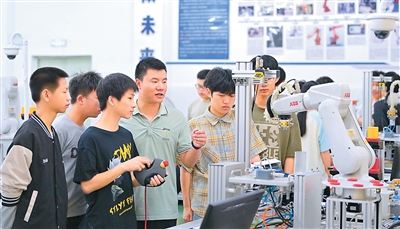
Group 1 - The core theme of the news is the transformation of vocational education through the integration of digital technologies such as AI, big data, and cloud computing, aiming to better align educational outcomes with market demands [2][5]. - The conference "Inclusive and Symbiotic: Building a Smart Ecosystem for Vocational Education" highlighted the need for innovative teaching methods and the importance of personalized learning paths for students [2][3]. - Challenges faced by educators include insufficient classroom engagement, inadequate practical training due to resource constraints, and the difficulty of standardizing teaching for diverse student skill levels [3][4]. Group 2 - The development of AI evaluation platforms in schools allows for personalized analysis and feedback for students, enhancing their learning experience [4]. - Collaboration between educational institutions and industries is becoming a trend, with companies like Xiaomi forming partnerships with numerous schools to create a talent ecosystem that meets industry needs [6][7]. - Initiatives like the "Spring Bud Plan" aim to integrate digital tools into vocational training, providing a platform for 10 million students to connect their skills with industry requirements [6][7].
打造大湾区语言服务产业发展新高地
Zhong Guo Jing Ji Wang· 2025-03-09 22:56
Core Viewpoint - The Guangdong-Hong Kong-Macao Greater Bay Area is experiencing rapid development in the language service industry, driven by its geographical advantages, strong economic power, and innovative atmosphere, but faces challenges such as uneven industry layout, lack of scale effects, and insufficient high-end talent [1][2]. Group 1: Policy Support - The language service industry in the Greater Bay Area is characterized by a high proportion of small and medium-sized enterprises, which struggle to achieve scale effects and international competitiveness due to the absence of unified planning and industry standards [1][2]. - There is a pressing need for the Greater Bay Area to establish clear development goals and strategic paths for the language service industry, optimizing resource allocation and creating a comprehensive regulatory framework [2]. Group 2: Technological Innovation - Artificial intelligence is identified as a core engine for the new industrial revolution, significantly enhancing the efficiency and quality of language services through innovations such as machine translation and voice recognition [2]. - The Greater Bay Area boasts a strong technological foundation with leading companies like Huawei and Tencent, which should leverage cutting-edge technologies to drive digital transformation in the language service industry [2][3]. Group 3: Talent Development - Leading companies in the industry are encouraged to collaborate with universities and research institutions to create integrated training bases, providing practical opportunities for language service talent to enhance their skills [3]. - Examples of successful collaborations include Guangdong University of Technology's partnerships with Huawei and Tencent, which have explored innovative paths for integrating talent development with industry needs [3]. Group 4: Service Model Upgrade - The demand for diverse language services is increasing due to the Belt and Road Initiative and the expansion of BRICS countries, yet there is a significant gap in the supply of non-common language services in the Greater Bay Area [4]. - Educational institutions should adapt to market demands by diversifying language service programs and establishing a "specialty + language" training model to meet the evolving needs of the language service market [4].